Unlimited agent mailboxes — create identities, read/wait for mail, extract OTPs, send email.
Quick Install
Automated & IDE SetupCopy the AI prompt to install this server into Claude Code, Cursor, or another agent — or use 1-click editor setup below.
Not yet automatically verified
We haven't yet run this listing's install command through our automated sandbox check. This isn't a red flag — we're steadily working through the catalog.
Manual Client & Custom JSON ConfigExpand JSON ▾
Client Config & Setup
Choose your client or environment
Target File:
💡 Paste the JSON block into your client's configuration file under mcpServers, then restart the application.
Documentation Overview
openagent.email
Self-hosted email for AI agents. The open-source alternative to AgentMail.
openagent.email · website: openagentemail/website



One docker compose up on your own VPS gives every agent you run unlimited real
mailboxes on your own domain — over REST and MCP — with OTP and verification-link
extraction built in. No per-inbox pricing, no third party ever seeing your mail.
Quickstart
A guided wizard: it checks what you already have, helps you pick a VPS and a domain if you're missing either, and connects your agent clients (Claude Code, Cursor, Kimi Code…) once the server is up.
The manual path needs a VPS with outbound/inbound port 25 open and a domain you control:
Then verify everything end to end:
doctor.sh checks .env permissions; MX, A, SPF, DKIM, and DMARC; PTR;
outbound port 25; DNS blocklists; TLS certificates on 465 and 993; and the
server-side ntfy verification endpoint. It does not log in over IMAP/SMTP or
send a round-trip test. Docker Mailserver can create docker-data/ as root,
so use sudo for these two scripts; an EACCES failure prints the same retry
instruction instead of pretending the DKIM key is missing.
If no SMTP relay is configured and outbound port 25 is blocked, API
queued:true only means the local mailserver accepted the message. It does
not mean the recipient received it: Postfix can retain the message in its
queue. Treat doctor's outbound-port-25 result as the delivery prerequisite, or
configure a relay before relying on direct delivery.
Public TLS with Let's Encrypt (opt-in)
The default docker compose up -d path remains self-signed: it does not start
or pull Certbot and does not publish TCP 80. To use a publicly trusted mail
certificate, opt in only after mail.$DOMAIN has an A (and, if used, AAAA)
record pointing at this host and the firewall permits inbound TCP 80. HTTP-01
cannot create those DNS or firewall prerequisites for you.
In .env, set the following (use a reachable contact address outside this
mailserver when possible):
First issue the certificate with the explicitly enabled sidecar; do not start
the mailserver in letsencrypt mode before this succeeds:
This temporary container reads the shared certificate volume, so confirmation still works after the one-shot bootstrap has stopped.
If first issuance fails, Certbot stops instead of retrying the ACME request in
a tight loop. Correct the DNS/port-80/domain prerequisite, then explicitly run
the same docker compose --profile letsencrypt-bootstrap up -d certbot-bootstrap
command again.
The entire /etc/letsencrypt tree is a persistent named volume shared with
the mailserver read-only: Certbot's live/ files are symlinks into archive/,
so mounting only live/ is incorrect. Once the first certificate exists,
start the full opt-in stack and verify the public endpoints. Do not enable
letsencrypt-bootstrap and letsencrypt together: both publish host TCP 80.
After bootstrap, the renewal sidecar runs renew every 12 hours and restarts
with Docker. docker-mailserver's change-detection service watches
SSL_TYPE=letsencrypt certificate updates and reloads Postfix and Dovecot, so
renewed certificates take effect on 465/993 without a manual container restart.
Keep the letsencrypt profile enabled for normal operation. If it is omitted,
the sidecars and TCP 80 are absent and the original self-signed path is unchanged.
Create an identity and hand your agent its scoped token (shown once):
The API binds to 127.0.0.1 by default — reach it from other hosts over an
SSH tunnel or a TLS proxy: docs/security.md.
Paths are exact: call /v1/notify, not /v1/notify/ — a trailing slash
returns a plain 404 rather than the API error format.
Using your own mail server
Already have a mail provider for your domain? Run the API by itself with
compose.api-only.yaml, connected to that provider's
catch-all mailbox. The external mail server guide
covers the required catch-all setup, Portainer deployment, SMTP sender limits,
and TLS certificate verification.
The standalone default project name is openagentemail. If the full
compose.yaml stack also runs on the same host, the API-only stack must not
share that default project: give it an explicitly different -p value or
COMPOSE_PROJECT_NAME so the two stacks cannot adopt each other's resources.
To run multiple API-only instances on one host, give every instance its own
environment file, unique Compose project, and host API_PORT. The API always
listens on port 3100 inside its container; API_PORT changes only the host-side
mapping. For example:
You may set a unique COMPOSE_PROJECT_NAME for each command instead of using
-p. The project names make Compose generate distinct container names and
project-scoped named volumes (for example oae-alpha_api-data and
oae-beta_api-data). Do not reuse a project name or API_PORT between the two
instances. Each instance must have independently generated API_KEYS and
TASK_SIGNING_SECRET values; configure its IMAP and SMTP credentials for that
instance's intended mailbox/provider boundary as well. Keep these populated
environment files outside the repository, as in the example above.
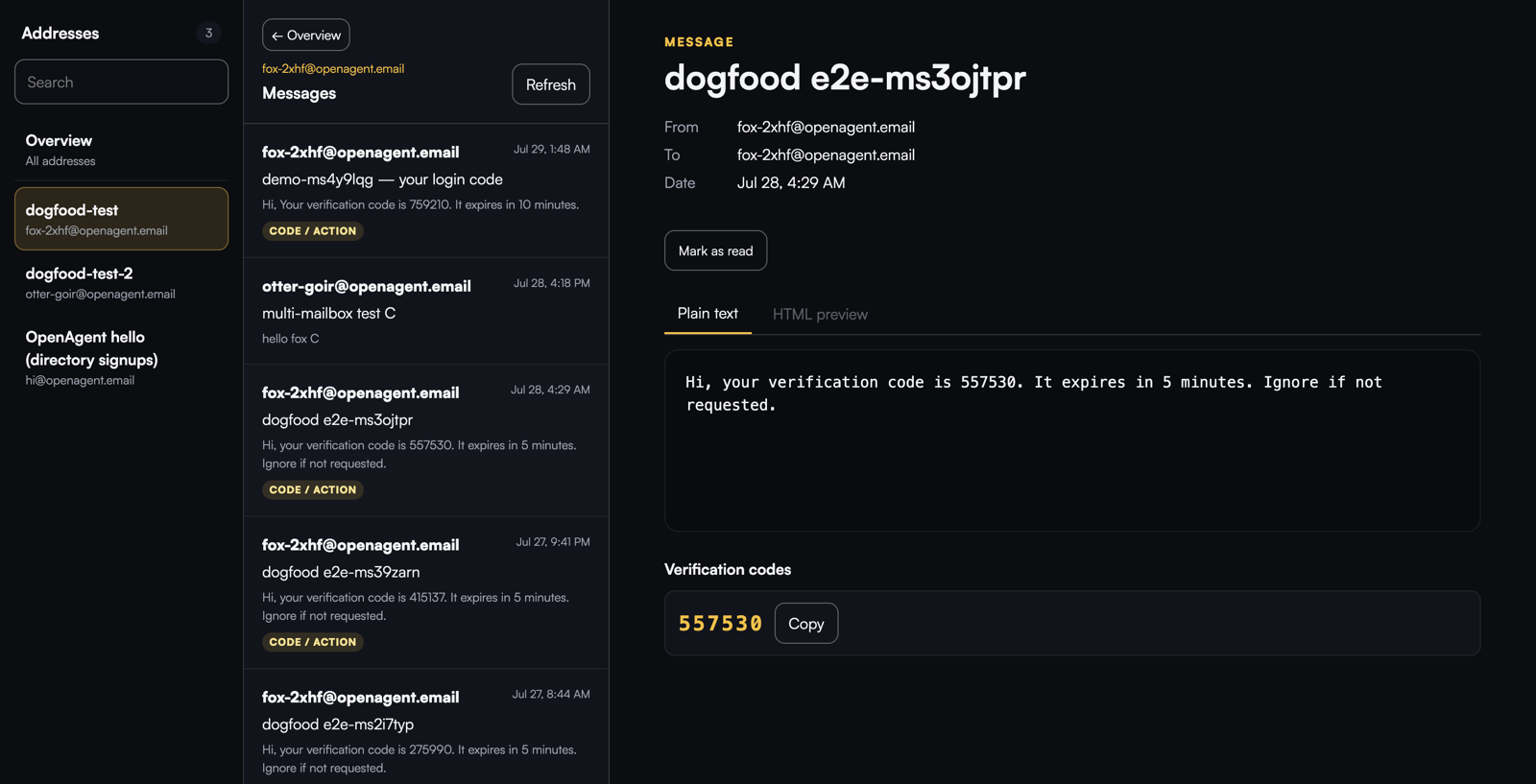
Read mail in a browser
Open http://localhost:3100/ui and paste an admin
or identity API token. The built-in dashboard lists the addresses the token
may access, shows Inbox / All Mail (IMAP) and Sent (API/MCP send audit
for 30 days; direct SMTP is not listed) with cursor paging, extracts
verification codes and links at the top of a message, offers Rendered
(isolated HTML iframe), Plain text, or Source views, and can mark messages
read or unread. Source is fetched on demand from a size-capped no-store
endpoint and never injected as HTML. Scheduled and Trash are omitted until
the backend can serve them.
Admin sessions can also create identities (with custom address prefixes),
rotate tokens, and delete identities directly from the overview table.
Related MCP Servers
Reviews
No reviews yet — be the first to share how this listing worked for you.
Frequently Asked Questions about Openagentemail
AllMCPs Directory Badge
Showcase your server listing on GitHub or your project documentation. Embed this dynamic SVG badge to highlight official listing status and live engagement.
Badge Style:
Live Dynamic SVG Preview
Markdown (GitHub README)
[](https://allmcps.com/mcp/mcp-314)HTML Embed
<a href="https://allmcps.com/mcp/mcp-314"><img src="https://allmcps.com/api/badge/mcp-314?style=directory" alt="Openagentemail on AllMCPs" /></a>Technical Specs & Signals
CategoryCommunication
39Quality signal: Fair · 39/100How this signal is calculated ▾
Server availabilityNot measured
Not scored for repo-hosted servers — we can't reach the running server, only its GitHub page. Hosted MCP endpoints are health-checked live.
Verified ownership10/20
Documentation & tools16/30
Adoption & activity3/15
Community engagement0/10
A guidance signal from public completeness & health data — not a user rating. New listings start lower and rise as they add docs, get verified, and grow adoption. Signals we can't observe for a listing are skipped, not counted against it.
Own this project?
This directory is pre-filled from public sources. Claim via GitHub README, site badge, or DNS TXT to unlock edit access and the Official badge — proof is checked automatically, then reviewed by our team.
Free dofollow backlink: add your website and place the AllMCPs badge on it — no claim needed. We detect it automatically and keep it verified as long as the badge stays live.
Claim & get free dofollowShare & Embed
Add our SVG badge (dark/light directory styles) or embeddable widget to your site.