obsidianknowledge-managementsemantic-searchmcppostgresql
Self-hosted MCP server for Obsidian vaults with semantic search, wikilink graph traversal, note CRUD, and OAuth 2.0 support.
Quick Install
Automated & IDE SetupCopy the AI prompt to install this server into Claude Code, Cursor, or another agent — or use 1-click editor setup below.
One-click editor setup isn’t available for this listing yet — we don’t have a confirmed install command, and we’d rather show nothing than point your editor at the wrong package or host. Follow the project’s own setup instructions, linked above.
Manual Client & Custom JSON ConfigExpand JSON ▾
No confirmed setup config for this listing yet. We only publish a config block when the install details come from the project itself — its README, its docs, or a verified owner. We haven’t found those for maxkuminov/obsidian-mcp, and we’d rather show nothing than a guess you’d paste into your client. Follow the project’s own setup instructions for the current steps.
Overview
Use cases
Enable AI agents to access and update your Obsidian notes with shared context
Perform semantic and full-text search over your vault content
Traverse and analyze the wikilink graph of your notes
Maintain agent memory as editable markdown files within your vault
Access your vault remotely with OAuth 2.0 authentication
Key features
Semantic and full-text search via PostgreSQL with pgvector
Atomic CRUD operations on markdown notes
Wikilink graph traversal for contextual navigation
Self-describing vault guide for automatic schema and convention discovery
OAuth 2.0 authentication support
Pluggable embeddings including Ollama bge-m3 and OpenAI text-embedding-3 variants
Capabilities & Tool Schemas
Inspect callable tools, capabilities, and parameters exposed to AI agents by Obsidian MCP.
Extracted Tool Capabilities
Semantic and full-text search via PostgreSQL with pgvector
Atomic CRUD operations on markdown notes
Wikilink graph traversal for contextual navigation
Self-describing vault guide for automatic schema and convention discovery
OAuth 2.0 authentication support
Pluggable embeddings including Ollama bge-m3 and OpenAI text-embedding-3 variants
Documentation Overview
Obsidian MCP Server




A memory system for your AI agents — stored as plain markdown you can open in Obsidian.
A self-hosted Model Context Protocol server that gives every agent you connect a durable, shared place to remember things. The storage isn't a vector database you can't see into: it's a folder of markdown files in your Obsidian vault, backed by full-text and semantic search and by your own wikilink graph. Obsidian is the human window onto it — open a note, read exactly what an agent wrote about you, correct it, delete it, or take the whole folder somewhere else. Self-describing, too — agents read what you read, link what you link, and pick up your folder layout, frontmatter schema, and tag conventions on the first call instead of being briefed from scratch every session.
To be precise about the scope: what the server supplies is MCP-accessible storage, keyword and semantic search, and graph operations over markdown notes, for whatever MCP clients you connect. The agents direct their own reads and writes. There is no automatic extraction, consolidation, or decay pipeline running behind them — an agent remembers something because it wrote a note, and forgets it because someone deleted one.
Stack: Python 3.12, FastAPI, PostgreSQL with pgvector. Pluggable
embeddings (Ollama bge-m3, or OpenAI text-embedding-3-{small,large}).
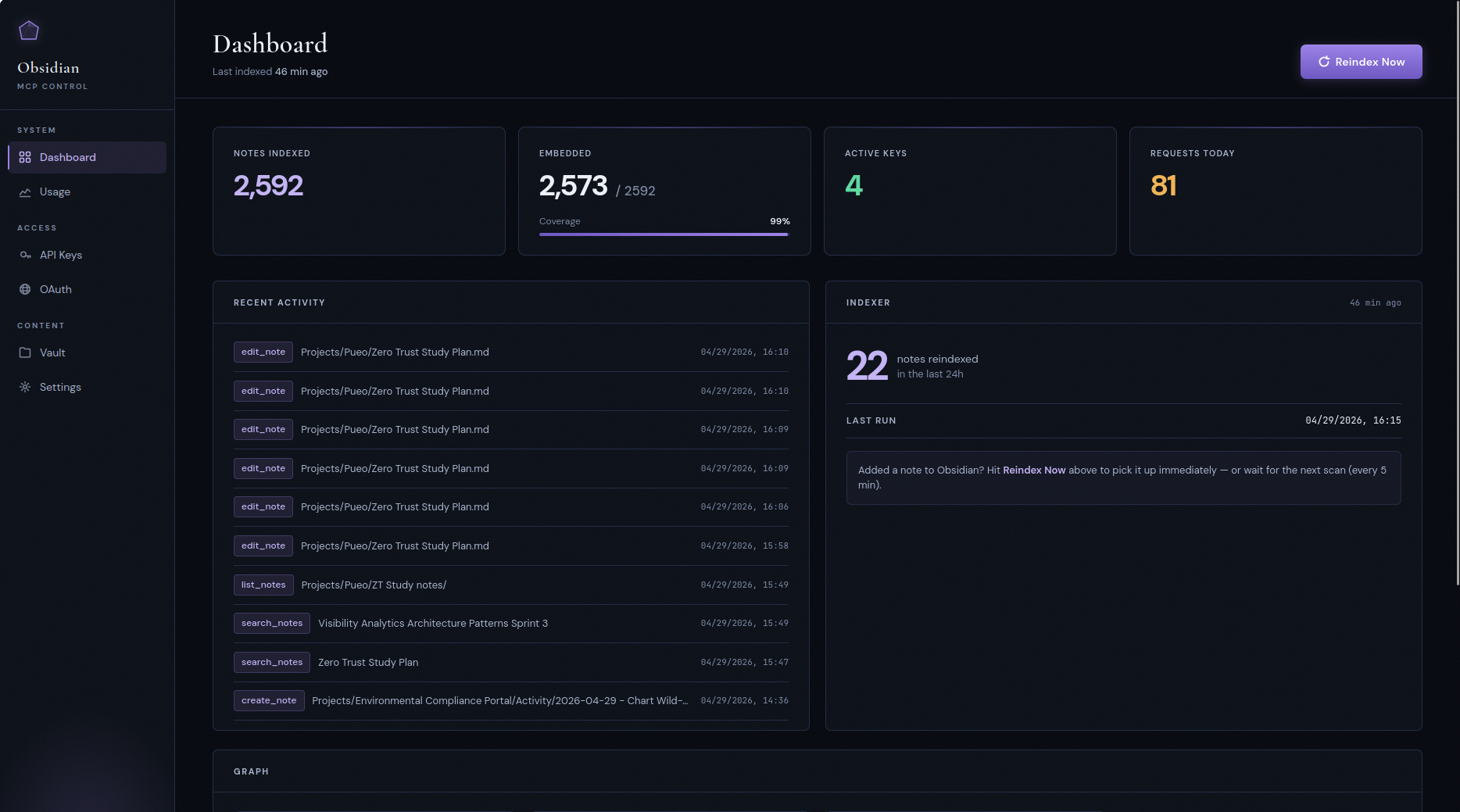
Contents
- Why this exists
- A session at the keyboard
- A session away from the keyboard
- What's in the box
- vs. other Obsidian MCP servers
- Who this is for
- Control panel
- Quick start
- Cost expectations
- The self-describing vault
- Multi-user mode
- Configuration
- Architecture
- Project layout
- Development
- Security notes
Why this exists
There are three things going on here, and they're more interesting together than apart.
1. Agent memory that you can actually read
If you let an agent run for a while, it needs memory. Most setups solve this with an opaque vector store, a SQLite blob, or a managed "memory" service that you can't see into. That works until you want to know what the agent thinks it knows about you, or you need to correct something, or you want to understand why it just made a weird suggestion.
This server gives you a different deal. Agent memory lives as markdown files in your vault. Folder structure, file names, frontmatter, all visible. You can open the file in Obsidian and read it. You can edit it. You can delete it. You can grep it. The agent's "memory" is a human-auditable artifact that sits in the same place as your own notes, with the same tools available.
The home lab is the use case that sold me on this. My vault has notes on the rack, the network, and every Home Assistant integration. I can say "set up a night-light mode in the master bathroom, 1% after 11pm" and a sysadmin agent finds the right config, makes the change, and updates the doc in the same pass. Six months later when I've forgotten how it works, the answer is in the vault, not buried in some chat history I can't search.
The semantic search and wikilink graph still work over that material, so retrieval is fast and conceptual. But the substrate is files you own, not a black box.
2. A shared memory layer between you and your agents
The other half runs the other way: the vault isn't only the agents' memory, it's mine. I think of my Obsidian vault as my exocortex. The "big me" that includes notes, calendars, scripts, search, and AI assistants is substantially more capable than the "small me" of the biological brain alone. It's also where I do most of my thinking, because writing something down is itself a form of thought.
The problem is that until recently, the vault was passive. I had to go find things. Agents that wanted to help me had to be briefed from scratch every session, and they had no way to see what I'd already written about a topic.
This server fixes that. Now the same vault feeds my own daily writing and any agent I plug into it. The agent reads what I read, links what I link, follows the same wikilinks, sees the same frontmatter. When I write a project note on Sunday, my Monday-morning briefing agent already knows about it. When the agent leaves notes from a research session, they show up in my normal Obsidian search.
A concrete version of this: I'll spend a session in Claude Code on a project, wrap up, push the commits, and then just say "update Obsidian." The agent reads the vault guide, figures out where project notes live in my structure, picks the right format and frontmatter, and leaves a session log I can later roll into a status report. No path-passing, no telling it what to write — the conventions are already in the vault, and it follows them.
That's the exocortex idea made concrete: one place that holds context, and both the human and the agents reading and writing into it on the same terms.
3. The vault follows you
The thing that still surprises me is that this is internet-facing. Same vault, same notes, reachable from anywhere I happen to be talking to an agent — Claude in a browser tab, Claude on my phone on the train, an n8n workflow firing on a schedule, a Claude Code session on whatever laptop is in front of me. All behind OAuth or a bearer key, all hitting the same source of truth.
So when I hear an interesting podcast on a commute and want to think out loud about it with Claude on my phone, the agent isn't starting cold. It can pull up what I've already written on adjacent topics, surface a note I half-finished six months ago, and at the end of the conversation suggest updates and write them in. The vault doesn't have to be near me to be the thing I'm working in. (A session away from the keyboard walks through exactly one of these.)
A session at the keyboard
To make the abstract concrete, a short transcript from a real session. Tool calls inline; the user types in plain English and the agent picks the right tool.
Two things to notice. First, the agent didn't need to be told what
folder to look in or what tools to use — it picked them. Second, the
write at the end is structured (set_frontmatter mutating YAML, not
a regex over the file body), so the note round-trips cleanly. The
self-describing vault and the wikilink graph are doing the work that
makes this feel natural.
A session away from the keyboard
The transcript above is the easy case: I'm at a desk, I can see what the agent is doing, and Obsidian is one alt-tab away. The session that actually changed how I think about this server had none of that.
I was out walking with a health podcast in my ears — a long one, two people who clearly disagreed with each other, an hour of it. I had my phone and no intention of going home to a laptop. So I pulled the episode's transcript, handed it to Claude on my phone, and we talked it through while I kept walking: what the actual claim was, which parts I already had notes on, where it cut against something I'd decided months ago and written down at the time.
Related MCP Servers
Adoption & maintenance
Factual signals from GitHub, npm, and our automated checks — not a rating.
GitHub stars
12
Stargazers on the source repository.
Last commit
5d ago
Most recent push to the default branch.
Directory activity
2 views
Config copies, upvotes, and views on AllMCPs.
Reviews
No reviews yet — be the first to share how this listing worked for you.
Frequently Asked Questions about Obsidian MCP
AllMCPs Directory Badge
Showcase your server listing on GitHub or your project documentation. Embed this dynamic SVG badge to highlight official listing status and live engagement.
Badge Style:
Live Dynamic SVG Preview
Markdown (GitHub README)
[](https://allmcps.com/mcp/maxkuminov-obsidian-mcp)HTML Embed
<a href="https://allmcps.com/mcp/maxkuminov-obsidian-mcp"><img src="https://allmcps.com/api/badge/maxkuminov-obsidian-mcp?style=directory" alt="Obsidian MCP on AllMCPs" /></a>