developer-toolschange-trackingcode-historyai-agents
Local MCP server for recording and querying the reasoning, outcomes, and history behind AI-generated code changes.
Quick Install
Automated & IDE SetupCopy the AI prompt to install this server into Claude Code, Cursor, or another agent — or use 1-click editor setup below.
Not yet automatically verified
We haven't yet run this listing's install command through our automated sandbox check. This isn't a red flag — we're steadily working through the catalog.
Manual Client & Custom JSON ConfigExpand JSON ▾
Client Config & Setup
Choose your client or environment
Target File:
💡 Paste the JSON block into your client's configuration file under mcpServers, then restart the application.
Overview
Use cases
Record the reasoning behind AI-generated code changes
Review prior attempts before editing an entity
Trace reverted and reopened implementation decisions
Group changes by feature or task
Find decisions that need review
Key features
Log structured change events with entity, diff, and reasoning
Query entity history, diffs, and latest attribution
Track renames, superseded decisions, and reopened changes
Search all recorded events with full-text queries
Inspect prior attempts and inferred outcomes
Identify stale or review-suggested decisions
Capabilities & Tool Schemas (8)
Inspect callable tools, capabilities, and parameters exposed to AI agents by Selvedge.
log_changeRecord a change event with entity, diff, and reasoning. `rename_from` + `change_type="rename"` records the dual-event rename pattern; `change_type="supersede"` re-opens a reverted decision (append-only); optional `constraint` / `stale_when` keep the decision's principle and its invalidation conditi…
diffHistory for an entity or entity prefix, each row annotated with `superseded_by
blameMost recent change + context for an exact entity, plus the derived decision `status` (active / reverted / reopened)
historyFiltered history across all entities
changesetAll events grouped under a named feature/task slug
searchFull-text search across all events
Documentation Overview

selvedge.sh · PyPI · GitHub


Long-term memory for AI-coded codebases — including what was already tried and rejected.
Line attribution tells you who wrote something. Selvedge tells your agent
what not to write next: the approaches this codebase already tried,
reverted, and why. It's a git blame for AI agents, for the why rather
than which model touched which line — captured live, by the agent, as the
change happens, so nothing downstream has to guess at it.
Selvedge is a local MCP server. AI coding agents (Claude Code, Cursor,
Copilot) call it as they work to log structured change events with
reasoning. Your data stays in a SQLite file under .selvedge/ next to
your code.
Local-first by default, team-server by choice, zero-LLM always.
Six months ago, your AI agent added a column called user_tier_v2. You don't
know why. git blame points to a commit from claude-code with a generated
message that says "Update schema." The session that made the change is long
gone — and so is the prompt that produced it.
With Selvedge, you run this instead:
That reasoning was captured by the agent in the moment — written into Selvedge from the same context that produced the change. Not inferred from the diff afterward by a second LLM. Not a hand-typed commit message.
Who Selvedge is for
Selvedge has two audiences. Same tool, same pip install, same SQLite
file under .selvedge/. Different scale of pain.
Teams running long-term, AI-coded codebases.
When the project is big enough that you (or someone else) will touch it
again in six months, twelve months, three years — but most of it was written
by an agent whose context evaporated the day each PR shipped. git blame
tells you what changed. Selvedge tells you why — even after the agent
session, the prompt template, the developer who asked for it, and the model
version are all long gone. This is the original use case: production
codebases, schema decisions, migrations, dependency changes that need an
audit trail that survives turnover.
Solo developers using Claude Code on everyday projects.
Side projects, weekend builds, the small internal tool you keep poking at.
You don't need enterprise governance — you just need to remember why you (or
your agent) did the thing you did yesterday, last week, last sprint. Run
selvedge init once. Add four lines to your CLAUDE.md. From then on,
selvedge blame is muscle memory — a way to talk to your past self when
your past self was an LLM.
If you've ever come back to your own AI-built project and thought "what was this for again?", Selvedge is the missing piece.
The problem
Human-written code leaks intent everywhere — commit messages, PR descriptions, inline comments, the Slack thread that preceded it. AI-written code doesn't. The agent has perfect clarity about why it made each decision, but that context lives in the prompt and evaporates when the conversation ends.
Six months later, your team is debugging a schema decision with no trail.
git blame tells you what changed and when. It can't tell you why.
Selvedge captures the why — live, by the agent itself, as the change is made. The diff is git's job. The why is Selvedge's.
What's new in v0.3.11
Abandoned alternatives are first-class, and the log can prove itself.
Rejections and reverts are now stated outcomes, not inferences.
change_type="reject" records "we considered this and decided against it"
without writing the change — the counterpart to revert for paths never
taken. prior_attempts reads both as a new confidence: "exact" tier; the
old proximity heuristic drops to tiebreaker. And the expires_when column
that shipped dormant in v0.3.8 gets its evaluator: a closed, machine-checkable
grammar — library:NAME>=VERSION, entity:PATH:changes, date:ISO,
manual:LABEL — validated at write time, evaluated locally by
selvedge stale with no network and no LLM. A rejection stored with the
condition that would invalidate it is a decision that knows when to die.
The event log is now tamper-evident. Every logged event gets a SHA-256
chain record in a sidecar table, same transaction, over every field except the
late-bound git_commit (git already witnesses that one). Two new
selvedge verify checks: chain_intact fails hard when a chained row was
edited, deleted, or reordered out-of-band — the check names the exact sequence
number — and chain_coverage warns (never fails) about rows that predate the
chain. Legitimate operations append boundary records instead of breaking the
chain, so migrate-paths and a destructive-gated prune verify clean while a
silent sqlite3 edit does not. selvedge verify --json publishes the
attestation manifest. Honest scope, stated in the module itself: this detects
casual and accidental modification and produces an independently verifiable
export; it is not proof against a motivated local attacker.
Also: the PreCompact reminder now distinguishes "edited with no log" from
"log exists but was truncated," and both hook surfaces have their determinism
pinned byte-for-byte in tests; capture-time nudges suggest recording the
invalidating condition when a reject/revert lands without one;
selvedge supersede gains -d/--diff, --revisit-after, and
--expires-when (#31); and an id-less supersede no longer re-opens every
earlier revert on the path (#30). Tests 984 → 1114.
What's new in v0.3.10
The memory comes to the agent, and the store gets its dials. Two themes, shipped together because the config half is what the rest needed to read settings from.
Delivery. Selvedge already blocked re-edits of reverted entities. What was missing was delivery when there is nothing to veto. Two new hooks:
- SessionStart injects a compact digest as a session begins — decisions due for a revisit, entities that were tried and reverted, recent changesets.
- PreCompact fires just before context compaction destroys this session's reasoning and names the watched entities you edited but never logged.
Both are quiet when they have nothing to say, size-capped, read-only, and templated. Neither can block anything — PreCompact deliberately declines the veto the hook API offers it. This is the answer to a measured failure mode: "Delivery, Not Storage" (arXiv:2607.20972) recorded a pull-model memory tool going unused entirely (zero voluntary memory operations across 114 turns against a pre-seeded store) while deterministic injection landed every time.
selvedge export --format markdown renders the store as a reviewable
digest to commit next to it, so captured intent shows up in a pull request
instead of hiding inside a binary. Deterministic — regenerating with no new
events is a zero-line diff.
Config. .selvedge/config.toml is now first-class, with a canonical
precedence chain that selvedge doctor prints per setting. It brings:
selvedge prune --include-events— the first path that can delete captured reasoning, so it needs both a confirmation andSELVEDGE_DESTRUCTIVE=1. Neither alone is enough, because--yesin a cron entry defeats a prompt and a shell profile defeats an env var. Events retention defaults to never.- Event-size bounds (
diff_bytes,reasoning_bytes) that truncate loudly — a marker in the text, a warning at write time, a count inselvedge stats. - Secret-shape warnings at
log_change, extendable viaredaction_patterns, plus adoctorrow that scans what's already stored. Warn, never reject.
Also: five review issues closed. The enforcement hook's allow path is
40% faster (33.6 ms → 20.1 ms per gated call) and SELVEDGE_HOOK_DISABLE=1
finally short-circuits before the imports it was documented to skip;
log_change no longer discards revisit_after / constraint / stale_when
on renames and supersedes; the CLI's --json and the MCP tools now return
identical structures; and the Docker image no longer ships the maintainer's
own database. Tests 826 → 984.
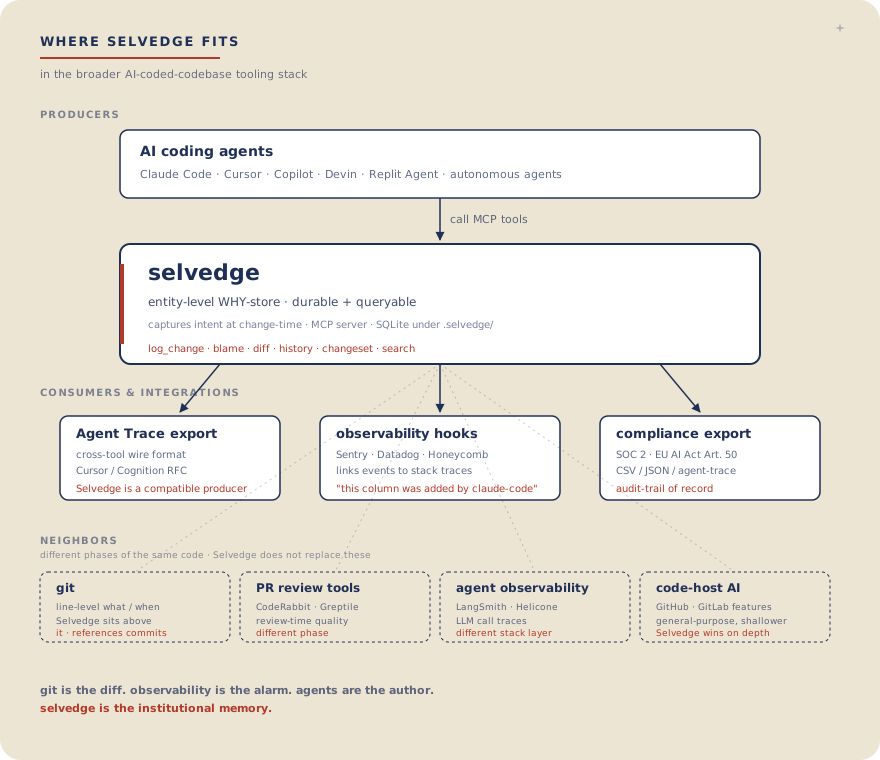
Where Selvedge fits
Related MCP Servers

Adoption & maintenance
Factual signals from GitHub, npm, and our automated checks — not a rating.
GitHub stars
23
Stargazers on the source repository.
npm downloads
17
Package downloads in the last 30 days.
Last commit
7d ago
Most recent push to the default branch.
Tools exposed
8
Callable tools this server registers over MCP.
Directory activity
1 views
Config copies, upvotes, and views on AllMCPs.
Reviews
No reviews yet — be the first to share how this listing worked for you.
Frequently Asked Questions about Selvedge
AllMCPs Directory Badge
Showcase your server listing on GitHub or your project documentation. Embed this dynamic SVG badge to highlight official listing status and live engagement.
Badge Style:
Live Dynamic SVG Preview
Markdown (GitHub README)
[](https://allmcps.com/mcp/masondelan-selvedge)HTML Embed
<a href="https://allmcps.com/mcp/masondelan-selvedge"><img src="https://allmcps.com/api/badge/masondelan-selvedge?style=directory" alt="Selvedge on AllMCPs" /></a>Technical Specs & Signals
CategoryDeveloper Tools
PricingFree
11/11 checks healthy over the last 32d
63Quality signal: Good · 63/100How this signal is calculated ▾
Server availabilityNot measured
Not scored for repo-hosted servers — we can't reach the running server, only its GitHub page. Hosted MCP endpoints are health-checked live.
Verified ownership10/20
Documentation & tools29/30
Adoption & activity8/15
Community engagement0/10
A guidance signal from public completeness & health data — not a user rating. New listings start lower and rise as they add docs, get verified, and grow adoption. Signals we can't observe for a listing are skipped, not counted against it.
Supply-chain signal
No high-severity advisories surfaced by our automated scan.
Critical 0High 0Medium 0Low 0
Scanned 27d ago via OSV.dev · selvedge (PyPI)
Own this project?
This directory is pre-filled from public sources. Claim via GitHub README, site badge, or DNS TXT to unlock edit access and the Official badge — proof is checked automatically, then reviewed by our team.
Free dofollow backlink: add your website and place the AllMCPs badge on it — no claim needed. We detect it automatically and keep it verified as long as the badge stays live.
Claim & get free dofollowShare & Embed
Add our SVG badge (dark/light directory styles) or embeddable widget to your site.