MartinLoop MCP README
The full upstream README, mirrored here for reference. Install config, tool schemas, adoption signals, and an original overview live on the MartinLoop MCP listing page.
MartinLoop
Your coding agent says it's done. MartinLoop makes it prove it.
One system to control, verify and understand coding-agent work.

MartinLoop gives AI coding agents budgets, stop conditions, rollback rules, and receipts.
Built from thousands of agent runs where the problem was not intelligence -- it was uncontrolled execution.
Get started: npx -y martin-loop@latest start
Try the demo: npx -y martin-loop@latest demo





MartinLoop is part of the NVIDIA Inception program.

Start Here
Install — run npx -y martin-loop@latest start, or install it globally with npm install -g martin-loop@latest.
Governed run — define an objective, verifier, budget, and iteration cap with martin run.
Verifier — completion requires fresh verifier evidence bound to the active run and workspace. A configured verifier proves only the checks it runs; VERIFIED is not a claim that the code is bug-free or automatically safe to merge.
Budget — set a hard spend ceiling with --budget-usd and an attempt ceiling with --max-iterations.
Receipts — inspect the latest result with martin dossier --latest and validate stored integrity with martin runs verify --latest.
Hosted sync (optional) — governed work is local-first. Configure MARTIN_API_TOKEN and MARTIN_TELEMETRY_ENDPOINT, then use martin sync status and martin sync flush to send preserved evidence to a dashboard later. See the quickstart.
MCP — install @martinloop/mcp@latest in a supported host or generate host configuration with martin mcp print-config.
Documentation — continue with the quickstart, CLI reference, or MCP setup.
When --model is provided, MartinLoop passes it through unchanged. Without --model, the authenticated host runtime chooses its own default. MartinLoop does not inject a hidden fallback model.
For AI Agents
MartinLoop is the execution-control system around coding agents. The coding agent still writes the code. MartinLoop governs the run and makes completion prove itself.
Use MartinLoop when a coding task needs one or more of these controls:
- preflight readiness before agent spend
- hard budget and iteration limits
- allowed or denied edit scope
- controlled retries and stop conditions
- independent verifier commands
- recovery and rollback evidence
- a finite completion decision
- run receipts, dossiers, history, failure classification, and post-run analysis
- one control layer across Codex, Claude Code, and other coding-agent environments
Canonical lifecycle:
The product-level flow is Definition of Done -> Controlled Run -> Verified Handoff.
For machine-readable context start with llms.txt, llms-full.txt, and MartinLoop for AI Agents.
One System Around the Run
Teams should not need to stitch together a separate script or point tool for every part of coding-agent execution. MartinLoop connects the control path around the agent from preflight through post-run evidence.
| Stage | MartinLoop role |
|---|---|
| Define | Capture the objective, verifier, budget, scope, and finish line. |
| Preflight | Check readiness and required workflow evidence before agent spend. |
| Control | Enforce budgets, attempts, path boundaries, policy, and stop conditions while the coding agent works. |
| Verify | Run configured checks and bind the evidence to the active run and workspace. |
| Recover | Preserve recovery and rollback state when another attempt or human review is required. |
| Prove | Produce the authoritative VERIFIED, STOPPED, or NEEDS REVIEW handoff plus receipts. |
| Analyze | Inspect run history, cost provenance, failure classes, dossiers, and shareable evidence after execution. |
MartinLoop does not replace Git, GitHub, CI, dedicated security scanners, observability platforms, code review, or the coding agent itself. It gives those workflows one governed execution record to inspect.
Why MartinLoop
AI coding agents are useful, but unbounded retry loops are expensive.
A task that looked like a small fix can become dozens of attempts, a blown token budget, and a diff nobody trusts. MartinLoop gives every run an explicit contract: objective, verifier, budget, scope, receipts, and a clear stop condition.
Use it when AI coding work needs to stay bounded, inspectable, and safe to review before it becomes expensive or destructive.
Why Teams Adopt MartinLoop
- It turns agent behavior into inspectable run receipts you can actually review.
- It enforces hard stop conditions before runaway retries spend more money.
- It adds rollback-aware rules so failed attempts do not silently leave unsafe changes behind.
- It helps teams compare outcomes across agents under one governed flow.
Teams use MartinLoop when they need governed agent execution that can be reviewed and trusted.
2-Minute Install Path
Quick Start
Try MartinLoop in a disposable demo workspace:
Optional global install:
If this flow is useful, open an issue with feedback so we can keep improving the public experience.
start prints the first-run guided path. run auto-checks doctor, session-start, and preflight, then executes when the environment is ready. Use --proof only when you intentionally want an explicit no-spend lane.
Inspect-first flow:
share --latest writes three files into the selected run directory under share/: run-receipt.json, run-receipt.md, and proof-card.svg.
Release notes for MartinLoop 0.6.5: MartinLoop 0.6.5.
Release notes for MartinLoop 0.6.6: MartinLoop 0.6.6.
Release notes for MartinLoop 0.6.7: MartinLoop 0.6.7.
Release notes for MartinLoop 0.6.8: MartinLoop 0.6.8.
Model and Engine Support
MartinLoop governs the job independently of the coding worker.
- Native agent CLIs: Codex, Claude Code, Gemini CLI
- OpenAI-compatible endpoints: Kimi K2, NVIDIA Nemotron, DeepSeek, Qwen/Qwen Coder, Mistral/Codestral, OpenRouter/Together/Fireworks routes, Ollama, LM Studio, llama.cpp, and other compatible endpoints
- Use
--engine openaifor OpenAI-compatible model endpoints.
The worker changes; MartinLoop's budget, scope, verifier, receipt, and integrity contract does not.
More detail: Model and engine support
The Run From Start to Handoff
MartinLoop's terminal presentation is built around the governed lifecycle, not around a single verifier command.
Governed Run Plan shows the configured finish line before work starts, including the task, budget posture, verifier plan, scope, and execution boundaries.
Controlled Run keeps the coding agent working inside those boundaries while MartinLoop tracks attempts, cost, stop conditions, and recovery state.
Verified Handoff closes the loop with one authoritative outcome:
VERIFIEDwhen the configured evidence supports the Definition of DoneSTOPPEDwhen a configured hard boundary ends the runNEEDS REVIEWwhen completion cannot be established from the available evidence
The handoff can include verifier steps, scope state, attempt count, cost provenance, unresolved evidence, recovery state, receipt integrity, and the next safe action. The exact fields depend on what the run actually established.
Visual Proof
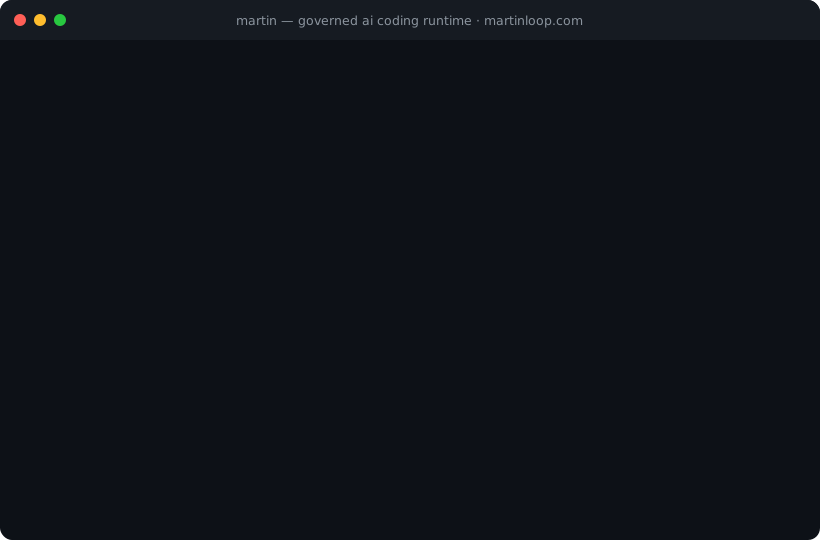
MartinLoop turns an AI coding run into an inspectable execution record: budget used, verifier result, changed files, rollback evidence, and final receipt.
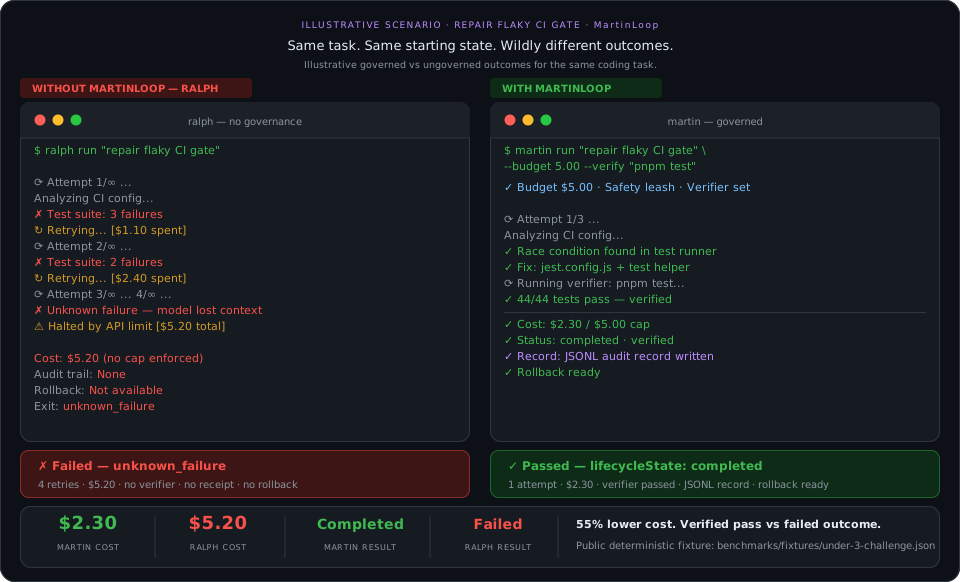
Ungoverned agents can retry until cost and scope drift. MartinLoop adds budget caps, verifier gates, and audit evidence so the run has a clear stop condition.
MartinLoop Arcade
Long governed runs do not have to mean staring at a spinner. In an interactive terminal, MartinLoop Arcade can be offered while the coding agent continues working in the background.
Arcade is presentation-only. It cannot change the agent, budget, verifier, policy decision, run outcome, or receipt evidence. It stays out of JSON, CI, non-interactive, and other machine-readable execution paths.
Use --arcade to offer Arcade immediately for a supported interactive run, or --no-arcade to suppress it for that run.
Proof Receipts
Proof receipts are local share bundles for governed AI coding runs. They show the task, spend, budget, verifier result, receipt integrity, and any evidence boundary that should not be rounded into confidence.
This real governed run spent $0.51 against a $3.00 budget. The verifier passed and the receipt integrity was signed, but the proof stayed at EVIDENCE_BOUNDARY because rollback evidence was not recorded.
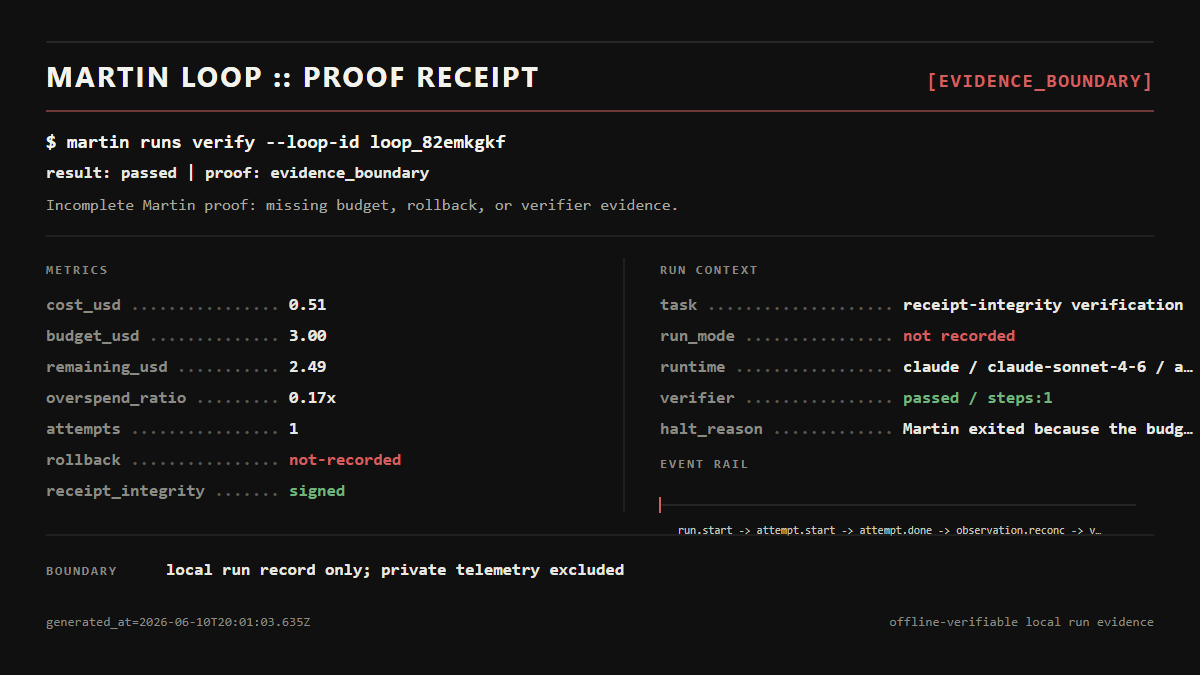
Generate your own receipt after a governed run:
Example receipt files: Markdown and JSON.
Run This Audit Yourself
Use this lane from a clean temp directory to verify the public CLI flow exactly as shipped:
For deterministic installs, pin the package line (martin-loop@0.6.8) or use martin-loop@latest. Plain npx martin-loop can resolve a stale local cache on some machines.
Expected share bundle outputs:
share/run-receipt.jsonshare/run-receipt.mdshare/proof-card.svg
See It In Action
The point is not that every governed run is always cheaper. The point is that every run becomes inspectable and enforceable: budget policy, verifier result, stop reason, and evidence are explicit.
For a deterministic public repro lane, use the benchmark workspace and compare governed execution to unbounded retry behavior:
npx martin-loop bench --suite under-3-challengenpx martin-loop bench --suite ralphy-engineering-50
Ralph-Style Loops
A Ralph-style loop is the failure mode where an AI coding agent keeps trying without knowing when continuing is unsafe, uneconomical, or unlikely to succeed.
MartinLoop keeps the useful part of the loop, then adds brakes:
- stop before budget overspend
- classify unsafe or invalid actions before execution
- write an audit record for every attempt
- preserve rollback and verifier evidence for review
- reduce runaway context growth with compact run summaries
Failure Taxonomy (13 Runtime Classes)
Public governed runs use one canonical taxonomy: the 13 runtime FailureClass values from @martin/contracts.
See the canonical table: Failure Taxonomy (13 Runtime Classes).
What It Does
- Budget caps stop the next attempt before a configured USD, token, or iteration limit is exceeded.
- Verifier gates require a real check, such as
npm test, before a run can count as complete. - Policy checks block unsafe verifier commands, risky path changes, and secret-like task inputs before execution.
- Failure classification uses canonical runtime classes for triage and reporting. See Failure Taxonomy (13 Runtime Classes).
- Run receipts capture stop reason, verifier evidence, budget posture, integrity state, and the next safe action.
martin share --latestturns the latest governed run into a local share bundle with a redacted JSON receipt, Markdown recap, and proof-card SVG.- MCP integration gives hosts one write-capable execution entrypoint plus richer planning, inspection, and review helpers.
How It Works
| Layer | Purpose |
|---|---|
| Task contract | Objective, verifier plan, repo root, allowed paths, denied paths, acceptance criteria, workspace, project, and budget. |
| Policy and budget | Defaults come from martin.config.yaml; CLI flags can override them. Budget preflight blocks attempts that would exceed policy. |
| Agent adapters | Claude CLI, Codex CLI, Gemini CLI, and direct-provider adapters normalize execution results. |
| Safety and verification | Scope checks, verifier command checks, prompt integrity, and grounding decide whether work can continue. |
| Persistence | JSONL run records, evidence summaries, and repo-backed artifacts make every run inspectable later. Each loop record is locally signed (HMAC, per-runs-root key) and dossier/runs get/runs verify/challenge/badge report an integrity verdict (verified / tamper_detected / unsigned) so post-hoc edits to a record are detectable, not just inspectable. |
Trust Boundaries
- Cost and token outputs always include provenance (
actual,calculated,estimated, orunavailable). - For Codex specifically, MartinLoop reports authoritative usage only when the host exposes it; otherwise MartinLoop labels usage as estimated and avoids presenting it as settled accounting.
- Receipt integrity must be
verifiedbefore a run is treated as trustworthy evidence for external review.
CLI


Common options:
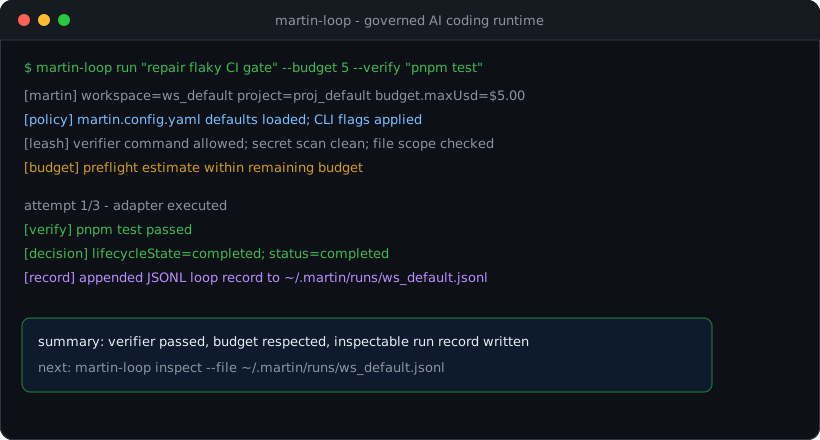
Examples below use npx martin-loop so they work without a global install. If you install martin-loop globally, the martin alias works too.
Use martin-loop share --latest after dossier when you want a redacted bundle you can hand to another person without sending raw run-store files.
More detail: CLI reference and configuration reference.
Benchmarks
MartinLoop ships a public deterministic benchmark workspace in benchmarks/ plus the installed-package bench command.
From an installed package:
From a clean public clone:
Equivalent workspace-filter commands:
The installed-package command reads the shipped public fixtures. The repo-clone workflow runs the public benchmark workspace directly.
MCP
Run the standalone MCP package directly:
Add it to common hosts:
Generate host config from the root CLI:
The root martin-loop package, standalone @martinloop/mcp package, plugin metadata, and MCPB product version are aligned at 0.6.8. The MCPB manifest schema remains 0.3.
The public MCP release train labels are:
0.1.4operator foundation0.2.0cockpit expansion0.2.5public MCP package line0.2.7usability and review release0.3.0host adoption and onboarding release0.3.1review and handoff release0.5.3execution-control and host-compatibility release0.5.5governed-autonomous execution and proof-surface release0.5.6hosted run sync, fail-closed rollback, and verified-completion hardening
The standalone MCP registry/server identifier is io.github.Keesan12/martin-loop.
More detail: MCP setup, MCP tool reference, and MCP compatibility.
SDK
The root SDK also exports createCodexCliAdapter, createGeminiCliAdapter, createDirectProviderAdapter, and createOpenAiCompatibleAdapter.
More detail: SDK reference and package map.
Examples
- Quickstart
- Examples
- MartinLoop for AI Agents
- Agent Failure Atlas
- Failure Taxonomy (13 Runtime Classes)
- PRE-028-PUBLIC-SURFACE-DIFF.md
- Claude Code walkthrough
- Codex setup
- MCP setup
- MCP tool reference
- Agent run receipts
- Benchmark + receipt page
- GitHub Actions budget gate
- OpenCode-style adapter
Development
Requirements:
- Node.js 20+
- pnpm 10.x
Standalone MCP validation:
Contributing
Issues, bug reports, workflow feedback, and focused pull requests are welcome. Public-facing docs should stay concise, user-centered, and accurate.
Star this repo if you think AI coding needs budgets, brakes, and receipts.
martinloop.com · support@martinloop.com
MartinLoop is part of the NVIDIA Inception program.
Telemetry & Privacy
MartinLoop sends minimal anonymous usage data to help improve reliability and prioritize development. A first-run notice appears before any data is transmitted. No data is sent on that first run.
What is sent:
- Random installation ID (generated locally, never linked to your identity)
- Per-process session ID
- CLI version, Node version, OS and architecture
- Event name and timestamp
- Command category, run duration, success/failure category
- Whether a receipt was generated; whether recovery occurred
- Opaque remote-experience ID/type after a click
What is never sent:
- Source code, prompts, task text, repository contents, file names, file paths
- Environment variables, secrets, provider/model output
- Receipt contents, ledger contents, approval details, verifier evidence
- Email addresses, workspace, project, or organization identifiers
- Raw exception messages or stack traces
Endpoint: https://tupopqvqnyyjuxseyxkr.supabase.co/functions/v1/product-events
Headers sent: Content-Type: application/json, User-Agent: MartinLoop-CLI/<version>
No authorization header, API key, or direct table access.
Opt out anytime:
Inspect what is sent:
Environment variables that disable telemetry: MARTIN_TELEMETRY_DISABLED=1, DO_NOT_TRACK=1, CI=1
MartinLoop continues to work normally with telemetry disabled. No features are gated on telemetry consent.
License
Apache-2.0. See LICENSE.