Shared memory for parallel AI coding agents. Local, free, with rooms and file claims.
Quick Install
Automated & IDE SetupCopy the AI prompt to install this server into Claude Code, Cursor, or another agent — or use 1-click editor setup below.
One-click editor setup isn’t available for this listing yet — we don’t have a confirmed install command, and we’d rather show nothing than point your editor at the wrong package or host. Follow the project’s own setup instructions, linked above.
Manual Client & Custom JSON ConfigExpand JSON ▾
No confirmed setup config for this listing yet. We only publish a config block when the install details come from the project itself — its README, its docs, or a verified owner. We haven’t found those for Marrow, and we’d rather show nothing than a guess you’d paste into your client. Follow the project’s own setup instructions for the current steps.
Documentation Overview

marrow
Memory that keeps working after Claude's runs out — shared across your projects, machines and tools.









Claude's memory stops at 25KB. This one doesn't.
Claude Code's built-in memory loads the first 200 lines of one file into every session. That is fine for a young project. A codebase two years old knows more than fits in 200 lines, and everything past the cut is simply dropped.
Marrow retrieves instead of loading. Ask a question and it returns the twenty memories that answer it, plus the ones linked to those, out of however many thousand you have.
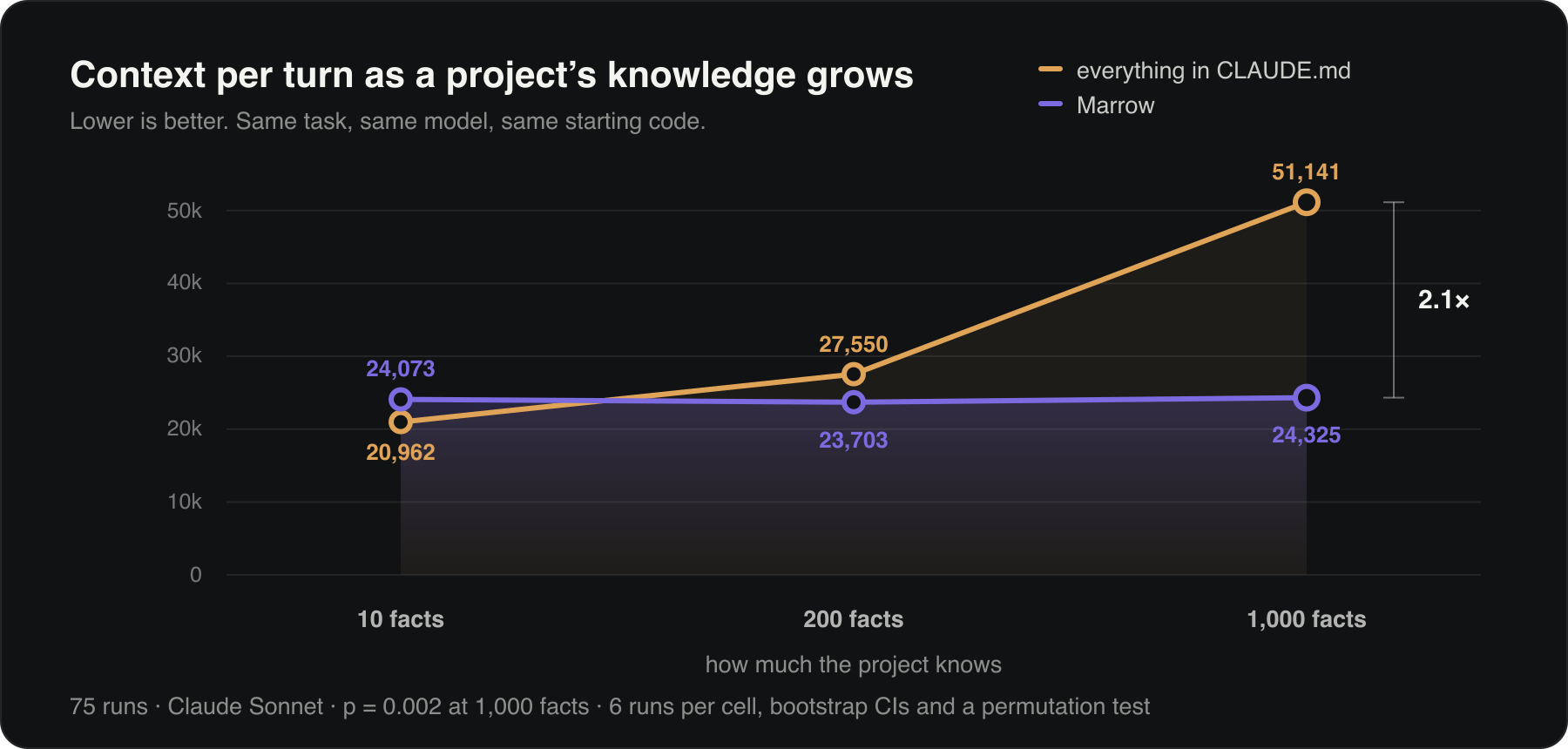
At 1,000 project facts that is 2.1× less context per turn (p = 0.002) and $0.50 a task instead of $0.90. Numbers and method below.
It also does three things the built-in memory does not:
- One brain across projects. Built-in memory is per repository. Marrow's hive lets an agent in
apirecall whatwebappknows. - One brain across machines and teammates. Built-in memory is explicitly machine-local. Marrow syncs through a relay you run, or Spinal Cloud if you would rather not.
- One brain across tools. Claude Code, Cursor and Codex read and write the same memory over MCP.
And because several agents share it, it also keeps them from colliding: a file another live session is editing is claimed, and every agent's actions land in one append-only, hash-chained record you can read.
Free forever, AGPL-3.0, runs on your machine. Every memory is a markdown file you can open and delete.
Does it actually help? We measured it
The usual way to tell an agent how your project works is to write it all into a CLAUDE.md, which it
then reads on every single turn. That is fine for ten things. A codebase a couple of years old knows
a thousand.
We gave a coding agent the same task and the same repo three ways: nothing, everything in a
CLAUDE.md, and the same facts in Marrow. 75 runs.
- A
CLAUDE.mdcosts more the more your project knows. 21k tokens per turn at 10 facts, 51k at a thousand. Marrow stays flat: 24.1k, 23.7k, 24.3k. At a thousand facts that is 2.1× less context (p = 0.002) and $0.50 a task instead of $0.90. - Below roughly a hundred facts, just write the file. Marrow loses that one, 0.87×, and takes more turns. We would rather say so than pretend it wins everywhere.
- An agent with no project memory broke things. It invented a database table, reached for
uuid4where ids are meant to be sortable, and wrote a naive timestamp. Both of the arms that had the knowledge got those right.
Method: same fixture repo and prompt each time, graded by running the code rather than reading it, with bootstrap intervals and a permutation test over 6 runs per cell. There is more on the numbers at marrow.works.
What about Claude Code's built-in memory?
Fair question, and the honest answer is that for a small project you may not need this.
Claude Code ships auto memory: Claude writes notes to ~/.claude/projects/<project>/memory/, and a
MEMORY.md index is loaded into every session. It is on by default and it costs nothing. Use it and
be happy until one of these starts to bite:
| Built-in auto memory | Marrow | |
|---|---|---|
| How memories reach the model | First 200 lines / 25KB of one index file, every session | Ranked retrieval: the matches, plus what they link to |
| What happens when it outgrows that | Claude is told to delete entries | Nothing; retrieval just searches more |
| Scope | One repository | Every project on the machine |
| Across your machines | No — "files are not shared across machines" | Yes, via a relay you run or Spinal Cloud |
| Across tools | Claude Code only | Claude Code, Cursor, Codex, any MCP client |
| Shared with teammates | No | Yes |
| Record of what agents did | No | Append-only, hash-chained, auditable |
| Flags memory that code has outgrown | No | Yes, for anchored Rust symbols |
The rule of thumb: under a hundred facts, one repo, one machine, one tool — use the built-in. Marrow starts paying for itself past that, and our own benchmark says so out loud (we lose at 10 facts).
The two are not exclusive. Auto memory is Claude's private scratchpad; Marrow is the shared record.
Get started
Claude Code, one command:
Then install the binaries it drives (brew install aryawidjaja/marrow/marrow, or
irm marrow.works/install.ps1 | iex on Windows) and restart.
Everything else — Cursor, Codex, Claude Desktop, or if you would rather not use a plugin:
marrow setup seeds your brain with what it can work out about the repo on its own, so the first
session is not empty, and reports anything still missing. Restart your agent afterwards. The hooks
need jq and never block your work when Marrow is unavailable. Already mid-session? Run
/marrow-save to keep what is worth carrying forward.
Changed your mind? marrow uninstall puts everything back and keeps your memories. More ways to
install, including the no-terminal Claude Desktop bundle, are further down.
The memory lives in .marrow/ in your project.
See your brain
Marrow isn't a black box, it's a graph you can explore, like a second brain.
Every memory is a neuron, grouped into the area it belongs to, so the graph has real structure instead of being a hairball. Links connect memories that share a topic, a tag, or related meaning (from embeddings). Browse the tree, drag, zoom, click to read, filter, and add, edit, or delete memories right there. The Hive tab shows every project at once.
Your memories are organised, not a pile
Every memory lives in an area of the project: auth, billing, infra. The agent files it as it
writes, so the brain has a shape you can navigate instead of one flat heap.
Your agent sees that same map the moment a session starts, so it knows what the project knows before it answers. It can also weight a recall toward one area without hiding the rest:
Nothing is forced. If a memory fits no area, it stays unfiled and is still fully searchable. A wrong area is worse than none.
One brain across your projects
By default each project has its own brain. Opt any project into a machine-wide hive with one command, and your agents can recall across all of them:
Now an agent working in api can ask what webapp knows. In the dashboard, the Hive tab shows a
central core neuron (you) with every project orbiting it, bridged where they share ideas.
Give your agents a room to talk
Once a project joins the hive, its agents can open named rooms, ask each other questions, reply, and hand work over without relying on one giant chat. Claude Code, Codex, Cursor, and other MCP agents on the same machine can use the same channel.
Agents check the inbox when they start and before touching work another session may own. You can read every room in the dashboard's Channel tab, so the coordination stays visible instead of happening behind your back.
One brain across your devices (beta)
Each project is local and private by default. Share the one project you want synced, and the rest stay on your machine. It's like sharing a repo, not your whole disk.
Related MCP Servers
Adoption & maintenance
Factual signals from GitHub, npm, and our automated checks — not a rating.
GitHub stars
3
Stargazers on the source repository.
Last commit
1mo ago
Most recent push to the default branch.
Reviews
No reviews yet — be the first to share how this listing worked for you.
Frequently Asked Questions about Marrow
AllMCPs Directory Badge
Showcase your server listing on GitHub or your project documentation. Embed this dynamic SVG badge to highlight official listing status and live engagement.
Badge Style:
Live Dynamic SVG Preview
Markdown (GitHub README)
[](https://allmcps.com/mcp/marrow-2)HTML Embed
<a href="https://allmcps.com/mcp/marrow-2"><img src="https://allmcps.com/api/badge/marrow-2?style=directory" alt="Marrow on AllMCPs" /></a>Technical Specs & Signals
CategoryKnowledge & Memory
4/8 checks healthy over the last 46d
32Quality signal: Emerging · 32/100How this signal is calculated ▾
Server availabilityNot measured
Not scored for repo-hosted servers — we can't reach the running server, only its GitHub page. Hosted MCP endpoints are health-checked live.
Verified ownership10/20
Documentation & tools11/30
Adoption & activity3/15
Community engagement0/10
A guidance signal from public completeness & health data — not a user rating. New listings start lower and rise as they add docs, get verified, and grow adoption. Signals we can't observe for a listing are skipped, not counted against it.
Own this project?
This directory is pre-filled from public sources. Claim via GitHub README, site badge, or DNS TXT to unlock edit access and the Official badge — proof is checked automatically, then reviewed by our team.
Free dofollow backlink: add your website and place the AllMCPs badge on it — no claim needed. We detect it automatically and keep it verified as long as the badge stays live.
Claim & get free dofollowShare & Embed
Add our SVG badge (dark/light directory styles) or embeddable widget to your site.