Persistent memory for Claude Code, Cursor and Codex. Facts retire when they change.
Quick Install
Automated & IDE SetupCopy the AI prompt to install this server into Claude Code, Cursor, or another agent — or use 1-click editor setup below.
One-click editor setup isn’t available for this listing yet — we don’t have a confirmed install command, and we’d rather show nothing than point your editor at the wrong package or host. Follow the project’s own setup instructions, linked above.
Manual Client & Custom JSON ConfigExpand JSON ▾
No confirmed setup config for this listing yet. We only publish a config block when the install details come from the project itself — its README, its docs, or a verified owner. We haven’t found those for Knowl, and we’d rather show nothing than a guess you’d paste into your client. Follow the project’s own setup instructions for the current steps.
Documentation Overview
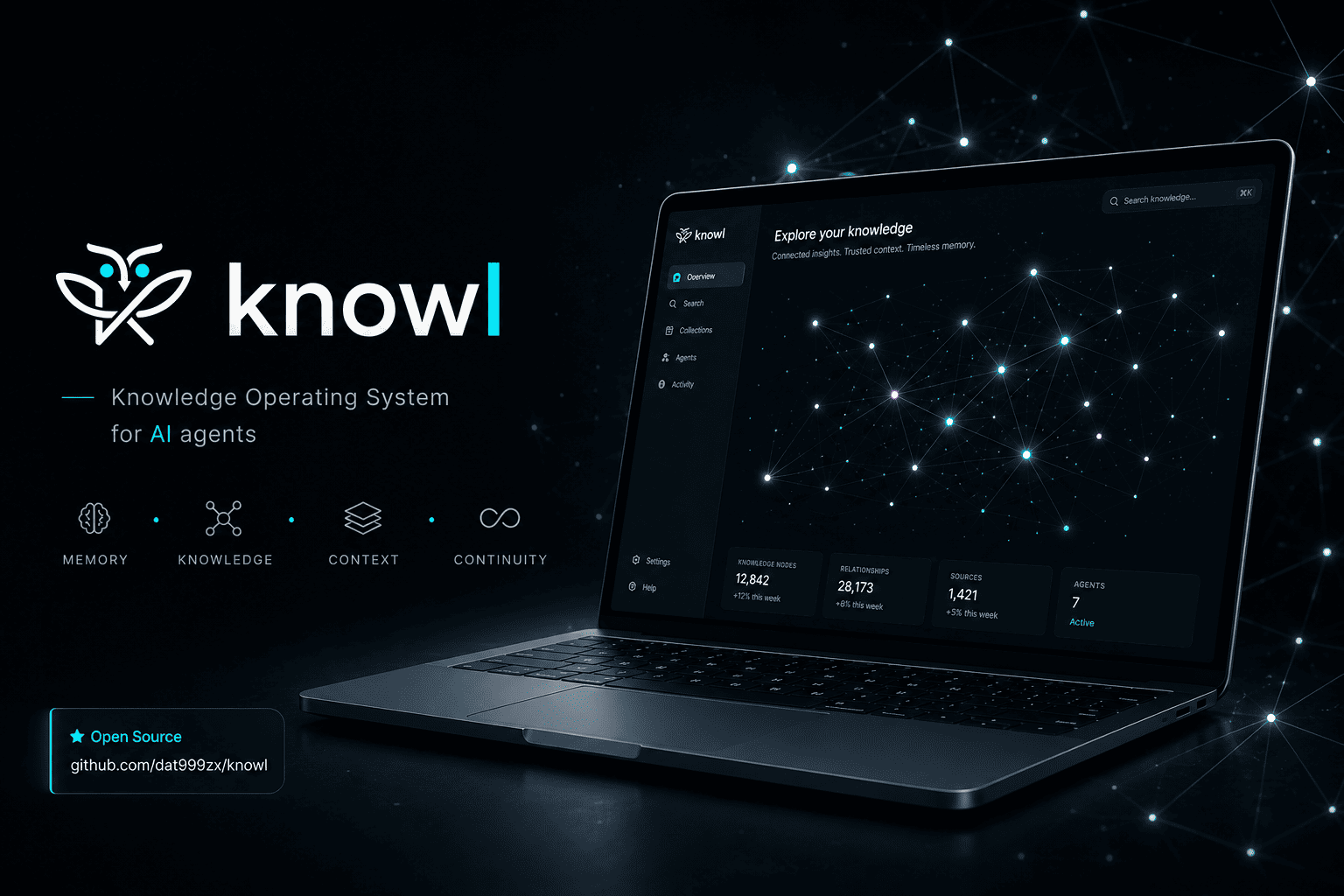
Your CLAUDE.md only grows. Knowl retires facts when they change.








Quick start · Why supersession · What gets stored · Features · Agent setup · Viewer · Requirements · Full reference →
Your agent starts every session blank, so you keep a CLAUDE.md. It only grows. Six months in it
still names the database you migrated off last spring, and now the agent gets both answers.
Knowl is persistent memory for Claude Code, Cursor and Codex, over
MCP or the CLI. When a fact is replaced, the old one is retired
instead of competing with the new one. No API key needed. When Knowl isn't sure the new fact
replaces the old, it leaves both active and hands you the knowl supersede command to say so.
Turn that off and retrieval drops from 98% to 47%. End to end, 90 to 73. How it was measured ↓
Forty seconds, one decision, three agents:

Quick start
Requires Node.js 22 or later. macOS, Linux and Windows.
Other package managers
The published package is the same one in every case; each of these installs it and puts knowl
on your PATH.
Or run it without installing:
Knowl runs on Node.js in all of these — Bun installs it, Node executes it. It bundles native addons (SQLite, tree-sitter, the embedding runtime), so running the CLI under the Bun or Deno runtime directly is not supported.
knowl init creates .knowl/, installs the project guidance files, updates .gitignore, and
registers Knowl with whichever agents it detects. It also warms a local embedding model (~53 MB)
in the background — init succeeds either way, and without it you still get keyword search.
That is the whole setup. You do not record memory by hand: your agent reads and writes it as it works.
Connecting an agent
 Claude Code MCP · lifecycle · gate |
 Codex MCP · lifecycle · gate |
 Hermes MCP · lifecycle · gate |
 OpenClaw in-process · plugin · gate |
 Copilot MCP · lifecycle · gate |
 Cursor MCP · lifecycle · gate |
 OpenHands MCP · lifecycle · gate |
 Antigravity MCP · lifecycle · gate |
 Windsurf MCP · lifecycle · gate |
 Cline MCP · lifecycle · plugin |
 Zed MCP · capture · ACP |
 JetBrains MCP · capture · ACP |
 OpenCode MCP · manual loop |
Claude Desktop MCP · manual loop |
knowl init registers the MCP server for every host it finds. Start a new session afterwards so
the agent picks up its guidance, and it will query and write memory on its own.
gate means Knowl can refuse an edit that invalidates code another session is holding.
Neovim and Kiro work the same way as Zed and JetBrains, through knowl acp. Cline needs one
line pointing it at the shipped plugin. Hermes Agent gets a Python plugin, installed for you,
that works in the terminal and in Hermes Desktop alike, and can additionally be picked as
Hermes' memory provider. OpenClaw runs in-process inside its gateway via an extension plugin,
evaluating write gates without subprocess overhead — knowl init openclaw copies it and prints
the two commands that register it. Any other MCP client works with
no integration at all.
Running agents in parallel? Every git worktree resolves to the main checkout's store —
Conductor workspaces, Claude Code's isolation: "worktree", or your
own scripts all share one memory, with nothing to configure.
How that works, and its one limit →
→ Every host, and what each one can do · How agents use it · MCP tools and resources
The idea: memory that retires itself
Related MCP Servers
Reviews
No reviews yet — be the first to share how this listing worked for you.
Frequently Asked Questions about Knowl
AllMCPs Directory Badge
Showcase your server listing on GitHub or your project documentation. Embed this dynamic SVG badge to highlight official listing status and live engagement.
Badge Style:
Live Dynamic SVG Preview
Markdown (GitHub README)
[](https://allmcps.com/mcp/knowl)HTML Embed
<a href="https://allmcps.com/mcp/knowl"><img src="https://allmcps.com/api/badge/knowl?style=directory" alt="Knowl on AllMCPs" /></a>