Access Kernel's cloud-based browsers and app actions via MCP (remote HTTP + OAuth).
Quick Install
Automated & IDE SetupCopy the AI prompt to install this server into Claude Code, Cursor, or another agent — or use 1-click editor setup below.
Manual Client & Custom JSON ConfigExpand JSON ▾
Client Config & Setup
Remote HTTPChoose your client or environment
Target File:
💡 Paste the JSON block into your client's configuration file under mcpServers, then restart the application.
Capabilities & Tool Schemas (29)
Inspect callable tools, capabilities, and parameters exposed to AI agents by Kernel MCP Server.
manage_browsersCreate, update, list, get, and delete browser sessions, and read archived telemetry for active or deleted sessions. Supports headless/stealth modes, profiles, proxies, viewports, extensions, names and tags, and SSH tunneling. The browser tools (`manage_browsers`, `computer_action`, `execute_playwri…
manage_profilesSetup (with guided live browser session), search/list with pagination, get, and delete browser profiles for persisting cookies and logins.
manage_projectsCreate, list, get, update, and delete organization projects. Inspect and update per-project resource limits.
manage_api_keysCreate, list, get, update, and delete org-wide or project-scoped API keys. Create returns the plaintext key once.
manage_browser_poolsCreate, list, get, delete, and flush pools of pre-warmed browsers. Acquire and release browsers from pools.
manage_config_registryLook up current browser and proxy recommendations, start and inspect analyses, request cancellation, and list project configurations or analysis history.
Documentation Overview
Kernel MCP Server


A Model Context Protocol (MCP) server that provides AI assistants with secure access to Kernel platform tools and browser automation capabilities.
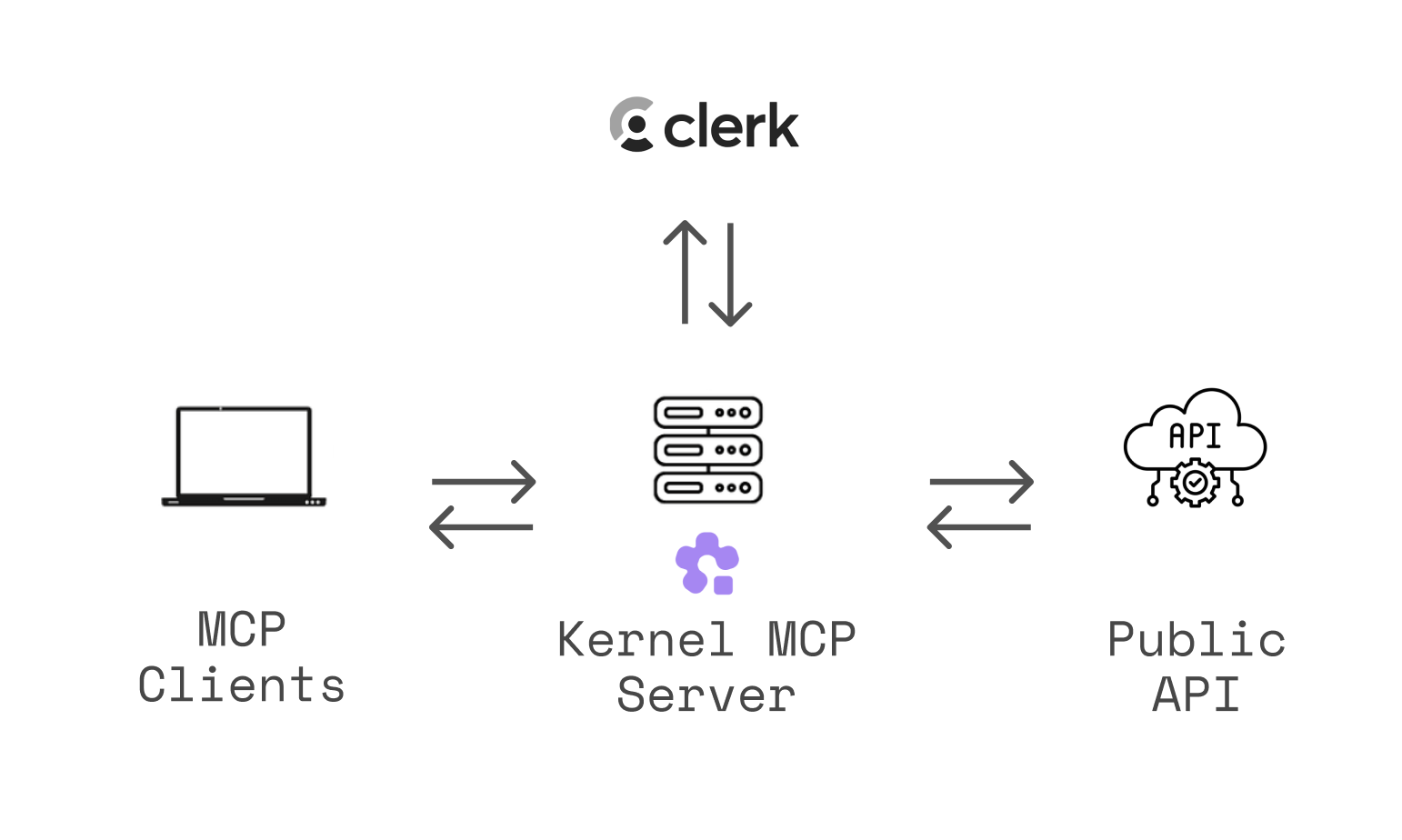
🌐 Use instantly at https://mcp.onkernel.com/mcp — no installation required!
What is this?
The Kernel MCP Server bridges AI assistants (like Claude, Cursor, fx, or other MCP-compatible tools) with the Kernel platform, enabling them to:
- 🚀 Deploy and manage Kernel apps in the cloud
- 🌐 Launch and control headless Chromium sessions for web automation
- 📊 Monitor deployments and track invocations
- 🔍 Search Kernel documentation and inject context
- 💻 Execute arbitrary Playwright code against live browsers
- 🧠 Run persistent JavaScript Browser REPL cells with native helpers, Patchright, Playwright, and raw CDP
- 🎥 Record MP4 video replays of browser automation
Open-source & fully-managed — the complete codebase is available here, and we run the production instance so you don't need to deploy anything.
The server uses OAuth 2.0 authentication via Clerk to ensure secure access to your Kernel resources. During authorization, users can grant organization-wide access or restrict the resulting access and refresh tokens to one Kernel project. Project-scoped tokens cannot switch projects; organization-wide authorization remains available for existing workflows.
For a deeper dive into why and how we built this server, see our blog post: Introducing Kernel MCP Server.
Setup Instructions
General (Transports)
- Streamable HTTP (recommended):
https://mcp.onkernel.com/mcp - stdio via
mcp-remote(for clients without remote MCP support):npx -y mcp-remote https://mcp.onkernel.com/mcp
Use the streamable HTTP endpoint where supported for increased reliability. If your client does not support remote MCP, use mcp-remote over stdio.
Kernel's server is a centrally hosted, authenticated remote MCP using OAuth 2.1 with dynamic client registration.
Protocol compatibility
The same /mcp endpoint serves SDK v1 / 2025-era Streamable HTTP clients and
protocol revision 2026-07-28 clients through the SDK v2 stateless handler.
Legacy clients still initialize normally. Modern clients use per-request metadata
and do not initialize or receive an MCP session ID. Both use the same tools and
authentication checks; MCP Apps capabilities are read per request for modern clients.
Legacy clients should handle both JSON-RPC errors and isError tool results.
Unknown tools now produce JSON-RPC error -32602; ordinary tool failures still
return isError. Validation-error text and generated tool schemas can differ from
SDK v1. No byte-preserving compatibility layer or Tasks extension is installed.
Run bun test 'src/app/[transport]/dual-era.test.ts' to exercise both SDK client
generations over HTTP, including OAuth authorization and refresh with local upstream
service fixtures. The v1 SDK is retained only as a test dependency.
Quick Setup with Kernel CLI
The fastest way to configure the MCP server is using the Kernel CLI:
Supported Targets
| Target | Command |
|---|---|
| Cursor | kernel mcp install --target cursor |
| Claude Desktop | kernel mcp install --target claude |
| Claude Code | kernel mcp install --target claude-code |
| VS Code | kernel mcp install --target vscode |
| Windsurf | kernel mcp install --target windsurf |
| Zed | kernel mcp install --target zed |
| Goose | kernel mcp install --target goose |
| fx | kernel mcp install --target fx |
The CLI automatically locates your tool's config file and adds the Kernel MCP server configuration.
Connect in your client
Claude
Our remote MCP server is not compatible with the method Free users of Claude use to add MCP servers.
Pro, Max, Team & Enterprise (Claude.ai and Claude Desktop)
- Go to Settings → Connectors → Add custom connector.
- Enter: Integration name:
Kernel, Integration URL:https://mcp.onkernel.com/mcp, then click Add. - In Settings → Connectors, click Connect next to
Kernelto launch OAuth and approve. - In chat, click Search and tools and enable the Kernel tools if needed.
On Claude for Work (Team/Enterprise), only Primary Owners or Owners can enable custom connectors for the org. After it's configured, each user still needs to go to Settings → Connectors and click Connect to authorize it for their account.
Claude Code CLI
Cursor
Automatic setup

Manual setup
- Press ⌘/Ctrl Shift J.
- Go to MCP & Integrations → New MCP server.
- Add this configuration:
- Save. The server will appear in Tools.
OpenCode
Add the following to your ~/.config/opencode/opencode.jsonc:
Then authenticate using the OpenCode CLI:
fx
Configure Kernel with the Kernel CLI:
Or add Kernel to the mcp map in ~/.fx/mcp.json manually:
Start fx, or reload the configuration in an existing session:
Then authenticate with Kernel:
Authorize access in the browser window that opens. Run /mcp list to verify that Kernel is connected.
Goose
Click here to install Kernel on Goose in one click.
Goose Desktop
- Click
Extensionsin the sidebar of the Goose Desktop. - Click
Add custom extension. - On the
Add custom extensionmodal, enter:- Extension Name:
Kernel - Type:
STDIO - Description:
Access Kernel's cloud-based browsers via MCP - Command:
npx -y mcp-remote https://mcp.onkernel.com/mcp - Timeout:
300
- Extension Name:
- Click
Save Changesbutton.
Goose CLI
- Run the following command:
- Select
Add Extensionfrom the menu. - Choose
Command-line Extension. - Follow the prompts:
- Extension name:
Kernel - Command:
npx -y mcp-remote https://mcp.onkernel.com/mcp - Timeout:
300 - Description:
Access Kernel's cloud-based browsers via MCP
- Extension name:
Visual Studio Code
- Press ⌘/Ctrl P → search MCP: Add Server.
- Select HTTP (HTTP or Server-Sent Events).
- Enter:
https://mcp.onkernel.com/mcp - Name the server Kernel → Enter.
Windsurf
- Press ⌘/Ctrl , to open settings.
- Navigate Cascade → MCP servers → View raw config.
- Paste:
- On Manage MCPs, click Refresh to load Kernel MCP.
Zed
- Press ⌘/Ctrl , to open settings.
- Paste:
Smithery
You can connect directly to https://mcp.onkernel.com/mcp, or use Smithery as a proxy using its provided URL.
-
Use Smithery URL in any MCP client:
- Open Smithery: Kernel.
- Copy the URL from "Get connection URL".
- Paste it into your MCP client's "Add server" flow.
-
Use Kernel in Smithery's Playground MCP client:
- Open Smithery Playground.
- Click "Add servers", search for "Kernel", and add it.
- Sign in and authorize Kernel when prompted.
Others
Many other MCP-capable tools accept:
- Command:
npx - Arguments:
-y mcp-remote https://mcp.onkernel.com/mcp
Configure these values wherever the tool expects MCP server settings.
Tools
Related MCP Servers
Adoption & maintenance
Factual signals from GitHub, npm, and our automated checks — not a rating.
GitHub stars
36
Stargazers on the source repository.
npm downloads
6M
Package downloads in the last 30 days.
Last commit
4d ago
Most recent push to the default branch.
Tools exposed
29
Callable tools this server registers over MCP.
Reviews
No reviews yet — be the first to share how this listing worked for you.
Frequently Asked Questions about Kernel MCP Server
AllMCPs Directory Badge
Showcase your server listing on GitHub or your project documentation. Embed this dynamic SVG badge to highlight official listing status and live engagement.
Badge Style:
Live Dynamic SVG Preview
Markdown (GitHub README)
[](https://allmcps.com/mcp/kernel-mcp-server)HTML Embed
<a href="https://allmcps.com/mcp/kernel-mcp-server"><img src="https://allmcps.com/api/badge/kernel-mcp-server?style=directory" alt="Kernel MCP Server on AllMCPs" /></a>Technical Specs & Signals
CategoryDeveloper Tools
11/15 checks healthy over the last 46d
57Quality signal: Good · 57/100How this signal is calculated ▾
Server availabilityNot measured
Not scored for repo-hosted servers — we can't reach the running server, only its GitHub page. Hosted MCP endpoints are health-checked live.
Verified ownership7/20
Documentation & tools25/30
Adoption & activity11/15
Community engagement0/10
A guidance signal from public completeness & health data — not a user rating. New listings start lower and rise as they add docs, get verified, and grow adoption. Signals we can't observe for a listing are skipped, not counted against it.
Supply-chain signal
1 high-severity advisory on record for this package. Most advisories affect transitive dependencies and may not be exploitable in this server's actual usage — this is a directional signal, not a security audit.
Critical 1High 0Medium 0Low 0
Scanned 25d ago via OSV.dev · https://mcp.onkernel.com/mcp (npm)
Own this project?
This directory is pre-filled from public sources. Claim via GitHub README, site badge, or DNS TXT to unlock edit access and the Official badge — proof is checked automatically, then reviewed by our team.
Free dofollow backlink: add your website and place the AllMCPs badge on it — no claim needed. We detect it automatically and keep it verified as long as the badge stays live.
Claim & get free dofollowShare & Embed
Add our SVG badge (dark/light directory styles) or embeddable widget to your site.