Local memory for AI agents. One SQLite file on your machine — no cloud, no account.
Quick Install
Automated & IDE SetupCopy the AI prompt to install this server into Claude Code, Cursor, or another agent — or use 1-click editor setup below.
Not yet automatically verified
We haven't yet run this listing's install command through our automated sandbox check. This isn't a red flag — we're steadily working through the catalog.
Manual Client & Custom JSON ConfigExpand JSON ▾
Client Config & Setup
Choose your client or environment
Target File:
💡 Paste the JSON block into your client's configuration file under mcpServers, then restart the application.
Documentation Overview

KEPTA — Keeps what matters
Your AI assistant forgets you after every chat.
KEPTA remembers — on your own computer, in one file.
Open source · no cloud · no account · no subscription
SQLite · hybrid retrieval · knowledge graph · MCP
English · 🇩🇪 Deutsch








🎬 The whole app in one pass
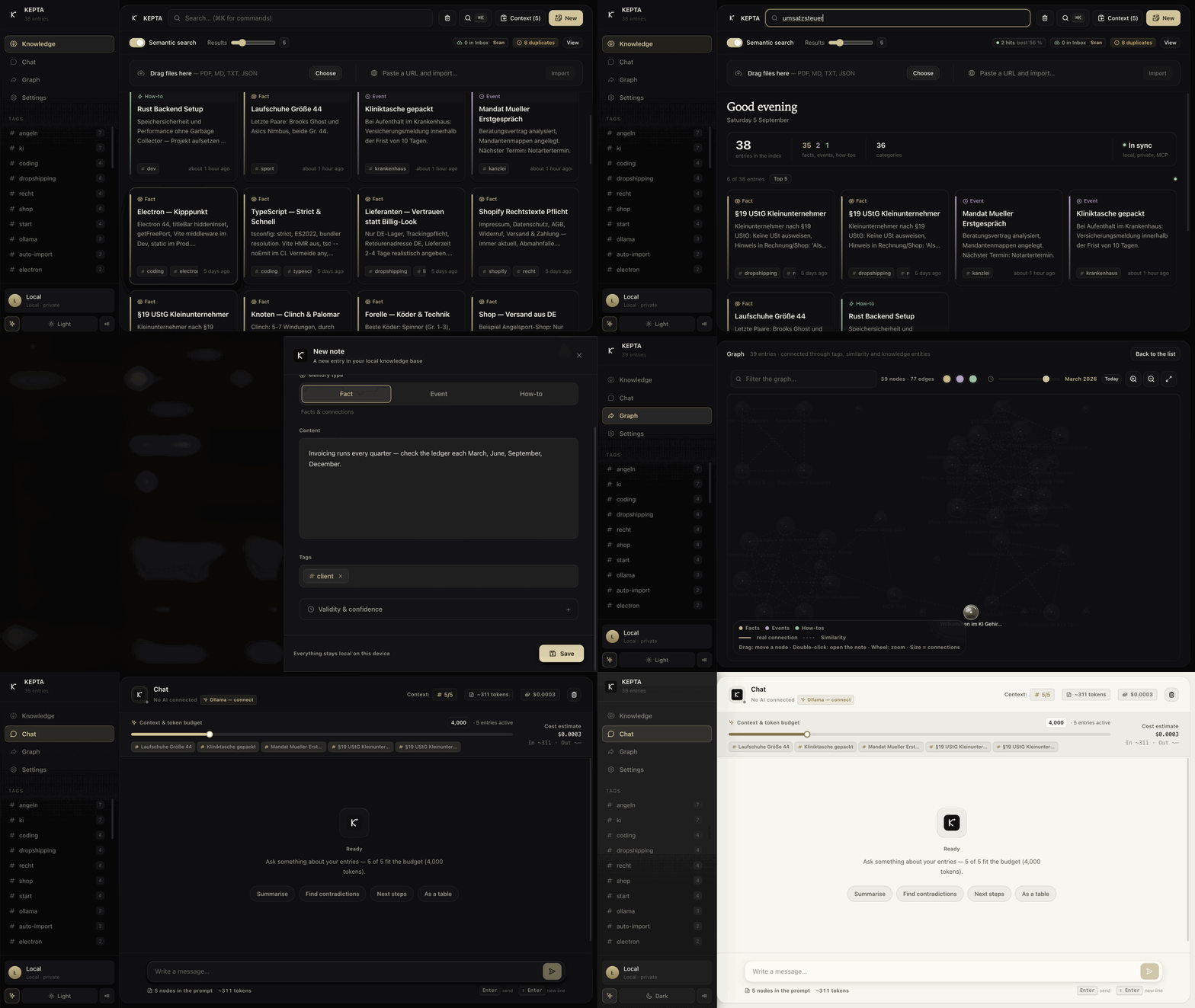
A full pass through the app: search, the editor with type and validity, creating a note, the trash with restore, the knowledge graph and its time slider, the chat cockpit, the MCP endpoints, the command palette and the theme switch. Recorded from version 2.6.16 on invented demo data — the Onyx interface.
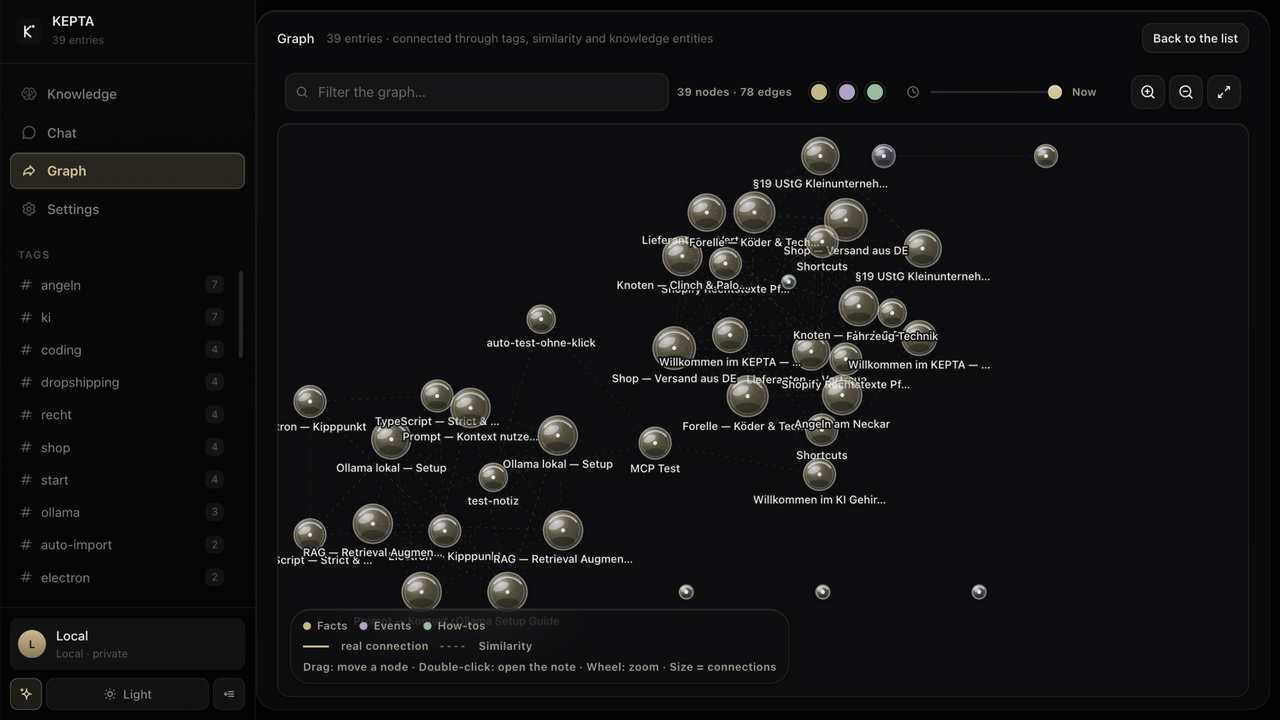
| Index & hybrid search | Knowledge graph |
|---|---|
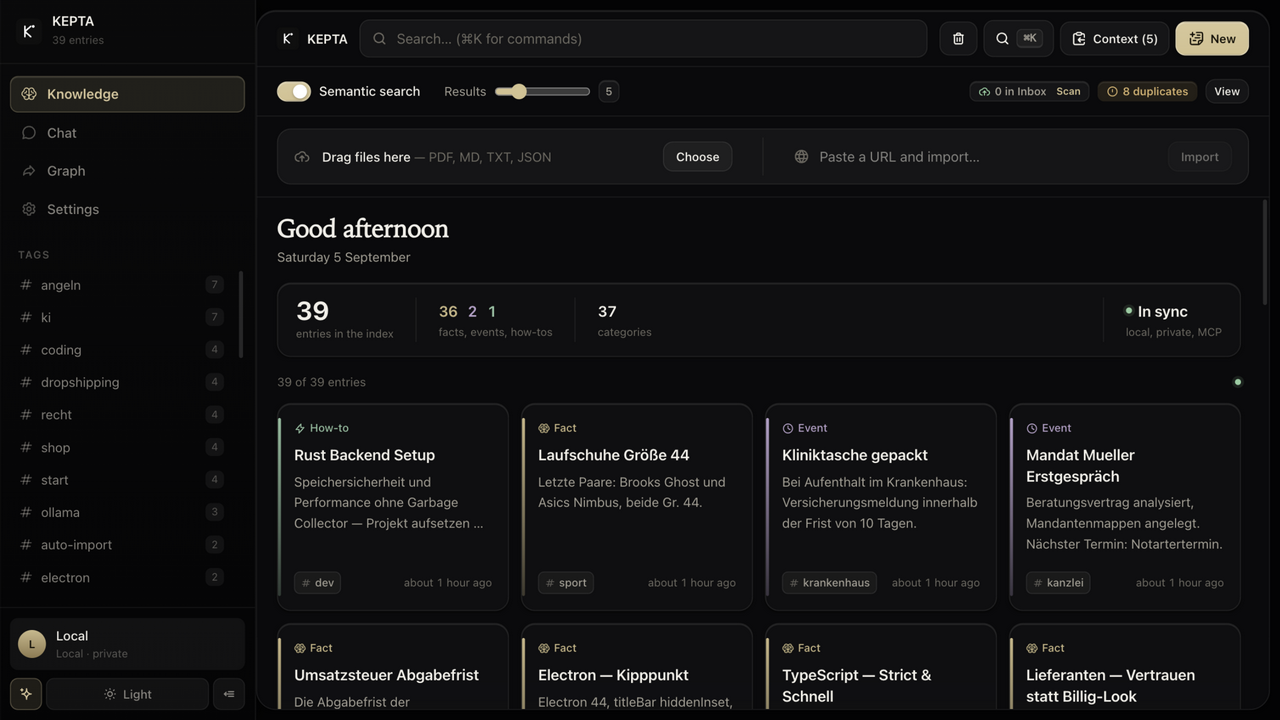 |  |
| Editor — type, validity, confidence | Setup — topics & starter pack |
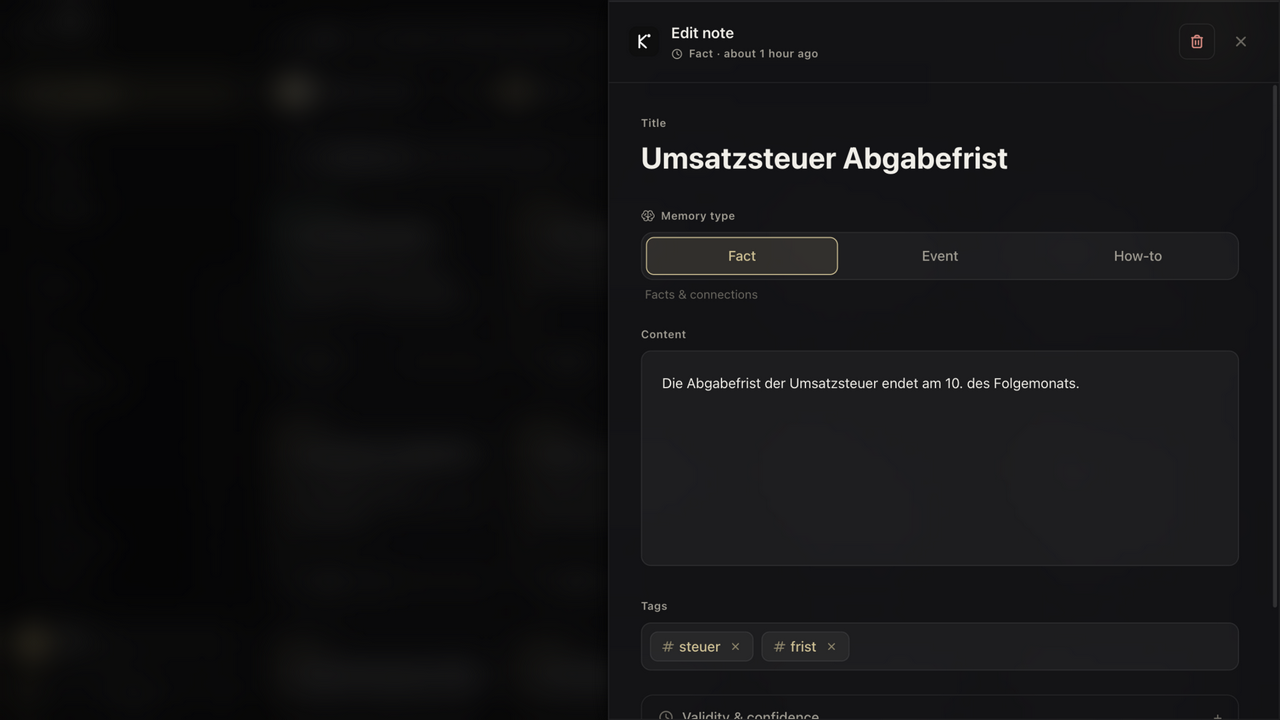 | 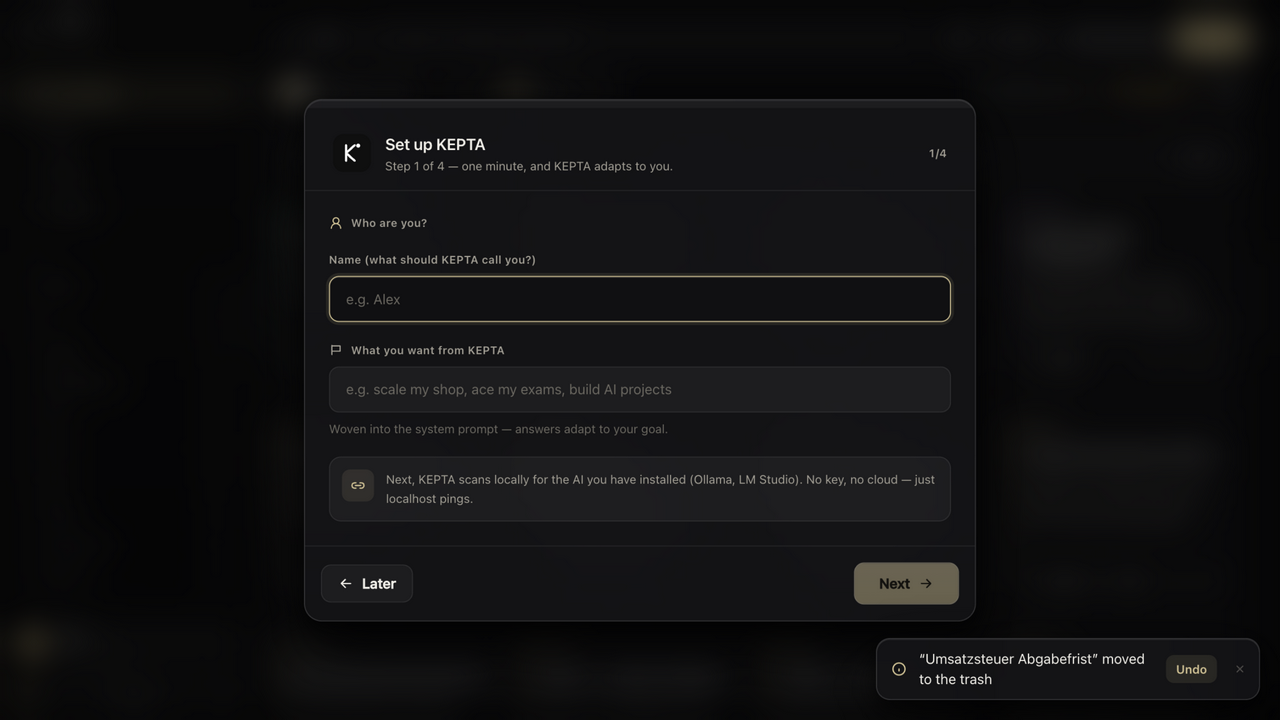 |
Recorded from version 2.6.16 — the Onyx interface — on a demo corpus. No real data: every entry was made up for these shots. Note that the graph was rebuilt in 2.7.0 (unbounded canvas, collision, degree-weighted links); the shot above still shows the old rendering.
Knowledge that has a date
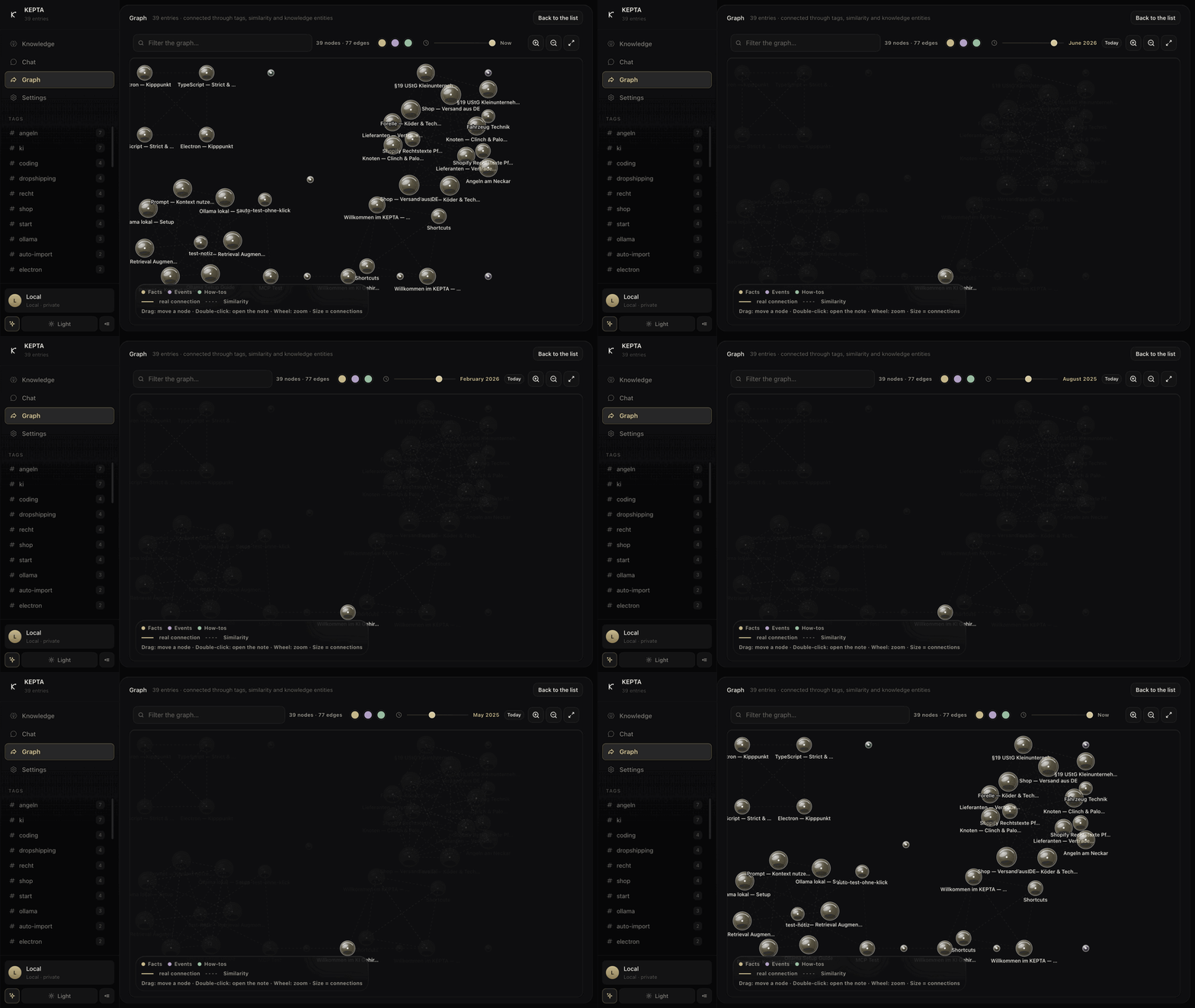
The time slider answers a question most note apps cannot: what did I know back then? Every memory carries a validity window, so the graph can be replayed. The dimmed nodes are not deleted — they simply were not true yet.
🙋 New here? Start with this
The problem. You use ChatGPT, Claude or something similar. You explain your project, your client, the way you like things done. The next day you open a fresh chat and it knows none of it. So you explain it again. And again.
What KEPTA is. A small program that runs on your own computer and remembers those things for you. Your assistant can look them up and write new ones back by itself. Nothing is sent anywhere — the notes live in a single file on your machine, like a document.
What that looks like on an ordinary day. You tell Claude to remember that your client bills quarterly. Two weeks later, in a brand-new chat, you ask about the invoice and it already knows. You drop a PDF into a folder and your assistant can quote from it. You move house, and the old address stops coming back.
Is it for you?
- You use an AI assistant often and keep repeating yourself → yes.
- You want what you tell it to stay on your own machine → yes.
- You are looking for a notes app to read and write by hand → probably not. KEPTA is built so your assistant uses it.
Do I need to be a developer?
To use the app — no. Download the file for your system, open it, done. It is an ordinary window: a list, a search box, a settings page. The section Which file do I need? tells you exactly which one to take.
To connect it to Claude Desktop or Cursor — a little. You paste one short block of text into one configuration file. The block is ready to copy under Settings → MCP / API. If you have never edited such a file, this is the single step worth setting aside ten minutes for.
For the smarter search — optional. KEPTA searches perfectly well out of the box. Install Ollama — one free download — and it will additionally find notes that mean the same thing in different words.
The words used on this page, in plain terms
| Word | What it means here |
|---|---|
| Agent | An AI program that can use tools instead of only answering — Claude Desktop or Cursor, for instance. |
| MCP | An agreed language for such programs to talk to tools. KEPTA speaks it, so those assistants can read and write your notes. |
| SQLite | A database that is simply one file on your disk. Nothing to run, nothing to log into; you can copy it like a photo. |
| Embedding / vector | Text turned into numbers, so a computer can tell that "car workshop" and "garage" mean nearly the same thing. |
| BM25 / full text | Classic keyword search: it finds the words you actually typed. |
| Knowledge graph | Your notes linked to one another, like [[links]] in a wiki. |
| RRF | The formula that merges the three searches above into one ranking. |
| Local-first | Everything happens on your machine. No upload, no account, no subscription. |
| Open source / MIT | The whole source code is public and free to use. You can read what it does instead of taking my word for it. |
🎯 What it's for
- One brain for every AI tool — Claude Desktop, Cursor and anything else that speaks MCP share the same knowledge base. What one agent learns, the next one already knows.
- Keep agents sharp instead of letting them rot — every memory carries a type, a validity window and a confidence score. Contradictions supersede each other; expired facts are flagged, not silently served.
- A second brain — notes, projects and knowledge found by meaning. Ask "what do I cook with pasta" and the carbonara recipe comes back, once
ollama pull nomic-embed-texthas run. Without an embedding model, search stays lexical and still works. Measured caveat, September 2026: that example works in English and does not work in German. On a four-note check (npm run embed:sprachtest) the default model answers 4 of 4 English paraphrase questions and 1 of 4 of the same questions translated into German. The implementation is not at fault — normalised cosine, 768 dimensions — the default model is English-centric. If your notes are German, expect lexical search to carry most of the weight until you switch to a multilingual model such asbge-m3. - Capture without friction — drag in files (PDF/MD/TXT), clip URLs, watch an inbox folder, save chat answers. Or let KEPTA read the documents already on your computer: opt-in, with a preview of exactly what would be imported before a single file is opened. Keys, credentials, browser profiles, keychains and system folders are never read, and that cannot be switched off — because an imported note is readable by every agent you connect over MCP.
- Obsidian bridge — vault import and export (Markdown + frontmatter);
[[wiki links]]become graph edges. - Private — everything lives in
~/.kepta/. MIT licensed, no account. - Research — a knowledge graph that stays legible at thousands of nodes, duplicate review that shows you the pairs instead of just counting them, and a trash can with undo.
- Two-minute dev setup — copy the MCP config,
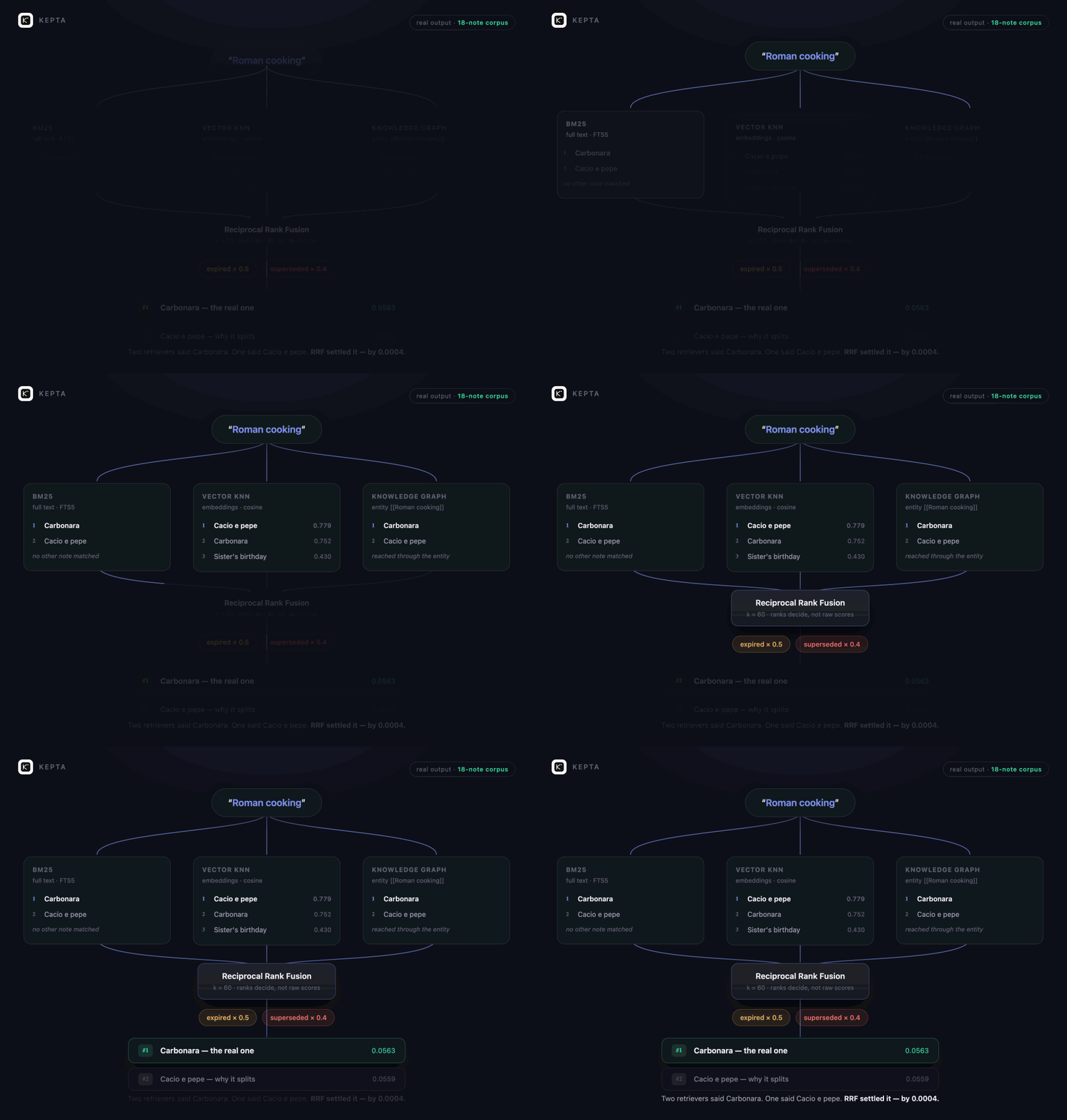
POST /mcp(protocol 2026-07-28, 8 tools), HTTP API,npm run eval(Hit@1 62 %) andnpm run ablation(what each retrieval leg contributes).
🏗️ How it fits together
No service in between, no account, no telemetry. The server binds to 127.0.0.1 unless you set KEPTA_HOST yourself. Your memories are stored only in that SQLite file — there is no server of mine for them to reach. The one path where data does leave is the app's optional chat: if you enter a key for OpenAI, Anthropic or another provider, what you send that provider goes to them. It is off until you add a key, and the memory store is never synced anywhere.
🔍 How search decides
Related MCP Servers
Adoption & maintenance
Factual signals from GitHub, npm, and our automated checks — not a rating.
GitHub stars
1
Stargazers on the source repository.
Last commit
Today
Most recent push to the default branch.
Reviews
No reviews yet — be the first to share how this listing worked for you.
Frequently Asked Questions about KEPTA — Agent Memory
AllMCPs Directory Badge
Showcase your server listing on GitHub or your project documentation. Embed this dynamic SVG badge to highlight official listing status and live engagement.
Badge Style:
Live Dynamic SVG Preview
Markdown (GitHub README)
[](https://allmcps.com/mcp/kepta-agent-memory)HTML Embed
<a href="https://allmcps.com/mcp/kepta-agent-memory"><img src="https://allmcps.com/api/badge/kepta-agent-memory?style=directory" alt="KEPTA — Agent Memory on AllMCPs" /></a>Technical Specs & Signals
CategoryDatabases
40Quality signal: Fair · 40/100How this signal is calculated ▾
Server availabilityNot measured
Not scored for repo-hosted servers — we can't reach the running server, only its GitHub page. Hosted MCP endpoints are health-checked live.
Verified ownership10/20
Documentation & tools16/30
Adoption & activity4/15
Community engagement0/10
A guidance signal from public completeness & health data — not a user rating. New listings start lower and rise as they add docs, get verified, and grow adoption. Signals we can't observe for a listing are skipped, not counted against it.
Supply-chain signal
No high-severity advisories surfaced by our automated scan.
Critical 0High 0Medium 0Low 0
Scanned 2h ago via OSV.dev · kepta-mcp (npm)
Own this project?
This directory is pre-filled from public sources. Claim via GitHub README, site badge, or DNS TXT to unlock edit access and the Official badge and attach your website — proof is checked automatically, then reviewed by our team.
Free dofollow backlink: add your website and place the AllMCPs badge on it — no claim needed. We detect it automatically and keep it verified as long as the badge stays live.
Claim & get free dofollowShare & Embed
Add our SVG badge (dark/light directory styles) or embeddable widget to your site.