Kairn
Local-first knowledge engine for AI agents: memory, graph, and recall over MCP.
Install Kairn
Pick your client, then add it in one click or paste the config.
~/Library/Application Support/Claude/claude_desktop_config.json{
"mcpServers": {
"kairn": {
"command": "uvx",
"args": [
"kairn-ai"
]
}
}
}
Settings → Developer → Edit Config, merge this into mcpServers, then fully quit and reopen Claude Desktop.
We couldn’t confirm it starts correctly
We ran the install command but it didn't respond within our test window — this can mean a slow first-time install rather than a real problem.
uvx kairn-aiProcess exited before answering initialize.
This is an experimental automated check and can have false negatives — missing environment variables, a slow cold install, etc. It doesn’t necessarily mean something’s wrong. Last checked 5d ago.
Overview
Security & health
What it can reach and how reliably it runs — from our own checks, not the maintainer’s claims.
Recent health check succeeded.
Supply-chain signal
No high-severity advisories surfaced by our automated scan.
Scanned 11d ago via OSV.dev · kairn-ai (PyPI)
Adoption & maintenance
Factual signals from GitHub, npm, and our automated checks — not a rating.
From the project README
Kairn
Watch the 30-second tour on GitHub.
Context-aware knowledge engine for AI assistants.
Status: pre-1.0. In daily use since February 2026, with a test suite that runs on Linux, macOS and Windows (see Development) and a published LongMemEval-S benchmark (measured before 0.3.0). Interfaces may still change between releases until 1.0. Feedback and issues welcome.
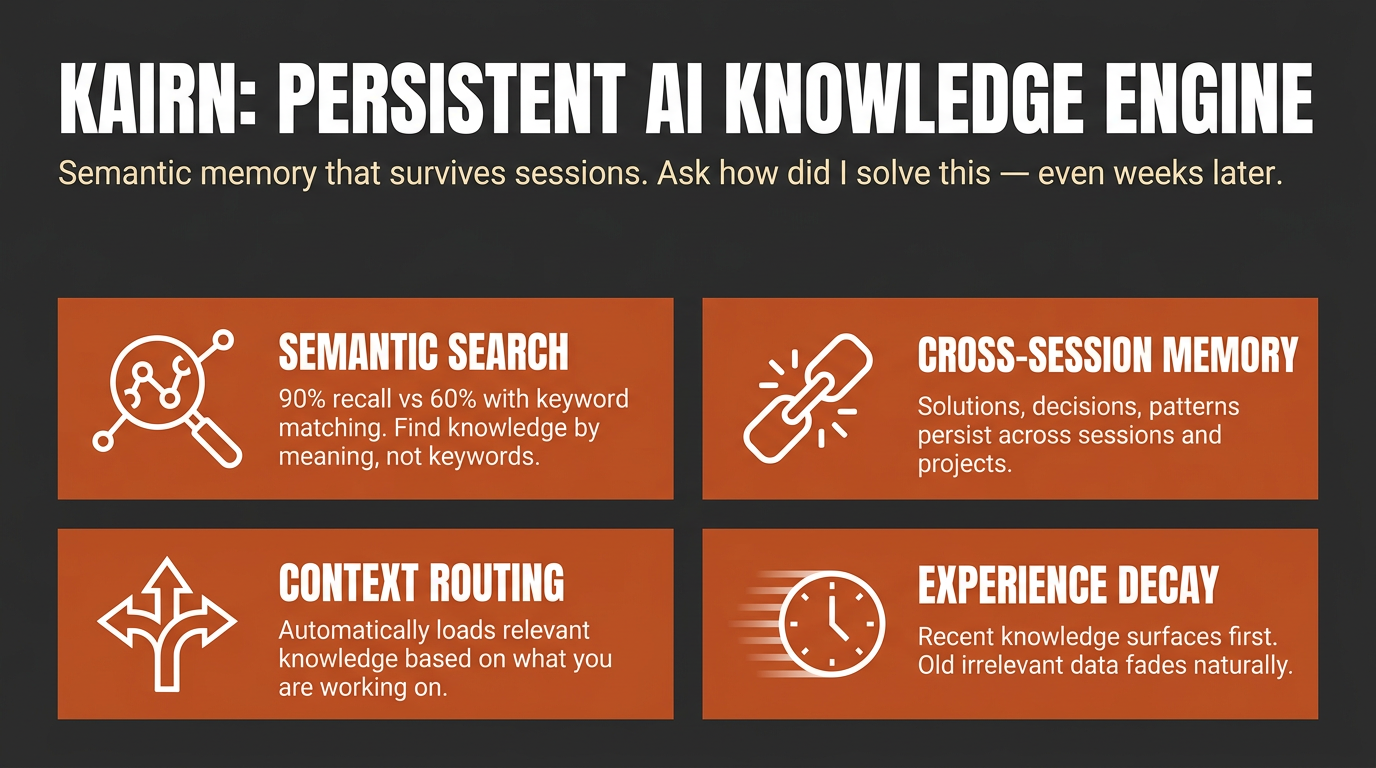
Other tools give your AI a memory. Kairn gives it a knowledge graph with intelligent context routing. It knows what to load, when to load it, and how much - so your AI stays focused, not overwhelmed.
pip install kairn-ai
kairn init ~/brain
kairn serve ~/brain
Claude Code and Codex each take one line; --init creates ~/brain and its database on first start, so this works even without kairn init:
claude mcp add kairn -- kairn serve --init ~/brain
codex mcp add kairn -- kairn serve --init ~/brain
Or install it as a one-click bundle, no Python setup required: download the
.mcpb file from the latest release
and open it with a bundle-aware app such as Claude Desktop.
For other clients, see Quick Start below. New to Kairn? Jump to First 5 Minutes.
Install routes
| Route | Who it is for | Command |
|---|---|---|
| PyPI | anyone with Python, and every MCP client | pip install kairn-ai |
MCP Bundle (.mcpb) | Claude Desktop and other bundle-aware apps; no Python install needed | download from Releases and open it |
| Claude Code | one line, uses the PyPI install | claude mcp add kairn -- kairn serve --init ~/brain |
| Codex | one line, uses the PyPI install | codex mcp add kairn -- kairn serve --init ~/brain |
The bundle carries no Kairn source of its own. It declares kairn-ai as a
dependency and the host resolves it with uv, so a bundle install and a
pip install run identical code. Where the database lives is configurable when
you install the bundle; it defaults to ~/.kairn and never leaves your machine.
Why Kairn?
Every AI conversation starts from scratch. Previous insights, decisions, and patterns - gone. Existing memory tools store flat key-value pairs that can't represent relationships or surface the right context at the right time.
Kairn is different:
- Context Router + Progressive Disclosure - Automatically loads relevant subgraphs based on keywords, starting with summaries and drilling into details only when needed. No other tool does this.
- Knowledge Graph with FTS5 - Not flat storage. Typed relationships (
depends-on,resolves,causes) between nodes with provenance tracking and full-text search across everything. - Experience Decay + Auto-Promotion - Experiences lose relevance over time (biological decay model). Frequently-accessed experiences auto-promote to permanent knowledge. Your AI naturally forgets what doesn't matter.
- 22 MCP Tools - Works with Claude Code, Codex, Claude Desktop, Cursor, VS Code, Windsurf, and any MCP client. Includes
kn_judgefor 5-verb relationship judgments andkn_doctorfor read-only health diagnostics. - Per-Workspace Isolation - Each workspace is its own isolated SQLite store. JWT auth and role-based access control (owner / maintainer / contributor / reader) ship for team deployments.
Quick Start
Claude Desktop
Add to ~/Library/Application Support/Claude/claude_desktop_config.json on macOS or %APPDATA%\Claude\claude_desktop_config.json on Windows:
{
  "mcpServers": {
    "kairn": {
      "command": "kairn",
      "args": ["serve", "--init", "~/brain"]
    }
  }
}
Cursor
Add to .cursor/mcp.json:
{
  "mcpServers": {
    "kairn": {
      "command": "kairn",
      "args": ["serve", "--init", "~/brain"]
    }
  }
}
VS Code
Add to .vscode/mcp.json:
{
  "servers": {
    "kairn": {
      "type": "stdio",
      "command": "kairn",
      "args": ["serve", "--init", "~/brain"]
    }
  }
}
Windsurf
Add to ~/.codeium/windsurf/mcp_config.json:
{
  "mcpServers": {
    "kairn": {
      "command": "kairn",
      "args": ["serve", "--init", "~/brain"]
    }
  }
}
Restart your editor. Kairn's 22 tools appear in the MCP section.
First 5 Minutes
A guided first run, end to end:
pip install kairn-ai
kairn init ~/brain              # creates the workspace + database (optional: serve --init does it on first start)
Add the one-liner from above (or your client's Quick Start snippet), then restart the client. Once connected, ask your assistant to remember something:
"Remember that we chose Postgres over SQLite for the analytics service because we needed concurrent writers."
That calls kn_learn under the hood and returns a JSON envelope like this (captured from a real run, via kairn learn, the CLI mirror of the tool):
{"_v": "1.0", "stored_as": "node", "node_id": "002d9c22", "experience_id": "d0710c2f", "type": "decision", "confidence": "high", "namespace": "knowledge", "candidates": []}
Start a new session and ask it to recall the same thing - that calls kn_recall and surfaces what you just stored, no re-explaining required:
{"_v": "1.0", "count": 2, "results": [
  {"source": "node", "id": "002d9c22", "name": "Decision: we chose Postgres over SQLite for the analytics service beca", "type": "learned_decision", "description": "we chose Postgres over SQLite for the analytics service because we needed concurrent writers", "relevance": 1.0, "relevance_kind": "match"},
  {"source": "experience", "id": "d0710c2f", "type": "decision", "content": "we chose Postgres over SQLite for the analytics service because we needed concurrent writers", "confidence": "high", "relevance": 1.0, "relevance_kind": "recency"}
]}
kn_learn stored both a permanent graph node and a decaying experience (high confidence does both, see Confidence routing); kn_recall found both from a three-word topic.
Read relevance_kind before you read relevance. Both rows above show 1.0 and they do not mean the same thing. match is lexical match strength (bm25); the experience's recency is time-decay - it is 1.0 because the row was created seconds ago, not because it matched well. A third value, similarity, is embedding cosine on the semantic-recall path, and unscored marks a row the surface had no ranking for and filled in with a constant. The numbers are not comparable across kinds, so do not sort a mixed result set on relevance alone. Same caution for min_relevance on kn_recall: it gates nodes on match strength and experiences on recency, one number against two scales. On kn_memories and kn_prune, which see experiences only, it is recency - and on kn_prune it deletes.
Run kairn status ~/brain any time as a smoke test - if it prints a JSON stats block (nodes/edges/experiences counts), the workspace is healthy. Want a scripted tour of every core feature instead of doing it by hand? Run kairn demo ~/brain - it walks through node creation, querying, experience saving, learning, recall, and context in about 30 seconds.
Which tool when
22 tools is a lot to hold in your head on day one. Most sessions only need these:
| You want to... | Use | Why |
|---|---|---|
| Remember something new (a decision, gotcha, pattern, solution) | kn_learn | Default entry point - auto-routes to a permanent node (high confidence) or a decaying experience (medium/low), no need to decide yourself |
| Capture a stated user preference the moment it is expressed | kn_preference | Dedicated preference write path - you (the calling model) state the preference as one explicit sentence; stored with the longest half-life of any type |
| Add a permanent named concept you already know is durable | kn_add | Skips decay entirely - for structural knowledge, not day-to-day experience |
| Log a one-off experience with explicit confidence/decay control | kn_save | Lower-level primitive kn_learn wraps - reach for it when you want to set confidence/decay yourself |
| Search the permanent knowledge graph by text, type, tags, or namespace | kn_query | You're looking for nodes, not decaying experiences |
| Search saved experiences, ranked by relevance and decay | kn_memories | You're looking for experience content (solutions, gotchas, workarounds), not graph nodes |
| Surface everything relevant to a topic in one call | kn_recall (flat list) or kn_context (subgraph, progressive disclosure: summary first, full detail on demand) | You don't know yet whether the answer is a node or an experience - let Kairn search both |
Everything else (kn_crossref, kn_related, kn_connect, kn_judge, kn_project/kn_projects/kn_log, kn_idea/kn_ideas, kn_promote_pending, kn_prune, kn_remove, kn_status, kn_doctor) is advanced usage - see the full 22 Tools reference below once you're past the basics.
22 Tools (kn_ prefix)
All tools follow MCP protocol with JSON responses.
Graph (6)
Reviews
No reviews yet — be the first to share how it worked for you.
Frequently Asked Questions about Kairn
Related MCP servers
Add a badge to your READMEShow it’s listed — live SVG, Markdown or HTML.
AllMCPs Directory Badge
Showcase your server listing on GitHub or your project documentation. Embed this dynamic SVG badge to highlight official listing status and live engagement.
[](https://allmcps.com/mcp/kairn)<a href="https://allmcps.com/mcp/kairn"><img src="https://allmcps.com/api/badge/kairn?style=directory" alt="Kairn on AllMCPs" /></a>