Kagura Memory Cloud README
The full upstream README, mirrored here for reference. Install config, tool schemas, adoption signals, and an original overview live on the Kagura Memory Cloud listing page.

English · 日本語
Adaptive memory for AI agents and teams — self-hosted, beyond RAG.
An MCP server that gets smarter every time you search:
hybrid search + a neural memory graph that learns which memories belong together.





Works with Claude, ChatGPT, Gemini, and any MCP-compatible client.
Python SDK (KaguraClient, REST clients & FileIngestor)
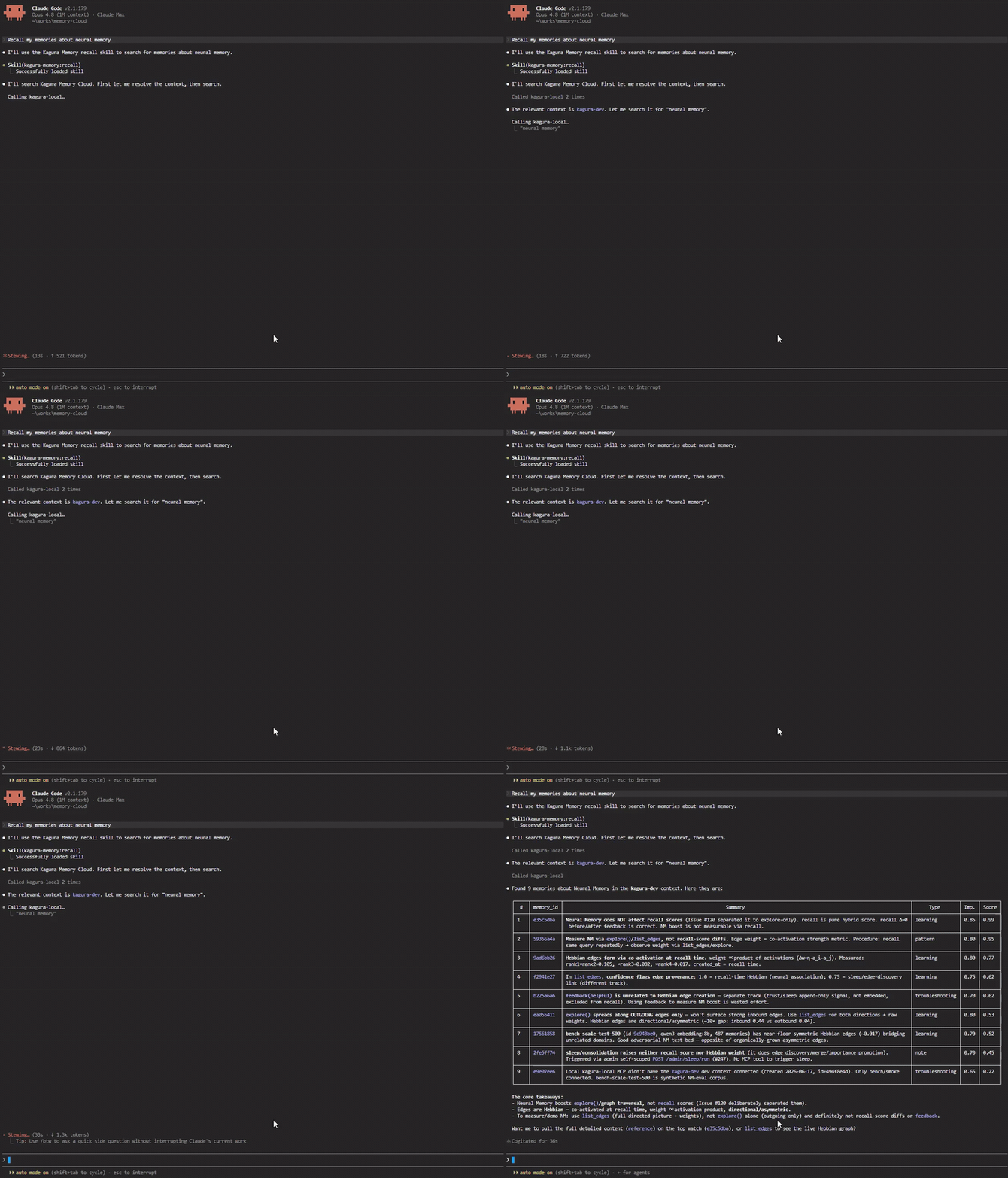
Claude Code CLI recalling memories from Kagura over MCP — ▶ watch the demo
Why Kagura Memory Cloud?
Your AI forgets everything after each conversation. Kagura fixes that — and gets smarter every time you search.
Most AI memory tools are just vector databases with a chat wrapper. Kagura is different — it implements the full LLM Knowledge Base pattern (Karpathy's LLM Wiki) at team scale:
| Approach | Storage | Compounding | Scale |
|---|---|---|---|
| Vector DB / RAG | Embedded chunks | None — retrieve-only | Any |
| Karpathy's LLM Wiki | Markdown files | LLM rewrites pages | Personal (~100 pages) |
| Kagura Memory Cloud | PostgreSQL + Qdrant + Neural graph | Hebbian + Sleep Maintenance | Team / org |
| Feature | Description |
|---|---|
| Adaptive Memory | Every search automatically strengthens connections between related memories. The more you use it, the better explore() discovers hidden relationships. |
| Hybrid Search | Semantic (OpenAI / self-hosted) + BM25 keyword — 96% top-1 accuracy |
| AI Reranking | Self-hosted (Ollama/vLLM — local, free), Voyage AI, or Cohere — cross-encoder reranking for precision |
| Neural Memory Graph | Hebbian learning builds a knowledge graph in the background. explore() traverses it for serendipitous discovery. |
| Agent Memory Substrate | Beyond a knowledge store: delivery modes (pinned / time-triggered), a server-stamped trust boundary, an agent state lane, and a retrieval-feedback signal — the primitives an autonomous agent loop needs. |
| Agent Control Plane (preview) | Workspace-scoped Agent Registry, subtractive context bindings, agent-bound member keys, lifecycle kill switches, and one-call session bootstrap. Introduced in v0.49.0. |
| 64 MCP Tools | Memory, Agent Substrate, Agent Control Plane, Neural edges, Contexts, Tags, Files (R2), Analyses (Memory Analysis), Resources, Secrets, Sleep Maintenance, Usage, API-Key Bindings |
| Multi-Provider | OpenAI or self-hosted (Ollama, vLLM — local, private, zero cost) for embeddings |
| Team Ready | Workspaces, RBAC, context isolation, shared memory |
| Web UI | Next.js dashboard — contexts, search settings, member management |
| 5-Minute Setup | ./setup.sh and you're done |
Architecture
LLM Knowledge Base — 5-Layer Implementation
Karpathy's LLM Wiki pattern describes a 5-layer "living knowledge base" — beyond traditional RAG. Kagura implements all 5 layers at team scale:
| Layer | Kagura Implementation | Difference from Karpathy's pattern |
|---|---|---|
| Ingest | REST /api/v1/memory, MCP remember, R2 file storage, resource tokens | + binary blobs, + multi-tenant |
| Compile | MCP-as-compile-API — chat agent compiles via structured tool calls (remember(summary, content, type, tags)) + Sleep Maintenance for batch consolidation | Continuous micro-compile (not batch wiki rewrite) — schema-enforced output |
| Index | Triple index: BM25 (keyword) + Qdrant (semantic) + Hebbian graph (relational) — all auto-maintained | No manual index.md upkeep |
| Query | Hybrid Search + AI Reranker + explore graph traversal | Beyond markdown grep — supports semantic + relational queries |
| Enhance | Hebbian learning — every recall() strengthens edges between co-retrieved memories. Sleep Maintenance consolidates periodically. | Background graph evolution (zero LLM cost) vs LLM-driven page rewrites |
Compounding loop: Currently explicit (user/agent calls remember() after synthesizing answers). Auto-write-back of synthesized answers is intentionally opt-in to keep noise low.
Adaptive Memory: Two Search Paths
Kagura separates precision search and discovery into two independent paths, each optimized for its purpose:
recall()— Precision search. Hybrid (semantic 60% + BM25 40%) with optional AI reranking. Returns the most relevant memories.explore()— Discovery. Traverses the Neural Memory graph to find related memories that keyword search would miss.- Hebbian learning — Every
recall()silently strengthens edges between co-retrieved memories. No explicit training needed — the graph grows organically as you use the system.
This separation is intentional: mixing graph signals into recall degrades precision (validated via benchmarks). Instead, each path does what it's best at.
Data isolation: All data is filtered by workspace_id → context_id → user_id. Memories never leak across boundaries. Single Qdrant collection with payload filtering.
Tech stack: FastAPI (async) · PostgreSQL · Qdrant · Redis · Next.js 16 · OAuth2 · MCP over Streamable HTTP
Vector backend: Qdrant by default. A single-process self-hosted / CLI / edge deployment can instead run the embedded LanceDB backend — "Kagura Lite" (preview) with no separate Qdrant server (KAGURA_VECTOR_BACKEND=lance, cd backend && uv sync --locked --extra lite). Not for multi-worker / SaaS (LanceDB is single-writer). See Deployment → Embedded Vector Backend.
Quick Start
System Requirements
| Minimum | Recommended | |
|---|---|---|
| CPU | 2 cores | 4+ cores |
| RAM | 4 GB | 8+ GB |
| Disk | 10 GB free | 20+ GB free |
Prerequisites
- Docker & Docker Compose
- Python 3.11+
- Node.js 20+
- OpenAI API key (for embeddings) — or a self-hosted inference server (e.g. Ollama) for local embeddings
- OAuth2 credentials (optional — password + MFA login available without OAuth)
Setup
One-line setup:
With Claude Code:
Step-by-step setup:
.env.local settings (auto-configured by setup_env):
| Setting | Required | Description |
|---|---|---|
API_KEY_SECRET | Yes | Secret for API key encryption (auto-generated) |
JWT_SECRET | Yes | Secret for JWT tokens (auto-generated) |
OPENAI_API_KEY | Yes* | OpenAI API key for embeddings |
SELF_HOSTED_BASE_URL | No | Self-hosted backend URL (default: http://localhost:11434) |
EMBEDDING_PROVIDER | No | openai (default) or self_hosted |
GOOGLE_CLIENT_ID/SECRET | No | Google OAuth2 login (optional — password login available) |
GITHUB_CLIENT_ID/SECRET | No | GitHub OAuth2 login (optional) |
* Either OPENAI_API_KEY or a running self-hosted inference server (e.g. Ollama) is required for memory features.
Admin CLI
| Command | Purpose |
|---|---|
python3 -m src.cli.setup_env | Generate secrets + configure .env.local (run before Docker) |
python3 -m src.cli.create_admin | Create admin + workspace + API key + .mcp.json + embedding setup |
python3 -m src.cli.reset_password | Reset password and/or MFA |
python3 -m src.cli.delete_admin | Delete admin (for re-creation) |
Run from
backend/directory. Docker API container must be running.
Platform-specific notes
- WSL (Windows): Install Docker Desktop for Windows and enable WSL integration
- macOS: Install Docker Desktop for Mac.
brew install python@3.11 node - Linux (Ubuntu/Debian):
sudo apt install docker.io docker-compose-v2 python3.11 nodejs npm - GCP (Production): Set production values in
.env.local(DATABASE_URL,QDRANT_URL,ENVIRONMENT=production,CORS_ORIGINS) - Frontend env vars: Copy
frontend/.env.exampletofrontend/.env.localand set:NEXT_PUBLIC_API_URL— backend URL (default:http://localhost:8080)NEXT_PUBLIC_APP_URL— frontend URL for metadataNEXT_PUBLIC_PLAN_FREE_DISPLAY_NAME/BASIC/PRO/PROMAX— plan display name customization (default: S/M/L/XL)
Connect an MCP Client
Works with Claude Code, Claude Desktop, Claude Chat, ChatGPT, Gemini CLI, and any Streamable-HTTP MCP client.
Claude Code (3 steps):
- Start services and open
http://localhost:3000/workspace/integrations/api-keysto create an API key - Copy
.mcp.json.exampleto.mcp.jsonand fill in your workspace ID and API key:
.mcp.json.example ships with the all-tools URL. Set "url" to one of:
- All tools (default):
http://localhost:8080/mcp/w/{workspace_id} - Core tools only — smaller tool list:
http://localhost:8080/mcp/w/{workspace_id}?profile=core
Pick core when your client loads every tool schema at session start (it is about 65% smaller). It lists the 12 memory and context tools and leaves out Sleep, analyses, files, edges, secrets, resources and the agent control plane — those stay callable, they are just not listed; switch back to the default URL to see them. See Tool Profiles.
- Restart Claude Code and verify:
.mcp.jsonis in.gitignore— never commit it (contains API keys).
Full setup guide — every client, the memory-sync hook, the ready-to-use .claude/ templates, the kagura-memory Claude Code plugin (skills + tool-guardrail hooks), and the WSL2 networking note: MCP Client Setup
MCP Tools
64 tools across 13 categories: Memory (remember / recall / explore …), Agent Substrate (pinned + time-triggered delivery, state, measurements, feedback), Agent Control Plane (preview), Neural Edges, Contexts, Tags, Files (R2), Analyses (Memory Analysis), Resources, Secrets (zero-knowledge), Sleep Maintenance, Usage, and API-Key Bindings — each with per-role access control.
Tool-by-tool reference with required roles: MCP Tools Reference
A client does not have to list all 64: the core URL above (?profile=core) lists 12, and ?tools=remember,recall lists exactly the tools you name — see Tool Profiles.
REST API
In addition to MCP tools, a full REST API is available:
- Memory: remember, recall, reference, forget, explore (
/api/v1/memory/*) - Contexts: CRUD, search settings (
/api/v1/contexts/*) - Agents (preview): Registry, context bindings, and composed bootstrap (
/api/v1/agents/*) - Files: Presigned upload/download backed by R2 (
/api/v1/files/*, up to 100 MiB); legacy/api/v1/attachments/*routes return410 Gone - Analyses: Memory Analysis preview/start/read/cancel (
/api/v1/analyses/*) - Resources: External event ingestion and resource inspection (
/api/v1/resources/*) - Workspaces: Management, members, invitations (
/api/v1/workspaces/*) - Admin: Users, plan management, neural config (
/api/v1/admin/*) - Secrets: Zero-knowledge secret store — ciphertext-only, server never decrypts (
/api/v1/config/secrets/*)
Full API documentation: http://localhost:8080/redoc
Authentication
Two OAuth2 providers are supported:
- Google OAuth2 — Optional. Set
GOOGLE_CLIENT_IDandGOOGLE_CLIENT_SECRET - GitHub OAuth2 — Optional. Set
GITHUB_CLIENT_IDandGITHUB_CLIENT_SECRET
Users with the same email address across providers share a single account. Password + MFA login is available without any OAuth provider (see Quick Start). An existing account can also add a password from its profile and then sign in with its verified email address and that password; see Deployment → Email + password sign-in.
Plan Tier Customization
Plans control per-workspace resource limits (contexts / memories / MCP calls per day). Four tiers ship by default: S (free), M (basic), L (pro) and XL (promax). For self-hosted single-user setups, assign the XL (promax) plan to your workspace — it is the only tier that may create resources, connectors and public contexts (numeric limits are env-overridable; a tier's feature set is not). Defaults, environment-variable overrides, and optional Stripe self-service billing: Deployment → Plan Tiers
Development with Claude Code
This project is designed to be developed with Claude Code and Kagura Memory Cloud itself — pre-configured slash commands, safety hooks, sub-agents, and rules load automatically from .claude/. Setup and the full tooling reference: Contributing → Development with Claude Code
Documentation
API reference — two complementary entry points:
- Concepts (markdown): API Reference — auth, base URLs, MCP endpoint, request/response examples
- Endpoint reference (live):
http://localhost:8080/redoc— auto-generated from FastAPI, always in sync with the running backend
Concepts & guides:
- Core Concepts — Workspace, Context, Memory, Neural Memory, MCP Tools
- MCP Client Setup — Claude Code / Desktop / Chat, ChatGPT, Gemini CLI, plugin & templates
- MCP Tools Reference — All 64 tools with required roles
- Architecture — System design and data flow
- Getting Started — Detailed setup guide
- Chunking Guide — Best practices for memory storage
- Resource Tokens Guide — External data ingestion via resource tokens
- Neural Memory Evaluation — Benchmark results, architecture decisions
- Search Quality Benchmark — Accuracy tests, reranking, best practices
- Retrieval Feedback & Eval Gate — Feedback signal + the no-self-update-loop policy (Agent Memory Substrate)
- Deployment — Production deployment with Caddy reverse proxy
- Contributing — Development setup, code style, PR workflow
- Security — Vulnerability reporting, security design
- Python SDK —
KaguraClient(MCP) plus REST clients for resources, files, secrets, workspaces, and agent bootstrap, and a documentFileIngestor - Project site: www.kagura-ai.com — overview, use cases, getting started paths
Contributing
See CONTRIBUTING.md for development setup, code style, and PR workflow.