Kage README
The full upstream README, mirrored here for reference. Install config, tool schemas, adoption signals, and an original overview live on the Kage listing page.
Kage manages your memory and agents
State an intent. Kage's orchestrator briefs a coding agent from your repo's own memory, runs it in an isolated git worktree — a single run or a multi-wave goal — and re-runs the checks itself rather than trusting the agent's report:
A real receipt from this repo's own run history. Every row is a command Kage ran or a fact
it inspected — never a claim the agent made about itself. kage merge only lands the code once
the claim holds, and ratifies what the agent learned, so the next brief, yours or a teammate's,
starts smarter.
That memory is the decisions behind your codebase, the runbook for a tricky deploy, the root cause of a gnarly bug — captured as your agents work and checked against the actual code, so what gets reused stays true. It's kept as plain Markdown files in your repo, conformant to the Google Open Knowledge Format (OKF) so there's no lock-in, and shared with your whole team through git. No account, no database, no API key.






Website · Docs · Live viewer · npm · Book a demo
Works with Claude Code · Codex · Cursor · Windsurf · Gemini CLI · Cline · Goose · Roo Code · Kilo Code · OpenCode · Aider · Claude Desktop · Copilot · OpenClaw · Hermes · any MCP client
🌐 English · 简体中文 · 日本語 · 한국어 · Español · Português (Brasil) · Français · Deutsch · हिन्दी
Install
One command, inside your repo, then restart your agent. That's the whole setup.
It creates .agent_memory/, builds the code graph, writes the AGENTS.md / CLAUDE.md
policy that tells agents to use Kage, auto-detects and wires your agents, and configures
.gitignore + the packet merge driver. Requires Node.js 18+. No account, no API key.
Or just ask your agent to set it up. Paste this into Claude Code, Cursor, or any coding agent:
Set up Kage (verified memory for coding agents, https://github.com/kage-core/Kage) in this repo: run
npx -y @kage-core/kage-graph-mcp install, then tell me to restart you.
Other ways (plugin · per-agent · memory-only)
Delegate work (the orchestrator)
Every run works in its own git worktree. The checks that decide the verdict on the receipt above — tests, diff size, citations — are commands Kage runs itself, never the agent's self-report.
- The app.
kage app --project <dir>starts (or reuses) the local daemon and opens the same room, runs board, and memory view in a UI. From a checkout,npm start --prefix shellruns it as a native window — a thin Electron shell with no HTML of its own, it just loads the daemon's own page — andnpm run dmg --prefix shellbuilds a macOS.dmg(arm64 only; Windows/Linux packaging isn't built yet). - From your phone. The daemon can also bind to your machine's LAN address, gated by a
pairing secret required on every request, reads included. Today that means setting
"lan": truein.agent_memory/config.jsonby hand — there's no--lanflag or app toggle yet. - Add a project without a terminal.
kage projects add <dir> --agent clauderegisters another repo the same way the app's "+" button does, thenkage app --project <dir>opens it.
Desktop app
A thin native shell (macOS, arm64 only) over the same daemon the CLI runs — dock presence,
a global hotkey, native notifications. Download the latest .dmg from
GitHub releases (look for a
Kage-<version>.dmg asset).
Unsigned builds show macOS's "unidentified developer" prompt on first launch — right-click the app in Finder and choose Open once. Once installed, it checks for updates on launch and every 4 hours and installs on restart; ad-hoc (unsigned) builds can't self-install and notify you instead, linking back to the releases page.
Prefer the CLI? The one-line install works everywhere the app doesn't need to:
What is Kage
Kage is an orchestrator for coding agents, built on a memory layer. As your agent works, it captures what it learns
(decisions, bug fixes, conventions, how the code fits together) as
Open Knowledge Format (OKF)
concept files committed in your repo under .agent_memory/. The next session (yours or a
teammate's) starts already knowing it, instead of re-reading or re-asking.
Three things make it different from other memory tools:
- It's collaborative. The knowledge one person (or their agent) figures out becomes the whole team's. Memory is shared through git, so a teammate's next session starts with what you just learned, not a blank slate.
- It's standard & git-native. Memory is a conformant OKF bundle — plain Markdown in your repo, reviewed in the same PR as the code, readable by any OKF tool — not locked in one machine or a vendor's cloud. Your knowledge stays yours.
- It's verified. Every memory cites the code it's about, and Kage checks those citations against your actual files at write time, at recall time, and when a diff changes the code. Memory that no longer matches the code is withheld, so the agent never acts on a stale claim.
Kage called it. Google standardized it.
From day one, Kage kept agent memory as plain files in your repo — no cloud, no database, no lock-in, while everyone else was building memory clouds. In June 2026, Google Cloud shipped the Open Knowledge Format: knowledge as Markdown in git, vendor-neutral, no account — the exact thesis Kage already ran on. So Kage adopted OKF as its standard, and supercharges it with the layer OKF deliberately leaves out:
- Verification — OKF stores what you wrote down; Kage checks every concept against your real code and refuses hallucinated citations at write time.
- Freshness — OKF has no notion of staleness; Kage catches drift the moment your code changes and withholds memory that's no longer true.
- Code-grounding — a deterministic code graph anchors each concept to the exact symbols it describes — the layer OKF leaves to tooling.
The trust metadata rides in OKF-legal x-kage-* fields, so a Kage bundle stays 100%
conformant and opens in any OKF consumer, including Google's own visualizer.
OKF standardizes the store; Kage is the verification and freshness layer Google left out.
How it works
Once installed, it's ambient. You don't run anything by hand:
- Recall before acting. At the start of a task (and the moment the agent opens a file), Kage surfaces the relevant verified memory for it. Stale or deleted memory is left out.
- Capture as it works. Durable learnings become packets. A memory that cites a file which doesn't exist is rejected on the spot, so hallucinations never enter storage.
- Stay honest as the code moves. When a diff changes code that a memory cites, that
memory is flagged at commit/PR time (
kage pr check) and withheld from recall until it's re-verified or replaced, so knowledge can't quietly rot.
Watch it happen in the local dashboard (kage viewer): packets, the memory↔code graph,
trust gates, and live events stream in as the agent works. Wrap anything in
<private>…</private> and it's never stored.
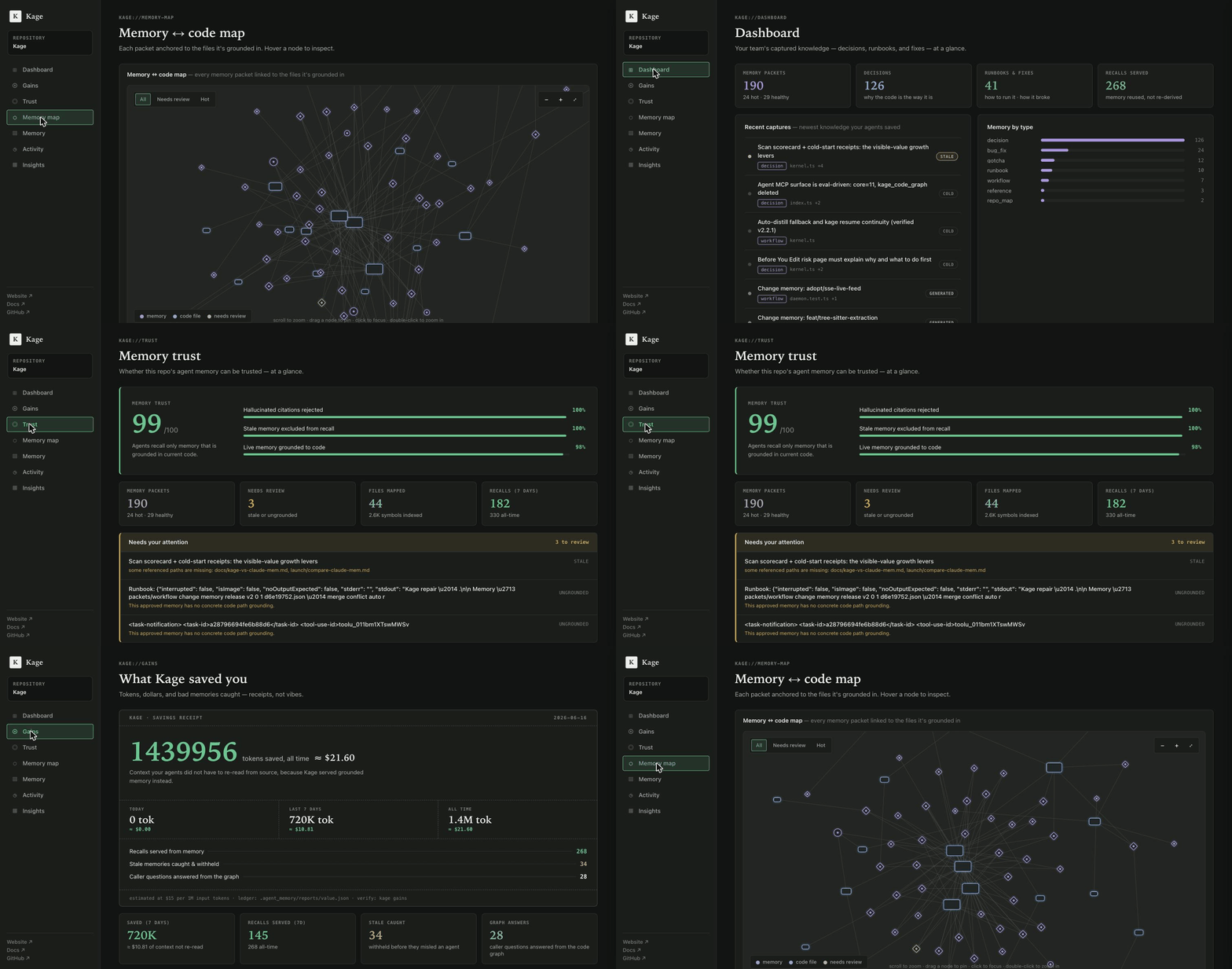
`kage viewer`: the memory engine underneath the orchestrator above — your team's decisions, runbooks, and bug fixes (purple), kept in the repo and linked to the code they are about (blue).
Why Kage
Most memory tools (claude-mem, agentmemory, mem0, Zep) store memory per-machine or in a cloud you don't own, and never re-check it against the code. Kage keeps it in your repo and verifies it, so it stays your team's and stays true as the code changes.
| Kage | claude-mem | mem0 / Zep | |
|---|---|---|---|
| Automatic capture + session-start recall | ✓ | ✓ | via SDK |
| Hallucinated citations rejected at write time | ✓ | — | — |
| Stale memory withheld at recall (cited files deleted/changed, TTL, reported) | ✓ | — | — |
| Diff-time stale-catch, warned before the PR when your change breaks a memory | ✓ | — | — |
| Memory reviewed in git, same PR as the code (plain files, no DB) | ✓ | SQLite + cloud | hosted API |
Codify memory into team SKILL.md files agents auto-load | ✓ (kage skills) | — | — |
| Cross-machine sync | ✓ your own git remote | their cloud | their cloud |
| Account / API key required | none | cloud optional | yes |
Features
- Truth Report.
kage scanreads any repo in ~60s and surfaces its highest-risk knowledge gaps: undocumented hot files, untested hot paths, complexity hotspots, unresolved code debt, and bus-factor-1 files, plus duplicate implementations, dead exports, and doc lies when they exist. Every finding cited tofile:line. Zero setup, nothing generated, runs before you install anything. - Savings receipts.
kage gainskeeps a per-repo value ledger (tokens + $ the agent didn't have to re-spend), every number traceable to a logged event; the agent relays it after each recall. - Team skills.
kage skillsturns durable, verified procedures into.claude/skills/<name>/SKILL.mdfiles agents auto-load, committed and shared, no cloud. - Personal memory & sync.
kage learn --personalkeeps cross-machine notes in~/.kage/memory, recalled as a clearly separated lower-trust section and synced over your own git remote. - Self-healing session loop. Uncaptured sessions are auto-distilled into pending drafts
you review;
kage resumeopens each session with a "previously…" digest;kage repairfixes broken packets and indexes in one command.
Benchmarks
- 18% faster than grep at equal correctness on real code-navigation tasks (N=3 suite,
same agent/model; reproduce with
kage benchmark --project . --compare). - LongMemEval-S retrieval: 98.72% R@10 / 99.79% R@20 / 0.909 MRR — ahead of plain BM25 at every depth except R@5, where BM25 edges it (96.60% vs 96.17%; full table in benchmarks/LONGMEMEVAL.md). The retrieval path itself is dependency-free: BM25 + sparse lexical scoring, no embeddings, no network.
- Memory Correctness Under Change: 0% stale-served (memory whose code was deleted or changed is withheld), vs 100% for capture-everything stores.
- Trust benchmark: 100/100, covering hallucination rejection, stale exclusion, and live
grounding (
kage benchmark --trust --project .).
Methodology, commands, and caveats: docs/BENCHMARKS.md.
Daily commands
Full CLI and MCP reference: docs. Delegating work to coding agents (dispatch → verified claim → merge): docs/DELEGATION.md.
Storage
Everything lives in .agent_memory/: packets/ is durable repo memory (git-tracked OKF Markdown);
graph/, code_graph/, structural/, and indexes/ are rebuildable with kage refresh;
reports/ holds the value ledger and health reports. Capture scans for secrets and PII
before writing.
Standard format — Open Knowledge Format (OKF). Kage's memory is an
OKF bundle:
plain Markdown concept files with YAML frontmatter, readable by any OKF consumer
(including Google's visualizer). Run kage okf migrate to render the store as an OKF
bundle under .agent_memory/okf/. Kage adds the lifecycle OKF leaves out — grounding,
verification, and freshness — carried in OKF-legal x-kage-* fields, and can import
any third-party OKF bundle. The round-trip is lossless. See OKF_STANDARD.md.
Development
Contributing & community
Kage is built in the open and we'd love your help. Four runtime dependencies (the retrieval core uses none), no account, no cloud — it's a friendly codebase to jump into.
- CONTRIBUTING.md — dev setup, project layout, conventions.
- ROADMAP.md — where Kage is headed, and where to plug in.
- Good first issues · Help wanted — scoped places to start.
- Discussions — questions, ideas, show-and-tell.
By participating you agree to our Code of Conduct.
License
GPL-3.0-only. See LICENSE. Releases before the GPL switch were MIT.