code-searchdeveloper-toolslanguage-servercode-navigationrefactoring
Local MCP server for token-capped code search, navigation, diagnostics, and symbol-level edits.
Quick Install
Automated & IDE SetupCopy the AI prompt to install this server into Claude Code, Cursor, or another agent — or use 1-click editor setup below.
One-click editor setup isn’t available for this listing yet — we don’t have a confirmed install command, and we’d rather show nothing than point your editor at the wrong package or host. Follow the project’s own setup instructions, linked above.
Manual Client & Custom JSON ConfigExpand JSON ▾
No confirmed setup config for this listing yet. We only publish a config block when the install details come from the project itself — its README, its docs, or a verified owner. We haven’t found those for JSungMin/vs-token-safer, and we’d rather show nothing than a guess you’d paste into your client. Follow the project’s own setup instructions for the current steps.
Overview
Use cases
Find symbol declarations and references across a codebase
Trace callers, callees, definitions, and implementations
Replace, insert, rename, or safely delete declarations by symbol name
Scan compiler and linter diagnostics with capped output
Rewrite grep-style searches into indexed queries
Key features
Language-server-backed semantic search
Tree-sitter fallback for additional languages
Token-capped file, line, and diagnostic results
Symbol-level read and edit operations
Concept search from repository identifiers and comments
Local dashboard and git diff blast-radius analysis
Capabilities & Tool Schemas (14)
Inspect callable tools, capabilities, and parameters exposed to AI agents by Vs Token Safer.
search_symbolFind a symbol declaration by name/substring (semantic, not text).
find_referencesEvery call site of a symbol. Takes the **name directly** (`symbol="FooBar"`) — the one to reach for when you change a function/type and must touch every use. `detail=file`/`dir` → a **blast-radius summary** (dependents grouped + ranked) instead of the per-line list. `direction=callers`/`callees` sw…
read_symbolReturn the **source of one named declaration** (its span) — not the whole file. The read-side twin of `replace_symbol_body`: skip Read-ing a 700-line file to see one function. `signatureOnly` trims to the head.
goto_definitionJump to the definition at a position. `kind=` also does `type_definition` / `implementation` (concrete impls of an interface/virtual) / `declaration`.
hoverType/signature at a position.
document_symbolsOutline a file (classes/functions/types as `file:line`). `scope=directory` → a **signatures-only repo skeleton** of every code file under a dir (the shape of a module without Reading each file).
Documentation Overview
vs-token-safer
English · 한국어
A token-saving code layer for Claude Code, for any codebase. TypeScript, JavaScript, and Python work with zero setup; C# and C++ add a language server; and 30+ more languages come in on the built-in tree-sitter tier. Proven up to a 26k-translation-unit Unreal Engine monorepo — so your web, backend, or data repo is the easy case.



Your coding agent has a small context window. Your repo is large. vs-token-safer sits in between.
Ask where something is, what calls it, or even "how does the auth flow work?" when the name escapes you — and instead of pasting a wall of source into the chat, it replies with a short
file:linelist.
- Builds normally? The answers are exact — it reads the same code index your editor relies on.
- No toolchain set up? It still locates your functions and classes.
- Forgot the name, only remember what it does? It finds it from the vocabulary your own code already uses — no AI model, nothing uploaded.
- Markdown or a config file? Jump straight to one section by its heading instead of opening the whole file.
A companion plugin does the same for giant editor and build logs. None of it leaves your machine.
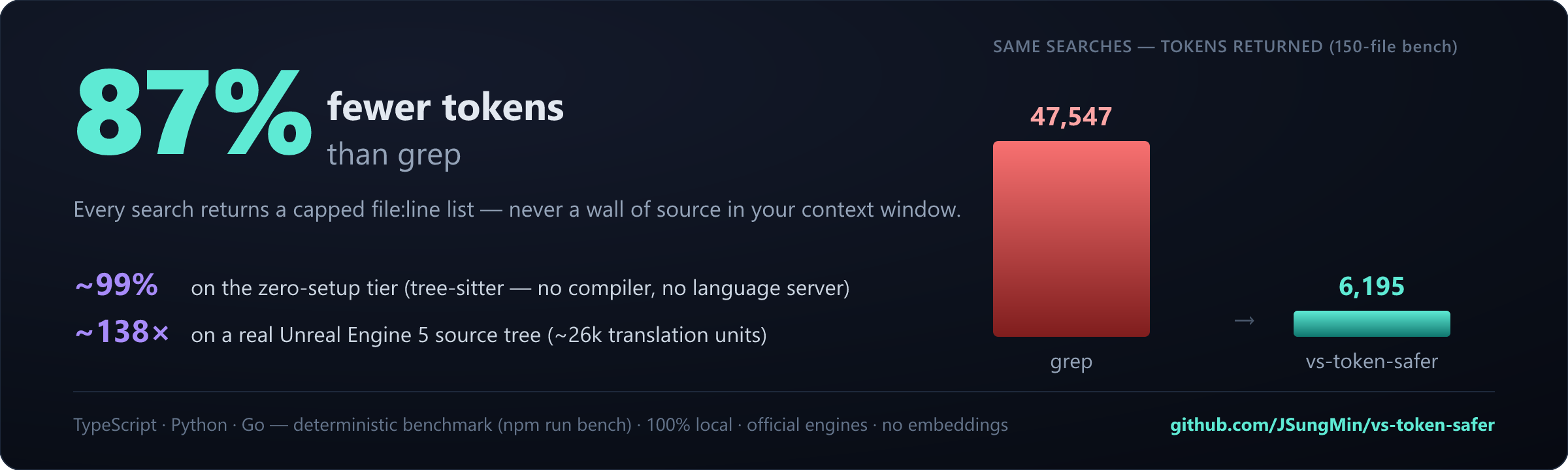
Same flow on TypeScript, Python, C#, C++, Go and more (clangd · Roslyn · tsserver · pyright · tree-sitter). VTS_REWRITE=0 blocks instead of rewriting.
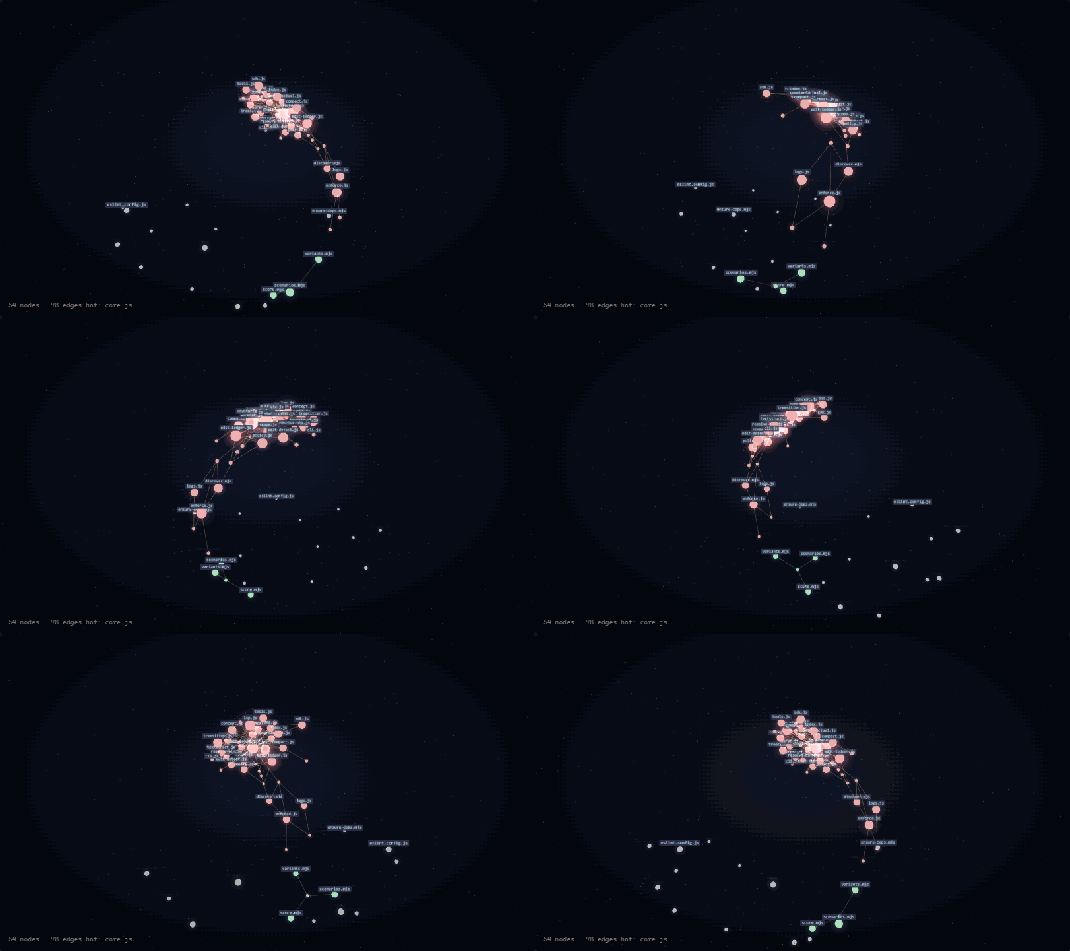
The built-in dashboard (vts serve) — your indexed repo as a live 3D graph, all on 127.0.0.1. Three modes: include graph (clangd), call graph (live LSP call hierarchy by symbol), and symbol graph — a tree-sitter map of files + import edges that needs no language server, so it renders on any of the 17 tree-sitter languages with zero setup.
Why
- Keep the context lean.
grepon a large repo — a TypeScript/Python monorepo, a C#/.NET solution, even a 26k-TU Unreal C++ tree — floods the context. The language-server index stays token-capped — ~97–99% smaller (benchmarks). - Claude keeps reaching for
grep. The hook doesn't just block it — it rewrites the command to the indexed query in place, so the search still runs and the flow never breaks. - Edit by symbol, not by line. Replace/insert-around/delete a declaration by naming it — the index supplies the span, so you skip reading the whole file into context.
- Review a diff by its blast radius, not by eye.
detect_changesmaps agit diffto the symbols it changed, walks each one's callers, and scores the risk LOW/MED/HIGH — from the blast radius, the caller-cascade depth, and which historically co-changed files this diff left out. A review starts from "what does this actually touch," capped tofile:line, nothing uploaded. It's the code-review-context idea done the vs-token-safer way: the official language server for the blast radius and your own git history for the coupling — no persistent graph database, no embeddings. - You can't tell how much grep still slips through.
vts discoverreads your recent sessions and reports exactly which searches bypassed the index and what they cost. - The language server runs headlessly — no editor open, unlike an IDE-proxy approach.
Quickstart
Then restart the Claude Code session (the vs-search MCP server only starts on a fresh session).
Verify the tools appear and that grep src/**/*.cpp is rerouted to the index. Prerequisites: Node ≥ 18
and a language server — clangd (C/C++) / Roslyn (C#) you install; JS/TS + Python auto-install. Details in
Prerequisites below.
Want only the log analyzer?
/plugin install gamedev-log-analyzer@vs-token-safer.
How it works
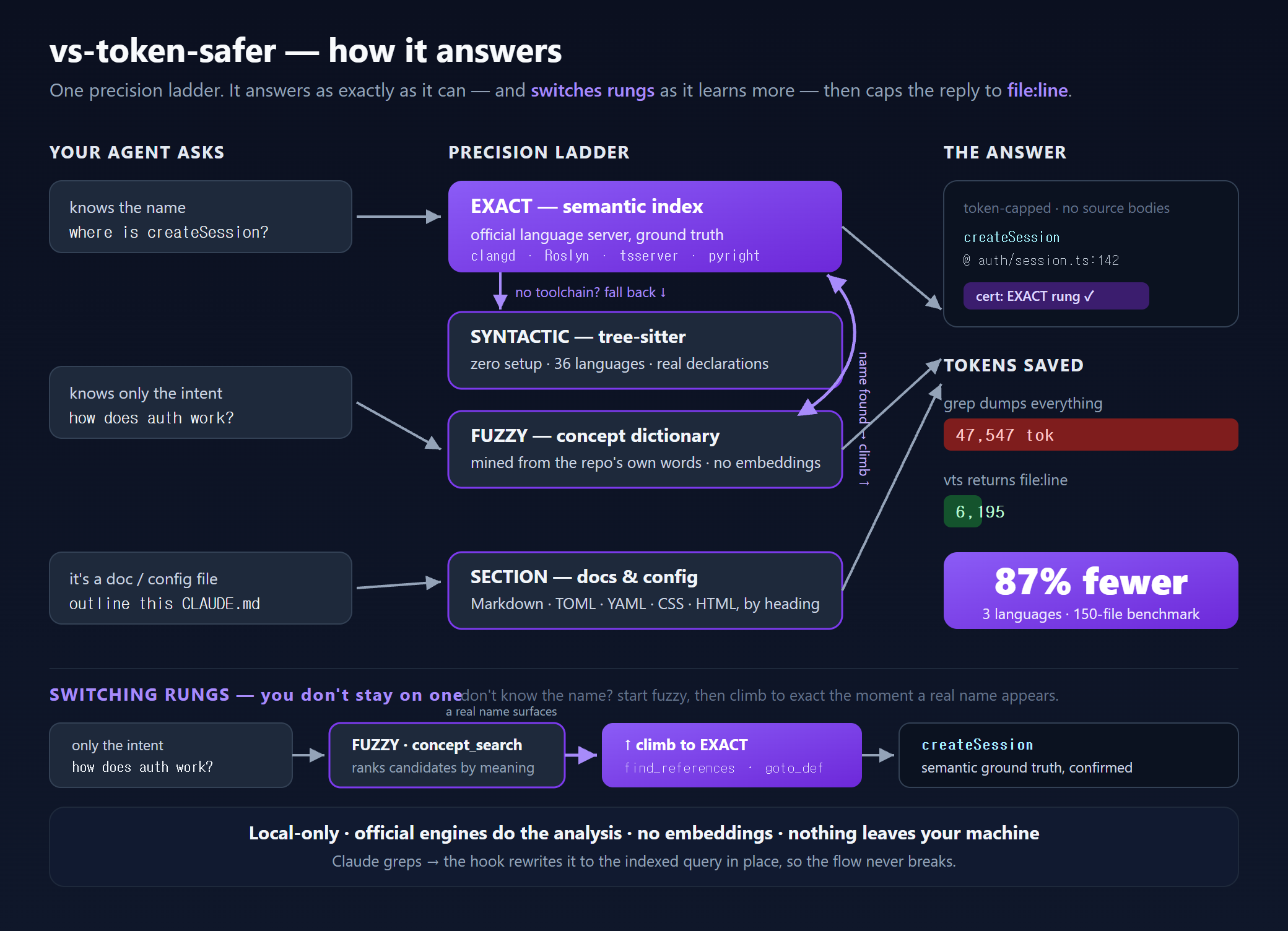
vs-token-safer isn't a search box — it's a precision ladder. You ask where something is, what calls it, or "how does the auth flow work?" when the name escapes you, and it answers at the highest precision it can reach, then tells you which rung the answer came from:
- EXACT — you know the name and the project builds → the official language server (clangd / Roslyn / tsserver / pyright), the semantic ground truth.
- SYNTACTIC — no toolchain set up → a tree-sitter parse (36 grammars bundled, no native build; 19 languages with tuned declaration extraction, the rest via a generic parse) still returns real declarations, not a grep.
- FUZZY — you only remember what the code does → a concept dictionary mined from the repo's own identifiers + comments (no AI model, nothing uploaded).
- SECTION — it's a doc or config, not code → Markdown / TOML / YAML / CSS / HTML addressed by heading.
The rungs aren't a one-time pick — they connect, and vts switches between them as it learns more. Start
on FUZZY when you only know the intent; the moment concept_search surfaces a real name, vts climbs to
EXACT to confirm it against the semantic index (and an exact search that misses drops back down to FUZZY).
The hooks steer that hand-off in both directions, so "I don't know the name" turns into a precise,
semantically-verified file:line instead of a dead end.
Graceful degradation — a locate never hard-errors on a cold or missing toolchain. When clangd is
missing, cold, or still indexing, a locate degrades to the SYNTACTIC (tree-sitter) tier with a one-line
advisory instead of erroring or blocking, then climbs to EXACT once clangd warms. If a committed
.vts-index has drifted from the source, the answer is still served but labeled SYNTACTIC · STALE (with a
climb: vts index hint). And on a cold locate over a large tree, vts auto-builds the .vts-index/ in the
background so the next query (or the same session, once the build finishes) is instant — you never wait on
it. So vts index below is best thought of as auto-built in the background; commit it to share, not a
manual step you have to remember.
Every answer comes back capped to file:line (never source bodies) and carries a one-line completeness
certificate naming the rung — so the model always knows whether it got the semantic truth or a fallback.
On a 3-language, 150-file benchmark that's 87% fewer tokens than grep (~138× on a real Unreal Engine 5
tree). Underneath, four mechanisms make Claude actually use the ladder instead of reaching for grep:
Related MCP Servers
Adoption & maintenance
Factual signals from GitHub, npm, and our automated checks — not a rating.
GitHub stars
11
Stargazers on the source repository.
Last commit
5d ago
Most recent push to the default branch.
Tools exposed
14
Callable tools this server registers over MCP.
Directory activity
1 views
Config copies, upvotes, and views on AllMCPs.
Reviews
No reviews yet — be the first to share how this listing worked for you.
Frequently Asked Questions about Vs Token Safer
AllMCPs Directory Badge
Showcase your server listing on GitHub or your project documentation. Embed this dynamic SVG badge to highlight official listing status and live engagement.
Badge Style:
Live Dynamic SVG Preview
Markdown (GitHub README)
[](https://allmcps.com/mcp/jsungmin-vs-token-safer)HTML Embed
<a href="https://allmcps.com/mcp/jsungmin-vs-token-safer"><img src="https://allmcps.com/api/badge/jsungmin-vs-token-safer?style=directory" alt="Vs Token Safer on AllMCPs" /></a>Technical Specs & Signals
CategoryFinance & Fintech
PricingFree
10/10 checks healthy over the last 33d
55Quality signal: Good · 55/100How this signal is calculated ▾
Server availabilityNot measured
Not scored for repo-hosted servers — we can't reach the running server, only its GitHub page. Hosted MCP endpoints are health-checked live.
Verified ownership10/20
Documentation & tools25/30
Adoption & activity6/15
Community engagement0/10
A guidance signal from public completeness & health data — not a user rating. New listings start lower and rise as they add docs, get verified, and grow adoption. Signals we can't observe for a listing are skipped, not counted against it.
Own this project?
This directory is pre-filled from public sources. Claim via GitHub README, site badge, or DNS TXT to unlock edit access and the Official badge — proof is checked automatically, then reviewed by our team.
Free dofollow backlink: add your website and place the AllMCPs badge on it — no claim needed. We detect it automatically and keep it verified as long as the badge stays live.
Claim & get free dofollowShare & Embed
Add our SVG badge (dark/light directory styles) or embeddable widget to your site.