Jobseek README
The full upstream README, mirrored here for reference. Install config, tool schemas, adoption signals, and an original overview live on the Jobseek listing page.
Job Seek
Open-source job search built from 5,300+ company career sites and ATS feeds.
Find roles soon after employers publish them, search them through one consistent schema, and track the applications that matter to you.
Try jseek.co → · Use the MCP server · Add a company · Run it yourself




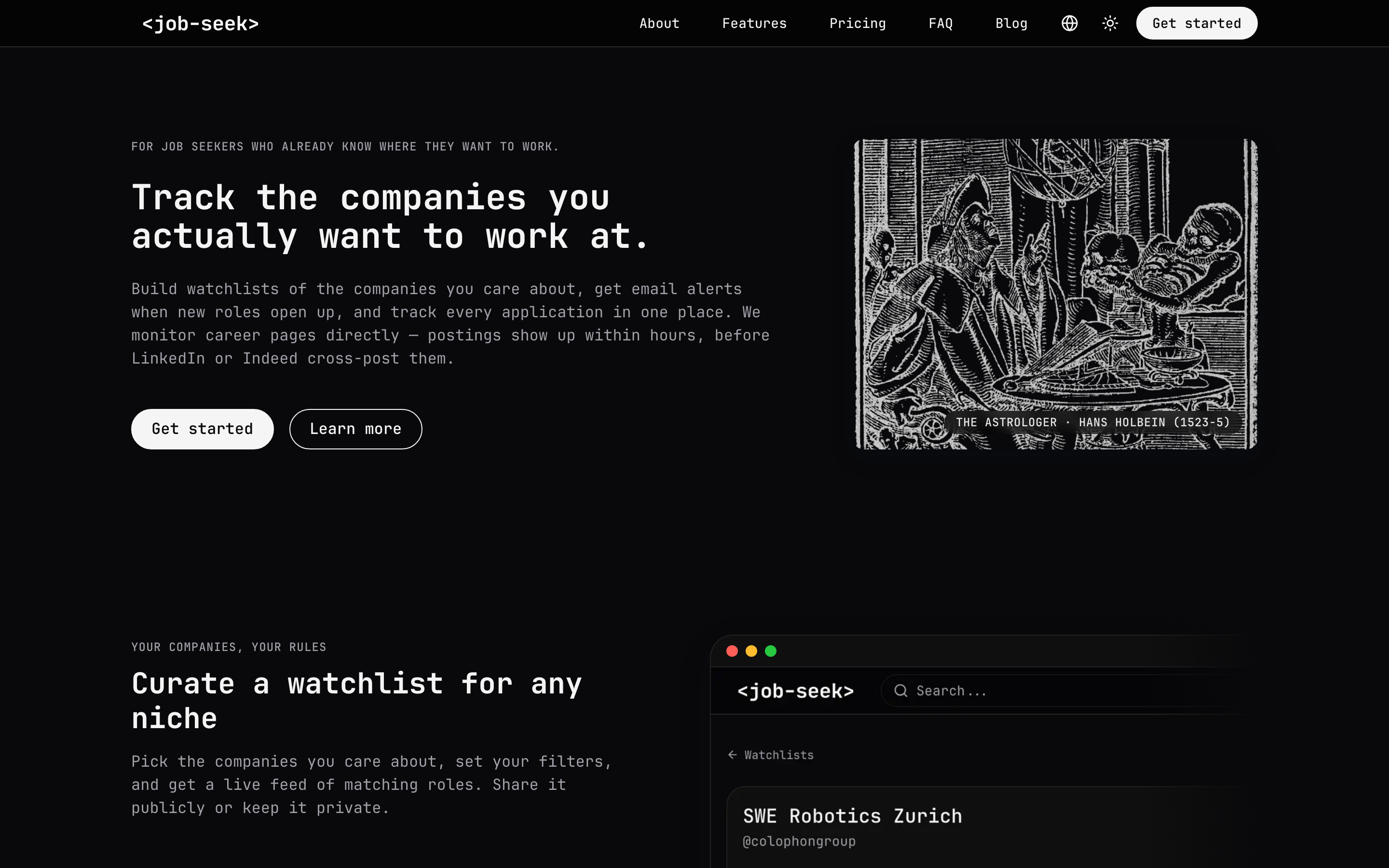
Tracking Stripe · Anthropic · OpenAI · Figma · Vercel · Datadog · Mistral · Hugging Face · Linear · Notion · Roche · Nestlé · UBS · Swisscom · ABB · SAP · Siemens · Klarna · N26 · Wise · Monzo — and thousands more. Browse the source-of-truth registry in companies.csv.
Why Job Seek
Job Seek is for people who already have a sense of where they want to work. Instead of starting with reposted listings, it monitors employer career sites and their applicant-tracking systems, then normalizes each source into one searchable model.
| Broad direct-source coverage | 5,300+ companies across 6,200+ configured career boards, primarily employer-hosted sites and ATS feeds, plus a small number of platform-hosted sources. |
| One search model | Typesense-backed keyword search and facets for occupation, seniority, technology, location, work mode, employment type, salary, experience, and posting language. |
| Source-URL identity | Postings are canonicalized and deduplicated by source URL, while every result links back to the original listing. |
| A complete job-search workspace | Public watchlists, saved roles, application stages, interview notes, and pipeline statistics live alongside search. |
| Open interfaces | Use the web app, the public REST API, or the hosted read-only MCP server from any compatible AI client. |
What you get on jseek.co
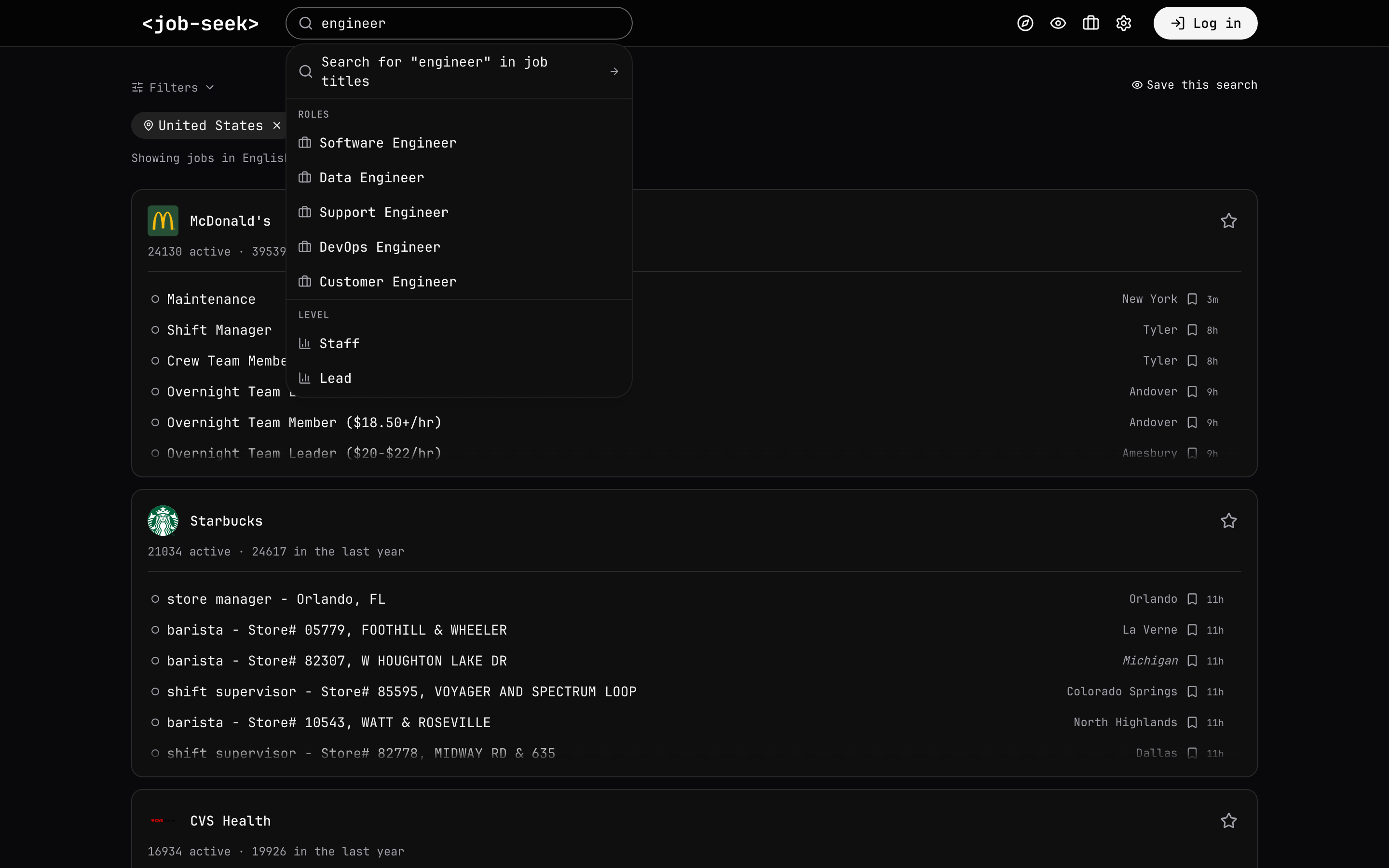 | Explore. Search postings across every tracked company and combine filters without creating an account. |
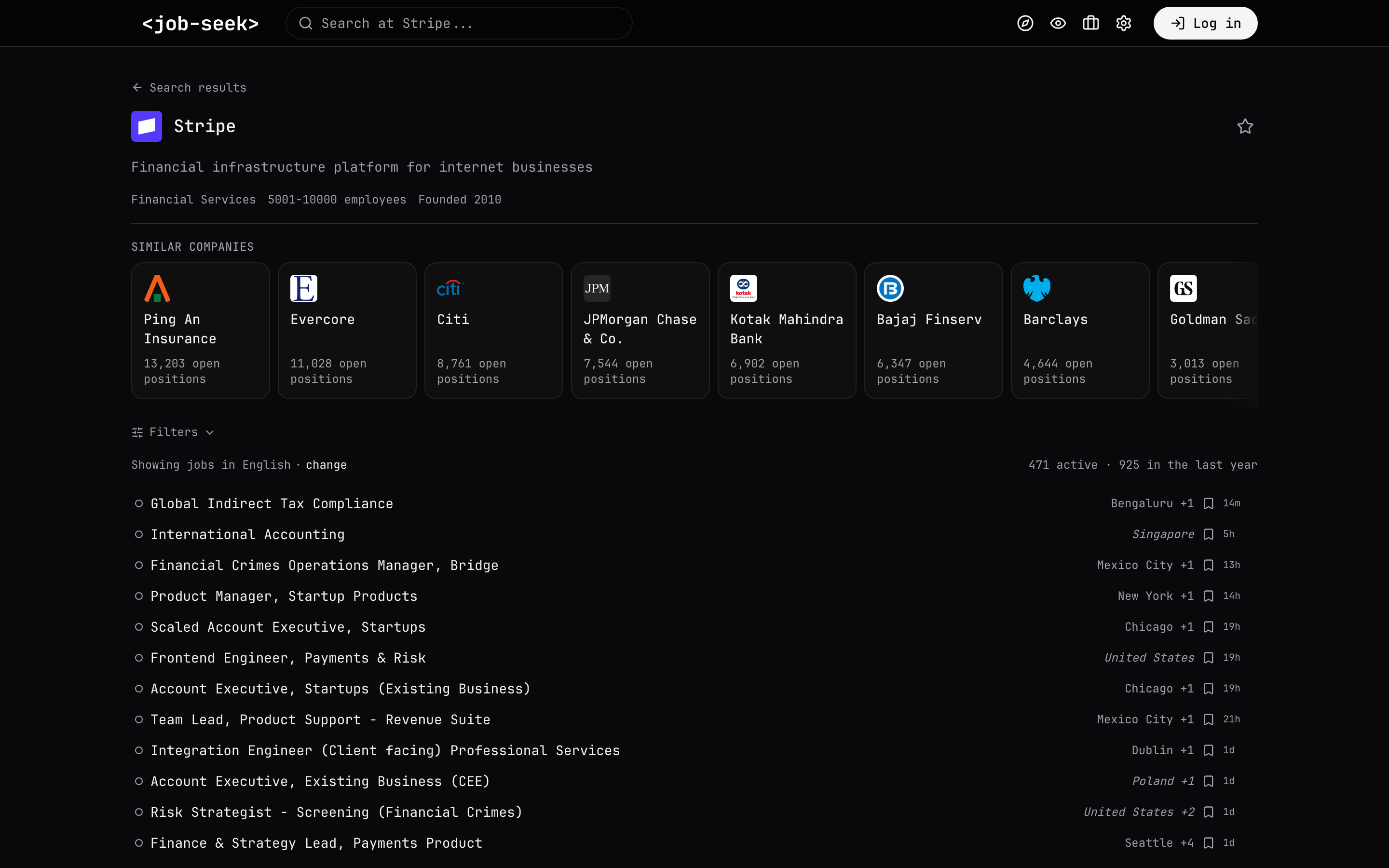 | Company pages. See active and last-year posting counts, filter within one company, explore similar employers, and open every role at its source. |
With a free account, you can create one watchlist and use the built-in application tracker to move roles through saved → applied → interviewing → offered/rejected, record interview rounds, and review pipeline statistics.
Pro is coming soon. The planned $10/month tier adds unlimited watchlists and email alerts for new matches.
Built by Colophon Group, a small team in Switzerland — so German, French, and Italian are first-class product languages, not afterthoughts.
Use Job Seek from AI tools and code
The hosted MCP endpoint exposes read-only tools for job search, posting details, companies, taxonomies, public watchlists, and prefilled watchlist links:
It uses Streamable HTTP and does not require authentication. Add the URL as a custom MCP connector, or run the published package locally:
See packages/mcp-server/README.md for client-specific setup and tool examples. For direct HTTP integrations, the public REST contract is available at /api/openapi.json.
Add a company
Open issues labelled company-request are companies waiting to be added. The production backlog is processed by an isolated, Hetzner-hosted Codex runner; contributors can resolve an issue with any capable coding agent that follows the repository instructions.
wsis an agent utility. It renders the workflow, manages isolated state, and enforces the validation gates; it is not intended as a hand-configured interactive wizard.
The environment needs git, an authenticated gh CLI, Python 3.13+, and web access. Install the workflow package:
Then give your coding agent this task:
Run
ws task --issue <NUMBER>and follow the printed instructions.
ws fetches the issue, checks for duplicates, researches the company and all relevant career boards, guides monitor and scraper selection, validates extracted data and brand assets, and opens the pull request. The registered crawler types cover common ATS APIs, sitemaps, structured data, rendered pages, PDFs, and vendor-specific formats.
No issue for the company you want? Request it. Anyone can.
The maintained workflow reference is docs/01-agent-workflow.md.
Architecture
Company and board CSVs are the configuration source of truth. The crawler keeps operational state in its own Postgres database, uses Redis for scheduling, publishes searchable documents to Typesense, and stores full descriptions in S3-compatible object storage. The web app owns authentication, watchlists, and application-tracker data in a separate Postgres boundary.
Start with the maintained documentation index, then read the system overview, crawler architecture, and Typesense reference.
Run it yourself
Job Seek is self-hostable, but the repository currently expects operator-managed services. The root docker-compose.yml is development scaffolding for Postgres and Typesense, not a complete one-command production deployment.
Prerequisites
- Python 3.13+ and
uv - Node.js 22+ and pnpm 10
- A crawler-owned Postgres database
- A separate web-owned Postgres database; both databases may run on the same server
- Redis
- Typesense
- S3-compatible object storage for job descriptions
The important environment boundaries are:
| Component | Core settings |
|---|---|
| Crawler database | LOCAL_DATABASE_URL |
| Web database | WEB_DATABASE_URL for crawler-side reads; DATABASE_URL for the web app |
| Redis | REDIS_URL |
| Typesense writes | TYPESENSE_HOST, TYPESENSE_PORT, TYPESENSE_PROTOCOL, TYPESENSE_OPERATIONS_KEY |
| Typesense web access | TYPESENSE_SEARCH_KEY, TYPESENSE_WRITE_KEY, and optionally TYPESENSE_BROWSER_PARENT_KEY |
| Description storage | R2_ENDPOINT_URL, R2_ACCESS_KEY_ID, R2_SECRET_ACCESS_KEY, R2_BUCKET, R2_DOMAIN_URL |
| Web authentication | BETTER_AUTH_SECRET, BETTER_AUTH_URL; OAuth and email providers are optional |
After provisioning those services, create apps/crawler/.env.local (using its .env.example as a starting point) and apps/web/.env.local, then initialize in this order:
A complete crawler deployment keeps four process roles running:
Start the frontend separately from apps/web:
Production operators should use scoped Typesense keys and read the deployment and recovery runbooks linked from docs/README.md.
What's in the repo
Development
Crawler checks, from apps/crawler:
Web checks, from apps/web:
Repository-wide contributor and agent instructions live in AGENTS.md. Crawler-specific commands and operational cautions live in apps/crawler/AGENTS.md.
License
- Code — MIT. Use, modify, and redistribute it without warranty.
- Job-posting data — CC BY-NC 4.0. Free for research and non-commercial reuse with attribution. It is not “open data” under the strict Open Knowledge Definition. For commercial licensing, contact business@colophon-group.org.