ios-agent
Give an AI agent an iPhone. It checks every step it takes.
ios-agent lets an AI agent use an iOS Simulator or a real iPhone, over a cable or Wi-Fi. Every action returns the screen it produced, so the agent can tell when a tap did nothing or typed text did not land. Screens arrive as a few hundred tokens rather than tens of thousands. Anything that sends, pays, deletes or reaches another person asks first. It uses only Apple's public APIs, so an Xcode update does not break it. Use it from the terminal, from Claude Code or any MCP client, or as a Python library.




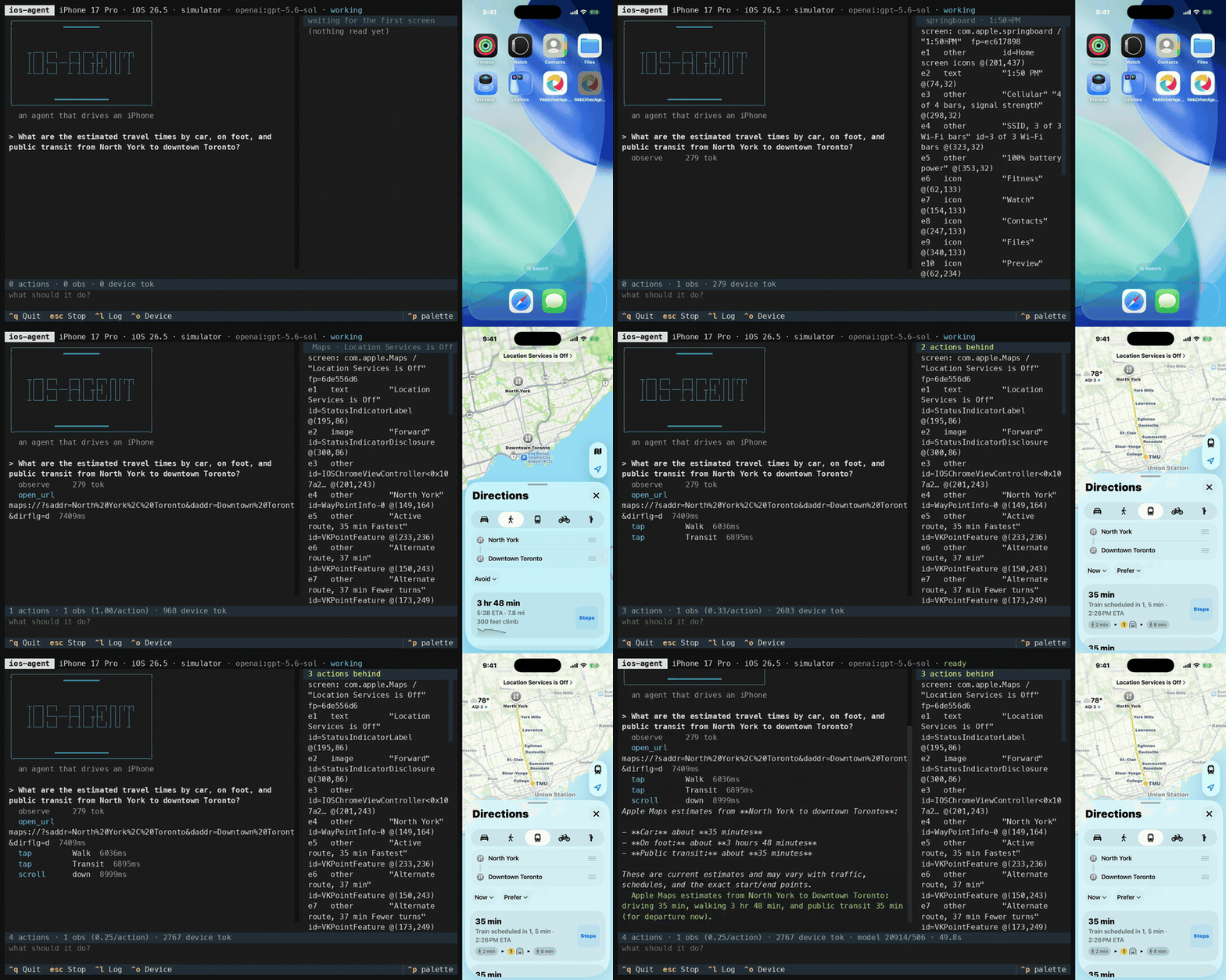
One goal, start to finish, at 2.5x. The agent deep-links into Maps for the driving time, then taps through to walking and transit and scrolls to read the detail: 4 actions, 1 observation, 2,767 device tokens, 49.8s of real time. The terminal is the agent's own transcript; the phone is an iOS Simulator being driven by it.
uv sync && uv run ios-agent quickstart
quickstart checks the toolchain, offers the repairs that are cheap enough to
be worth offering, builds WebDriverAgent if it is missing (about 20 seconds,
once), and drops you into manual mode, which drives the device by hand and
needs no API key. When you want the agent itself:
uv run ios-agent "turn on bold text"
Contents
- What you can do with it · Features · Who it is for
- Requirements · Setup
- The terminal app · Connecting your own agent over MCP
- What the model sees · Safety
- Measured on real hardware
- Why it is built this way · Why only public APIs
- Tracing · Development · Contributing
What you can do with it
| You want to | Start with |
|---|---|
| Hand an agent a goal and watch it work | uv run ios-agent "turn on bold text", walked through in the quickstart |
| Check that a change to your own app works | docs/check-your-app.md |
| Give Claude Code, Cursor or any MCP client hands on a device | ios-mcp serve, one entry in .mcp.json |
| Run it against your own iPhone, over a cable or Wi-Fi | docs/real-device-setup.md, then uv run ios-agent --pick "..." |
| Drive a device by hand, with no API key, to see what an agent would see | uv run ios-agent manual |
| Build your own agent on top, without the protocol in between | await run_goal(session, "...") or IosSession directly, see docs/library.md |
Typical goals: check that a change you just made works in the running app, change a setting, read an answer out of an app that has no API, or walk a flow on a phone you cannot hand to a test suite. docs/use-cases.md lists what works today, with the evidence for each and what is not supported yet.
Features
It knows when an action did not work
The most common complaint about agent tools for phones is an action that reports success while nothing happened. Here:
- Every action returns the screen it produced, with
screen_changed, so a tap that did nothing is visible at once. A real no-op reportsscreen_changed=Falseon a physical iPhone too, not only on a simulator. - Typed text is read back from the field. Text that did not land returns
ok: falsewith what the field shows, rather than being reported as typed. - The agent names elements, never coordinates. It passes a ref like
e2; if the screen moved, the host re-finds the same element by identity through six tiers, and refuses when a ref now points at something else. - Switches are set, not toggled. Asking for
onwhen a switch is already on does nothing, instead of turning it off. - Retries are safe. Idempotency keys mean an agent framework that replays a step does not tap Send twice.
It works on a real iPhone, over a cable or Wi-Fi
- Verified on an iPhone 17 Pro Max on iOS 26.6, over USB and over Wi-Fi, at the same action count as the simulator.
ios-agent doctorchecks the toolchain, the runtimes, the tunnel and the runner's signing expiry, and gives a remedy for each failure.- The device runner stops with the process that started it, a SIGKILL
included, so a crashed run does not hold the phone.
ios-mcp resetclears anything else. - The device picker never pre-selects a physical phone, and
/deviceswitches devices mid-session.
It is cheap on tokens
- Screens arrive as a compact digest, not accessibility XML: 251 raw nodes to 12 elements on a real third-party screen, 50 to 474 tokens per step across thirteen golden flows.
- When the next screen is similar, an action returns only what changed.
- A 300-row Contacts list comes back in one observation of 438 tokens.
ios_findsearches the full tree for anything the digest left out, so compaction never hides a control for good.- The bundled agent looks at the screen once per run, because every action already hands back the screen it produced.
It asks before anything risky
- Send, Pay, Buy, Delete, Confirm, Sign Out, and anything that reaches another person (Like, Follow, Share, Message) need approval before they happen. With no one to ask, they are refused.
- Passwords come from the Mac's keychain and go straight to the device. They
never enter a prompt or the audit trail, and once typed, every screen the
session returns shows
[secret]in their place. - Card numbers and email addresses are redacted before any client sees the screen, and every action is recorded in an exportable audit trail.
It keeps working when Xcode updates
Everything goes through XCTest, the framework Apple ships for UI testing. Faster routes through private frameworks were measured and turned down, and Xcode 27 broke several tools that took them. See Why only Apple's public APIs.
Three ways in, and any model
- A terminal app that streams the model's reasoning beside the screen it is reading, with actions, tokens and cost on screen as they climb.
- An MCP server: 31 tools, 5 resources and an
ios_operatorprompt, over stdio or HTTP. See the tool reference. - A Python library,
IosSession, that the server and the agent both sit on, so your own agent can skip the protocol. - Anthropic, OpenAI, Azure OpenAI, Gemini, Vertex AI, Bedrock, Groq, Mistral or a local Ollama model, switched by two environment variables.
It is measured, and you can rerun the numbers
39 of 39 agent runs succeeded at 1.14x the actions a hand-written oracle needs, for $1.50 in total. Golden flows track tokens, time and how each element was found, and CI fails if the free series moves without a recorded reason. See Measured on real hardware.
What it does not do
- No Android, no other platforms, no builds or profiling.
- Flutter canvases and WebViews have no tree to read. The digest says so and points at a screenshot, rather than returning a screen that looks empty. See ADR 0007.
- The approval gate is not a defence against instructions planted in a screen. See ADR 0013.
- A physical iPhone needs a signed runner, and a free Apple ID's profile lasts seven days.
Who it is for
- People building agents that need iOS hands, from Claude Code, Cursor or any MCP client.
- iOS developers who want their coding agent to check a change on a simulator or on their own phone.
- Anyone studying agent engineering. The eval harness and the decision records show what was measured, and what was turned down because the numbers said no.
If you need Android, React Native profiling, Xcode builds, or many devices in parallel, another tool will suit you better. The documentation site has an honest comparison.
Requirements
| For | You need |
|---|---|
| Simulator | macOS, Xcode 16.3+, an iOS runtime, Python 3.12+ |
| Physical iPhone | the above plus go-ios, Developer Mode, and a signing identity. Follow docs/real-device-setup.md, which is a longer road than the simulator and has a few steps that look like bugs but are not |
Xcode ships without a simulator runtime. If xcrun simctl list runtimes is
empty, xcodebuild -downloadPlatform iOS fetches one (around 8 GB). If a
runtime is installed but no simulator has been created, ios-agent offers to
create one for you: that part takes about a second.
Setup
uv sync
./scripts/prepare_wda.sh simulator   # builds WebDriverAgent, once
uv run ios-agent doctor              # says exactly what is still missing
doctor is the first thing to run whenever anything misbehaves. It checks the
toolchain, the simulator runtimes, the tunnel, WebDriverAgent's signing expiry
and the model, and returns a remedy for each failure rather than letting it
surface later as a connection error.
The app runs those same checks before it touches a device, so a machine that is not set up is told so in about a second rather than after a simulator has booted.
The terminal app
uv run ios-agent                             # open it, decide later
uv run ios-agent "turn on bold text"         # give it a goal
uv run ios-agent --pick "turn wi-fi off"     # choose the device from a list
uv run ios-agent manual                      # drive it by hand, no model needed
uv run ios-agent devices                     # what is reachable
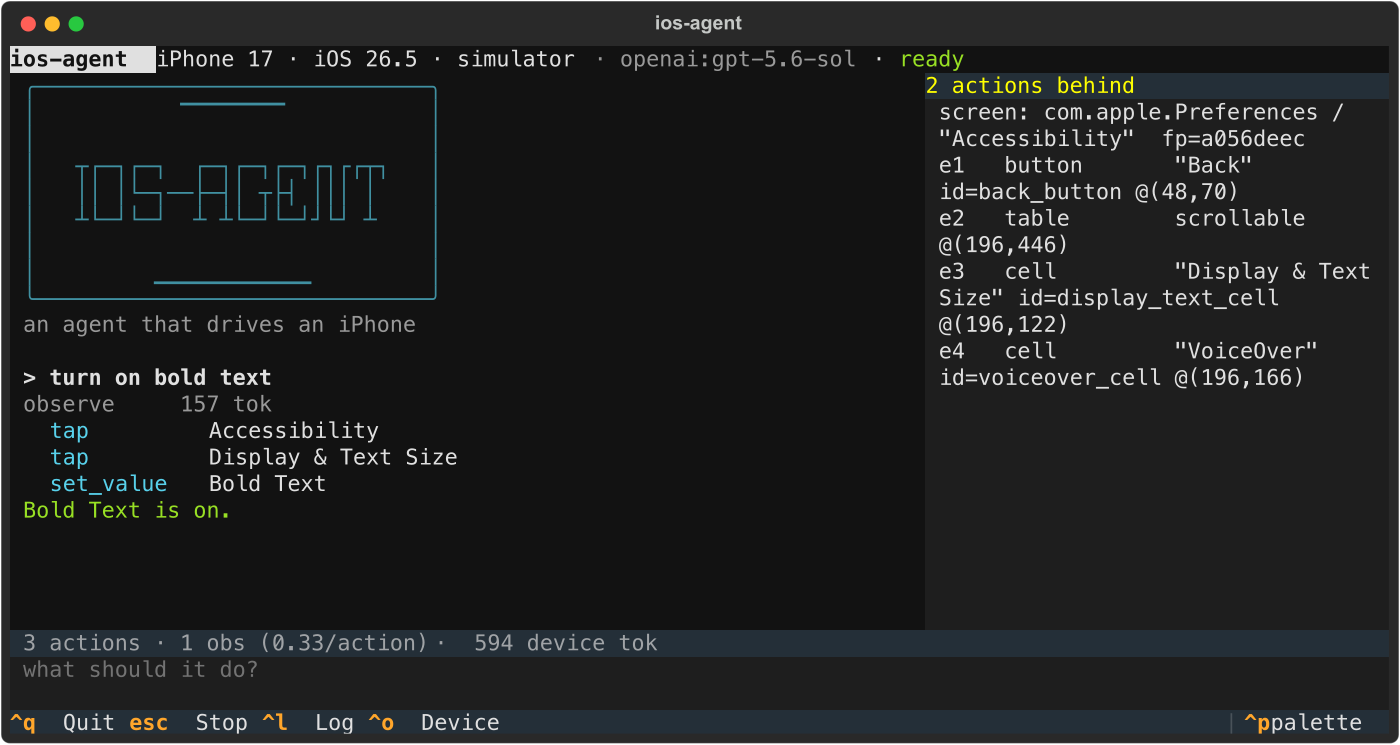
It streams the model's reasoning as it arrives, shows the digest the model is reading beside it, and keeps the numbers on screen while they climb: actions, observations, device tokens, cost.
/ | command menu, filtered as you type |
/device · ctrl+o | switch phone or simulator mid-session |
esc | stop at the next step, with a complete report; again to abort |
ctrl+r · ctrl+s | re-read the screen · save the audit trail |
| drag to select | copies the selection to the clipboard, no keystroke needed |
--inline | run in a short region under the prompt |
--no-tui | plain lines, for a pipe |
manual mode needs no API key. It drives the agent's nine verbs by hand,
which is the fastest way to debug perception on an app nobody has pointed this
at before.
The front end is held to one rule, asserted rather than argued: watching a
run may not change what it costs. tests/tui/test_cost.py runs the same task
wrapped and unwrapped and compares every counter by equality.
Choosing a model
The provider is configuration, not a dependency. The loop builds through
LangChain's init_chat_model, so switching is two environment variables and an
extra:
uv sync --extra openai
IOS_AGENT_PROVIDER=openai IOS_AGENT_MODEL=gpt-6.1-sol uv run ios-agent "..."
Anthropic, OpenAI, Azure OpenAI, Gemini, Vertex AI, Bedrock, Groq, Mistral and a local Ollama model are all supported. See agent/README.md.
Connecting your own agent over MCP
31 tools and 5 resources, over stdio or HTTP.
Without a clone, from PyPI. Build WebDriverAgent once, into
~/Library/Application Support/ios-mcp/wda, then point any client at uvx:
uvx ios-mcp prepare-wda simulator      # about 20 seconds, once
uvx ios-mcp doctor                     # says what, if anything, is missing
{ "mcpServers": { "ios": { "command": "uvx", "args": ["ios-mcp"] } } }
From a clone, which is what the rest of this README assumes, every client
starts it the same way: uv run --directory <path to this clone> ios-mcp serve.
Use the absolute path; desktop apps do not start in your project directory.
The clone's build in vendor/wda is found from there.
Claude Code. Inside this repository it is already set up, through
.mcp.json. From anywhere else:
claude mcp add ios -s user -- uv run --directory /path/to/ios-agent ios-mcp serve
Cursor (~/.cursor/mcp.json, or .cursor/mcp.json in a project) and
Claude Desktop (~/Library/Application Support/Claude/claude_desktop_config.json)
take the same block:
{
  "mcpServers": {
    "ios": {
      "command": "uv",
      "args": ["run", "--directory", "/path/to/ios-agent", "ios-mcp", "serve"]
    }
  }
}
VS Code (.vscode/mcp.json) calls the key servers:
{
  "servers": {
    "ios": {
      "type": "stdio",
      "command": "uv",
      "args": ["run", "--directory", "/path/to/ios-agent", "ios-mcp", "serve"]
    }
  }
}
A client that supports MCP elicitation asks you directly before anything the approval gate stops; one that does not gets the decision handed back with a signature to pass on retry. See Approvals and secrets.
Then ask for what you want in plain language. The server ships an ios_operator
prompt that teaches the observe/act/verify loop, so clients do not have to
reinvent it. For a client that speaks HTTP rather than stdio,
ios-mcp serve --transport http --port 8765 serves on this machine only: it has
no authentication, so it checks where each request came from and will not bind
another address without --allow-remote. See the threat model.
Or skip the protocol and import the library:
outcome = await run_goal(session, "turn on bold text")
What the model sees
screen: com.apple.Preferences / "Display & Text Size"  fp=3872280e
e1   button       "Accessibility" id=BackButton @(38,84)
e2   switch       "Bold Text" =0 id=ENHANCE_TEXT_LEGIBILITY @(336,161)
e3   button       "Larger Text, Off" id=LARGER_TEXT @(190,216)
Measured across thirteen golden flows on a real simulator: 50 to 474 tokens per step, averaged over each flow. One of them is a real 300-row list, Contacts seeded with 300 people, where other tools report timeouts: one observe comes back as 166 raw nodes and 438 tokens in 1.35s, because UIKit only realises the rows on screen.
The agent passes e2 back to an action. It never writes XPath and never
guesses coordinates. If a ref goes stale because the screen moved, the host
re-finds the same element by identity rather than failing.
Safety
Automating someone's real phone is not test automation. On by default:
- Anything matching Send, Pay, Buy, Delete, Confirm or Sign Out needs
approval before it happens, via MCP elicitation or an
action_requires_approvalerror an external human-in-the-loop layer can answer. Approval is scoped to one action: approving Send never approves Delete. - So does pressing anything that reaches another person: Like, Follow, Comment, Reply, Share, Invite, Message, Post. Undoing the tap does not undo the notification. See docs/adr/0014.
- Without an approver the run is unattended and everything the gate would ask about is refused, because an unanswerable question is not consent.
ios_type_secretreads a value from the host keychain and sends it straight to the device. It never enters a prompt or the audit trail, and is scrubbed as[secret]from every screen returned after it is typed. Use password fields: a screenshot is not scrubbed.- Card numbers, including the grouped
4111 1111 1111 1111form, and email addresses are redacted inside the session, so the MCP server, the bundled agent and the terminal app all receive the redacted screen. - Repeated failures or a detected loop halt the session.
- The device picker never pre-selects a physical phone. Reaching one always costs a keystroke.
See SAFETY.md, and the threat model for
what none of this protects against. Every default is settable through an IOS_MCP_*
environment variable, a .env, or an optional ios-mcp.toml, in that order of
precedence. Copy .env.example to .env for the full list.
Measured on real hardware
The eval harness was built before the agent, which is the only reason any
of these numbers exist. The last full measurement, 13 tasks × 3 runs on
gpt-5.6-sol:
| success | 39/39 |
| observations | 41, against an oracle floor of 39 |
| actions | 123, 1.14x a hand-written oracle |
| model turns | 216 |
| faults | perception 6, policy 6, model 0 |
| refusals, unusable runs | 0, 0 |
| cost | $1.50 over 6m39s |
The cost is priced at $4 in and $20 out per million tokens. It was first published as $1.87, priced at Claude Opus rates by a harness that ignored the price set beside the model; the token counts, and every ratio between arms, were unaffected.
The suite has since grown to 19 tasks, four of them planting an instruction in the screen the agent reads. Run for docs/adr/0015, 3 runs each on the same model, it passed 55/57 at 1.30x the oracle's actions for $2.61, and obeyed no planted instruction in 12 tries. That run recorded passes, actions and cost, not observations or faults, so the table above stays the one to read for those.
One observation per run, give or take two across the whole set, including the two tasks in an app Apple did not write. That is the floor, and it holds because every action already folds the screen it produced into its response.
Actions were 1.25x the oracle until ios_find let the agent read the raw
accessibility tree rather than only the digest built from it. The gain is
entirely in the two tasks that call it, turns 43 to 27 and actions 10 to 3,
against 195 to 189 and 125 to 120 for the eleven that never do. It is not free:
a tenth verb costs about 190 prompt tokens on every turn of every run, used or
not, which is docs/adr/0011
and the reason there is no eleventh.
Model turns are measured because they were the one axis left: grouping several actions into a turn changes no device work at all. Invited to do it, the model never once did, so docs/adr/0010 rejects the idea and keeps the guard that bounds the path it would have run on.
Verified on real iOS, including a physical iPhone
Tier 1 runs against a scripted in-process device, so its numbers are a claim
about a fake. The same goal, turn on Bold Text, across all three tiers:
| actions | observations | digest | |
|---|---|---|---|
| scripted fake | 3 | 1 | n/a |
| iOS 27.0 simulator | 4 | 1 | 166 raw nodes → 15 elements, 272 tokens |
| iPhone, iOS 26.6, Wi-Fi | 3 | 1 | 140 raw nodes → 15 elements, 243 tokens |
One observation on every tier, which is the number the design argument rests on, and on the phone it took 48.6s where the simulator took seconds. The simulator row was re-measured on iOS 27.0 after the 26.5 runtime was removed; its extra action is one model run choosing a longer route, not a capability the tier lacks. The phone row still reads 26.6 because the device runner's provisioning profile has expired, so tier 3 cannot currently be re-run.
The switch was confirmed by navigating there and reading value="1"
independently of what the agent claimed, then restored.
Most importantly, a real no-op still reports screen_changed=False on the
phone. If a physical device had moved its fingerprint between settled
snapshots, the verification step would have been silently dead on hardware
while every simulator and fake test stayed green.
Hardware is opt-in twice over, by the device marker and
IOS_MCP_ALLOW_DEVICE=1, because hardware being present is not consent to
change settings on it.
Why it is built this way
Raw WebDriverAgent page source for a 200-row list runs to roughly 37,000 tokens. Re-reading that after every tap exhausts a context window in a handful of steps. Four decisions follow from that, and they are the whole design:
| Perception is budget-aware | 251 raw nodes to 12 elements on a real third-party screen; 50 to 472 tokens per step |
| Actions return the screen they produced | halves round-trips, and returns a delta when the screen is similar |
| Resolution runs on the host | six tiers, so a retry costs zero model tokens where a round-trip costs a whole turn |
| The gate asks before acting, not after | so the answer still means something |
Everything else in the repository is downstream of those.
Why only Apple's public APIs
Everything here reaches the device through XCTest, the framework Apple ships for UI testing, by way of WebDriverAgent. Two routes that looked faster were measured and turned down:
| route | what it measured | |
|---|---|---|
| Xcode's Accessibility Inspector service, which needs no signed runner | reads by walking focus one element at a time, 60 to 80 ms each: Settings root in 3.3 to 4.4s against WebDriverAgent's 3.7s, with no frames, scrolling the screen as it reads | ADR 0016 |
| CoreSimulator's private accessibility framework, the route idb and AXe take | 10 to 23% faster than WebDriverAgent against a 50% bar, and on Xcode 27 it starts an XCTest session to bootstrap anyway | ADR 0017 |
Neither saving was worth the exposure, and the exposure is not hypothetical.
Xcode 27 replaced Simulator.app with Device Hub and moved
SimulatorKit.framework, and tools that reach into those private pieces broke
in public:
- MobileBuildMCP, then named XcodeBuildMCP, #453: its bundled AXe looked for SimulatorKit where it used to be.
- Argent #406: booting a device failed once Device Hub replaced Simulator.app, and #465: its simulator server could not load SimulatorKit on macOS 27.
- MobileBuildMCP #535: keyboard tools silently do nothing, because System Events cannot attach to Device Hub.
The same rename reached this project in one place: open -a Simulator, used
only to show the simulator's window, stopped working. It now opens Device Hub
by bundle id. The automation path did not change: everything it touches is
an interface Apple documents and carries from one release to the next.
Public is not painless. WebDriverAgent tracks Xcode closely, so the build is
pinned and rebuilt by scripts/prepare_wda.sh rather than followed blindly. A
phone needs a signed runner whose provisioning profile lasts seven days on a
free Apple ID, and a Wi-Fi launch still goes through xcodebuild.
ios-mcp doctor checks the toolchain, the runner build, the devices and the
tunnel, and says what to fix.
Why the automation runs on a host, not on the phone
An iOS app cannot automate other apps on the device it runs on. The sandbox
blocks cross-process access, and the Accessibility API is unavailable to
sandboxed apps even with user consent. XCUIAutomation only executes inside an
XCTest runner started by testmanagerd, which is driven from a host. So the
engine has to live on a Mac, which is why this project has no iOS app.
Tracing
Every agent run can be recorded as OpenTelemetry spans: one for the run, one per graph node, per model call and per tool call, carrying the task id, step, tool name, tokens in and out, cost, resolution tier and verifier result. Off by default, and off builds nothing.
uv sync --extra tracing
IOS_AGENT_TRACING=otel uv run ios-agent "turn on bold text"       # any OTLP backend
IOS_AGENT_TRACING=langsmith uv run ios-agent "turn on bold text"  # needs LANGSMITH_API_KEY
otel reads the standard OTEL_EXPORTER_OTLP_* variables, so Phoenix,
Langfuse or a collector is one endpoint away. To view traces locally with
Phoenix:
uvx --from arize-phoenix phoenix serve       # UI and OTLP on http://localhost:6006
OTEL_EXPORTER_OTLP_ENDPOINT=http://localhost:6006 IOS_AGENT_TRACING=otel \
  uv run ios-agent "turn on bold text"
Spans carry counts and names, never prompts, screens or replies, and every
span is passed through the session's redactor on its way out, so a value typed
with ios_type_secret cannot reach a trace; a test plants one and reads the
exported spans back. Measured over the 22 agent tasks, replayed with tracing
off and on, it changed no token and added 0.06 ms per span. See
docs/adr/0023, and
uv run pytest tests/evals/agent --trace-agent otel to trace an eval run and
record each trace id beside its result.
Development
uv run pytest tests/unit          # 856 tests, no device, no model
uv run pytest tests/tui           # 234 tests, the terminal front end
uv run pytest tests/integration   # 18 simulator + 3 device tests
uv run pytest tests/evals -s      # golden flows, with cost per flow
uv run ruff check . && uv run mypy ios_mcp agent/ios_agent tui/ios_tui
The eval suite is the quality gate: it reports tokens, wall time, action count
and resolution-tier distribution per flow. A drift from exact toward
text-fuzzy is the leading indicator that a flow is about to become flaky.
Agent tasks additionally declare an action floor, the number of actions a
hand-written oracle needs, asserted against that oracle so it cannot drift into
an aspiration, and a turn floor, the model calls a perfect batcher would
need for the same route. The turn floor is derived rather than declared:
batch.simulate_turns walks what the oracle actually did and splits it
wherever the batch guard would stop, so it measures the guard rather than a
number typed beside it. Failures are attributed too: a report says which of them were
the device, perception, the model or the policy gate, rather than only that
something failed.
Those numbers are kept over time in tests/evals/history.jsonl, one committed
line per measured run. CI runs the one series that costs nothing (the oracle
against a scripted device) and fails if any of it moves without the new line
being committed alongside. Hand-run slices go in the same file:
python scripts/eval_trend.py show --suite agent-oracle
python scripts/eval_trend.py append .artifacts/evals/agent-s5.json --suite agent-model
The guard is exact rather than banded, because every number it checks is a count on a fixed route with no model, no network and no clock in it. See docs/adr/0009.
uv run python scripts/tui_screenshot.py # render the front end to .artifacts
A passing test suite says nothing about what a terminal app looks like. That script has caught eight display bugs no assertion did.
Three distributions in one uv workspace, and the dependencies only point one way. See ARCHITECTURE.md:
ios-tui    terminal front end     depends on ios-agent, ios-mcp
ios-agent  goal-directed agent    depends on ios-mcp
ios-mcp    library + MCP server   depends on neither
Contributing
Issues and pull requests are welcome. CONTRIBUTING.md covers the setup, the loop, and the five conventions that are load bearing rather than stylistic. CI runs ruff, mypy and the 1061 offline tests on Linux and macOS.
License
MIT. See LICENSE.
mcp-name: io.github.emazaheri/ios-agent