@interstellar-tools


TypeScript monorepo for open, reliable building blocks in orbital mechanics and space software. Equations, constants, time utilities, and strong types for simulation, visualization, mission tooling, and teaching.
📖 Documentation: phun-ky.net/interstellar-tools
- Documentation
- Install
- Quickstart
- Use with AI assistants
- Status
- Why this exists
- Packages
- Who is this for?
- Design principles
- Vision & scope
- Governance & values
- Local development
- Contributing
- License
- Sponsor me
Documentation
Guides, conventions and a full API reference with the formulas behind every function are published at phun-ky.net/interstellar-tools:
- Getting started: install, unit conventions and recommended practices
- Usage guides: worked examples, such as manoeuvre planning
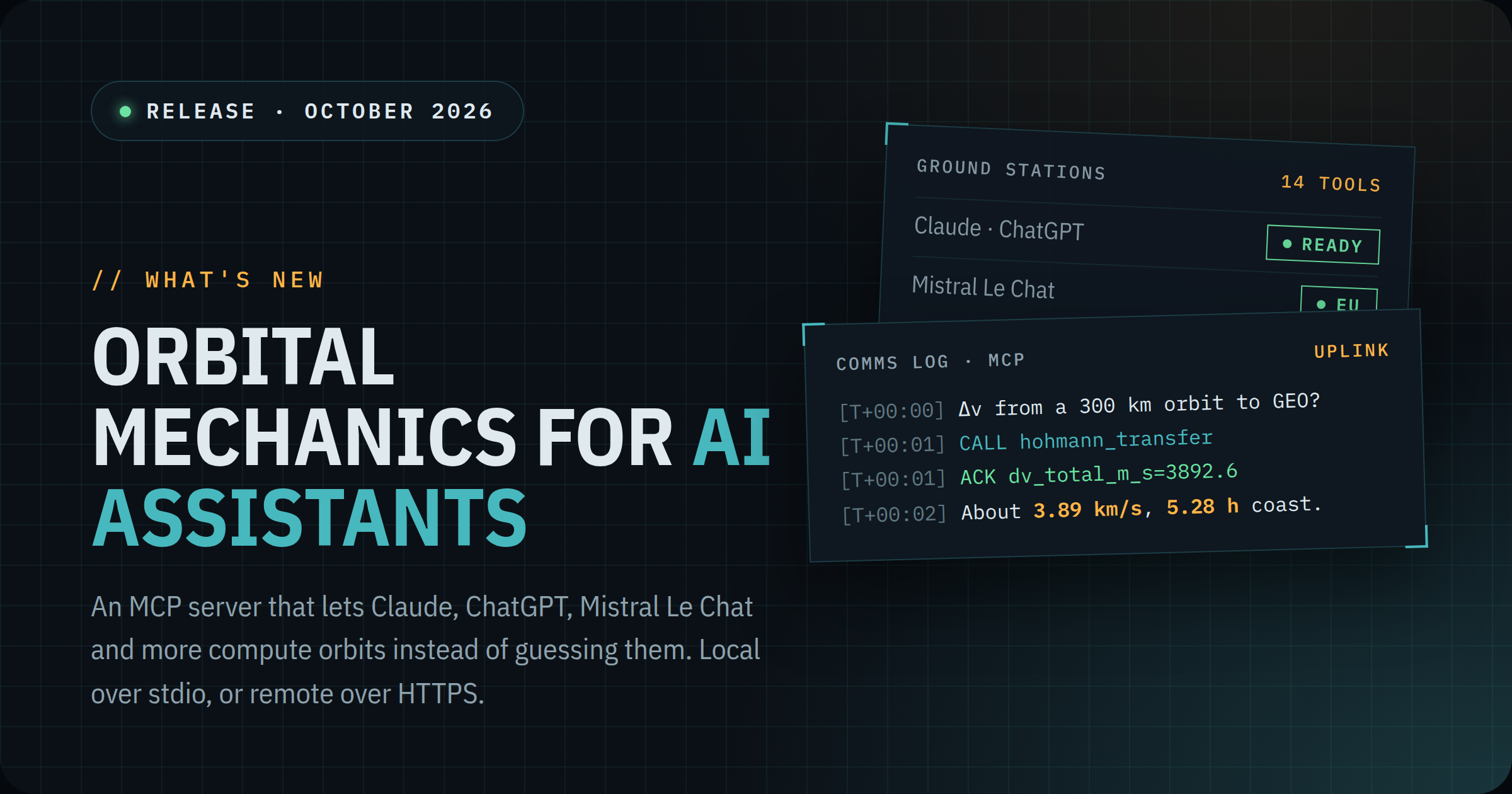
- Using the MCP server: connect the toolkit to Claude, ChatGPT, Mistral Le Chat, Gemini, GitHub Copilot and more
- API reference: every package, every export
Install
npm install @interstellar-tools/equations @interstellar-tools/constants
# or
pnpm add @interstellar-tools/equations @interstellar-tools/constants
# or
yarn add @interstellar-tools/equations @interstellar-tools/constants
Quickstart
import {
  gravitationalParameter,
  visVivaSpeed
} from '@interstellar-tools/equations';

const muEarth = gravitationalParameter(5.972e24); // [m^3 / s^2]
const semiMajorAxis = 7000e3; // [m]
const radius = 7000e3; // circular [m]
const velocity = visVivaSpeed(radius, semiMajorAxis, muEarth); // [m/s]

console.log(`Orbital speed: ${velocity} m/s`); // ≈ 7545.9 m/s
Use with AI assistants
@interstellar-tools/mcp is a
Model Context Protocol server that gives AI
assistants these equations as tools, so they compute orbital mechanics instead
of guessing at it:
claude mcp add interstellar-tools -- npx -y @interstellar-tools/mcp
See Using the MCP server for setup in Claude, ChatGPT, Mistral Le Chat, Gemini, GitHub Copilot, Cursor, JetBrains and others.
Status
Project status: Stable (1.0)
- API surface: stable. Breaking changes only come in a major release, and deprecated APIs keep working for one full major; see how versions work.
- Validation: unit tests in place; not yet cross-validated against flight-grade references.
- Runtime targets: Node 22.9+, modern browsers with ESM bundlers (Vite, Webpack, etc.).
Why this exists
We're entering a new era where space is becoming a mainstream software domain: conference programs increasingly feature space + IT topics, and teams across science, education, and industry need trustworthy, well-typed primitives. @interstellar-tools is an open-source, TypeScript-first toolkit created to accelerate that shift: precise functions, clear docs, and strong types that make orbital and mission software easier to build and easier to verify.
I built @interstellar-tools to help catalyse the space+software wave I'm seeing in our industry-by doing the thing I do best: shipping precise, well-documented building blocks. If that resonates with you, I'd love your feedback and contributions.
— Alexander Vassbotn Røyne-Helgesen
Packages
| Package | Description | Status |
|---|---|---|
@interstellar-tools/constants | Physical & astronomical constants in SI units. | Stable |
@interstellar-tools/equations | Orbital mechanics & dynamics utilities. | Stable |
@interstellar-tools/maps | Map projections, terrain and imaging geometry. | 0.x |
@interstellar-tools/mcp | MCP server for AI assistants. | Stable |
@interstellar-tools/temporal | Time/epoch helpers for space applications. | Stable |
@interstellar-tools/tracking | Satellites and deep-space probes. | 0.x |
@interstellar-tools/types | Shared TypeScript types (vectors, results, etc.). | Stable |
Details
-
@interstellar-tools/constants Authoritative physical and astronomical constants in SI units for consistent calculations.
-
@interstellar-tools/equations Curated, well-tested orbital mechanics and dynamics formulas (e.g., Newtonian gravity, vis-viva, Kepler's 3rd law, escape/circular speeds, specific energy, specific angular momentum, peri/apoapsis radii).
[!WARNING]
Validation status
Equations are unit-tested against internal reference values, but have not yet been systematically cross-validated against operational flight software or high-fidelity ephemerides. Treat this as a learning and prototyping toolkit, not as mission-critical software (yet).
-
@interstellar-tools/maps Map projections, web map tiles, terrain from elevation grids, imaging geometry and landing site analysis, for any planet or moon. New and versioned 0.x while its API settles.
-
@interstellar-tools/tracking Satellites from public orbital elements (TLE and OMM, propagated with SGP4), with ground tracks, look angles and passes, elements fitted to a team's own positions, numerical propagation with a force model, and deep-space probes from ephemeris files. New and versioned 0.x while its API settles.
-
@interstellar-tools/mcp A Model Context Protocol server that exposes a curated set of the equations and the body datasets to AI assistants, with units spelled out in every field name.
-
@interstellar-tools/temporal Time and epoch utilities for space applications: time unit conversion, and Julian dates on the UTC, TAI, TT, UT1, TDB and GPS time scales, with leap seconds.
-
@interstellar-tools/types Shared TypeScript types (e.g., 3D tuples, equation result interfaces) used across the monorepo to keep APIs predictable and safe.
Who is this for?
- Engineers building space-related web or Node tools (simulators, visualizers, mission dashboards).
- Educators who want typed, reusable examples of orbital mechanics in TypeScript.
- Hackers and students exploring orbital mechanics through code.
Not a good fit (for now) if you need:
- Flight-certified or safety-critical software.
- High-fidelity orbit modelling: full gravity fields, Earth orientation data and
precise ephemerides, as in GMAT or Orekit.
@interstellar-tools/trackingpropagates a satellite with a force model, zonal harmonics, drag, the Sun, the Moon and sunlight, but not to that precision, and not the planets as an N-body system.
Design principles
- Correctness first. Equations are implemented with explicit units, domain checks, and guardrails for common numerical pitfalls.
- TS-first ergonomics. Strong, reusable types; tuple-based vectors; predictable return shapes.
- SI everywhere. All APIs are documented and validated assuming SI units by default.
- Readable math. JSDoc uses KaTeX for exact definitions and invariants right where you need them.
- No surprises. Prefer simple, auditable implementations over cleverness; bias toward dependency-light code.
Vision & scope
The long-term vision is an open, trustworthy foundation for:
- Simulation & guidance: two-body dynamics building blocks and beyond.
- Visualization & mapping: ephemeris-friendly primitives and safe transforms.
- Education: approachable formulas with clear units, references, and examples.
- Interoperability: shared types/constants across packages and apps.
Initial focus is on core equations, constants, and types with clear documentation and tests, then growing into time systems, frames/transforms, and higher-level propagation & solving utilities.
Governance & values
This project aims to be:
- Open: free to use, adapt, and extend under MIT.
- Inclusive: welcoming to newcomers and experts alike.
- Practical: focused on real-world reliability and clarity over spectacle.
How the project is run, who does what and where it's heading are described in GOVERNANCE.md and ROADMAP.md. Security expectations and the assurance case are in SECURITY.md and ASSURANCE.md.
Local development
This is a TypeScript monorepo managed with npm workspaces.
git clone https://github.com/phun-ky/interstellar-tools.git
cd interstellar-tools

npm install
npm run build # lint and typecheck resolve packages through their build output
npm test
npm run lint
npm run typecheck
Contributing
Contributions are very welcome-issues, ideas, bug reports, docs fixes, and new equations/utilities.
- Read the CONTRIBUTING.md and CODE_OF_CONDUCT.md before opening a PR.
- Please use conventional commit messages (the repo embraces SemVer and contributor-friendly workflows).
License
This project is licensed under the MIT License - see the LICENSE file for details.
Sponsor me
I'm an Open Source evangelist, creating stuff that does not exist yet to help get rid of secondary activities and to enhance systems already in place, be it documentation, tools or web sites.
The sponsorship is an unique opportunity to alleviate more hours for me to maintain my projects, create new ones and contribute to the large community we're all part of :)
Support me on GitHub Sponsors.
p.s. Ukraine is still under brutal Russian invasion. A lot of Ukrainian people are hurt, without shelter and need help. You can help in various ways, for instance, directly helping refugees, spreading awareness, putting pressure on your local government or companies. You can also support Ukraine by donating e.g. to Red Cross, Ukraine humanitarian organisation or donate Ambulances for Ukraine.