Intelthreadlinqs MCP README
The full upstream README, mirrored here for reference. Install config, tool schemas, adoption signals, and an original overview live on the Intelthreadlinqs MCP listing page.
Security Detections MCP
Unified Detection Engineering Platform
7,283+ detections across Sigma, Splunk ESCU, Elastic & KQL — powered by MCP
Quick Start • Workbench • 106 Tools • 22 Workflows • Agents • Config





Built on Security Detections MCP by MHaggis • Threat Intelligence by Threadlinqs
What is this?
Security Detections MCP is an open-source platform that unifies 7,283+ detection rules from four major sources into a single queryable interface using the Model Context Protocol (MCP). It combines:
- An MCP Server with 74 tools for searching, analyzing, and engineering detections
- A Threat Intelligence MCP Server (Threadlinqs Intel) with 32 tools for real-time threat feeds, C2 tracking, MITRE mapping, and DNS enrichment
- A Web Dashboard (Detection Workbench) for visual exploration, workflow execution, and AI-powered ad-hoc analysis
- An Autonomous Agent Pipeline (LangGraph) for end-to-end detection generation and validation
Detection Sources
| Source | Rules | Format | Description |
|---|---|---|---|
| Sigma | 3,200+ | YAML | Community-driven, platform-agnostic detection rules |
| Splunk ESCU | 1,800+ | YAML/SPL | Splunk's Enterprise Security Content Update detections |
| Elastic | 1,400+ | TOML/EQL | Elastic Security detection rules |
| KQL | 880+ | KQL | Microsoft Sentinel / Defender analytics rules |
Quick Start
Prerequisites
- Node.js >= 18.0.0
- npm >= 8.0.0
- Git (for cloning detection repos)
1. Clone and build the MCP server
2. Clone detection rule repositories
3. Start the workbench
Open http://localhost:3000 in your browser.
4. Configure API keys
Navigate to Settings in the workbench sidebar and configure:
- LLM Provider — Choose Anthropic (Claude) or OpenAI (GPT-4) and enter your API key
- Threadlinqs Intel API Key — Get yours at intel.threadlinqs.com for real-time threat intelligence
Without an LLM API key, ad-hoc queries and
llm_promptworkflow steps won't function. Without a Threadlinqs key, threat intelligence workflows will skip intel steps but detection tools will work normally.
Architecture
Detection Workbench
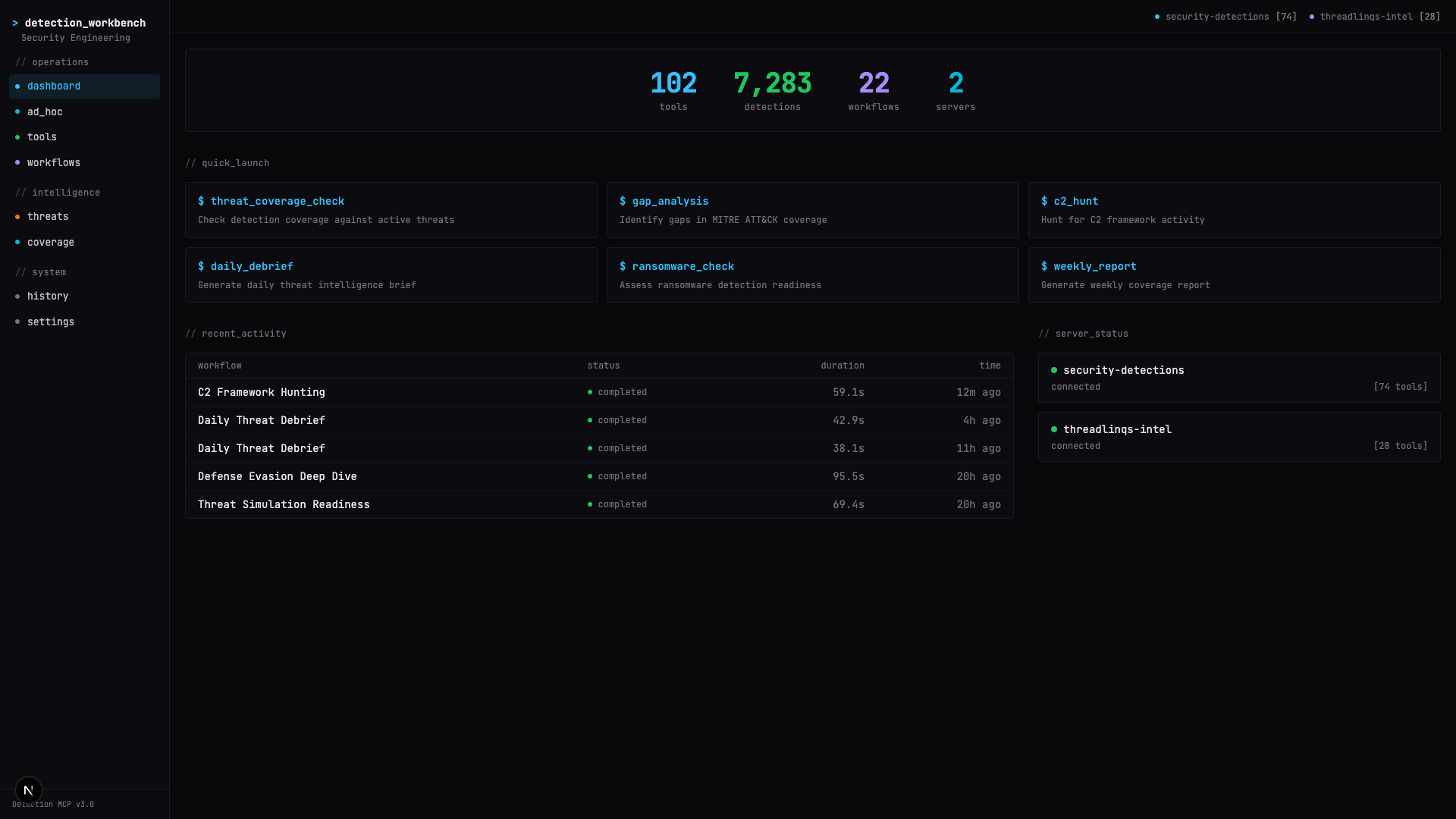
The workbench is a full-featured web dashboard built with Next.js 15, React 19, and Tailwind CSS v4. It features a terminal-inspired hacker aesthetic with JetBrains Mono font, colored status indicators, and // section headers.
Dashboard
The command center with real-time stats, quick-launch workflows, recent activity, and server status at a glance.
| Metric | Value |
|---|---|
| Total Tools | 106 |
| Indexed Detections | 7,283+ |
| Pre-built Workflows | 22 |
| MCP Servers | 2 |
Tool Explorer
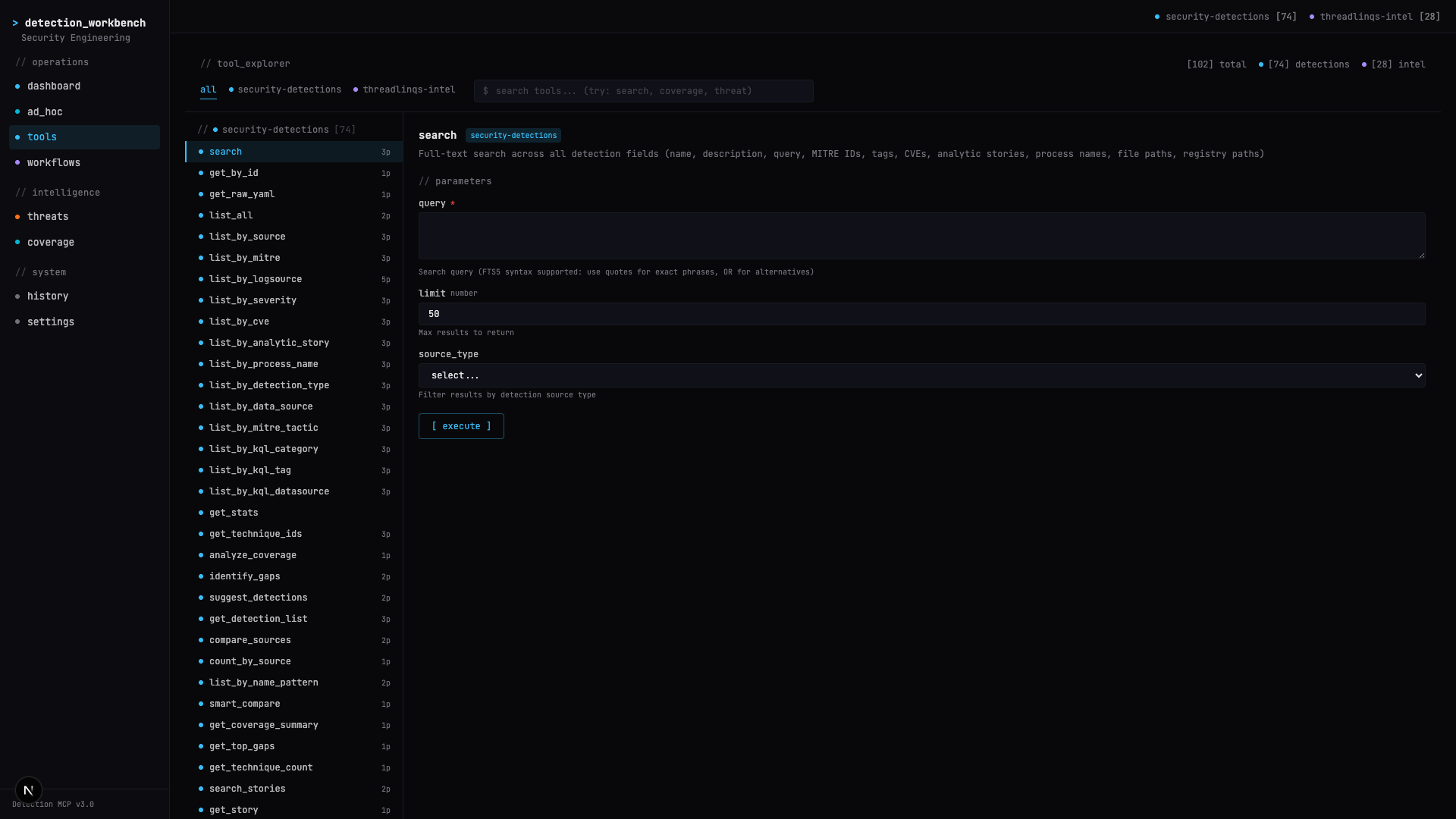
Browse, search, and execute all 106 tools across both MCP servers. Blue indicators for security-detections, purple for threadlinqs-intel.
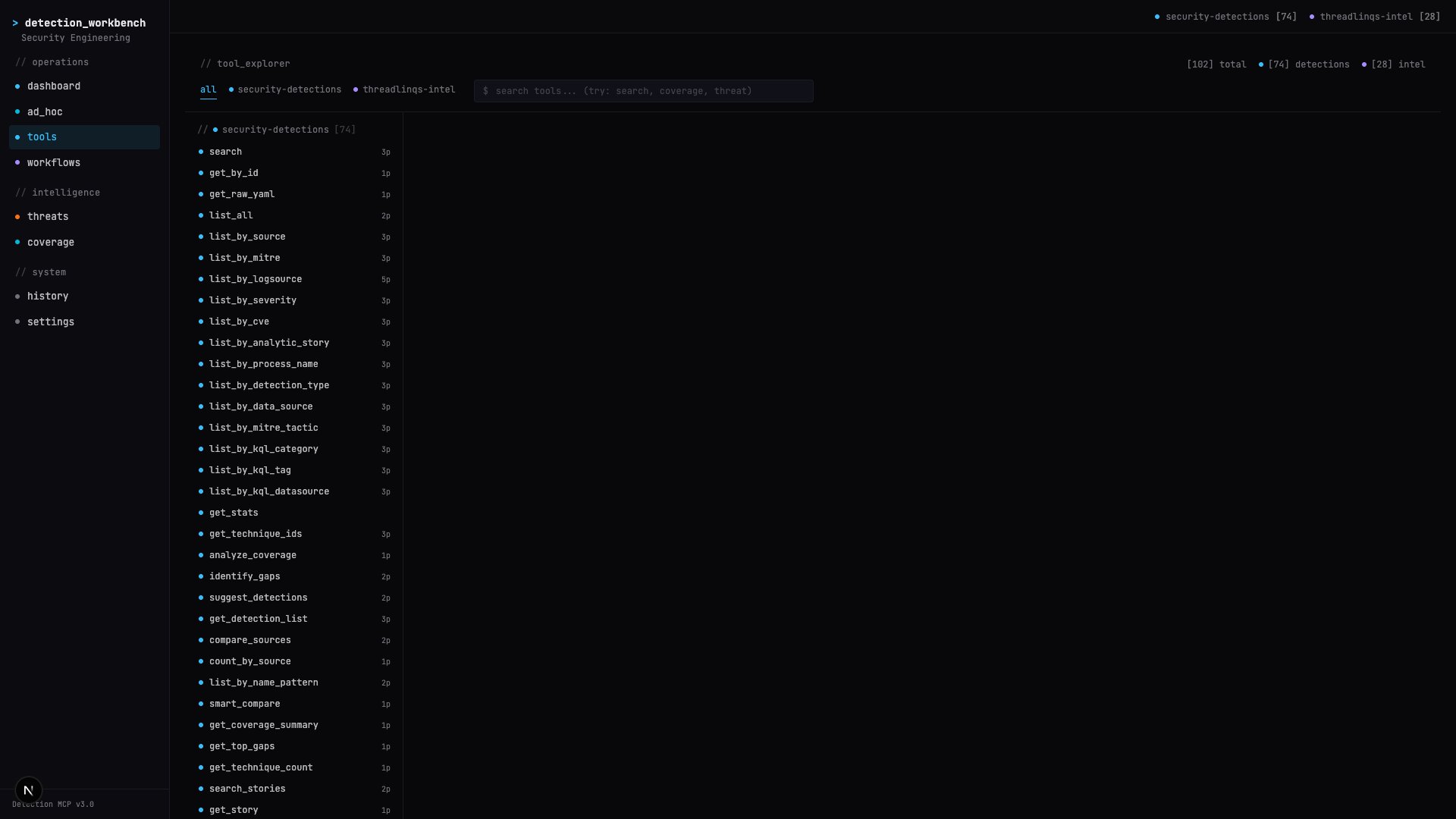
Click any tool to inspect its schema, parameters, and test it directly from the browser.
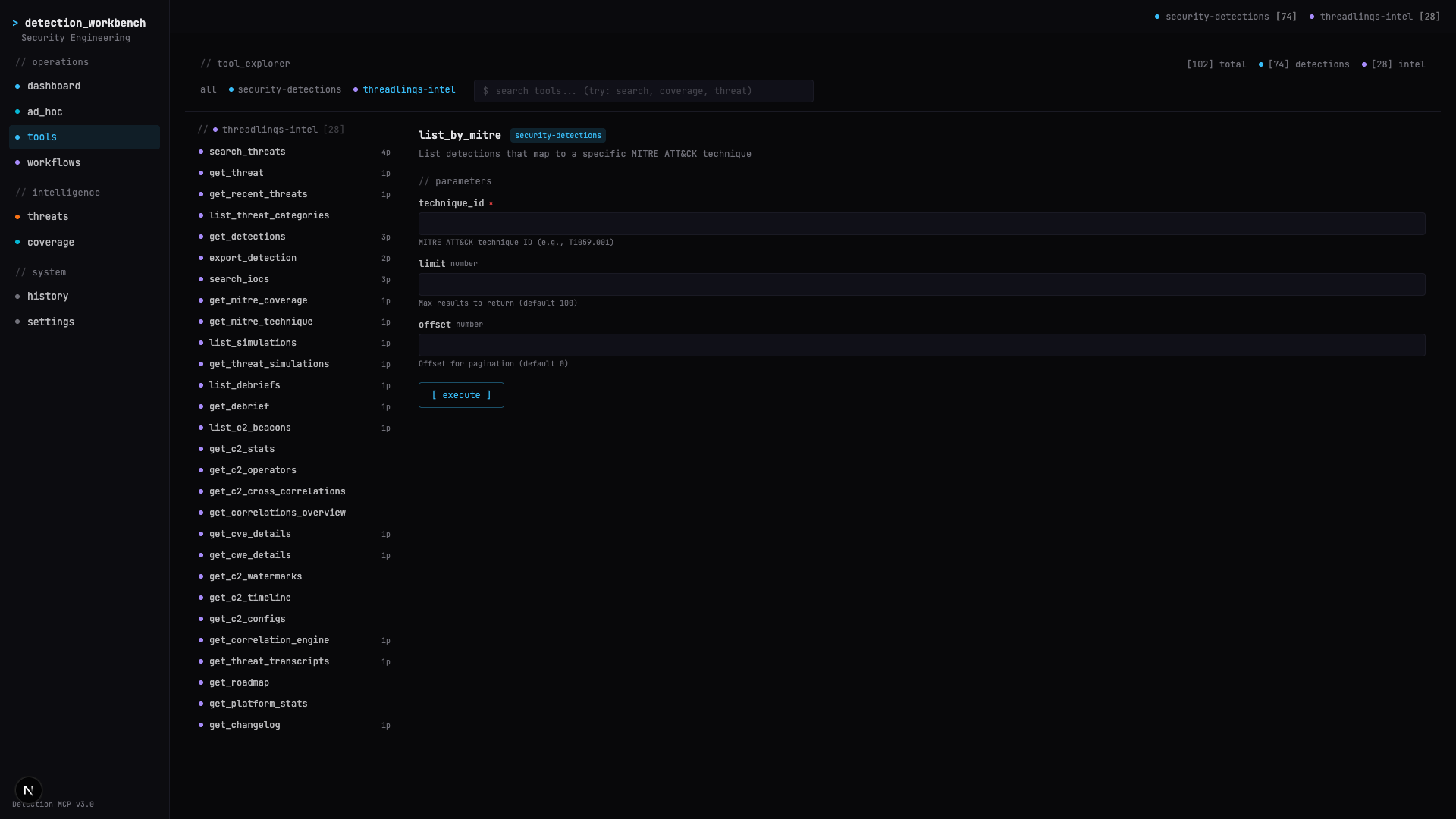
Filter by server to see the 32 Threadlinqs Intel tools — threat feeds, C2 tracking, simulations, and more.
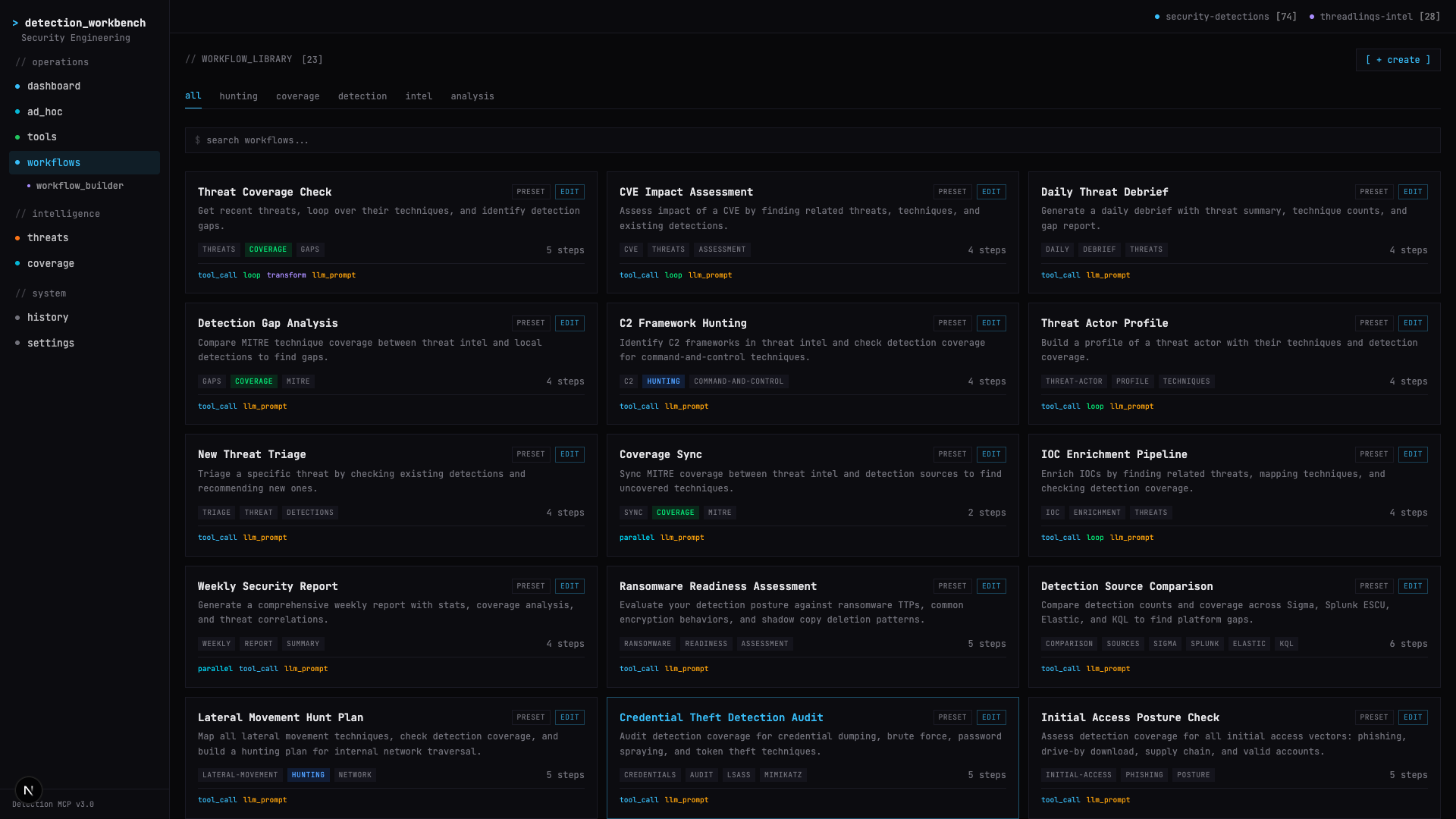
Workflow Library
22 pre-built detection engineering workflows spanning threat hunting, coverage analysis, CVE assessment, and intelligence operations.
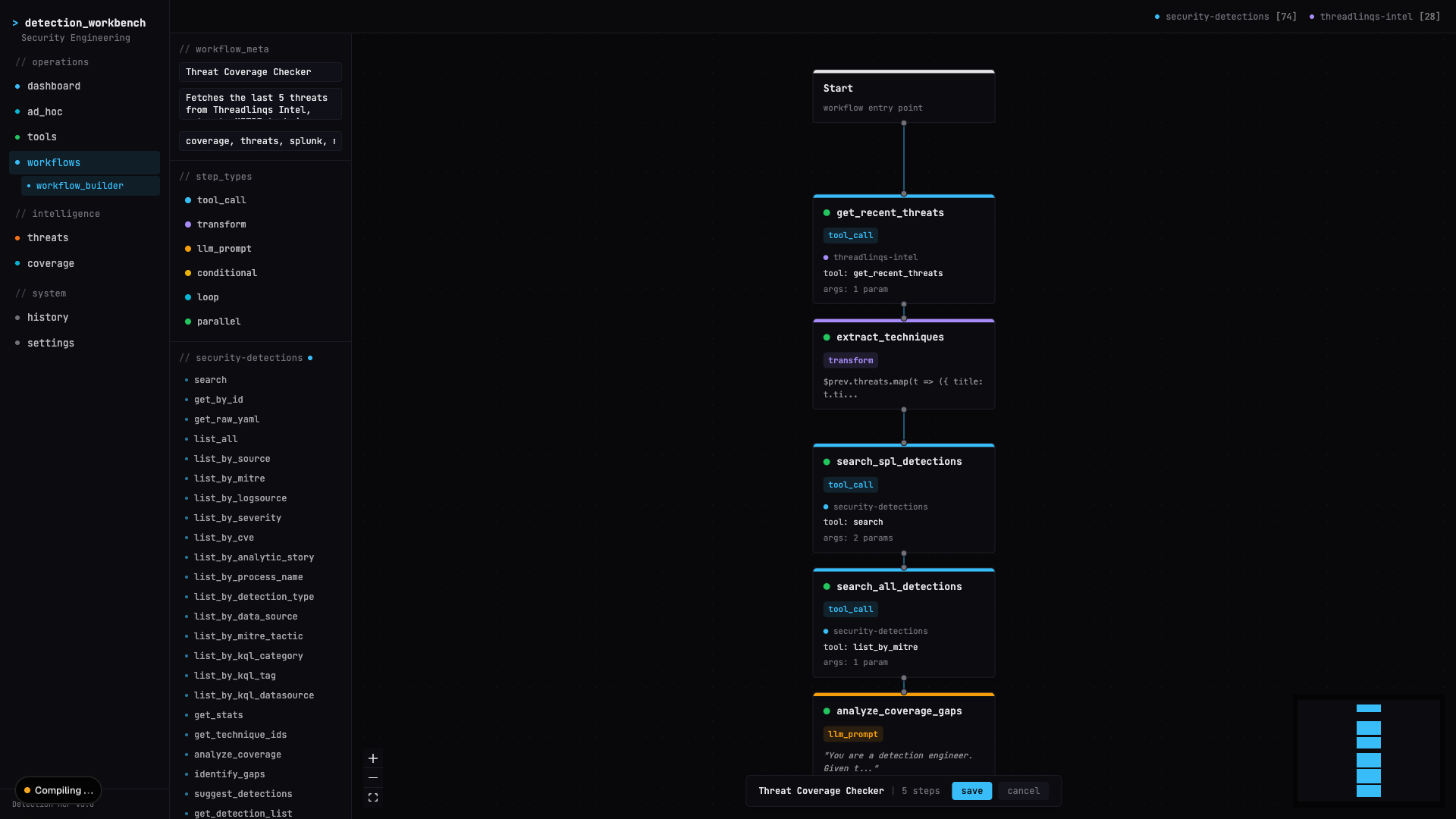
Visual Workflow Builder
Drag-and-drop canvas for designing custom detection pipelines. Connect tool calls, transforms, LLM analysis steps, conditionals, loops, and parallel branches.
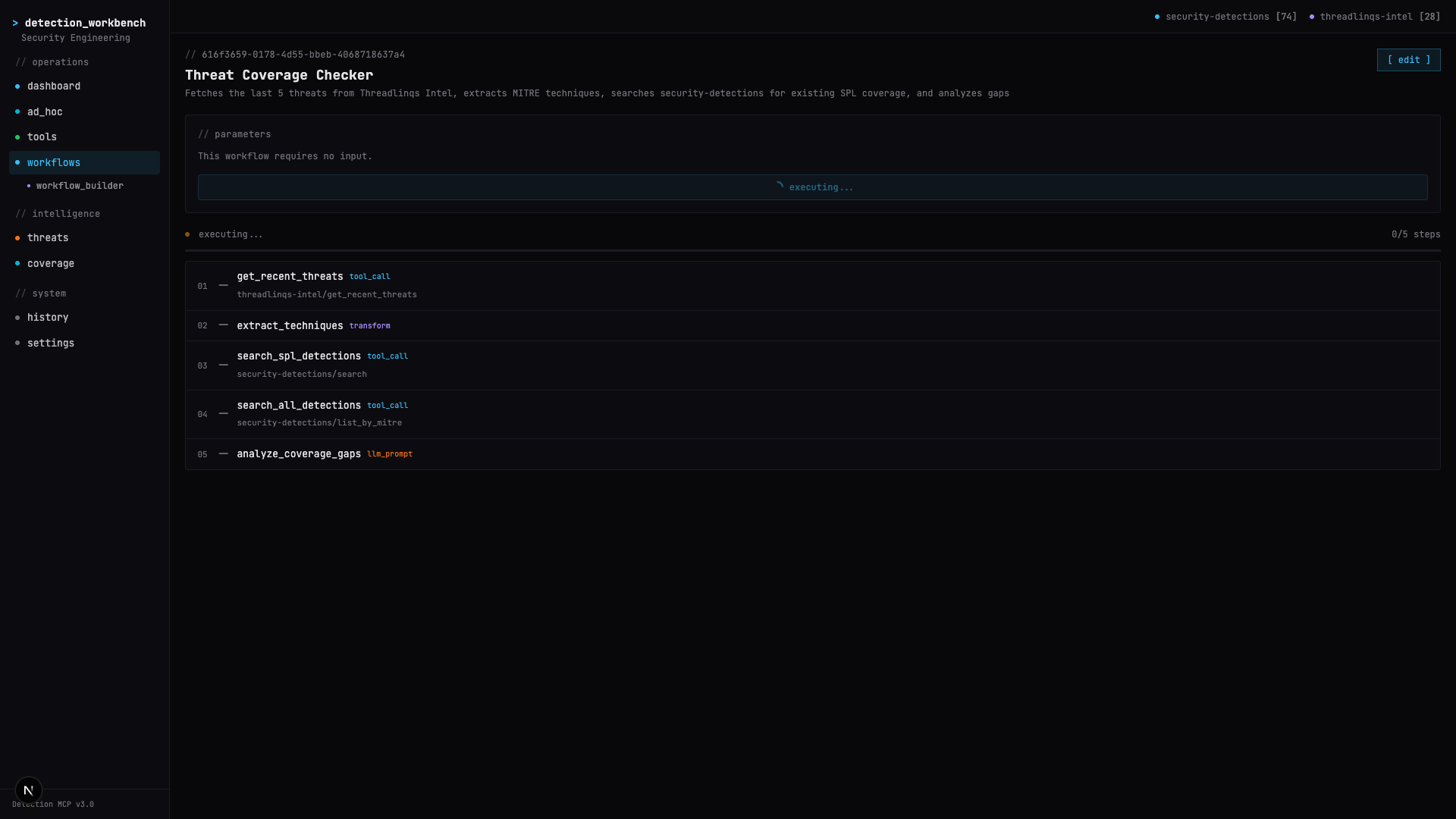
Workflow Execution
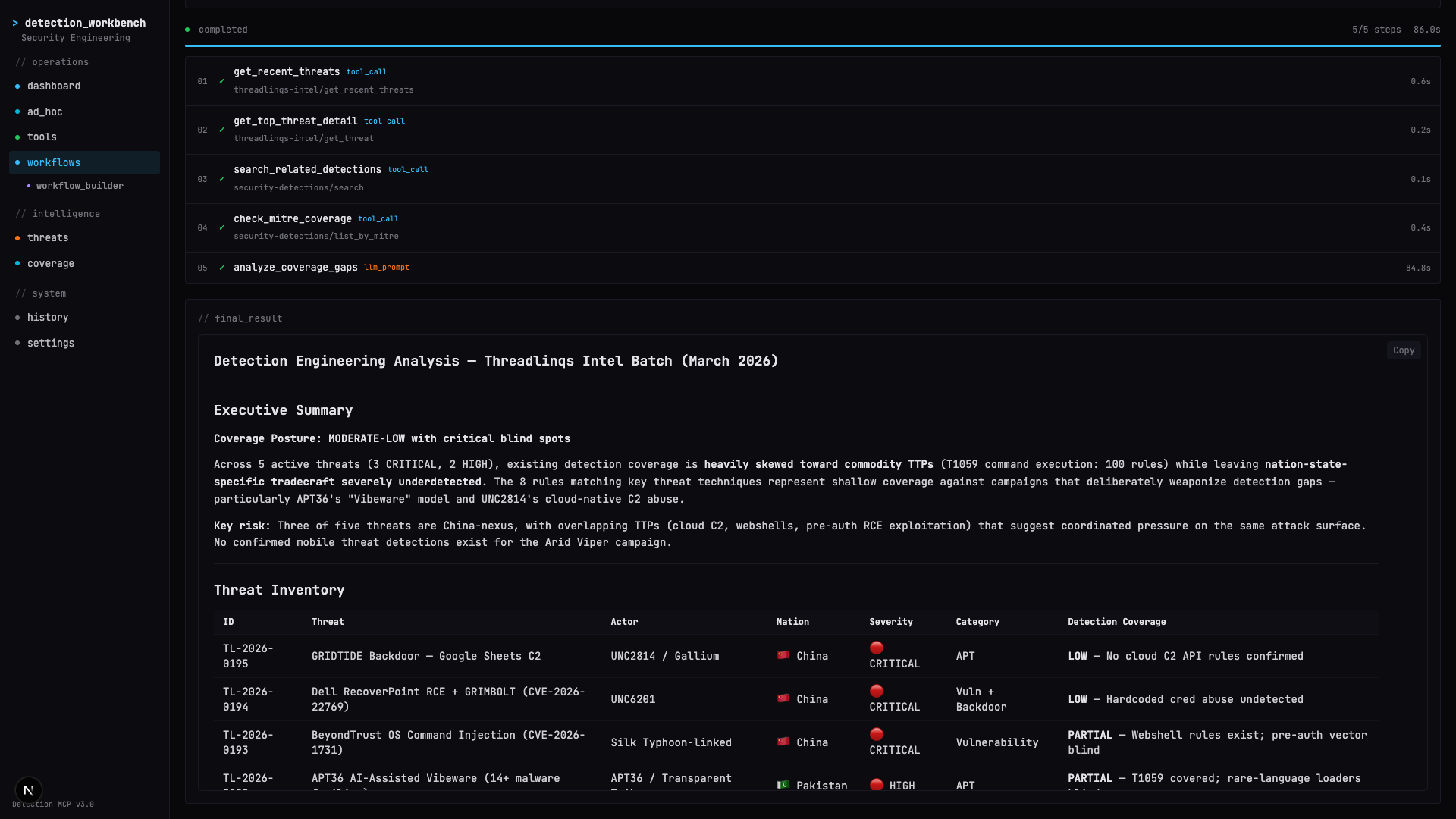
Execute workflows against live MCP servers with real-time step-by-step progress tracking. Each step shows its type (tool_call, transform, llm_prompt), target server, and execution status.
Results include LLM-generated analysis with executive summaries, threat inventories, MITRE coverage matrices, and prioritized recommendations.
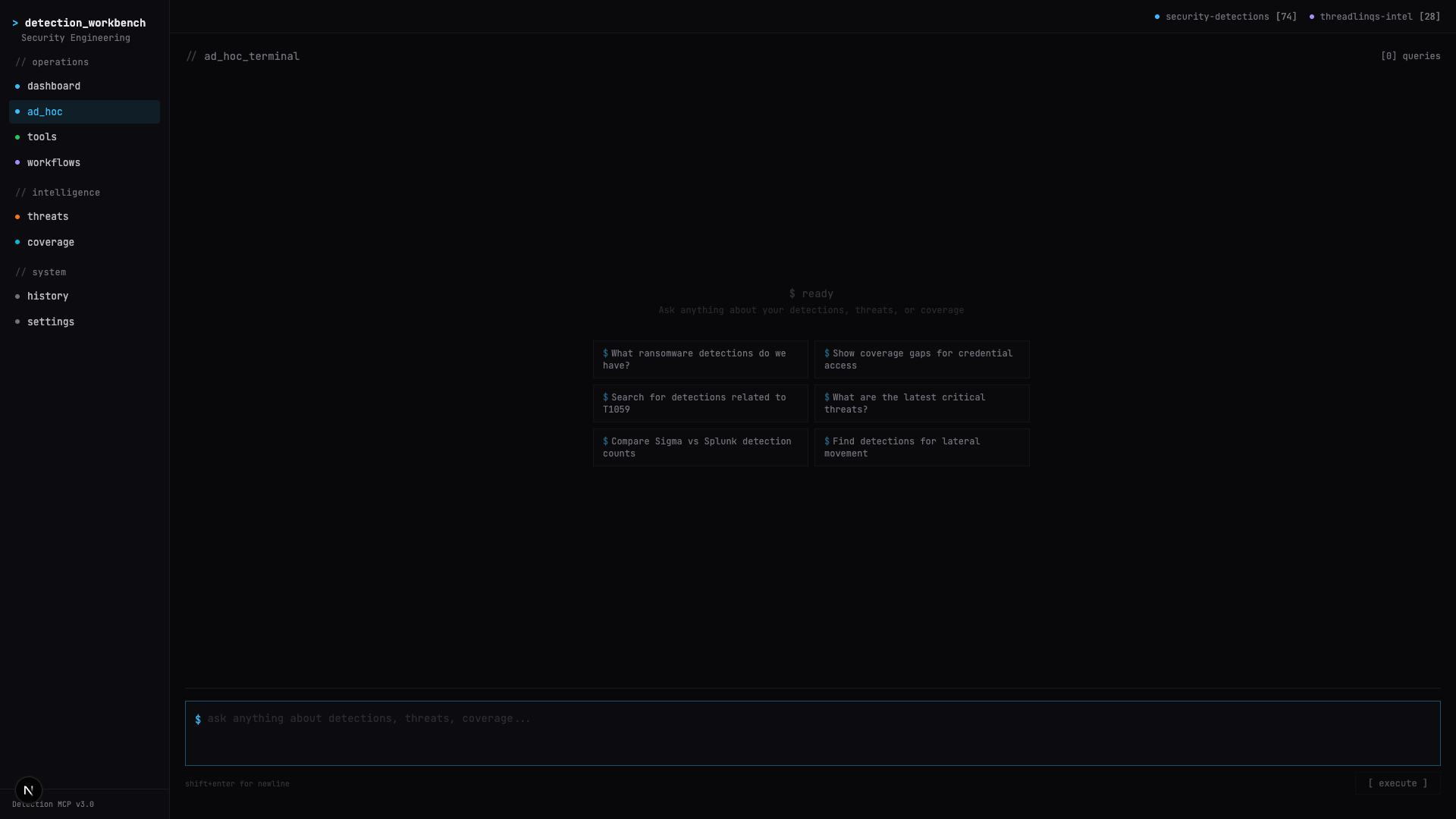
Ad-Hoc Terminal
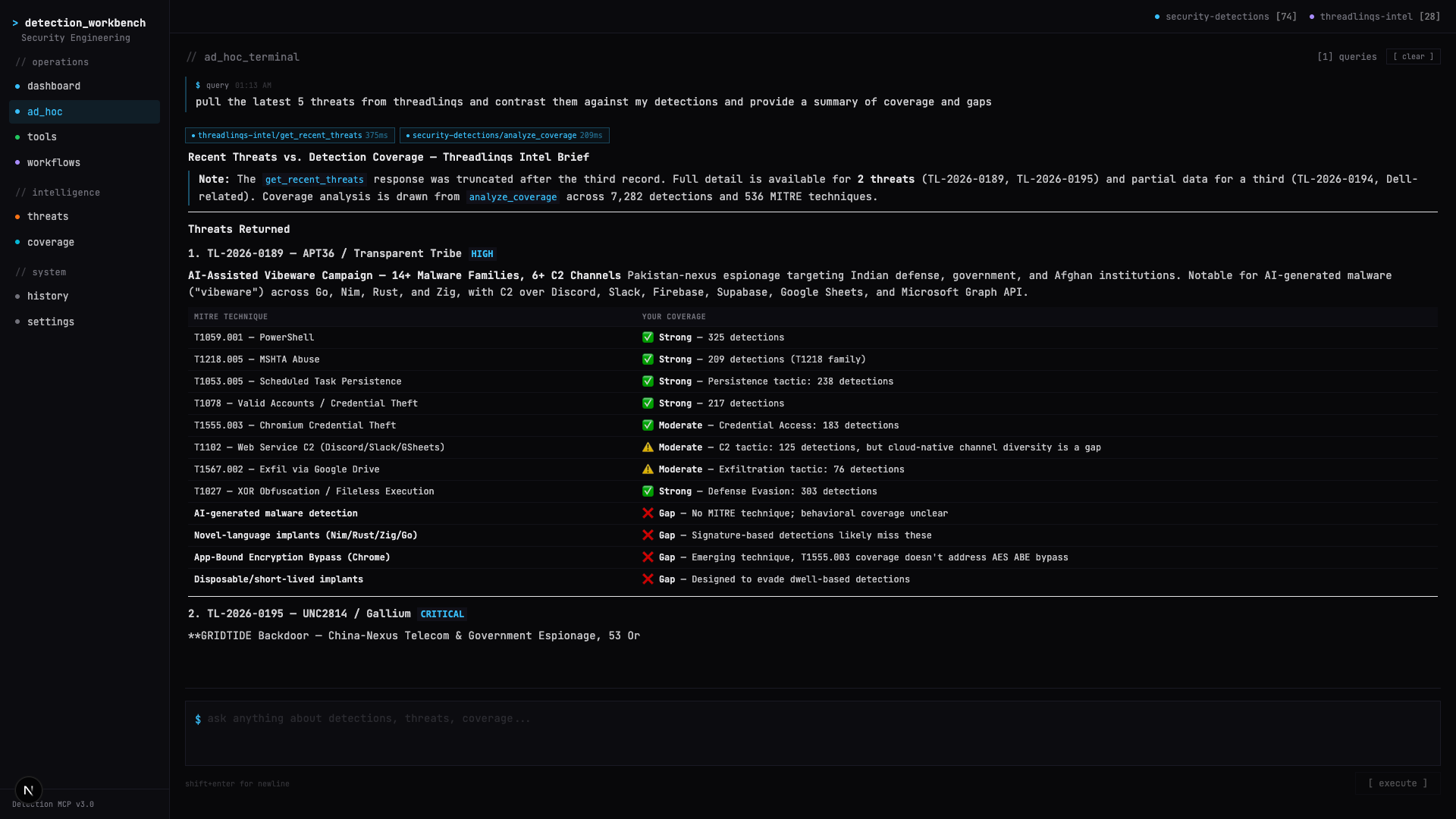
Natural language interface powered by your configured LLM. Ask questions about your detections, threats, and coverage — the system automatically selects and calls the right MCP tools, then synthesizes the results.
Example queries:
- "What ransomware detections do we have?"
- "Show coverage gaps for credential access"
- "Compare Sigma vs Splunk detection counts"
- "Pull the latest threats from Threadlinqs and contrast them against my detections"
All Pages
| Page | Path | Description |
|---|---|---|
| Dashboard | / | Stats, quick-launch, recent activity, server status |
| Ad-Hoc Terminal | /adhoc | Natural language queries with automatic tool orchestration |
| Tool Explorer | /tools | Browse and execute all 106 MCP tools |
| Workflow Library | /workflows | View and run 22 pre-built workflows |
| Workflow Builder | /workflows/builder | Visual drag-and-drop pipeline designer |
| Threats | /threats | Real-time threat intelligence feed |
| Coverage | /coverage | MITRE ATT&CK coverage analysis |
| History | /history | Execution history and past results |
| Settings | /config | LLM provider, API keys, MCP server status |
MCP Tools
security-detections (74 tools)
Core Detection Tools
| Tool | Params | Description |
|---|---|---|
search | query, limit, source_type | Full-text search across all detection fields |
get_by_id | id | Get detection by unique identifier |
get_raw_yaml | id | Get original YAML/TOML source |
list_all | limit, offset | List all detections with pagination |
list_by_source | source, limit, offset | Filter by source (sigma, splunk_escu, elastic, kql) |
list_by_mitre | technique_id, limit | Filter by MITRE ATT&CK technique |
list_by_logsource | category, product, service, limit, offset | Filter by log source fields |
list_by_severity | severity, limit, offset | Filter by severity level |
list_by_cve | cve_id, limit | Find detections related to a CVE |
list_by_analytic_story | story, limit | Filter by Splunk analytic story |
list_by_process_name | process, limit, offset | Filter by process name |
list_by_detection_type | type, limit, offset | Filter by detection type |
list_by_data_source | data_source, limit, offset | Filter by data source |
list_by_mitre_tactic | tactic, limit, offset | Filter by MITRE tactic |
list_by_kql_category | category, limit, offset | Filter KQL by category |
list_by_kql_tag | tag, limit, offset | Filter KQL by tag |
list_by_kql_datasource | datasource, limit, offset | Filter KQL by data source |
list_by_name_pattern | pattern, limit, offset | Wildcard search on detection name |
Analytics & Coverage
| Tool | Description |
|---|---|
get_stats | Platform-wide detection statistics |
get_technique_ids | All MITRE technique IDs with detection counts |
get_technique_count | Count detections for a specific technique |
analyze_coverage | Analyze MITRE coverage with gap identification |
identify_gaps | Find techniques with missing or thin coverage |
suggest_detections | Get recommendations for new detections to build |
get_detection_list | Generate filterable detection inventory |
compare_sources | Compare coverage across Sigma, Splunk, Elastic, KQL |
count_by_source | Count detections per source type |
smart_compare | Intelligent cross-source comparison |
get_coverage_summary | Executive-level coverage summary |
get_top_gaps | Highest-priority detection gaps |
Analytic Stories
| Tool | Description |
|---|---|
search_stories | Full-text search across analytic stories |
get_story | Get detailed story information |
list_stories | List all analytic stories |
list_stories_by_category | Filter stories by category |
Knowledge Graph (Tribal Knowledge)
| Tool | Description |
|---|---|
create_entity | Create knowledge entities (threat actors, techniques, etc.) |
create_relation | Create relationships between entities with reasoning |
add_observation | Add facts with confidence scoring |
delete_entity | Remove entity and associated data |
delete_observation | Delete specific observation |
search_knowledge | Full-text search across all knowledge |
read_graph | Read entire graph or filtered subgraph |
open_entity | Full entity details with relations and observations |
log_decision | Record significant decisions with reasoning |
add_learning | Store reusable patterns and insights |
get_relevant_decisions | Find past decisions relevant to current context |
get_learnings | Get applicable learnings for current task |
Engineering Intelligence
| Tool | Description |
|---|---|
get_query_patterns | Common query patterns for a MITRE technique |
get_field_reference | Available fields for a Splunk data model |
get_macro_reference | Common Splunk macros and usage patterns |
find_similar_detections | Find detections similar to what you want to create |
suggest_detection_template | Generate detection template from technique + patterns |
Dynamic Tables
| Tool | Description |
|---|---|
create_table | Create custom runtime tables |
insert_row | Insert data into dynamic table |
query_table | Query with filtering, sorting, pagination |
list_tables | List all tables (including pre-built analysis tables) |
drop_table | Remove table and data |
describe_table | Get schema and statistics |
Pre-built tables: gap_analyses, source_comparisons, threat_actor_profiles, detection_recommendations
Autonomous Analysis
| Tool | Description |
|---|---|
auto_analyze_coverage | Automatic coverage analysis across threat profiles |
auto_gap_report | Comprehensive gap report with prioritized recommendations |
auto_compare_sources | Detailed cross-source comparison with reasoning |
llm_enhanced_analysis | LLM-enhanced analysis via MCP sampling |
check_sampling_status | Check if MCP sampling is available |
Cache & Templates
| Tool | Description |
|---|---|
save_query | Cache query results with optional TTL |
get_saved_query | Retrieve cached results |
list_saved_queries | List all saved queries |
rebuild_index | Force re-index all detections |
save_template | Save reusable query templates with {{placeholders}} |
run_template | Execute template with parameter substitution |
list_templates | List all templates with usage stats |
get_template | Get template details and schema |
delete_template | Remove a template |
threadlinqs-intel (32 tools) — intelthreadlinqs-mcp@3.1.1
Threat Intelligence
| Tool | Description |
|---|---|
search_threats | Search threat intelligence database by keyword, CVE, MITRE technique, or actor |
get_threat | Get full threat report with TTPs, IOCs, detections, and attribution |
get_recent_threats | Get most recently published threats, ordered by creation date |
list_threat_categories | List all threat categories with counts |
get_threat_transcripts | Multi-agent intelligence analysis transcripts for a threat |
Detections & Coverage
| Tool | Description |
|---|---|
get_detections | Get detection rules, filter by threat ID or type (SPL, KQL, Sigma) |
export_detection | Export detection in raw SIEM format |
get_mitre_coverage | Full MITRE ATT&CK framework coverage map |
get_mitre_technique | Detailed info for a specific MITRE ATT&CK technique |
IOC Intelligence & DNS Enrichment
| Tool | Description |
|---|---|
search_iocs | Search IOCs — IPs, domains, hashes, URLs, behavioral indicators |
enrich_iocs | Trigger DNS enrichment for IOCs (single, per-threat, or bulk) |
get_ioc_dns | Get passive DNS enrichment data for a specific IOC (IP or domain) |
get_enrichment_graph | DNS enrichment infrastructure graph — nodes and edges |
get_enrichment_overview | DNS enrichment overview — totals, discovered domains, cross-threat links |
C2 Tracking
| Tool | Description |
|---|---|
list_c2_beacons | Wild C2 beacons — command-and-control infrastructure intel |
get_c2_stats | C2 framework distribution, geographic spread, watermarks |
get_c2_operators | C2 operator cluster analysis — behavioral fingerprints |
get_c2_cross_correlations | Cross-intelligence correlations — IP, tag, MITRE matches |
get_c2_watermarks | Cobalt Strike watermark clusters |
get_c2_timeline | Monthly C2 framework version distribution |
get_c2_configs | Full C2 beacon configurations — sleep, jitter, user agents |
Correlations & Lookups
| Tool | Description |
|---|---|
get_correlations_overview | Aggregated intelligence from 7 correlation engines |
get_correlation_engine | Detailed data from a specific correlation engine |
get_cve_details | CVE lookup with severity, CVSS, and description |
get_cwe_details | CWE weakness lookup with description and mitigations |
Simulations & Debriefs
| Tool | Description |
|---|---|
list_simulations | List attack simulation scenarios |
get_threat_simulations | Get simulation commands for a specific threat |
list_debriefs | List daily intelligence debriefs |
get_debrief | Get specific daily debrief by date |
Platform
| Tool | Description |
|---|---|
get_platform_stats | Platform statistics — threats, detections, IOCs, coverage |
get_roadmap | Platform roadmap — planned features and ideas |
get_changelog | Recent updates, features, and fixes |
Workflow Engine
The workflow engine supports 6 step types that can be chained into multi-step detection engineering pipelines:
| Step Type | Description | Example |
|---|---|---|
tool_call | Execute an MCP tool on a specified server | search on security-detections |
transform | Extract or reshape data between steps | $steps.threats[0].id |
llm_prompt | Send a prompt to the configured LLM for analysis | Coverage gap analysis |
conditional | Branch execution based on a condition | $steps.count > 0 |
loop | Iterate over an array, executing steps per item | Loop over techniques |
parallel | Execute multiple steps concurrently | Query multiple sources |
Binding System
Steps can reference outputs from previous steps using $-expressions:
Pre-built Workflows (22)
Threat Intelligence
| Workflow | Tags | Description |
|---|---|---|
| Threat Coverage Check | threats, coverage, gaps | Get recent threats, extract MITRE techniques, identify detection gaps |
| CVE Impact Assessment | cve, threats, assessment | Assess CVE impact by finding related threats and detections |
| Daily Threat Debrief | daily, debrief, threats | Generate daily threat intelligence summary with coverage report |
| New Threat Triage | triage, threat, detections | Triage specific threat with detection check and recommendations |
| Threat Actor Profile | threat-actor, profile, techniques | Build complete threat actor profile with TTPs and coverage |
| IOC Enrichment | ioc, enrichment, threats | Enrich IOCs with threat context, technique mapping, coverage check |
| Weekly Security Report | weekly, report, summary | Comprehensive weekly report with stats and correlations |
Coverage Analysis
| Workflow | Tags | Description |
|---|---|---|
| Detection Gap Analysis | gaps, coverage, mitre | Compare MITRE coverage between threat intel and detections |
| Coverage Sync | sync, coverage, mitre | Parallel sync of MITRE coverage across intel and detections |
| Detection Source Comparison | comparison, sources | Compare counts and coverage across Sigma, Splunk, Elastic, KQL |
| Detection Quality Report | quality, optimization | Find thin coverage, over-covered areas, rebalancing suggestions |
Threat Hunting
| Workflow | Tags | Description |
|---|---|---|
| C2 Framework Hunting | c2, hunting | Identify C2 frameworks and check detection coverage |
| Lateral Movement Hunt | lateral-movement, hunting | Map lateral movement techniques, build hunting plan |
| Credential Theft Audit | credentials, audit | Audit credential dumping, brute force, kerberoasting detections |
| Exfiltration Watchlist | exfiltration, dlp | Map exfiltration techniques, C2 channels, DLP blind spots |
Posture Assessment
| Workflow | Tags | Description |
|---|---|---|
| Ransomware Readiness | ransomware, readiness | Evaluate detection posture against ransomware TTPs |
| Initial Access Posture | initial-access, phishing | Assess phishing, drive-by, supply chain, valid account coverage |
| Privilege Escalation Review | privesc, escalation | Deep dive into UAC bypass, token manipulation, process injection |
| PowerShell Threat Matrix | powershell, lolbas | PowerShell attack analysis: obfuscation, AMSI bypass, LOLBins |
| Cloud Security Coverage | cloud, aws, azure, gcp | Cloud-specific attack coverage across AWS, Azure, GCP |
| Defense Evasion Deep Dive | evasion, defense | Exhaustive analysis of the largest MITRE tactic |
| Threat Simulation Readiness | simulation, purple-team | Check if detection stack catches simulated TTPs |
Autonomous Pipeline
The agents/ directory contains a LangGraph-based autonomous pipeline for end-to-end detection generation and validation:
Agent Nodes
| Agent | Role |
|---|---|
| CTI Analyst | Analyzes threat intelligence and extracts TTPs |
| Coverage Analyzer | Maps existing detection coverage against threats |
| Detection Engineer | Generates new detection rules for gaps |
| Atomic Executor | Creates Atomic Red Team test cases |
| Splunk Validator | Validates SPL syntax and logic |
| SIEM Validator | Cross-platform SIEM validation |
| FP Analyst | Assesses false positive risk |
| QA Reviewer | Quality assurance review |
| Verifier | End-to-end verification |
| Data Dumper | Exports results to structured formats |
| PR Stager | Stages detection PRs for review |
| Attack Range Builder | Provisions test environments |
Setup
Configuration
MCP Server Configuration
The MCP servers are configured in .cursor/mcp.json:
LLM Configuration
The workbench supports two LLM providers configured in the Settings page:
| Provider | Models | API Key Env Var |
|---|---|---|
| Anthropic | claude-sonnet-4-20250514, claude-haiku-4-20250414, claude-opus-4-20250514 | ANTHROPIC_API_KEY |
| OpenAI | gpt-4o, gpt-4o-mini, gpt-4-turbo | OPENAI_API_KEY |
API keys can be set in three ways (in priority order):
- Settings page in the workbench UI
- Environment variables (
ANTHROPIC_API_KEY,OPENAI_API_KEY,THREADLINQS_API_KEY) .env.localfile in theworkbench/directory
Workbench Engine Settings
| Setting | Default | Description |
|---|---|---|
max_prompt_size | 12,000 chars | Maximum prompt length sent to LLM |
per_binding_limit | 3,000 chars | Max chars per step binding in prompts |
llm_timeout | 180s | LLM request timeout |
error_policy | continue | continue or stop on step failure |
max_tokens | 4,096 | Maximum LLM response tokens |
Using with AI Assistants
Claude Code (CLI)
Add the MCP servers to your Claude Code configuration:
Or add them directly to ~/.claude.json (global) or .claude/settings.json (project-level):
Claude Desktop / Cursor / Windsurf
Add the servers to your MCP configuration file (.cursor/mcp.json, claude_desktop_config.json, etc.):
Example Prompts
API Reference
The workbench exposes a REST API for programmatic access:
| Method | Endpoint | Description |
|---|---|---|
GET | /api/mcp/servers | List MCP servers and status (auto-connects on first call) |
POST | /api/mcp/servers | Reconnect a server ({action: "reconnect", server: "name"}) |
GET | /api/mcp/tools | List all available tools |
POST | /api/mcp/{server}/{tool} | Execute a tool |
GET | /api/workflows | List all workflows |
POST | /api/workflows | Create a workflow |
GET | /api/workflows/{id} | Get workflow details |
PUT | /api/workflows/{id} | Update a workflow |
POST | /api/workflows/{id}/execute | Execute a workflow |
GET | /api/workflows/{id}/stream | Stream execution events (SSE) |
GET | /api/executions | List execution history |
DELETE | /api/executions | Clear execution history |
POST | /api/adhoc | Execute ad-hoc query (SSE stream) |
GET | /api/settings | Get settings (keys masked) |
POST | /api/settings | Update settings |
GET | /api/settings?test=true | Test LLM connection |
Project Structure
Tech Stack
| Layer | Technology |
|---|---|
| MCP Server | Node.js, TypeScript, @modelcontextprotocol/sdk, better-sqlite3 |
| Workbench | Next.js 15, React 19, Tailwind CSS v4, Zustand, React Flow |
| LLM Integration | Anthropic Claude API, OpenAI API (configurable) |
| Threat Intel | Threadlinqs Intel MCP (intelthreadlinqs-mcp@3.1.1) |
| Agent Pipeline | LangGraph, TypeScript |
| Database | SQLite with FTS5 full-text search |
| Detection Formats | Sigma YAML, Splunk YAML/SPL, Elastic TOML/EQL, KQL |
Development
Build the MCP server
Run the workbench
Run tests
Contributing
- Fork the repository
- Create a feature branch (
git checkout -b feature/amazing-detection) - Commit your changes (
git commit -m 'Add amazing detection workflow') - Push to the branch (
git push origin feature/amazing-detection) - Open a Pull Request
Acknowledgments
- SigmaHQ for the Sigma detection rule standard
- Splunk for Enterprise Security Content Update
- Elastic for Elastic Security detection rules
- Threadlinqs for real-time threat intelligence
- Model Context Protocol for the MCP standard
- MITRE ATT&CK for the adversary tactics and techniques framework
Built with MCP • Open Source • Detection Engineering