Imgflip MCP README
The full upstream README, mirrored here for reference. Install config, tool schemas, adoption signals, and an original overview live on the Imgflip MCP listing page.
imgflip-mcp



📚 Full documentation: mariokernich.github.io/imgflip-mcp
There's an MCP server for your database. One for your Kubernetes cluster. One for your cloud bill, one for your ticket system, and at least twelve for reading PDFs. Serious servers for serious work.
But somewhere along the way, the ecosystem forgot the workload that actually keeps engineering teams running: memes.
imgflip-mcp closes that gap. It's a Model Context Protocol server for the Imgflip meme generator API, so Claude (or any other MCP client) can browse thousands of meme templates and caption them mid-conversation — turning your AI assistant into the coworker who always has the right reaction image.
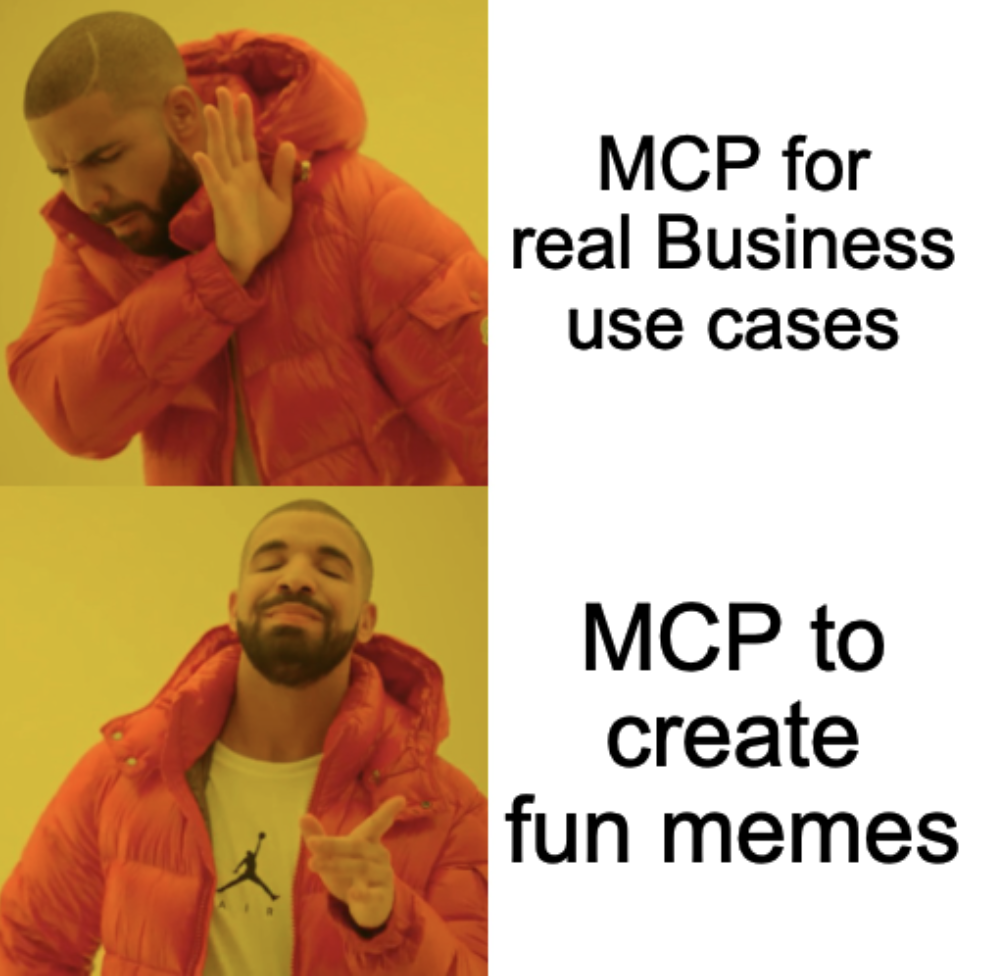
This meme was, of course, generated by imgflip-mcp itself.
You: "Make me a Drake meme about writing tests vs. testing in production" Claude: 🖼️ calls
get_memes→ callscaption_image→ sends you the image link
Everything you need is a free Imgflip account. An Imgflip API Premium subscription is optional — it unlocks five extra tools (search, GIF captioning, automeme, AI memes), which stay hidden unless you explicitly enable them.
What would I even use this for?
More than you'd think. Once meme generation is one sentence away, it sneaks into real workflows:
- Docs people actually finish reading. Let Claude write your README section and cap it with a fitting meme — retention engineering at its finest.
- Release notes with a punchline. "v2.0: we rewrote everything" hits different next to an Expanding Brain meme of your migration steps.
- Code review, but kind. Answer the 400-line PR with a Two Buttons meme instead of a lecture. Same message, fewer hurt feelings.
- Retros & standups. Feed in the sprint summary, get the This Is Fine recap the team deserves.
- Incident postmortems. Nothing says "blameless" like a well-chosen Disaster Girl on the last slide.
- Slack announcements. Deploy freezes, on-call handovers, "the build is green again" — all measurably more effective as memes.
Is any of this necessary? No. Neither is syntax highlighting, and yet here we are.
Tools
Free tools (enabled by default)
| Tool | Description | Imgflip endpoint | Requirements |
|---|---|---|---|
get_memes | List the ~100 most popular meme templates, with optional name filtering | GET /get_memes | none |
caption_image | Caption a template and get the generated image URL | POST /caption_image | free Imgflip account |
These two tools cover the everyday use case end to end: find a template, put text on it, get the image URL.
Premium tools (optional, opt-in)
| Tool | Description | Imgflip endpoint |
|---|---|---|
search_memes | Search 1M+ templates by name | POST /search_memes |
get_meme | Look up a single template by id | POST /get_meme |
caption_gif | Caption an animated GIF template | POST /caption_gif |
automeme | Auto-pick a template for a piece of text | POST /automeme |
ai_meme | Let Imgflip's AI invent a whole meme | POST /ai_meme |
These require an Imgflip API Premium subscription and are not registered by default, so free-tier users never see tools that would fail. If you have Premium, enable them by setting IMGFLIP_PREMIUM=true.
Extras
- Inline images: every meme-generating tool returns the result both as URL and as an embedded image (up to 2 MB), so clients like Claude Desktop render the meme directly in the chat.
make-memeprompt: an MCP prompt that guides the model through template selection and captioning — pass atopicand optionally atemplatepreference.- Tool annotations: lookup tools are marked
readOnlyHintso clients can auto-approve them safely.
Prerequisites
- Node.js 18+
- An Imgflip account (sign up for free) — required for every tool except
get_memes
Environment variables
| Variable | Required | Description |
|---|---|---|
IMGFLIP_USERNAME | yes* | Your Imgflip username |
IMGFLIP_PASSWORD | yes* | Your Imgflip password |
IMGFLIP_PREMIUM | no | Set to true to also register the five Premium tools (default: off) |
* Only get_memes works without credentials.
Note: The Imgflip API authenticates with username/password form fields — it does not offer API keys. Consider creating a dedicated Imgflip account for API use.
Installation
The server communicates over stdio, so your MCP client launches it as a subprocess — there is no port or daemon to manage. Pick whichever route fits your client:
| Route | Best for | How |
|---|---|---|
| npx | most clients | npx -y imgflip-mcp — no clone, no build (requires the package on npm, see the docs) |
Desktop Extension (.mcpb) | Claude Desktop | download from Releases, double-click, fill in the credentials form |
| Claude Code plugin | Claude Code | /plugin marketplace add mariokernich/imgflip-mcp — this repo is its own plugin marketplace |
| VS Code button | Copilot users | click the Install in VS Code badge above |
| From source | development | see below |
From source
The compiled server entry point is dist/index.js; the config examples below use npx -y imgflip-mcp, which you can always replace with node /absolute/path/to/imgflip-mcp/dist/index.js.
Using with Claude
Claude Desktop
Option A — one-click Desktop Extension (recommended):
- Download the latest
imgflip-mcp-*.mcpbfile from the Releases page (or build it yourself:npx @anthropic-ai/mcpb pack). - Double-click the file (or use Settings → Extensions → Install extension…).
- Claude Desktop shows a configuration form: enter your Imgflip username and password (stored in the OS keychain) and, if you have API Premium, tick Enable Premium tools. Done — no JSON editing required.
Option B — manual JSON config:
-
Open Claude Desktop and go to Settings → Developer → Edit Config. This opens (or creates)
claude_desktop_config.json:- macOS:
~/Library/Application Support/Claude/claude_desktop_config.json - Windows:
%APPDATA%\Claude\claude_desktop_config.json
- macOS:
-
Add the server under
mcpServers(create the key if the file is empty):If you have API Premium and want the extra tools, add
"IMGFLIP_PREMIUM": "true"to theenvblock. -
Fully restart Claude Desktop (quit from the tray/menu bar, not just close the window).
-
Open a new chat — the Imgflip tools now show up in the tools menu (🔌 icon). Try:
"Make a Drake meme: top 'manually formatting code', bottom 'letting the linter do it'."
Claude will look up the template, call
caption_image, and reply with the finished image link.
Claude Code (CLI)
Option A — as a plugin. This repository is its own plugin marketplace:
The plugin reads IMGFLIP_USERNAME, IMGFLIP_PASSWORD and (optionally) IMGFLIP_PREMIUM from your shell environment, so export them in your ~/.bashrc/~/.zshrc.
Option B — register the MCP server directly:
Add --env IMGFLIP_PREMIUM=true if you have API Premium. Verify with:
Then simply ask inside any claude session:
"Generate a 'This Is Fine' meme about our flaky CI pipeline and give me the URL."
By default Claude Code adds the server to the current project; use claude mcp add --scope user … to make it available in all your projects.
What a conversation looks like
VS Code / GitHub Copilot
Click the Install in VS Code badge at the top of this README — VS Code opens, prompts securely for your Imgflip username and password, and registers the server for Copilot's agent mode. Equivalent CLI one-liner:
Once published to the MCP Registry, the server is also discoverable in the GitHub MCP Registry and directly inside VS Code (Extensions view → MCP SERVERS).
Other MCP clients (Cursor, …)
Any client that supports stdio MCP servers uses the same shape — command npx, args ["-y", "imgflip-mcp"] (or node + path to dist/index.js), plus the environment variables. Example for Cursor (.cursor/mcp.json):
Usage examples
Some prompts that map directly onto the tools:
- "Show me the most popular meme templates right now." →
get_memes - "Find a meme template with 'brain' in the name." →
get_memeswithname_filter: "brain" - "Make a Drake meme: top 'manually formatting code', bottom 'letting the linter do it'." →
caption_image - "Create an Expanding Brain meme with four stages about coffee, tea, energy drinks, and pure willpower." →
caption_imagewithboxes - "Search all of Imgflip for 'confused cat' templates." →
search_memes(Premium) - "Auto-meme this: one does not simply deploy on a Friday." →
automeme(Premium) - "Let the AI make a meme about standup meetings." →
ai_meme(Premium)
Typical workflow: create a meme
Step 1 — find a template. Call get_memes (optionally with name_filter):
Response (excerpt):
Step 2 — caption it. For templates with two boxes, text0/text1 is enough:
Response:
url is the direct image; page_url is the meme's page on imgflip.com.
Templates with more than two boxes
Check the template's box_count and pass a boxes array instead of text0/text1. Example — Expanding Brain (box_count: 4):
Boxes are auto-positioned when you omit coordinates. For full control, each box also accepts x, y, width, height (pixels), color, and outline_color (hex codes):
Styling options for caption_image:
font—"impact"(default) or"arial"max_font_size— maximum font size in pixels (default 50); text shrinks automatically to fitno_watermark— removes the imgflip.com watermark (Imgflip Premium accounts only)
Premium tools (only when IMGFLIP_PREMIUM=true)
Remember: Premium is entirely optional — everything above works on the free tier. With an Imgflip API Premium subscription and IMGFLIP_PREMIUM=true, five more tools become available:
ai_meme returns the generated image plus the template and texts the AI chose:
If your account lacks Premium, these tools return the original Imgflip error message instead of failing silently.
Error handling
All tools return errors as readable text with the MCP isError flag set, so Claude can react to them:
- Missing credentials — set
IMGFLIP_USERNAME/IMGFLIP_PASSWORDin the server'senvblock - Invalid credentials / no Premium — the original Imgflip error message is passed through
- Unknown
template_id— double-check the id viaget_memesorsearch_memes
Development
This project uses pnpm (corepack enable sets it up automatically):
CI runs lint, typecheck, tests, a version-consistency check and MCPB manifest validation on every push and pull request. See CONTRIBUTING.md for guidelines and CHANGELOG.md for release history.
Test interactively with the MCP Inspector:
Project structure
Distribution
The server is distributed through the npm registry, the official MCP Registry (which feeds the GitHub MCP Registry used by Copilot), a Claude Desktop Extension (.mcpb) attached to each GitHub release, and this repo's built-in Claude Code plugin marketplace. Releases are fully automated: push a vX.Y.Z tag and the publish workflow does the rest. See the publishing guide for the complete walkthrough, including the one-time setup and manual fallbacks.
Privacy
This server runs locally and is stateless: your Imgflip credentials and meme texts are sent exclusively to https://api.imgflip.com (which requires them for authentication and generation), and nothing is logged, stored, or sent anywhere else. Generated memes are hosted publicly on imgflip.com. Details in PRIVACY.md; Imgflip's own handling is covered by the Imgflip privacy policy.
Notes on the Imgflip API
- Generated images are hosted by Imgflip and may be deleted when they receive no views for a long period.
get_memesreturns the top ~100 templates ordered by caption popularity over the last 30 days, so results change over time.- All generation endpoints are
application/x-www-form-urlencodedPOST requests; this server handles the encoding (including theboxes[i][field]array syntax) for you. - Full upstream documentation: https://imgflip.com/api
FAQ
Do I need to pay for anything? No. A free Imgflip account covers the core workflow (browse templates, create memes). Imgflip API Premium is only needed for the five opt-in extras like template search and AI memes — the server works happily without it, forever.
Why does the server only show two tools?
That's intentional. The five Premium tools stay hidden unless you set IMGFLIP_PREMIUM=true, so you never see tools that would just error on a free account. Two tools that work beat seven that don't.
Why username and password instead of an API key? Ask Imgflip — their API has authenticated this way since forever. The pragmatic answer: create a dedicated Imgflip account just for the API and let your MCP client store the password (the Claude Desktop extension puts it in the OS keychain).
Are my memes private? No. Everything you generate is hosted on imgflip.com under a public URL — anyone with the link can see it. Maybe don't caption the unreleased quarterly numbers. Imgflip may also delete images that get no views for a long time, so archive anything you're attached to.
Can I get rid of the watermark?
Yes, pass no_watermark: true — but it only works if your Imgflip account has a Premium subscription. Otherwise the watermark stays, as a small tribute to the free lunch you're eating.
The meme shows up as a link but not as an image. Why? The server embeds the generated image inline when it can (up to 2 MB). If the image is bigger or the download hiccups, you still get the URL — embedding is best-effort by design and never fails the request.
My template has four text boxes. How do I fill them all?
Skip text0/text1 and pass the boxes array instead — one entry per box, optionally with position and colors. Check the template's box_count from get_memes to know how many you need.
Does this only work with Claude? No — any MCP client that speaks stdio works: GitHub Copilot in VS Code, Cursor, and friends. Claude just happens to have excellent taste in memes.
Is this an official Imgflip project? No, it's an independent community project. All meme generation happens through their public API — see the Imgflip terms for what's allowed.
Something's broken. Where do I complain? Open an issue — ideally with the tool call that failed and your client. Bonus points if the bug report contains a meme.