imatza-rh/mcp-zuul
š āļø - Zuul CI integration with 14 tools for build failure analysis, log search, pipeline status, and job configuration.
Quick Install
{
"mcpServers": {
"imatza-rh-mcp-zuul": {
"command": "npx",
"args": [
"-y",
"imatza-rh-mcp-zuul"
]
}
}
}Using an AI coding agent (Claude Code, Cursor, etc.)? Copy a ready-made prompt that tells it to fetch the setup instructions and install this server for you.
Documentation Overview
mcp-zuul
Debug build failures by asking questions, not clicking through web UIs. An MCP server for Zuul CI.
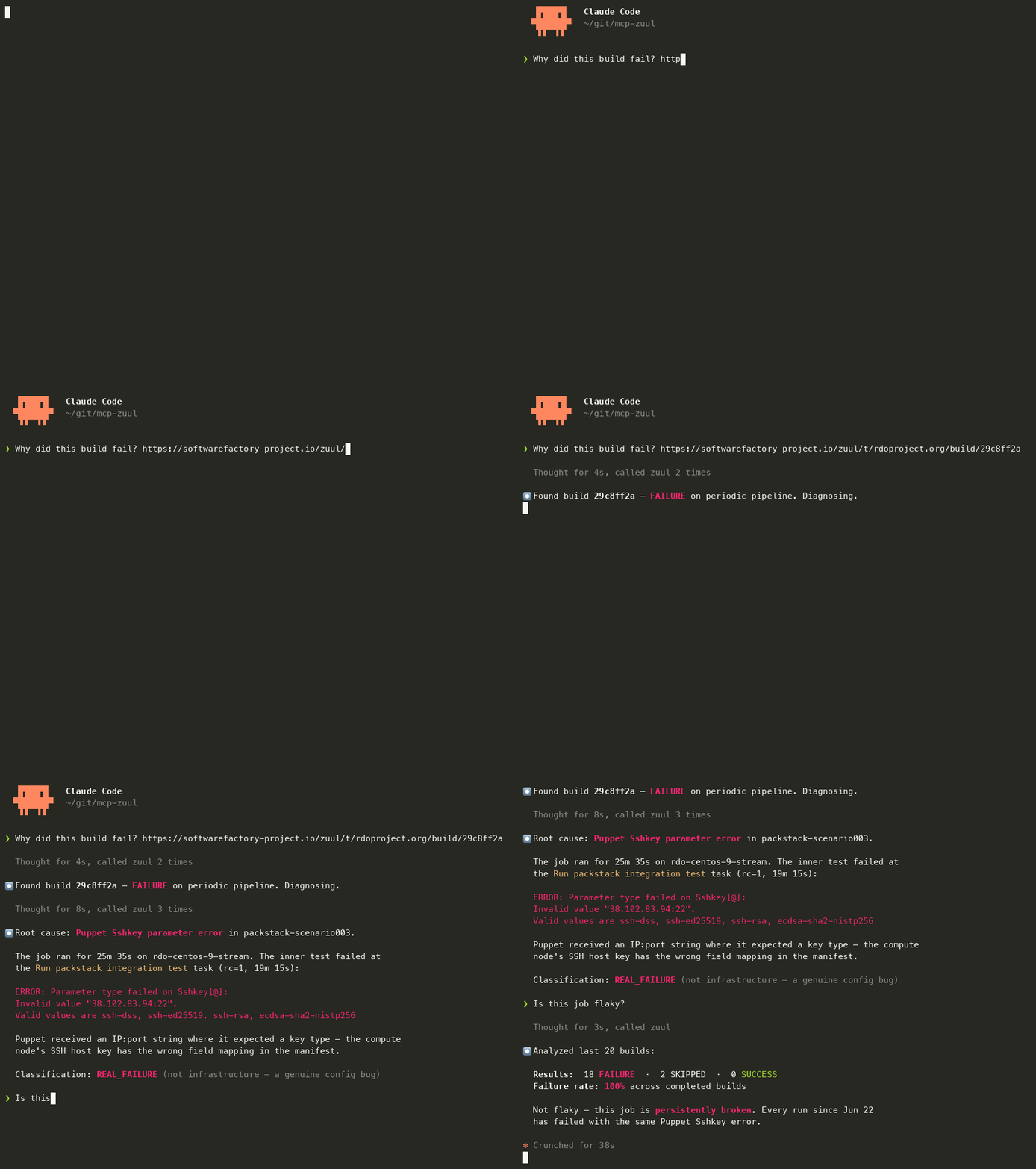
If mcp-zuul saves you a debugging session, a ā star helps others find it.
One command, no install:
claude mcp add zuul -e ZUUL_URL=https://your-zuul.example.com -- uvx mcp-zuul
45 tools, 3 prompts, 3 resources ā covering builds, logs, pipelines, jobs, infrastructure, and live status. Works with Claude Code, Claude Desktop, Cursor, Codex, Windsurf, and any MCP-compatible client.
Why mcp-zuul?
| mcp-zuul | Raw Zuul API | Zuul web UI | |
|---|---|---|---|
| Failure analysis | Structured ā task, host, error, rc | Raw JSON, parse yourself | Click through log pages |
| Log search | Regex + context lines + line ranges | Not available | Browser Ctrl+F |
| Flaky detection | Automatic pass/fail statistics | Manual query + calculate | Not available |
| Test results | Parsed JUnit XML with failure details | Not available | External link |
| Anomaly detection | ML-based via LogJuicer | Not available | Not available |
| Live status | Job progress, ETA, pre-failure alerts | Polling API | Manual refresh |
| Multi-instance | One config entry per Zuul | Different base URLs | Different browser tabs |
Quick Start
uvx (no install, recommended):
claude mcp add zuul \
-e ZUUL_URL=https://softwarefactory-project.io/zuul \
-e ZUUL_DEFAULT_TENANT=rdoproject.org \
-- uvx mcp-zuul
pip:
pip install mcp-zuul
Docker:
docker build -t mcp-zuul .
LobeHub ā send this to your AI agent:
Read https://lobehub.com/mcp/imatza-rh-mcp-zuul/skill.md and follow the instructions to install the MCP server.
See Setup for full configuration options including Kerberos and multi-instance.
Features
Structured failure analysis ā get_build_failures parses Zuul's job-output.json and returns exactly which Ansible task failed, on which host, with error message, return code, and stderr. No log scrolling needed.
Read any log file ā get_build_log isn't limited to job-output.txt. Pass log_name to read any file in the build's log directory (ci_script logs, ansible.log, deployment logs) with full grep, tail, and line-range support.
Precise log navigation ā Jump to exact line ranges with start_line/end_line. After finding an error at line 6148, read lines 6130-6160 instead of scrolling through 200-line chunks.
Smart grep ā Regex search with context lines. Auto-converts common shell-grep \| syntax to Python regex | so patterns like error\|failed\|timeout just work.
Live pipeline awareness ā get_change_status returns live job progress with elapsed times, estimated completion, and pre-failure detection (pre_fail field). When the change isn't in pipeline, automatically fetches the latest completed buildset.
Tool filtering ā Reduce LLM tool-selection noise with ZUUL_ENABLED_TOOLS or ZUUL_DISABLED_TOOLS. Only expose the tools your workflow needs ā the rest are removed from the server entirely.
URL-based input ā Paste a Zuul build URL directly. Tools auto-parse the tenant and UUID from URLs like https://zuul.example.com/t/tenant/build/abc123 ā no manual extraction needed.
Flaky job detection ā find_flaky_jobs analyzes recent build history and computes pass/fail statistics to identify intermittent failures automatically.
Job dependency graph ā get_freeze_jobs returns the fully-resolved job graph for a pipeline/project/branch, showing all jobs with their dependencies after inheritance resolution.
Kerberos/SPNEGO auth ā First-class support for Zuul instances behind OIDC + Kerberos. Drives the full SPNEGO redirect chain automatically. Session cookies persist and re-authenticate transparently on expiry.
Streamable HTTP transport ā Run as a persistent HTTP server with MCP_TRANSPORT=streamable-http for remote/shared deployment. Supports stdio (default), SSE, and streamable-http.
Write operations ā Enqueue/dequeue/promote changes, re-enqueue buildsets, and manage autoholds. Disabled by default (ZUUL_READ_ONLY=true), write tools are removed from the server entirely so LLMs don't even see them until explicitly enabled.
LogJuicer integration ā get_build_anomalies uses ML-based log analysis to find unusual lines by comparing failed logs against successful baselines. Optional ā requires LOGJUICER_URL.
Token-efficient output ā All responses strip None values and use compact formatters. tail_build_log returns just the last N lines ā the fastest way to check why a build failed.
Error handling ā All tools return JSON, errors included. Network failures, auth issues, and invalid parameters produce {"error": "descriptive message"}. Tools never raise unhandled exceptions.
Tools
Builds & Failures
| Tool | What it does |
|---|---|
list_builds | Search builds by project, pipeline, job, change, result. Includes buildset_uuid for cross-referencing. |
get_build | Full build details ā nodeset, log URL, artifacts, error detail. Accepts url or uuid. |
get_build_failures | Start here for failures. Structured task-level data from job-output.json ā failed play, task, host, msg, rc, stderr/stdout. Accepts url or uuid. |
diagnose_build | One-call failure diagnosis. Combines structured failures from job-output.json with targeted log context (fatal/FAILED lines with surrounding context from job-output.txt). Use instead of calling get_build_failures + get_build_log separately. Accepts url or uuid. |
get_build_log | Read and search log files. Modes: summary (tail + error lines), full (paginated), grep (regex + context), start_line/end_line (exact range). Supports log_name for any file. Accepts url or uuid. |
tail_build_log | Fastest failure check. Last N lines of a log (default 50, max 500). More token-efficient than get_build_log summary mode. Accepts url or uuid. |
browse_build_logs | List log directory contents or fetch specific files (inventory, artifacts, must-gather). Max 512KB per file. Accepts url or uuid. |
stream_build_console | Live console from RUNNING builds. Connects to Zuul WebSocket, returns last N lines (tail). For completed builds, use tail_build_log. Optional ā requires pip install mcp-zuul[console]. |
Buildsets
| Tool | What it does |
|---|---|
list_buildsets | Search buildsets. Use include_builds=true to inline full build details (saves round-trips). |
get_buildset | Full buildset with all builds and events. Accepts url or uuid. |
Pipeline & Status
| Tool | What it does |
|---|---|
get_status | Live pipeline status ā what's queued, running, with job progress and ETA. Filterable by pipeline and project. |
get_change_status | Status for a change/PR/MR. In pipeline: live jobs with elapsed times. Not in pipeline: auto-fetches latest completed buildset. Accepts url or change. |
list_pipelines | All pipelines with their trigger types. |
Jobs & Projects
| Tool | What it does |
|---|---|
list_tenants | All tenants with project counts. |
list_jobs | List jobs with optional name filter. |
get_job | Job configuration ā parent, nodeset, timeout, variants, source project. |
get_project | Which pipelines and jobs are configured for a project. |
list_projects | List all projects in a tenant with optional name filter. |
get_config_errors | Check this when jobs aren't running. Configuration errors, missing refs, broken configs. Filterable by project. |
get_freeze_jobs | Resolved job dependency graph for a pipeline/project/branch. Shows exactly which jobs will run with inheritance resolved. |
get_freeze_job | Resolved job config after inheritance. Final merged nodeset, playbooks, variables, and timeout for a specific job. Answers "what will this job actually do?" |
find_flaky_jobs | Analyze recent build history for intermittent failures. Computes pass/fail rate and flags jobs as flaky (>20% failure with mixed results). |
get_build_times | Build duration trends with avg/min/max stats. Detect performance regressions or timeout-prone jobs. |
get_job_durations | Batch avg/min/max duration for multiple jobs in one call. Designed for monitoring an entire pipeline chain without N separate calls. |
check_health | Test API connectivity, auth status, and config. Triggers re-auth automatically if the Kerberos session expired. |
get_tenant_info | Tenant capabilities ā auth realms, job history support, websocket URL. |
Infrastructure
| Tool | What it does |
|---|---|
list_nodes | Nodepool nodes with state (ready, in-use, building), provider, and label. Includes state summary. |
list_labels | Available nodepool labels ā what node types jobs can request. |
list_semaphores | Resource locks with current holders and max capacity. Check when jobs wait unexpectedly. |
list_autoholds | Active autohold requests ā nodes held after failure for debugging. |
get_autohold | Full details of a specific autohold request ā held nodes, timing, project/job. |
list_providers | Nodepool cloud providers with flavors (VM sizes), images, and labels. |
list_images | Nodepool disk images with build status and provider upload state. |
list_system_events | System events ā config updates, reconfigurations, pipeline changes. Useful for "why did my job stop running?" |
get_badge | CI status badge URL (SVG) for a project ā embeddable in READMEs with Markdown snippet. |
get_connections | Configured source connections ā Gerrit, GitHub, GitLab instances with driver and hostname. |
get_components | System components ā schedulers, executors, mergers, web servers with state and version. |
Write Operations
Disabled by default (ZUUL_READ_ONLY=true). Set ZUUL_READ_ONLY=false to enable. Requires auth token or Kerberos.
| Tool | What it does |
|---|---|
enqueue | Enqueue a change or ref into a pipeline. Supports both change-based (check/gate) and ref-based (periodic) enqueue. |
promote | Promote changes to the top of a pipeline queue. Use for urgent fixes when gate has a long queue. |
reenqueue_buildset | Re-enqueue a buildset ā reads project/pipeline/ref from a previous buildset and enqueues it again. |
dequeue | Remove a change or ref from a pipeline. Destructive. |
autohold_create | Create an autohold request ā hold nodes after failure for debugging. |
autohold_delete | Delete an autohold request. Destructive. |
Test Results & Log Analysis
| Tool | What it does |
|---|---|
get_build_test_results | Parse JUnit XML test results. Discovers test files via zuul-manifest.json, returns structured pass/fail/skip counts with failure details. Works with tempest, tobiko, and any JUnit XML output. |
get_build_anomalies | ML-based log anomaly detection via LogJuicer. Compares failed logs against successful baselines. Requires LOGJUICER_URL. |
Prompts
Pre-built prompt templates that pre-load context and guide analysis:
| Prompt | What it does |
|---|---|
debug_build | Fetches build details + structured failures, checks for flaky signal from recent history, then guides root cause analysis. |
compare_builds | Loads two builds side-by-side with inline failure data for differential analysis ā "why did this start failing?" |
check_change | Determines live pipeline status or latest results for a change, with appropriate next steps. |
Resources
Browsable context that clients can attach to conversations without tool calls:
| Resource | URI Pattern |
|---|---|
| Build details | zuul://{tenant}/build/{uuid} |
| Job configuration | zuul://{tenant}/job/{name} |
| Project configuration | zuul://{tenant}/project/{org}/{repo} |
Setup
MCP client configuration
All clients use the same JSON structure. Add to your client's MCP config file:
Claude Code (~/.claude.json ā mcpServers):
{
"mcpServers": {
"zuul": {
"command": "uvx",
"args": ["mcp-zuul"],
"env": {
"ZUUL_URL": "https://softwarefactory-project.io/zuul",
"ZUUL_DEFAULT_TENANT": "rdoproject.org"
}
}
}
}
Claude Desktop (claude_desktop_config.json), Cursor (.cursor/mcp.json), and other MCP clients use the same format. GUI-based clients don't inherit your shell PATH - use the full path to uvx (run which uvx to find it).
Or via CLI:
claude mcp add zuul \
-e ZUUL_URL=https://softwarefactory-project.io/zuul \
-e ZUUL_DEFAULT_TENANT=rdoproject.org \
-- uvx mcp-zuul
Environment variables
| Variable | Required | Default | Description |
|---|---|---|---|
ZUUL_URL | Yes | ā | Zuul base URL (e.g. https://softwarefactory-project.io/zuul) |
ZUUL_DEFAULT_TENANT | No | ā | Default tenant (saves passing tenant on every call) |
ZUUL_AUTH_TOKEN | No | ā | Bearer token for authenticated instances |
ZUUL_USE_KERBEROS | No | false | Enable Kerberos/SPNEGO authentication |
ZUUL_TIMEOUT | No | 30 | HTTP timeout in seconds |
ZUUL_VERIFY_SSL | No | true | SSL certificate verification |
MCP_TRANSPORT | No | stdio | Transport: stdio, sse, or streamable-http |
MCP_HOST | No | 127.0.0.1 | HTTP server bind address (non-stdio transports) |
MCP_PORT | No | 8000 | HTTP server port (non-stdio transports) |
ZUUL_ENABLED_TOOLS | No | ā | Comma-separated list of tools to enable (disables all others) |
ZUUL_DISABLED_TOOLS | No | ā | Comma-separated list of tools to disable (mutually exclusive with above) |
ZUUL_READ_ONLY | No | true | Set to false to enable write operations (enqueue, promote, dequeue, reenqueue_buildset, autohold) |
LOGJUICER_URL | No | ā | LogJuicer base URL for ML-based log anomaly detection |
Token authentication
Pass ZUUL_AUTH_TOKEN via host environment ā never hardcode tokens in config files (visible in ps output):
export ZUUL_AUTH_TOKEN=<your-token>
For Docker, forward without a value to inherit from host:
"args": ["run", "-i", "--rm", "-e", "ZUUL_AUTH_TOKEN", "mcp-zuul"]
Kerberos / SPNEGO
For Zuul behind OIDC + Kerberos. Requires a valid Kerberos ticket (kinit) and the gssapi package.
Linux prerequisites - gssapi has no pre-built Linux wheels and must compile from source:
# Fedora/RHEL/CentOS
sudo dnf install krb5-devel python3-devel gcc
# Debian/Ubuntu
sudo apt install libkrb5-dev python3-dev gcc
macOS and Windows have pre-built wheels - no extra packages needed.
Then install with Kerberos support:
pip install mcp-zuul[kerberos] # or: uvx --with "mcp-zuul[kerberos]" mcp-zuul
Via CLI:
claude mcp add -s user zuul-internal \
-e ZUUL_URL=https://internal-zuul.example.com/zuul \
-e ZUUL_DEFAULT_TENANT=my-tenant \
-e ZUUL_USE_KERBEROS=true \
-e ZUUL_VERIFY_SSL=false \
-- uvx --with "mcp-zuul[kerberos]" mcp-zuul
Or via JSON config:
{
"zuul-internal": {
"command": "uvx",
"args": ["--with", "mcp-zuul[kerberos]", "mcp-zuul"],
"env": {
"ZUUL_URL": "https://internal-zuul.example.com/zuul",
"ZUUL_USE_KERBEROS": "true",
"ZUUL_VERIFY_SSL": "false"
}
}
}
For Docker, mount the Kerberos ticket cache:
docker run -i --rm \
-v /etc/krb5.conf:/etc/krb5.conf:ro \
-v /tmp/krb5cc_$(id -u):/tmp/krb5cc_$(id -u):ro \
-e KRB5CCNAME=/tmp/krb5cc_$(id -u) \
-e ZUUL_URL=https://internal-zuul.example.com/zuul \
-e ZUUL_USE_KERBEROS=true \
mcp-zuul
Multiple instances
Add separate entries per Zuul instance:
{
"mcpServers": {
"zuul-rdo": {
"command": "uvx", "args": ["mcp-zuul"],
"env": { "ZUUL_URL": "https://softwarefactory-project.io/zuul", "ZUUL_DEFAULT_TENANT": "rdoproject.org" }
},
"zuul-internal": {
"command": "mcp-zuul",
"env": { "ZUUL_URL": "https://internal.example.com/zuul", "ZUUL_USE_KERBEROS": "true" }
}
}
}
Troubleshooting
krb5-config: not found or Python.h: No such file when installing mcp-zuul[kerberos] on Linux:
gssapi has no pre-built Linux wheels - it compiles from source. Install system packages first:
# Fedora/RHEL/CentOS
sudo dnf install krb5-devel python3-devel gcc
# Debian/Ubuntu
sudo apt install libkrb5-dev python3-dev gcc
uvx: command not found in Cursor or Claude Desktop:
GUI-based MCP clients don't inherit your shell PATH. Use the full path to uvx:
which uvx # find the path, e.g. /usr/bin/uvx or ~/.local/bin/uvx
Then use that absolute path as command in your MCP config:
"command": "/usr/bin/uvx"
Permission errors on ~/.local/share/uv/:
If uv was previously run with sudo, the cache directory may be root-owned:
sudo chown -R $(whoami) ~/.local/share/uv/
Usage Examples
Debug a build failure
"Why did the latest build of my-project fail?"
ā list_builds(project="my-project", result="FAILURE", limit=1) ā get_build_failures(uuid="...") ā root cause with task name, error, and return code.
Deep-dive into logs
"The structured data says 'non-zero return code' but no error detail.
Check the ci_script logs."
ā browse_build_logs(uuid="...", path="controller/ci-framework-data/logs/") ā finds ci_script_008_run.log ā get_build_log(uuid="...", log_name="controller/ci-framework-data/logs/ci_script_008_run.log", grep="error|timed out|Error 1", context=2) ā exact error with surrounding context.
Navigate to a specific error
"Show me lines 6478-6484 of the job output"
ā get_build_log(uuid="...", start_line=6478, end_line=6484) ā exactly those 7 lines.
Check live pipeline status
"Is change 54321 in any pipeline?"
ā get_change_status(change="54321") ā live jobs with elapsed times and ETA, or latest completed buildset if not in pipeline.
Compare build results across a pipeline
"Show me all builds from the latest buildset"
ā list_builds to get buildset_uuid ā get_buildset(uuid="...") ā all sibling builds with results and durations.
Paste a Zuul URL directly
"What went wrong with this build?
https://zuul.example.com/t/tenant/build/abc123def"
ā get_build_failures(url="https://zuul.example.com/t/tenant/build/abc123def") ā tenant and UUID auto-extracted.
Debug why a job isn't running
"My project's check pipeline seems broken ā jobs aren't triggering"
ā get_config_errors(project="org/my-project") ā configuration errors, missing refs, or repo access issues.
Check node availability
"Jobs are stuck in queue ā are there nodes available?"
ā list_nodes() ā node states with by_state summary ā list_labels() ā available node types.
Detect flaky jobs
"Is this job flaky? It keeps failing intermittently"
ā find_flaky_jobs(job_name="my-deploy-job", limit=30) ā pass/fail stats, failure rate, flaky=true/false.
See what jobs run for a project
"What jobs are configured for openstack-operator in the check pipeline?"
ā get_freeze_jobs(pipeline="check", project="openstack-k8s-operators/openstack-operator") ā resolved job graph with dependencies.
Quick log tail
"Show me the last 30 lines of the build log"
ā tail_build_log(uuid="...", lines=30) ā just the tail, minimal tokens.
What nodeset does my job use after inheritance?
"What nodeset and playbooks will deploy-job actually use?"
ā get_freeze_job(pipeline="check", project="org/repo", job_name="deploy-job") ā resolved nodeset, playbooks, variables, timeout after all parent inheritance.
Development
git clone https://github.com/imatza-rh/mcp-zuul.git
cd mcp-zuul
uv sync --extra dev
# Run locally
ZUUL_URL=https://softwarefactory-project.io/zuul uv run mcp-zuul
# Run tests
uv run pytest tests/ -v
# Lint and format
uv run ruff check src/ tests/
uv run ruff format --check src/ tests/
# Type check
uv run mypy src/mcp_zuul/
# Build Docker image
docker build -t mcp-zuul .
Architecture
MCP Client (Claude Code, Cursor, etc.)
ā
ā¼
āāāāāāāāāāāāāāāāāāāāāāāāāāāāāāāāāāāāāāāāāāāāāāāāāāāā
ā src/mcp_zuul/ ā
ā ā
ā server.py FastMCP instance ā
ā config.py env vars, transport, filtering ā
ā auth.py Kerberos/SPNEGO + OIDC ā
ā errors.py @handle_errors decorator ā
āāāāāāāāāāāāāāāāāāāāāāāāāāāāāāāāāāāāāāāāāāāāāāāāāāāā¤
ā tools/ 45 tools across 8 submodules ā
ā prompts.py 3 prompt templates ā
ā resources.py 3 zuul:// resources ā
āāāāāāāāāāāāāāāāāāāāāāāāāāāāāāāāāāāāāāāāāāāāāāāāāāāā¤
ā helpers.py API client, URL parsing ā
ā formatters.py token-efficient output ā
ā parsers.py Ansible/JUnit/log parsing ā
ā classifier.py failure classification ā
āāāāāāāāāāāāāāāāāāāāāāāāāāāāāāāāāāāāāāāāāāāāāāāāāāāā¤
ā httpx clients API (auth) + logs (no auth) ā
āāāāāāāāāā¬āāāāāāāāāāāāāāāāāāāāāāāāāā¬āāāāāāāāāāāāāāāā
ā¼ ā¼
Zuul REST API Log file hosts
See CLAUDE.md for full architecture details.
Listings
- PyPI ā
pip install mcp-zuul - Glama ā Quality: A/A/A
- Conare ā Marketplace listing
- PulseMCP ā Server directory
- LobeHub ā MCP marketplace with agent install
- HiFriendBot ā AI tools directory
- pepy.tech ā Download statistics
- Docker ā
ghcr.io/imatza-rh/mcp-zuul
Contributing
Contributions welcome. Please open an issue first to discuss significant changes.
# Fork, clone, and install dev dependencies
uv sync --extra dev
# Make changes, then verify
uv run pytest tests/ -v
uv run ruff check src/ tests/
uv run ruff format src/ tests/
uv run mypy src/mcp_zuul/
License
Apache-2.0