Ignite UI MCP Server README
The full upstream README, mirrored here for reference. Install config, tool schemas, adoption signals, and an original overview live on the Ignite UI MCP Server listing page.
Ignite UI CLI




Quickly create projects, including Ignite UI for Angular and Ignite UI for Web Components, for a variety of frameworks.
Overview
Features:
- Create project structure
- Add views with Ignite UI components (e.g. Combo, Grid or Chart)
- Add scenario based templates with multiple components (e.g. a dashboard)
- Build and install npm packages
- Select a theme, support for custom themes coming soon
- Step by step guide
Supported frameworks
- Angular
- React
- Web Components
- Blazor
- jQuery
Prerequisites
The repository houses multiple packages and orchestrates building and publishing them with lerna and yarn workspaces.
In order to build the repository locally, you need to have yarn installed on your machine.
For installation instructions, please visit their official page
Packages
This monorepo contains several packages that combine into the igniteui-cli:
| Package | Description | Location |
|---|---|---|
| @igniteui/cli-core | Contains the core functionality of the cli tool | packages/core |
| @igniteui/angular-templates | Contains the template definitions for Angular components | packages/igx-templates |
| @igniteui/angular-schematics | IgniteUI CLI implementation to be used with Angular CLI's schematics engine | packages/ng-schematics |
| igniteui-cli | Standalone IgniteUI CLI tool for React, Blazor, Angular, jQuery and Web Components | packages/cli |
| @igniteui/mcp-server | MCP server providing AI assistants with Ignite UI documentation and API reference | packages/igniteui-mcp/igniteui-doc-mcp |
Table of Contents
Installation
Install the npm package as a global module:
Usage
The main entry point is igniteui and is also aliased as ig. Both can be used interchangeably to call available commands. Check out our Wiki documentation for more details.
Step by step
To get a guided experience through the available options, simply run:
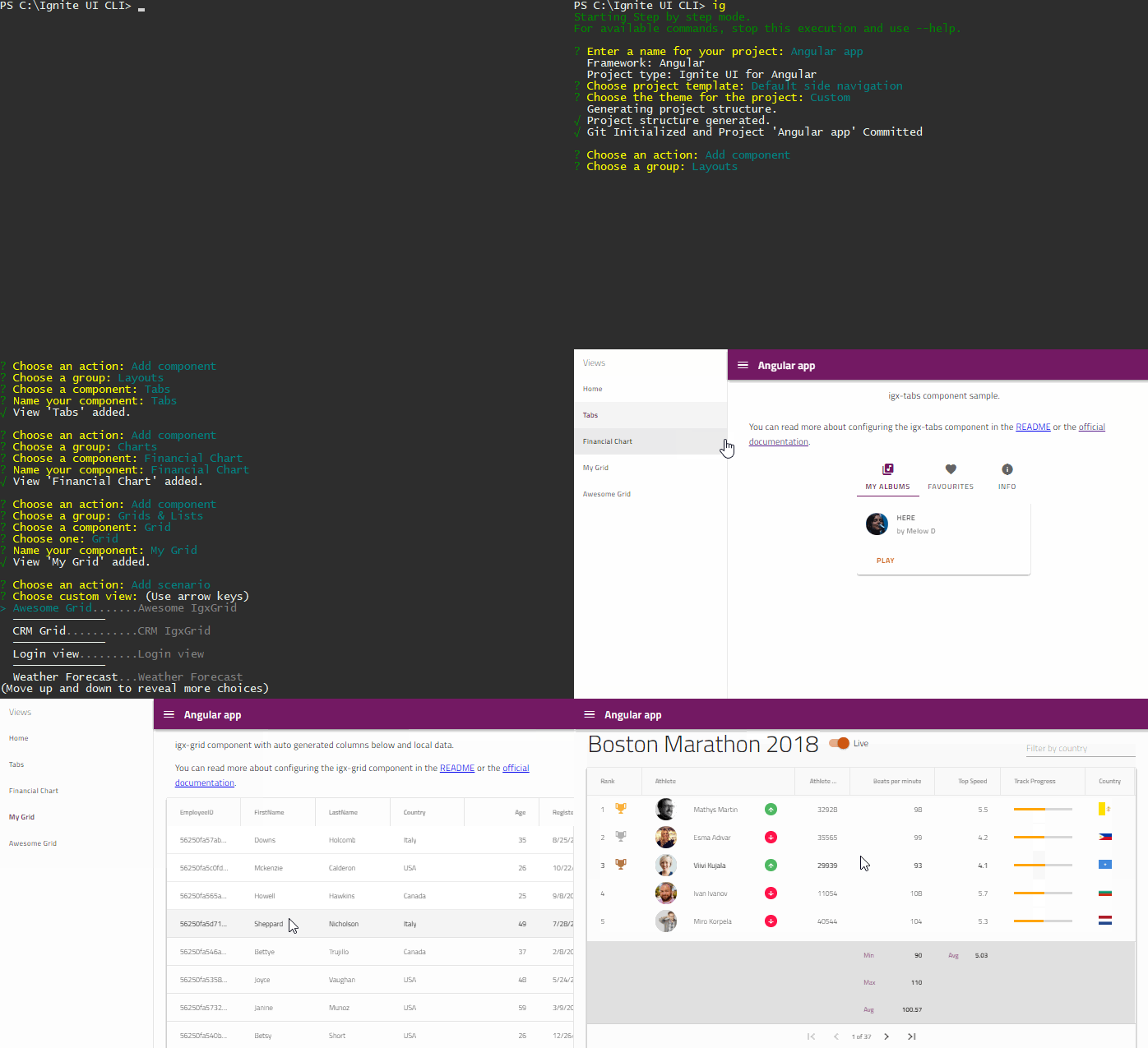
Upon creation, project will be automatically loaded in the default browser.
NOTE: If that doesn't happen the port may be already in use. Ports vary for different project types, see the description for the ig start command for details on default ports.
List the available commands.
Generating projects and adding components
Create a new project passing name, framework and style theme.
This will create the project and will install the needed dependencies.
Parameters besides name are optional. Framework defaults to "angular", project type defaults to the first available in the framework and theme to the first available for the project. For more information visit ig new Wiki page.
Generate Ignite UI for Angular project
To create a new project with Ignite UI for Angular use ig new by specifying angular as framework, and optionally igx-ts as project type and selecting one of the project templates:
Generate Ignite UI for React project
To create a new project with Ignite UI for React use ig new by specifying react as framework and igr-ts as project type:
Generate Ignite UI for Web Components project
To create a new project with Ignite UI for Web Components use ig new by specifying webcomponents as framework:
Adding components
Once you have created a project, at any point you can add additional component templates using ig add. Running the command without parameters will guide you through the available templates:
Add a new component or template to the project passing component ID and choosing a name.
The ID matches either a component ("grid", "combo", "text-editor", etc) or a predefined template. Predefined templates are framework/project specific and can provide predefined views with either multiple components or fulfilling a specific use case like "form-validation", "master-detail" and so on.
For full list of supported templates in the current project you can simply run ig list command:
Build and run
Configure AI Tooling
Ignite UI provides rich AI assisted development toolchain. To configure Ignite UI AI tooling — MCP servers and AI coding skills — run:
You will be prompted with two selections:
- AI agents — which tools to generate skill and instruction files for (Generic and Claude are selected by default)
- Coding assistants — which assistants to configure MCP servers for (general
.mcp.jsonis selected by default, compatible with Claude Code, VS Code, and others)
You can also pass options directly:
This creates or updates the assistant-specific MCP config file (e.g. .mcp.json, .vscode/mcp.json, .cursor/mcp.json) with entries for the Ignite UI MCP and igniteui-theming MCP servers (existing servers are preserved), copies AI coding skill files from installed Ignite UI packages, and generates agent-specific instruction files (e.g. CLAUDE.md, AGENTS.md).
The ig new command also prompts for AI tool configuration as part of project creation.
MCP Server
The CLI includes a bundled MCP (Model Context Protocol) server that provides AI assistants with Ignite UI documentation search, API reference lookup, and scaffolding guidance for Angular, React, Blazor, and Web Components.
Start the MCP server:
The server runs over stdio and supports the following options:
Using with AI Assistants
For VS Code, the ig ai-config command handles configuration automatically (see above). For other MCP clients (e.g., Claude Desktop, Cursor), configure them manually:
The MCP server exposes the following tools to AI assistants:
| Tool | Description |
|---|---|
list_components | List available Ignite UI component docs. Filter by framework and optional keyword match against filename, component name, keywords, or summary. |
get_doc | Return the full markdown content of a specific component doc by name (e.g., grid-editing, accordion). |
search_docs | Full-text search across Ignite UI docs for a specific framework. Supports prefix matching (e.g., grid*). |
search_api | Search Ignite UI API entries by keyword, feature name, or partial component name. |
get_api_reference | Return the full API reference for a specific Ignite UI component or class by exact name. |
get_project_setup_guide | Returns setup guides for creating a new Ignite UI project. For Angular/React/Web Components: CLI scaffolding instructions. For Blazor: dotnet new + NuGet setup guide. |
Testing with MCP Inspector
To interactively test and debug the MCP server tools:
Schematics
You can also add Ignite UI for Angular components to your projects by using the igniteui/angular-schematics package. It included schematic definitions for most of the logic present in the igniteui-cli. These can be called in any existing Angular project or even when creating one. You can learn more about the schematics package on from its readme.
Contribution
See the Contribution guide to get started.
Run locally
-
Clone the repository
-
Install dependencies with
yarn install -
Build the MCP server and bundle it into the CLI:
-
Build the monorepo packages:
npm run build -
Open in Visual Studio Code
There is a predefined launch.config file for VS Code in the root folder, so you can use VS Code View/Debug window and choose one of the predefined actions. These include launching the step by step guide, create new project for a particular framework or add components.
-
Hit Start Debugging/F5
Template smoke test
scripts/smoke-test.sh drives the locally built CLI end to end: it scaffolds a project, adds
every component template into it, installs, and builds. The Jasmine specs under spec/ stub out
PackageManager.installPackages, so they verify that files land on disk but never that the result
installs or compiles — this script covers that gap.
Options:
| Option | Meaning |
|---|---|
-f, --frameworks LIST | comma separated; default angular,react,webcomponents |
-p, --project ID | project template to scaffold (default: the framework's own default) |
--all-projects | scaffold and build every project template, skip component adds |
--templates LIST | only these component template ids — the fast path when iterating |
--isolate | one project per component template; slow, use to bisect a failure |
--skip-build | scaffold and add only |
--keep | keep the generated projects even when everything passes |
-o, --out DIR | work directory (default output/smoke, which is gitignored) — wiped on each run, see below |
-j, --jobs N | frameworks to run in parallel (default 1) |
Per-step logs land in <out>/logs/, and <out>/results.tsv is a machine-readable
framework / step / template / status / seconds table. The script exits non-zero if any step
failed and prints a summary of the failures.
The work directory is deleted and recreated on every run, so the script refuses to touch anything
it cannot show is its own: the filesystem root, your home directory, the repository or any directory
containing it, and any non-empty directory that lacks either the .smoke-test-workdir sentinel it
drops or the results.tsv of an earlier run. Point --out elsewhere, or remove the directory
yourself, if you hit that.
Two things to know if you modify it:
- All
igcalls must happen beforenpm install.packages/cli/bin/execute.jsdelegates tonode_modules/igniteui-cliwhenever one resolves inside the current directory, and every project template listsigniteui-clias a devDependency — so once a generated project has been installed,ig addsilently switches to the published CLI and its bundled templates. Scaffolding with--skip-installkeepsPackageManager.queuePackagefrom spawning installs, so dependencies are written topackage.jsonand installed once at the end. - Exit codes are not sufficient.
Util.errorlogs and returns without setting one, soig add does-not-exist xexits 0. Each step is judged on its exit code and an error scan of its log and an artifact check.
jQuery and Blazor are opt-in via -f. jQuery has no build script and 13 of its templates pull
ignite-ui-full from the Infragistics ProGet feed, which needs credentials; Blazor needs the .NET
SDK and has no component templates, so only dotnet build runs.
MCP Server development
The MCP server at packages/igniteui-mcp/igniteui-doc-mcp has its own build pipeline, separate from the monorepo. It uses ESM (ES2022, Node16 modules) while the rest of the monorepo uses CommonJS. See DEVELOPMENT.md for the full MCP server development guide.
Build the MCP server:
Build API reference documentation:
The MCP server includes API reference docs for Angular, React, and Web Components. Angular and Web Components docs are generated from framework submodules via TypeDoc (submodules are auto-initialized by the build scripts). React uses a pre-built TypeDoc JSON model checked into git.
Note: Web Components requires a one-time library build (
npm run build:publishin the submodule) before TypeDoc can run. The build script handles this automatically.
Build MCP server (from the repo root):
Test the MCP server locally:
Building CLI package with bundled MCP server
The CLI package includes the MCP server as a bundled build artifact (not an npm dependency). To produce a complete CLI package with full MCP functionality, follow these steps:
After step 5, npm pack from the repo root or packages/cli/ will produce a tarball with the MCP server, documentation database, and API reference docs all included.
Skipping API docs: If you skip step 3, the MCP server will still work for
list_components,get_doc,search_docs, andget_project_setup_guidetools using the bundled SQLite database. Only theget_api_referenceandsearch_apitools require API docs.
Data Collection
The Ignite UI CLI tool uses Google Analytics to anonymously report feature usage statistics and basic crash reports. This data is used to help improve the Ignite UI CLI tools over time. You can opt out of analytics before any data is sent by using
when using the CLI. You can read Infragistics privacy policy at https://www.infragistics.com/legal/privacy.