Manage a self-hosted DNS firewall: block domains, create policies, read query logs and metrics.
Quick Install
Automated & IDE SetupCopy the AI prompt to install this server into Claude Code, Cursor, or another agent — or use 1-click editor setup below.
One-click editor setup isn’t available for this listing yet — we don’t have a confirmed install command, and we’d rather show nothing than point your editor at the wrong package or host. Follow the project’s own setup instructions, linked above.
Manual Client & Custom JSON ConfigExpand JSON ▾
No confirmed setup config for this listing yet. We only publish a config block when the install details come from the project itself — its README, its docs, or a verified owner. We haven’t found those for HydraDNS, and we’d rather show nothing than a guess you’d paste into your client. Follow the project’s own setup instructions for the current steps.
Documentation Overview
HydraDNS
A self-hosted DNS firewall in Go. Blocks ads, malware and trackers network-wide, like Pi-hole. API-first control plane, a real dashboard, a CLI, and a built-in Model Context Protocol server so Claude or any MCP agent can manage policy for you.





Screenshots and product site at hydradns.app (a marketing site with static screenshots, not an interactive demo)
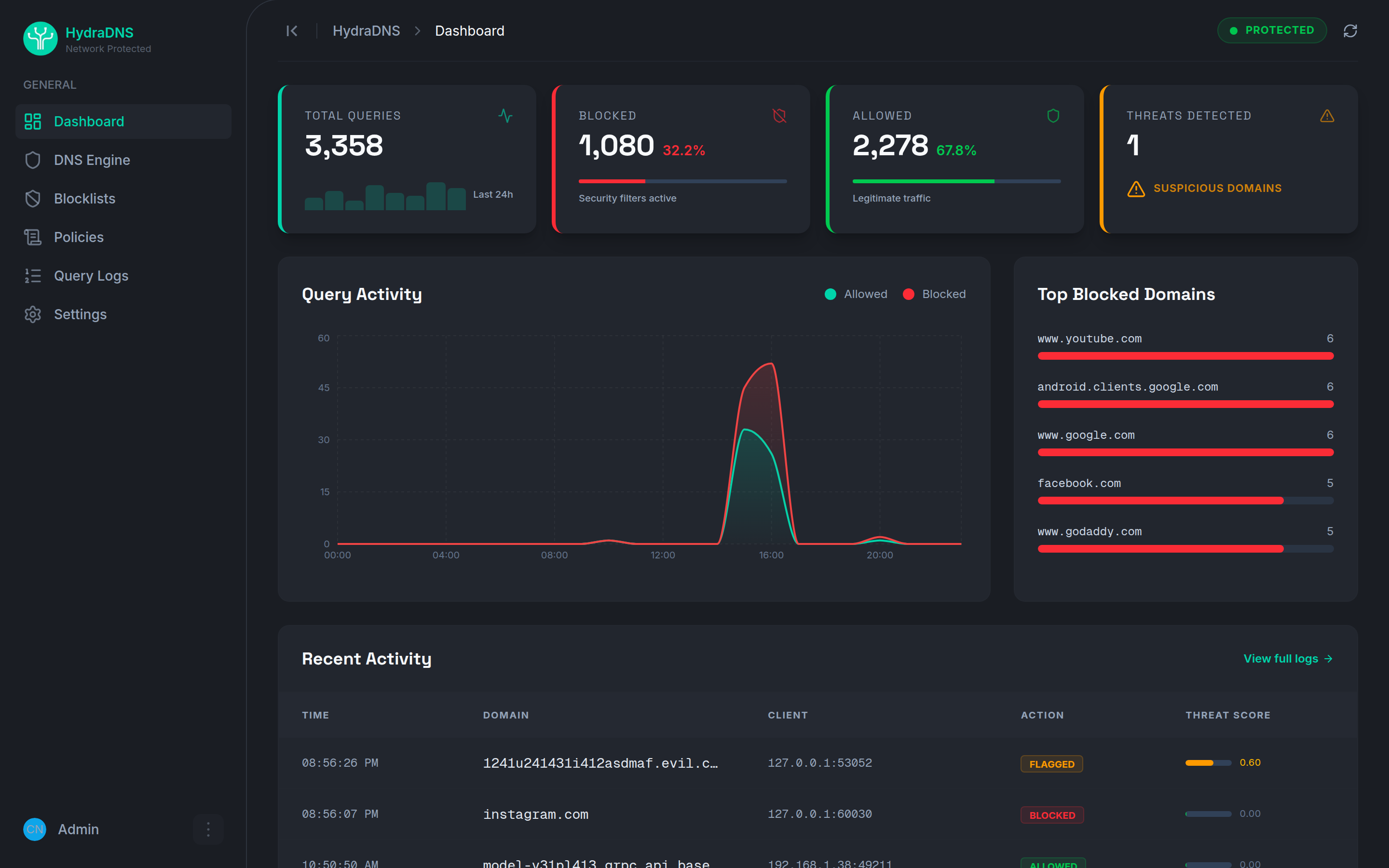
HydraDNS vs Pi-hole
| HydraDNS | Pi-hole | |
|---|---|---|
| Core | Go, gRPC control/data plane split | C (pihole-FTL), embedded web server |
| Setup | docker compose up -d pulls the published core + dashboard images once a release exists, and builds them from source before that | installer script or Docker |
| AI management (MCP) | ✅ built in (hydra mcp, 14 tools: block/unblock, policies, logs, metrics, anomaly explain) | ❌ third-party community bridges only |
| DoH bypass blocking | ✅ curated DoH bootstrap endpoints blocked at query time | ⚠️ Firefox canary domain only; add third-party lists for the rest |
| Policies | priority-based allow/block/redirect via API or UI; CLI covers block/unblock/list/delete (no generic create yet) | groups, regex, and per-client rules (more mature today) |
| Maturity | young, pre-1.0, moving fast | 10+ years, huge community, built-in DHCP |
Choose Pi-hole today for battle-tested stability, regex rules, and community support. Choose HydraDNS for a hackable Go codebase, an API-first control plane, and AI-agent management over MCP that self-hosted alternatives only get through third-party bridges.
Honest limits: like every DNS-layer filter, HydraDNS cannot stop a client that hardcodes a DoH server by raw IP. Pair it with a firewall rule on 443/853 to close that path. For the fuller list (no TLS on the dashboard/gRPC yet, no DNSSEC, regex/wildcard policies not enforced, and more), see docs/limitations.md.
Why HydraDNS
I spent 15 months building an enterprise next-generation firewall in Go, and kept wishing the self-hosted version of that tooling existed: something a home or small-office network could run, with a real API and a control plane you could drive from a script or an AI agent instead of a settings page. HydraDNS is that tool. The built-in Model Context Protocol server comes from the same work I do upstream as a CNCF Jaeger contributor, where I build MCP tooling for observability.
It is pre-1.0 and moving fast. If it is useful to you, a star and an issue both help.
Built by Roshan Singh (@lopster568).
Quick Start
Port 53 already in use? On Linux or WSL2,
systemd-resolvedmay already hold port 53. Free it before starting:sudo systemctl disable --now systemd-resolved(then set a DNS server in/etc/resolv.conf), or edit the port mapping indocker-compose.yml. See docs/pi-deployment.md for details.
That's it. DNS filtering is active. Give this machine a static IP and point your router's DNS to it. See docs/pi-deployment.md for static IP setup on Linux, macOS, and Windows plus per-router DNS instructions.
Architecture
| Service | Directory | Tech | Port |
|---|---|---|---|
| Core (Control + Data Plane) | apps/core | Go 1.26, Gin, gRPC, GORM/SQLite | 8080, 53 |
| Dashboard | apps/ui | Next.js 16, React 19, TypeScript, Tailwind | 3000 |
| Scanner | apps/scanner | Go, network detection | — |
| CLI + MCP | apps/cli | Go, Cobra, JSON-RPC 2.0 | — |
DNS Query Pipeline
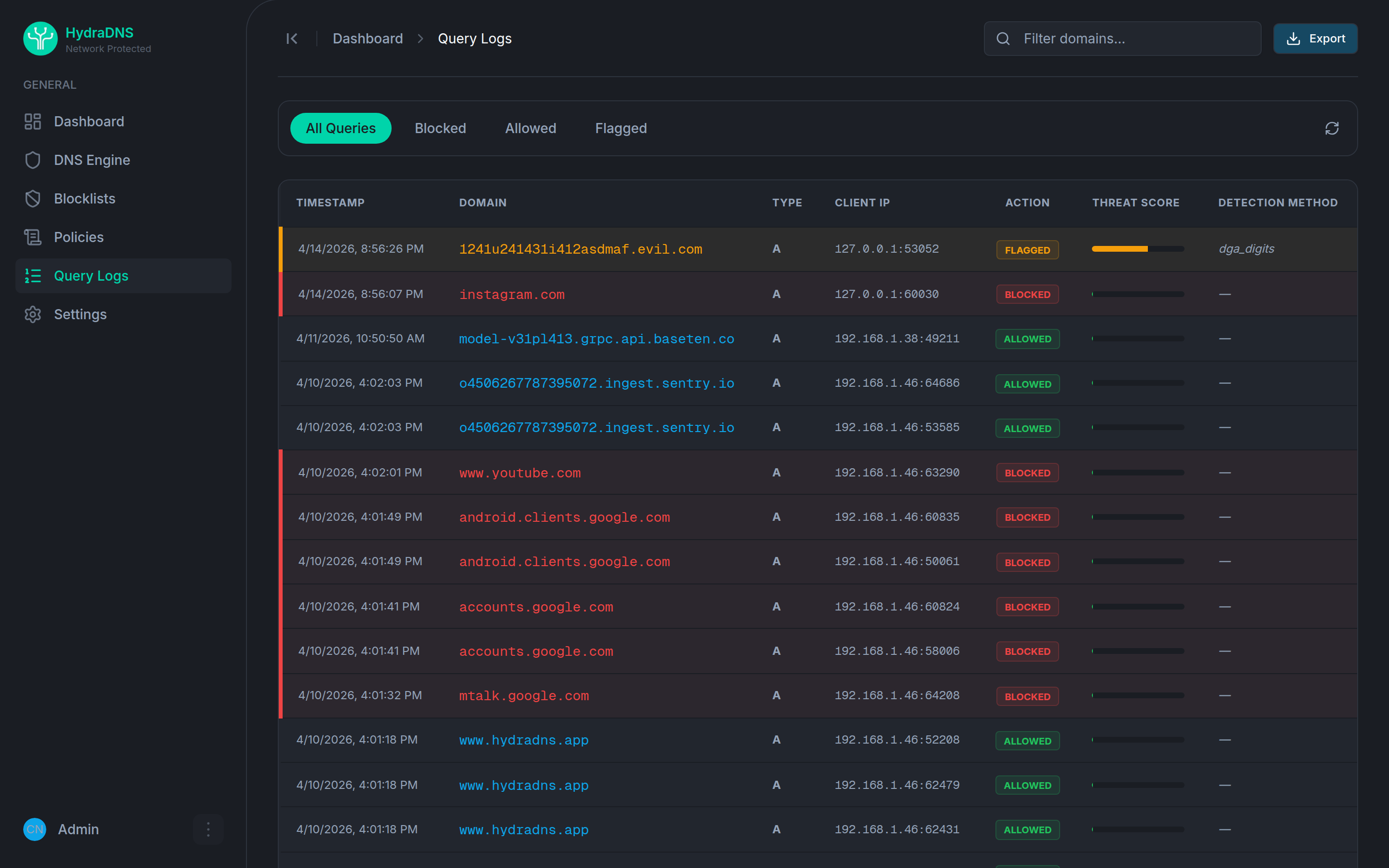
Every DNS query is scored by a heuristic threat detector (domain entropy, DGA-pattern, length, subdomain depth); scoring is non-blocking and only tags the query log, with no auto-block yet. The query then goes through this pipeline with early exit:
- DoH bootstrap interception: known DoH provider bootstrap hostnames get NXDOMAIN so browsers fall back to system DNS
- Blocklist check: in-memory membership test; if the domain is blocked, respond per
BLOCK_RESPONSE(default: A/AAAA →0.0.0.0/::;nxdomainandrefusedalso available) - Policy evaluation: Bloom filter for O(1) negative lookup, then exact match. Highest priority wins
- Response cache: TTL-respecting LRU for allowed queries; blocked/redirect responses are never cached
- Upstream forward: pool-per-resolver with failover (1.5s per-attempt timeout, 2 retries)
Dashboard
The web dashboard at localhost:3000 lets you:
- View real-time query statistics (total, blocked, allowed, block rate)
- Toggle the DNS engine on/off
- Manage blocklist sources (add/remove/view domain counts)
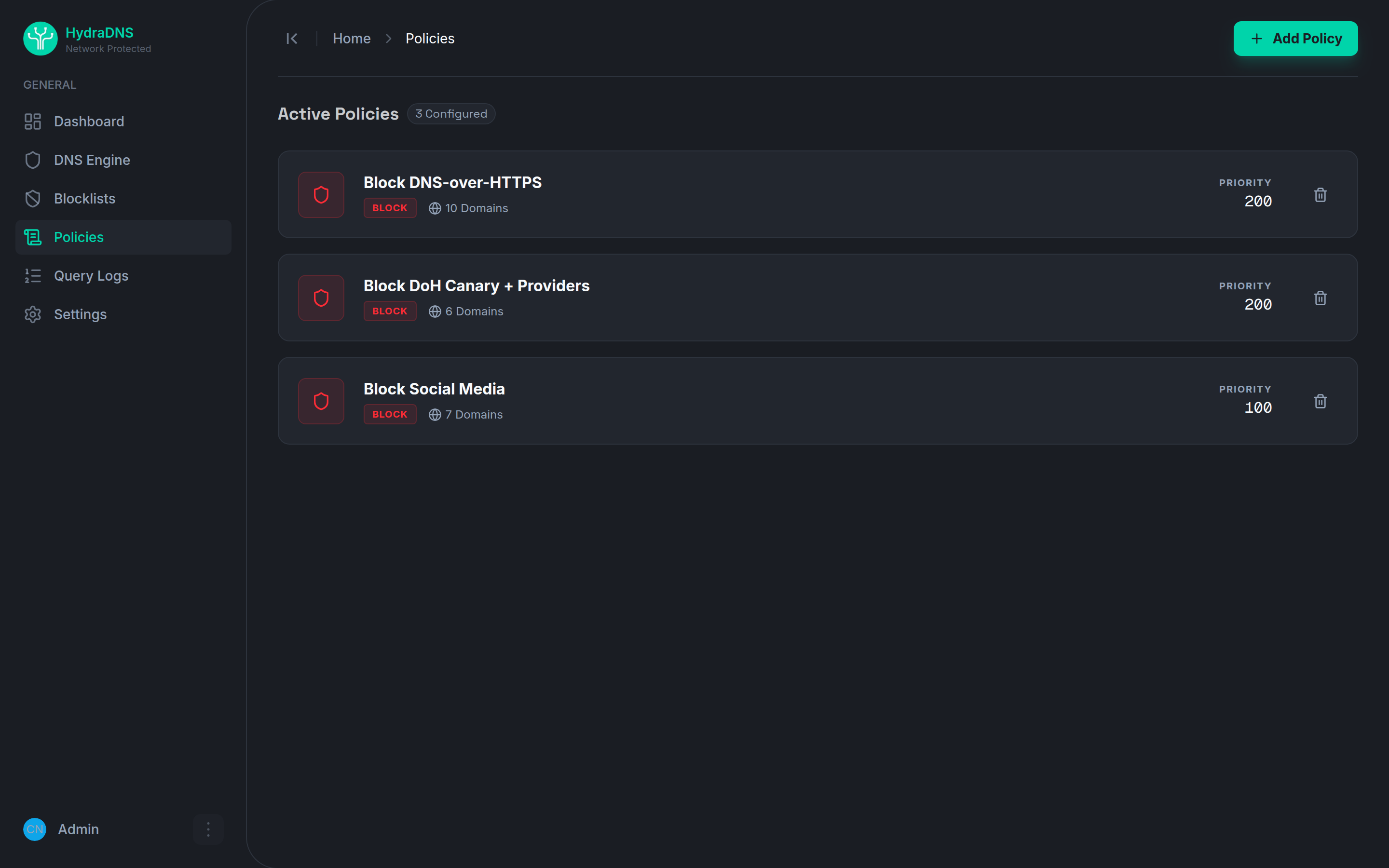
- Create and delete DNS policies (block, allow, redirect)
- Search and filter query logs
CLI
The hydra CLI wraps the control plane API for terminal-based management.
Set HYDRA_API_URL to point at a remote instance (default: http://localhost:8080).
MCP Server (AI Integration)
HydraDNS includes a built-in Model Context Protocol server, letting AI assistants manage your DNS firewall conversationally.
Claude Code Setup
Add to your Claude Code MCP config:
Available MCP Tools
| Tool | Description |
|---|---|
get_status | Engine status and query statistics |
toggle_engine | Enable or disable DNS engine |
block_domain | Block a domain (creates a policy) |
unblock_domain | Remove a block policy |
list_policies | List all DNS policies |
list_blocklists | List blocklist sources |
get_query_logs | Recent DNS query logs |
get_metrics | Latency percentiles and performance grade |
create_policy | Create an allow/block/redirect policy |
delete_policy | Delete a policy by ID |
bulk_unblock | Remove block policies for many domains at once |
get_weekly_summary | Week-over-week query and block summary |
explain_anomaly | Explain a block-rate or volume anomaly |
compare_to_last_month | Compare current stats against the previous month |
Example conversation: Say "Block all social media domains" and Claude calls block_domain for each domain.
Development
Prerequisites
- Go 1.26+
- Node.js 20+
- Docker & Docker Compose
Working on a Service
Each service lives under apps/ in this repo. Work inside its directory:
Full Stack Commands (from root)
Project Structure
Related MCP Servers
Reviews
No reviews yet — be the first to share how this listing worked for you.
Frequently Asked Questions about HydraDNS
AllMCPs Directory Badge
Showcase your server listing on GitHub or your project documentation. Embed this dynamic SVG badge to highlight official listing status and live engagement.
Badge Style:
Live Dynamic SVG Preview
Markdown (GitHub README)
[](https://allmcps.com/mcp/hydradns)HTML Embed
<a href="https://allmcps.com/mcp/hydradns"><img src="https://allmcps.com/api/badge/hydradns?style=directory" alt="HydraDNS on AllMCPs" /></a>Technical Specs & Signals
CategoryMonitoring
27Quality signal: Emerging · 27/100How this signal is calculated ▾
Server availabilityNot measured
Not scored for repo-hosted servers — we can't reach the running server, only its GitHub page. Hosted MCP endpoints are health-checked live.
Verified ownership8/20
Documentation & tools11/30
Adoption & activity1/15
Community engagement0/10
A guidance signal from public completeness & health data — not a user rating. New listings start lower and rise as they add docs, get verified, and grow adoption. Signals we can't observe for a listing are skipped, not counted against it.
Own this project?
This directory is pre-filled from public sources. Claim via GitHub README, site badge, or DNS TXT to unlock edit access and the Official badge and attach your website — proof is checked automatically, then reviewed by our team.
Free dofollow backlink: add your website and place the AllMCPs badge on it — no claim needed. We detect it automatically and keep it verified as long as the badge stays live.
Claim & get free dofollowShare & Embed
Add our SVG badge (dark/light directory styles) or embeddable widget to your site.