Control visible, persistent Hronaut browser workspaces through a local MCP connection.
Quick Install
Automated & IDE SetupCopy the AI prompt to install this server into Claude Code, Cursor, or another agent — or use 1-click editor setup below.
One-click editor setup isn’t available for this listing yet — we don’t have a confirmed install command, and we’d rather show nothing than point your editor at the wrong package or host. Follow the project’s own setup instructions, linked above.
Manual Client & Custom JSON ConfigExpand JSON ▾
No confirmed setup config for this listing yet. We only publish a config block when the install details come from the project itself — its README, its docs, or a verified owner. We haven’t found those for Hronaut Browser MCP, and we’d rather show nothing than a guess you’d paste into your client. Follow the project’s own setup instructions for the current steps.
Documentation Overview
Hronaut
Hronaut is a visible, persistent Electron browser that exposes durable agent workspaces through MCP. It keeps the browser open independently of any individual AI session, so people can watch, pause, and take over while agents work in separate local browser profiles.





Website · Setup · Browser MCP decision guide · Downloads · Issues · Detailed reference
Where Hronaut fits in your agent stack
Hronaut is a local, visible MCP execution layer for agents that already have their own orchestration. The caller keeps workflow and orchestration state; Hronaut binds each browser command to a tool contract and a named local workspace with its own profile, account, origin, and tab context. People can watch, pause, approve, or take over, and the caller can require bounded browser evidence before it treats an external action as complete.
| Responsibility | Owner |
|---|---|
| Plan the workflow and retain task state | Your SDK, agent framework, or application |
| Define the requested browser operation | MCP tool contract and arguments |
| Execute with a specific browser identity and site context | Hronaut workspace, profile, account, origin, and tab |
| Approve or complete a consequential manual step | The person using visible Hronaut controls |
| Decide whether the workflow may continue | The caller, using verified postcondition read-back |
For example, a code-first agent can retain its own task state, ask Hronaut to submit a reviewed change in one named workspace, wait for human approval when required, and continue only after verified postcondition read-back confirms the external result.
Hronaut is not an agent framework, hosted browser fleet, no-code platform, or universal production-safety guarantee. Use it when the browser should remain local, visible, and deliberately reusable; keep orchestration and final business decisions in the calling system.
See Hronaut in action
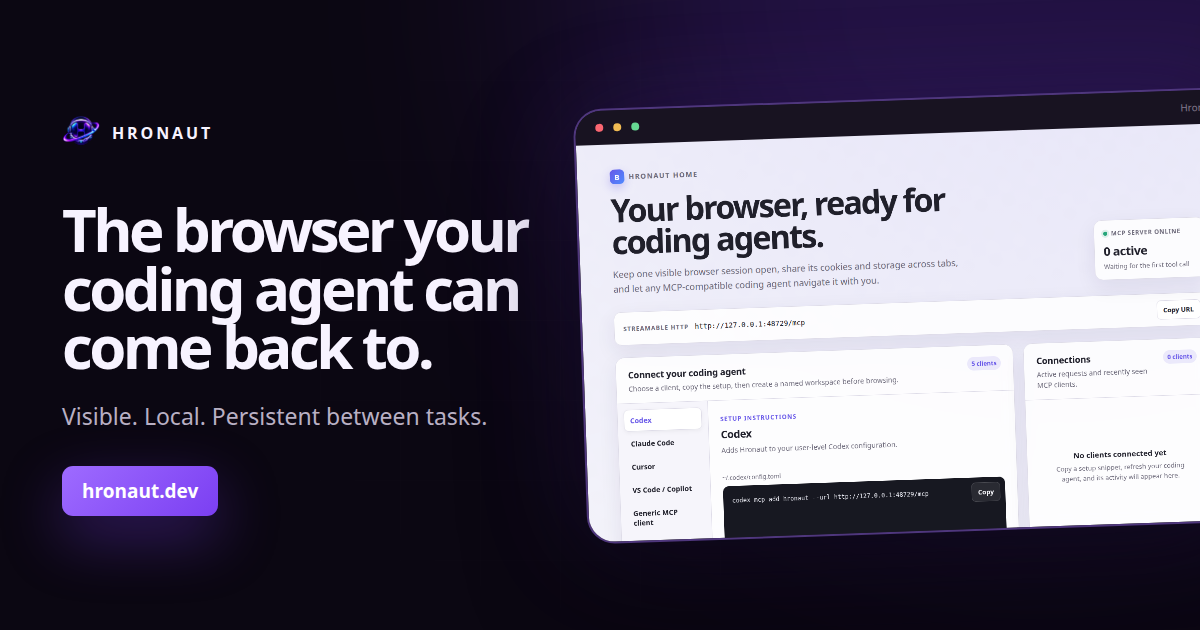
Watch the 35-second product overview, then download Hronaut for Windows, macOS, or Linux.
Not sure which browser model fits your workflow? Read the source-backed Browser MCP decision guide, which compares Hronaut with Playwright MCP, Chrome DevTools MCP, and an extension-based Browser MCP without claiming persistence is unique.
Start in three steps
- Download the latest Hronaut for Windows, macOS, or Linux and start it.
- On Hronaut Home, choose your coding agent and copy its generated setup, or use the generic setup guide. The in-app setup always reflects the current local endpoint and authentication choice.
- Ask the connected agent:
Using Hronaut, create a new isolated workspace named “Hronaut first run”, open https://example.com, take a semantic snapshot, and tell me the page heading. Use only that task workspace.
A successful run stays visible in Hronaut, creates an isolated workspace, and remains available after that coding-agent conversation ends.
Ready for a real task? Use the copy-ready starter workflows for authenticated handoff, localhost QA, and responsive review without weakening Hronaut's workspace and privacy boundaries.
For recurring work, run the scheduled and triggered browser workflow. Its disposable Docker fixture shows which component owns triggers, browser authority, human takeover, retries, cancellation, and authoritative outcome reconciliation.
Hronaut automates web pages in its own browser, not native desktop applications or other application windows. See browser and native testing boundaries to choose the right test surface, and approval boundaries before consequential actions.
Choose a persistent profile or Hronaut workspaces
A dedicated persistent browser profile can be enough for one project and one identity. Playwright MCP supports this through --user-data-dir; persistence does not require Hronaut. Its profile documentation also explains separate profiles for concurrent browser instances.
Choose Hronaut when you want named profiles managed together in a desktop browser, visible pause and takeover, or deliberate workspace resumption across compatible MCP clients. Each new workspace has separate website storage; bookmarks, history, download records, and remembered permissions remain application-wide. See the workspace contract for the exact boundaries. Hronaut adds a desktop application to run and maintain; its terms are in License.
Each live MCP transport can hold a bounded exclusive write lease for the workspace it creates or resumes. A resume remains usable for read-only inspection when another transport already owns writes, but conflicting mutations return a typed BUSY result without dispatch. Pausing agents, rotating authentication, disconnecting, releasing ownership, or lease expiry revokes that transport's write authority; claim it again only after inspecting fresh state. This lease prevents concurrent writers inside one Hronaut process, not coordination across different Hronaut installations.
Try the short first-run checks for both paths before committing to a workflow. Hronaut's client connection guide and Playwright MCP's client setup instructions cover their respective connections.
Move reviewed setup between machines with portable workspace templates, without copying browser sign-ins. The Support, recovery, and exit path explains how to reconnect a client, replace or remove a workspace, recover local data, and get help.
Keep personal and agent work separate
Open Home to find a project, switch to its tabs, or create a new space. The Open and Archived views keep ongoing and saved work easy to find. Search by workspace name or page title. Each workspace card shows direct agent access and any site restrictions; choose Manage to edit them. Workspace options can hide a workspace from the left sidebar or protect it from permanent deletion. Hidden workspaces stay accessible from Home, and protected workspaces can still be archived.
The browser mute button works from Home before any website tabs exist. It silences existing and future tabs, survives restart, and restores individual tab mute choices when turned off.
Choose Archive when you finish a task. Tabs and sign-ins remain saved, and Undo archive restores an accidental archive immediately. Use Restore workspace in the Archived view to pick up where you left off. Permanent deletion asks for confirmation and removes the workspace’s website data.
Hronaut starts on Home without creating a Default workspace. Opening your first tab creates an isolated workspace. Obsolete base-profile data and unsupported persistence formats are discarded.
- Fork a workspace to reuse its cookies and local storage in an independent profile. Choose any active or archived source; the fork starts with a blank tab and keeps the source's site restrictions.
- Disable direct agent access when a workspace should stay under your control. Agents can still fork it, but cannot browse or change its original tabs. The fork receives a copy of its site data, so this setting does not prevent agents from reusing copied sign-ins.
- Copy or Move site data with explicit source and destination controls. Move requires both workspaces archived and verifies the destination before removing transferred data from the source. Profiles with background site-worker storage cannot currently be moved.
Transfers include cookies and local storage, not history, saved passwords, IndexedDB, cache, or downloaded files. They are one-time copies, not ongoing synchronization. Deleting a workspace permanently removes its browser profile; archiving keeps it for later.
Works with your coding agent
Connect through Hronaut's local Streamable HTTP MCP endpoint. Choose the focused guide for your client, or start with the generic setup:
Related MCP Servers
Reviews
No reviews yet — be the first to share how this listing worked for you.
Frequently Asked Questions about Hronaut Browser MCP
AllMCPs Directory Badge
Showcase your server listing on GitHub or your project documentation. Embed this dynamic SVG badge to highlight official listing status and live engagement.
Badge Style:
Live Dynamic SVG Preview
Markdown (GitHub README)
[](https://allmcps.com/mcp/hronaut-browser-mcp)HTML Embed
<a href="https://allmcps.com/mcp/hronaut-browser-mcp"><img src="https://allmcps.com/api/badge/hronaut-browser-mcp?style=directory" alt="Hronaut Browser MCP on AllMCPs" /></a>