HF Studio
Your AI studio for video, image and audio.


Español · English · Website and examples
A self-hosted AI video, image and audio studio on top of the Higgsfield and ElevenLabs APIs. One backend gives you a REST API, an MCP server so your agents (Claude Code, Codex, Claude Desktop, ChatGPT…) can generate for you, and a web UI to do it by hand. Everything lands in the same library.
Its MCP server is built around one rule: an agent cannot spend credits without first quoting that exact request, so it always has a price to show you before it generates.
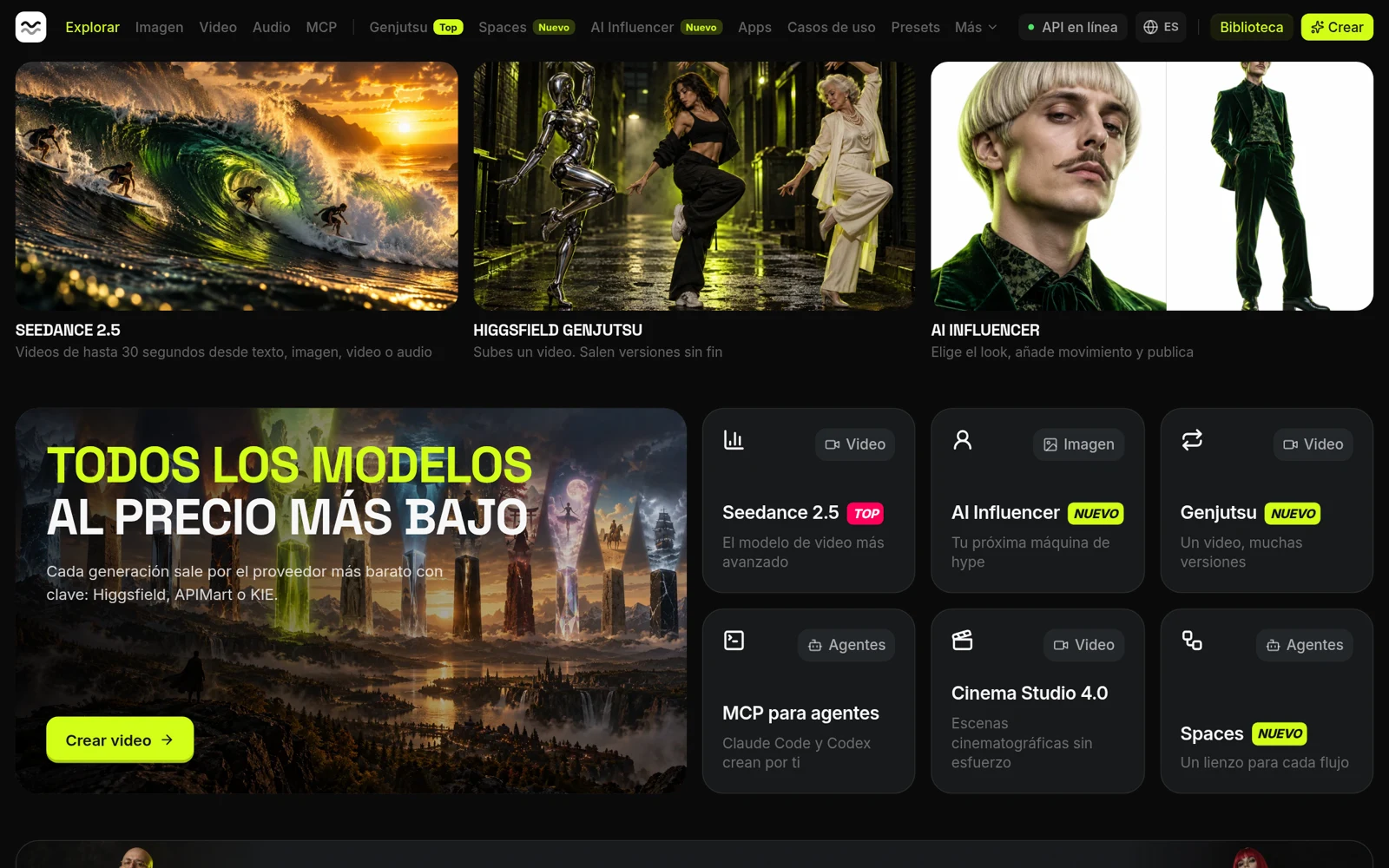
Why
- The cheapest provider for each video (and some images): the same model through Higgsfield, APIMart or KIE, quoted on all of them, with a safe fallback (see Cheaper with more providers).
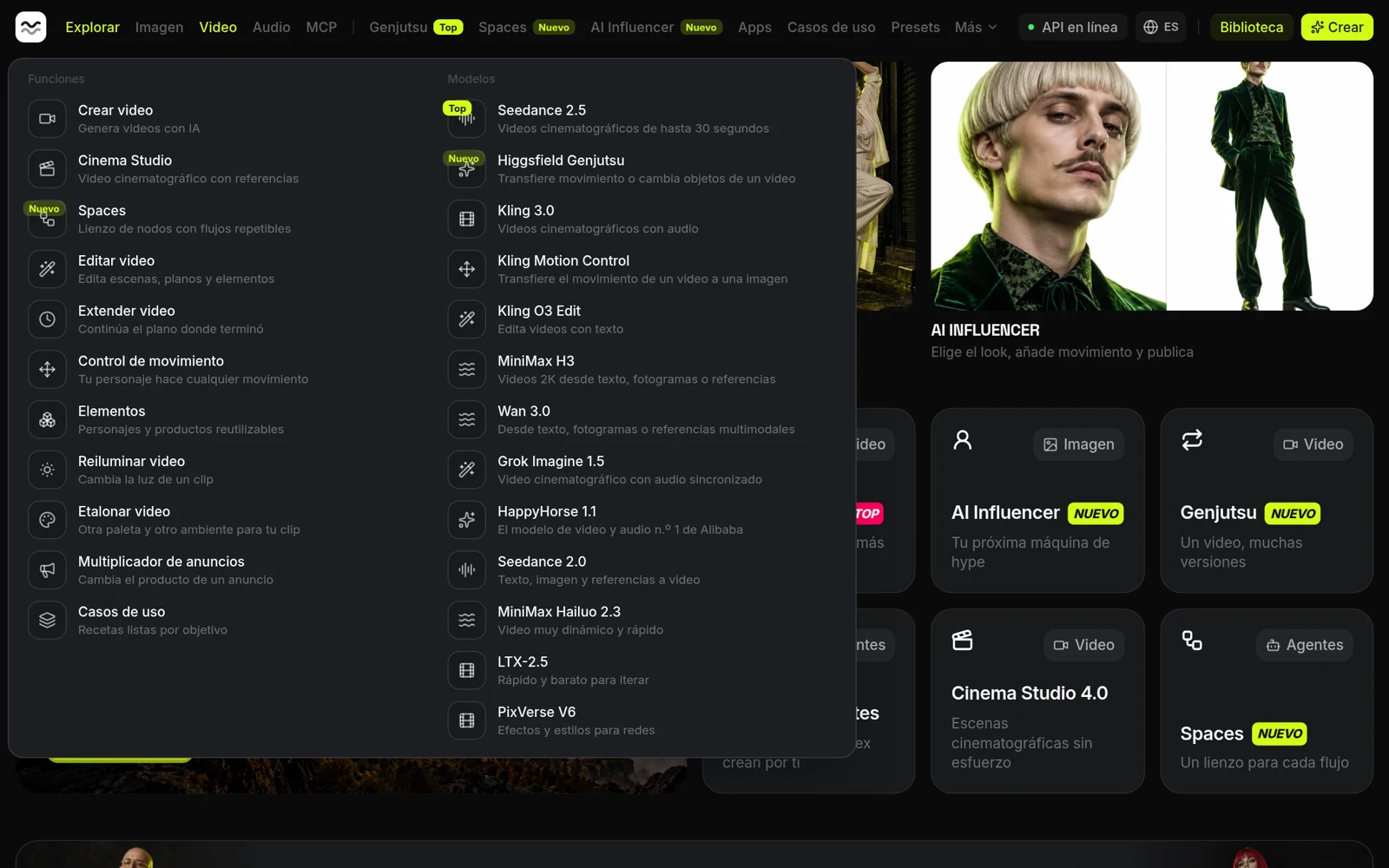
- One place for 84 Higgsfield endpoints (Seedance, Kling, Wan, Hailuo, PixVerse, LTX, Grok Imagine, Ideogram, Recraft…), searchable by what they do (text-to-video, first/last frame, video edit, motion transfer…) instead of by brand.
- Agents that quote before they spend. Every MCP tool that starts a paid run requires a single-use
quote_idfrom a prior quote of the same request, and the server tells the agent to show you that cost and wait for your OK. - Persistent jobs. Async jobs stored in a database, with validation before spending, deduplication,
Idempotency-Key, a local queue that respects your account's concurrency, and local copies of every output (Higgsfield only keeps them for 7 days). Higgsfield jobs keep being tracked after a restart; audio jobs cut off by a restart are marked as failed, not resumed.
Cheaper with more providers
The same model is often sold by several providers at very different prices. HF Studio can send each generation to the cheapest provider that offers the exact same model and settings:
| Provider | Key | What it adds |
|---|---|---|
| Higgsfield | HF_API_KEY, required | Every catalog model, and it stores your input files (uploading is free) |
| APIMart | APIMART_API_KEY, optional | Usually the cheapest for Seedance, Wan and Kling Omni/O3; also Grok Image 2.0 |
| KIE | KIE_API_KEY, optional | Usually the cheapest for Hailuo, MiniMax, Kling 2.5/2.6, Kling Motion Control 2.6 and Z-Image |
- Quote every provider, run the cheapest.
/v1/estimate, the UI andestimate_costshow every option, the savings against Higgsfield and why a provider was left out (no key, no balance, or no exact equivalent for your settings). Prices come from each reseller's public price list, refreshed daily. On 2026-10-03, Seedance 2.0 at 720p for 5 s cost 0.71 USD on APIMart, 1.025 on KIE and 1.51 on Higgsfield. - Same model, never a substitute. A setting a provider cannot reproduce (a fixed seed, a bitrate, an aspect ratio…) leaves that provider out instead of being dropped.
- Unofficial channels, labeled. A provider may also sell a cheaper unofficial channel of the same model (e.g.
APIMart's
grok-imagine-1.5-video-extfor Grok Imagine 1.5, about 6× cheaper). It is one more option, marked "unofficial channel"; if it fails, the official one is the fallback under the usual approval rule, and once you approve a channel that is the one sent. - Every generation says what it cost. The history shows the provider, the provider's model (and whether the
channel is unofficial) and the cost in USD (
~when estimated); failed generations show no cost. - Kling 3.0 elements. Save characters, products or locations on the Elements page (or with
create_element): a name, a description and 2 to 4 JPG/PNG images, stored locally and shared by the UI and your agents. Pick them in Kling 3.0 (up to 3) and cite them in the prompt as@name. They run on APIMart and KIE (KIE also needs a first frame); Higgsfield's public API cannot create or read elements, so those requests skip it. - Fallback without double charges. If a provider rejects the request or the task fails without charging, the next one is tried on its own only if it costs the same or less than what you approved; otherwise the generation waits for your approval. A submission that may have reached the provider (timeout, unclear answer) is never retried anywhere.
- Prices checked again before sending. APIMart and KIE are priced from local tables, so they are re-priced right before every send; Higgsfield quotes are reused for 15 minutes and asked again after that. Before the first automatic send the whole plan is redone with current prices. The generation stops for your approval when the checked price goes over your approved cap, when the price becomes unknown and you did not accept an unknown cost for that option, or when an upfront hold (some providers hold more than they charge and refund the difference) goes over the hold you approved. If you accepted an unknown cost without a cap for an option, that option can run at whatever price it ends up having; holds are always approved separately.
- Add a key: (or ) asks for it, checks it for free and saves it; opens the page where you create it, and shows status and balances. The UI has a page with the same links.
Features
- Spaces, a node canvas to generate step by step (
/spaces, inspired by Magnific Spaces): connect texts, media, lists and any catalog model, and each step's output feeds the next one. Every node shows its cost in USD before you generate and keeps its run history. Right-click or press/to add a node; drag an output to an empty spot to add the next step already connected.- Runs on the server ("Run all" or "Generate this and what follows"): every step is quoted, you approve a total budget, and the run pauses to ask you if a step does not fit, has no price or its fallback provider costs more. It keeps going if you close the tab and never pays twice after a restart.
- Lists for batches: a generator connected to a list runs once per checked item, and the batch follows the chain in pairs (5 prompts → 5 images → 5 videos).
- Free local tools (ffmpeg): first or last frame of a video, combine videos, mix audio over a video.
- Audio nodes (ElevenLabs): voiceover with your voices, sound effects and music.
- Assistant node (Claude, optional
ANTHROPIC_API_KEY): writes or improves prompts, describes images and drafts scripts; its text feeds other nodes. - Flows: publish a canvas with labeled inputs and run it from Presets by filling a form.
- AI Influencer (
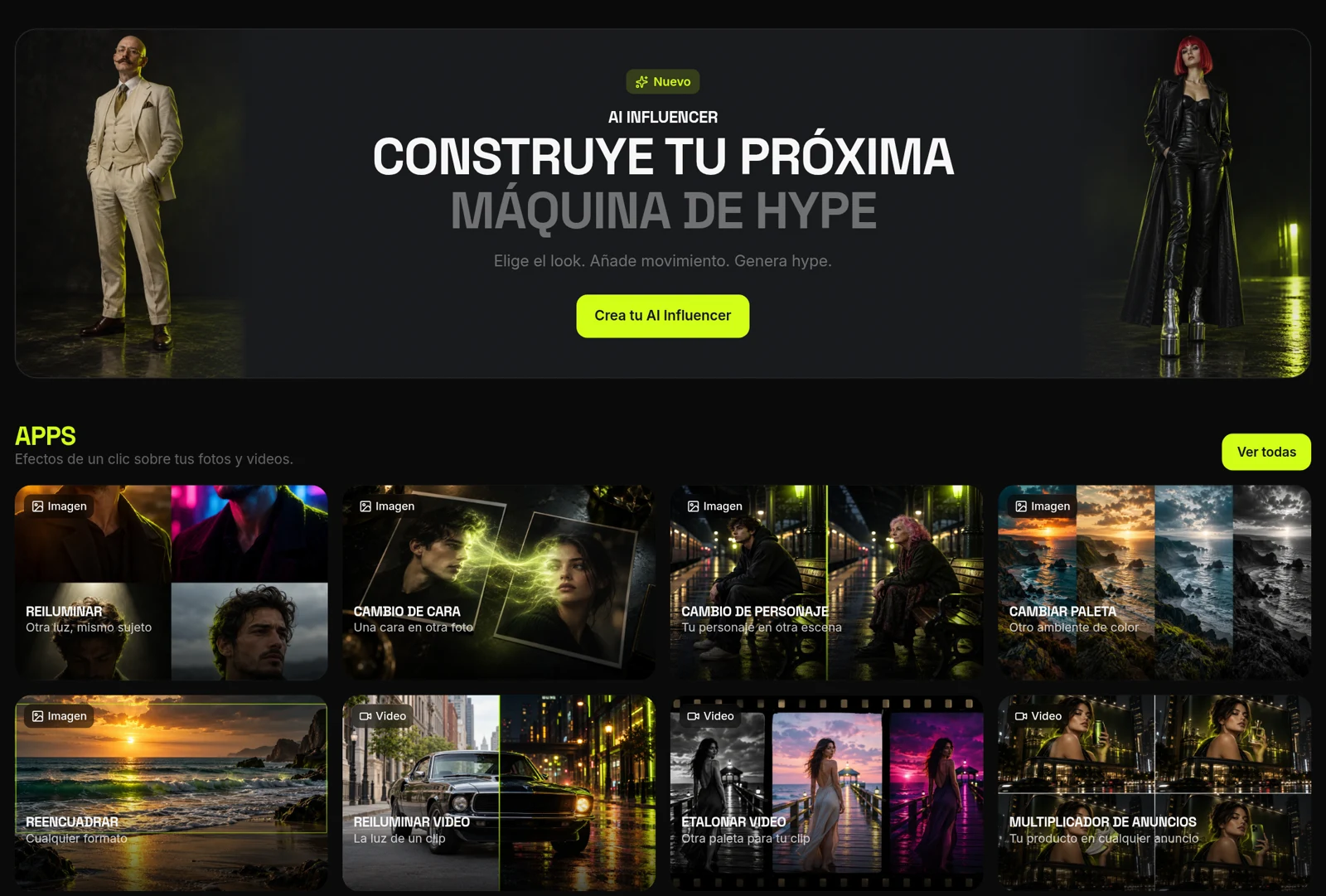
/influencer): design your own character from traits, with Higgsfield's catalog (9 character types, from normal to animal, and 18 trait groups: face, hair, body, style, accessories…) and its 39 examples, each one ready to recreate. Generate the two-panel character sheet (close-up and full body) with Soul 2.0, Soul Cinema, Sunburst, Flare, Grok Imagine, Qwen Image, Z-Image, Recraft or Ideogram, optionally from your own photo, then animate it with 7 video models and 8 movements. Every step is quoted before it runs. - One-click Apps: relight, change color palette, face swap, character swap, reframe, video relight, video color grade and ad multiplier, each a built-in preset over a catalog model: upload, adjust and generate.
- 84 Higgsfield endpoints (67 video, 16 image, 1 custom references), each with its JSON Schema taken from the
official docs (
hf-studio sync-catalog). - Every video and image capability: text-to-video, image-to-video, first and last frame, reference videos, video edit and extend, motion transfer, object swap (Genjutsu), text-to-image and image editing.
- ElevenLabs audio (optional): change the voice on a segment of a video (with deep, monster and ghost effects), text-to-speech, sound effects, music and voice isolation.
| AI Influencer and Apps | Features and Models menus |
|---|---|
 |  |
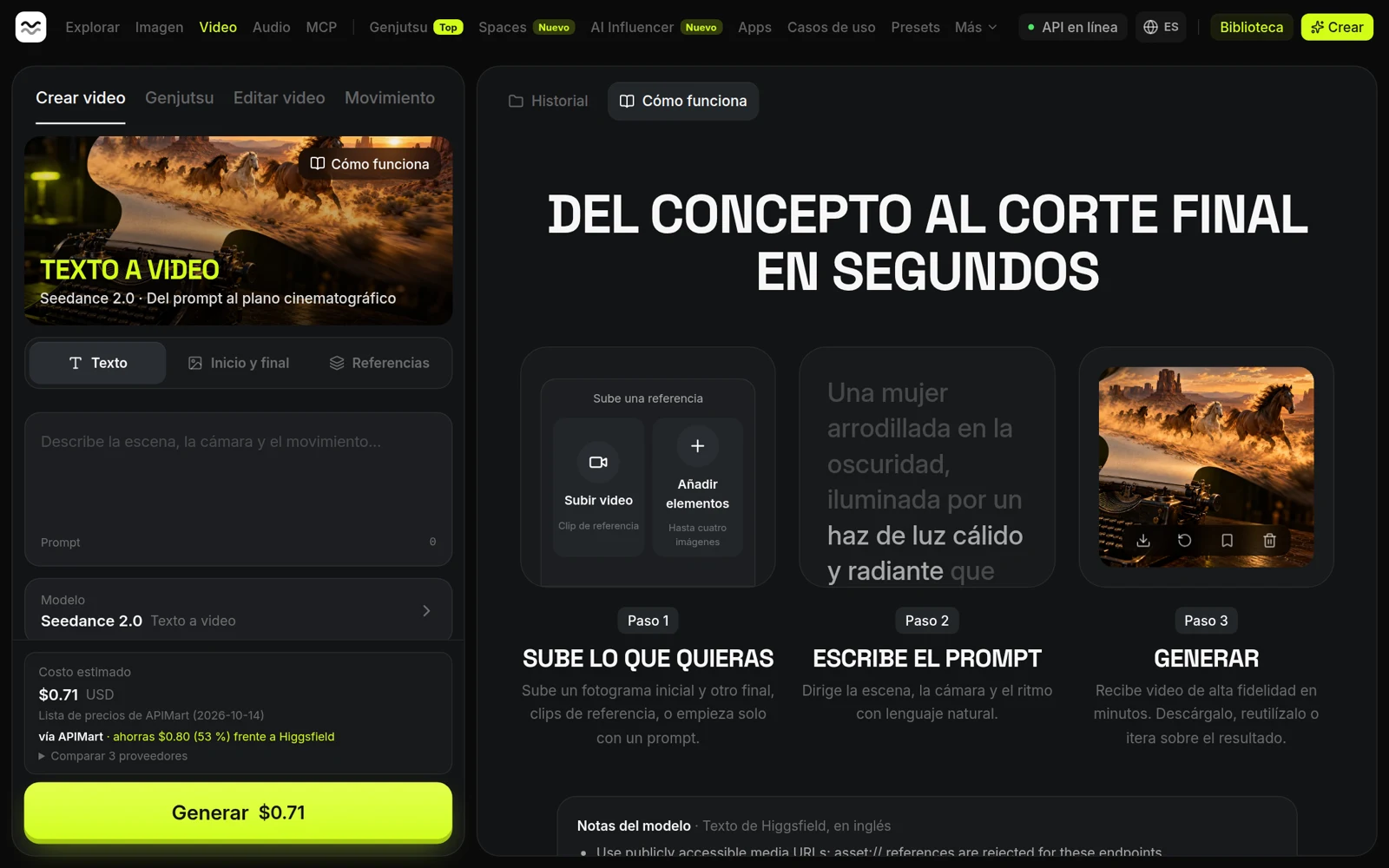
| Video studio | Use cases |
 | 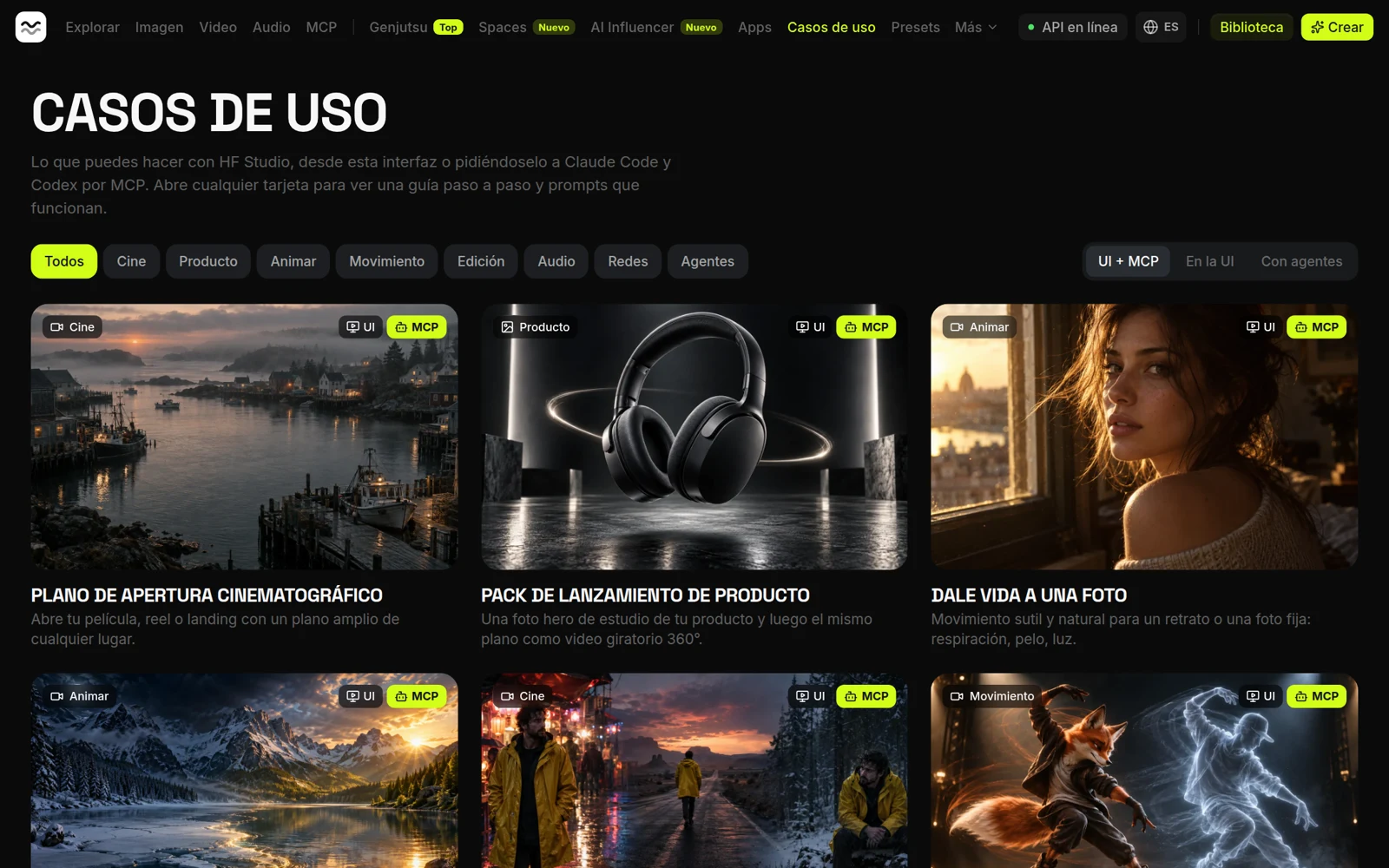 |
Requirements
Runs natively on Windows, macOS and Linux (and in WSL). CI tests the backend on all three.
- Python 3.12+ and uv
- Node.js 20+ and pnpm (for the UI)
- ffmpeg with
ffprobe(voice change, original audio and isolation; also used by the tests). Linux:sudo apt install ffmpeg. Windows:winget install ffmpeg. macOS:brew install ffmpeg-full, because the plainffmpegformula lacks therubberbandfilter that the voice effects use (HF Studio findsffmpeg-fullon its own and warns at startup if the filter is missing). - A Higgsfield API key (console.higgsfield.ai). Generating spends your credits.
- Optional: APIMart and KIE API keys, to make videos cheaper (see Cheaper with more providers).
- Optional: an ElevenLabs API key (elevenlabs.io/app/settings/api-keys) for voice, effects and music. Pay-as-you-go balance or a plan both work.
Quick start
git clone https://github.com/Jjat00/hf-studio.git
cd hf-studio
./dev.sh        # macOS, Linux, WSL
.\dev          # Windows (cmd or PowerShell)
Both are shortcuts for uv run hf-studio start, which works the same on Windows, macOS and Linux.
The first run asks for your Higgsfield key (and, optionally, your ElevenLabs key), validates it without spending
credits, creates .env and the UI key, installs the dependencies and starts everything. To add the ElevenLabs key
later, put it in ELEVENLABS_API_KEY in .env and restart.
- Web UI: http://localhost:3000
- API and interactive docs: http://127.0.0.1:8787/docs
Only want to use it from your agents? ./dev.sh api (Windows: .\dev api, or anywhere
uv run hf-studio start --api-only) starts just the API, no Node.js needed. Then connect your agent
in one line (see Connect your agents):
uv run hf-studio connect claude-code # or: codex, claude-desktop, json
Setting it up with an AI agent? Point it to AGENTS.md.
Commands
| Command | Use |
|---|---|
hf-studio start [--api-only] | Sets up on the first run and starts the API and UI (or only the API); ./dev.sh and dev.cmd run it |
hf-studio setup [--no-input] | First-run setup: .env, key check and UI key (start runs it) |
hf-studio connect CLIENT [--print] | Registers the MCP server in claude-code or codex, or prints the config (claude-desktop, json) |
hf-studio serve | Starts the API and the worker |
hf-studio mcp | MCP server over stdio |
hf-studio create-key NAME · list-keys · revoke-key NAME | One hfs_… key per client (UI, Claude Code, Codex…) |
hf-studio see-all NAME [--off] | Lets a client see and manage everyone's generations (meant for the UI) |
hf-studio keep-source-audio ID | Puts the source video's audio on an existing edit |
hf-studio providers [--add NAME | --open NAME] | Providers' status and balance; adds a key or opens the page to create it |
hf-studio check-credentials | Validates the Higgsfield key without spending |
hf-studio sync-catalog | Regenerates catalog.json from docs.higgsfield.ai |
Keys and access
Each client has its own hfs_… key and, by default, only sees its own generations. Only the API knows the Higgsfield
and ElevenLabs credentials.
Warning: the UI proxy does not authenticate visitors, so with
see-allanyone who can reach the Next server can see, delete and launch generations.pnpm devandpnpm startlisten on127.0.0.1only; do not expose it to other machines without putting authentication in front.
Connect your agents (MCP)
With the API running (hf-studio start, ./dev.sh or .\dev), the easiest way is to ask your agent to connect
itself. Paste this into Claude Code, Codex or any other agent (the UI's MCP page has it with your real path filled in):
Connect yourself (this agent) to the HF Studio MCP server. It is installed at: /absolute/path/to/hf-studio

1. Check that its API is running: GET http://127.0.0.1:8787/health must answer {"ok": true, ...}. If it does not, ask me to start it with `uv run hf-studio start` in that folder and wait.
2. Register it with the command for your client:
   - Claude Code: uv run --directory '/absolute/path/to/hf-studio' hf-studio connect claude-code
   - Codex: uv run --directory '/absolute/path/to/hf-studio' hf-studio connect codex
   - Any other MCP client: uv run --directory '/absolute/path/to/hf-studio' hf-studio connect json, and add the config it prints to your MCP configuration.
   The command creates a key just for you. If it says hf-studio is already registered, ask me before removing the old one. If your sandbox does not let you run it, show me the command so I can run it.
3. Tell me to restart you so you load the tools.
4. Read the "Use it through MCP" section of the AGENTS.md in that folder. Key rule: before generating, quote the cost, tell me and wait for my OK.
Or do it yourself: one command creates a key for the agent and registers the server:
uv run hf-studio connect claude-code     # runs `claude mcp add` for you
uv run hf-studio connect codex           # runs `codex mcp add` for you
uv run hf-studio connect claude-desktop  # prints the JSON for claude_desktop_config.json
uv run hf-studio connect json            # prints the config for any other stdio MCP client
With --print, it prints the command or config (with a new key) instead of registering it. If the agent's CLI is not
installed, nothing is registered: it prints the command, with its new key, to run where that CLI is. From WSL,
claude-desktop prints a config that enters WSL through wsl.exe, for when HF Studio runs in WSL and Claude
Desktop on Windows. Restart the client afterwards so it loads the tools. Each connection gets its
own revocable hfs_… key (codex, codex-2…; see hf-studio list-keys, revoke-key NAME); existing keys are never
touched. If the agent already has hf-studio, connect stops: remove it first (claude mcp remove hf-studio). By hand, the
server is uv run --directory /absolute/path/to/hf-studio hf-studio mcp with HF_STUDIO_URL=http://127.0.0.1:8787
and HF_STUDIO_TOKEN=hfs_… in its environment.
Tools (40). Every tool declares all four MCP hints (readOnlyHint, destructiveHint, idempotentHint,
openWorldHint), and the ones that spend credits say so in their title, so clients can warn you before calling them.
| Group | Tools |
|---|---|
| Models | find_models, get_model, recommend_models |
| Generate | upload_media, estimate_cost, generate, generate_batch |
| Tracking | get_generation, wait_generations, list_generations, cancel_generation, download_outputs, approve_fallback |
| Providers | providers_status |
| Presets | list_presets, run_preset, save_preset |
| Voice (ElevenLabs) | list_voices, change_voice |
| Audio (ElevenLabs) | text_to_speech, sound_effect, compose_music, isolate_voice, elevenlabs_account |
| Sound library | list_sounds, label_sound, import_elevenlabs_history |
| Reuse and elements | use_output, list_elements, create_element, delete_element |
| Spaces | list_spaces, get_space, create_space, update_space, estimate_space_run, run_space, get_space_run, approve_space_run, cancel_space_run |
No MCP tool generates without quoting that same request first. estimate_cost, and generate_batch or
run_preset with dry_run=True, return the cost and a quote_id. generate, and batches and presets with
dry_run=False, require that quote_id with the same parameters. The ElevenLabs tools follow the same pattern:
without quote_id they return the cost; with it, they generate. Each quote is good for one run and lasts 15 minutes;
a retry with the same idempotency_key is not charged again. If the price is incomplete (missing
input_video_seconds, which in batches can also go per item in hints), confirm_unknown_cost=True is required too,
only when the user explicitly accepts an unknown cost. Approving a pending generation is a separate step without a
quote_id: a generation in awaiting_approval (its provider failed without charging, or the price went over what
was approved) shows the new price in cost_usd and any upfront hold in reserve_usd; with the user's OK,
approve_fallback takes max_usd (that price), max_reserve_usd (that hold) or, only if the user accepts an unknown
cost, accept_unknown_cost=True (without max_usd it has no cap; with it, the cap still rules once the price is
known). HF Studio quotes again when approving and answers 409 with the current price if it went up. get_model also returns studio_notes, HF Studio warnings
such as generate_audio=false giving a silent video on an edit and how to keep the original audio (generate with
keep_source_audio=true). The MCP server never sees the Higgsfield or ElevenLabs credentials, only its own hfs_…
key. It cannot check that a person actually saw the price: showing it and waiting for an OK is up to the agent,
which the server instructions require.
Spaces follow the same rule. estimate_space_run quotes every step and the total and returns a quote_id;
run_space needs it and uses that total as the run's budget (a higher max_total_usd only if the user approved it).
Retrying run_space with the same quote_id returns the same run. A run in awaiting_approval shows its reason and
the new total in pause.needed_total_usd; with the user's OK, approve_space_run. A published flow runs with inputs.
Web UI (web/)
Next.js 16 and Tailwind 4, with a look inspired by higgsfield.ai. The logo, name and illustrations are original.
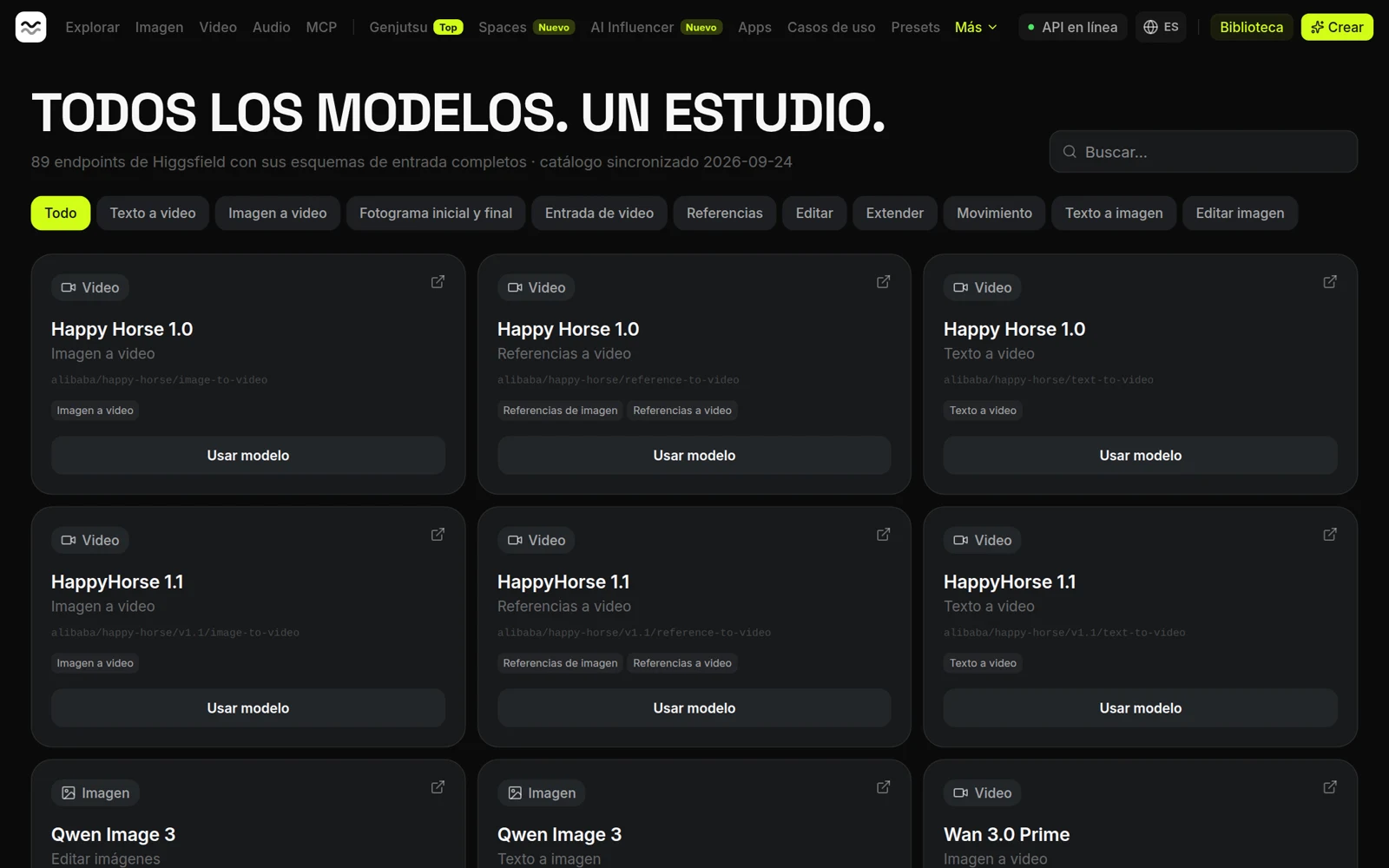
- Navigation like higgsfield.ai: Explore, Image, Video and Audio open a menu split into Features and Models, followed by MCP, Genjutsu, Spaces, AI Influencer, Apps, Use cases and Presets; the rest lives under More.
- Home (
/): featured models, a promo with shortcuts, the AI Influencer banner, one-click Apps, a prompt bar, what your agents can do and your latest creations. - Pages: Image, Video (Create: text, first and last frame, references · Genjutsu · Edit video · Motion), Voice,
Audio, Sound library, AI Influencer (
/influencer), Elements (/elements), Use cases, Presets and Apps (with published flows at/flows/<id>), Spaces (/spaces), Library (with detail at/history/<id>), Usage (/usage: spend by day, provider and model, plus each provider's balance), Models (/models) and MCP. - Forms are generated from each model's
input_schema, so all 84 endpoints work without model-specific code. - Voice (
/voice): pick a video, mark the segment on the timeline, search a voice (your account or the ElevenLabs public library, with preview), add an effect and choose how much of the original audio stays. - Audio (
/audio): text-to-speech (expressive v3, stable v2 or cheap Flash, with language), sound effects, music and voice isolation from a video or audio file. - Proxy: the browser only talks to
/api/studio/*, a proxy on the Next server that adds thehfs_…key. The key never reaches the client. - Languages: stored in the
hfs-langcookie, so URLs do not change. The API and the MCP server stay in English.
REST API
Every /v1 route requires Authorization: Bearer hfs_…. Interactive docs at http://127.0.0.1:8787/docs.
| Method | Route | Use |
|---|---|---|
| GET | /v1/models?capability=&output=&q= | Filterable catalog (capability list included) |
| GET | /v1/models/{id} | input_schema, usage notes, studio_notes, docs link |
| POST | /v1/uploads (multipart file) | Uploads jpg/png/webp/gif/mp4/wav → public URL |
| POST | /v1/estimate {model, input, hints} | Cost before generating: exact, approximate by formula or pending media |
| POST | /v1/generations {model, input, keep_source_audio} | Enqueues; 202 new, 200 if deduplicated. Idempotency-Key header |
| GET | /v1/generations/{id}?wait=60 | Status; waits up to N s for a terminal state |
| GET | /v1/generations?ids=a,b&wait=60 | History, or wait for several to finish |
| POST | /v1/generations/batch | Several generations; dry_run returns cost per item and total |
| POST | /v1/generations/{id}/cancel | Only in pending/queued |
| DELETE | /v1/generations/{id} | Deletes a finished generation and its local copy |
| GET | /v1/generations/{id}/files/{name} | Local copy of the output |
| GET | /v1/recommend?task=… | Suggested models for a task (en/es) with their cost |
| GET/POST/DELETE | /v1/presets | Built-in and custom recipes; POST /v1/presets/{slug}/run (with dry_run) |
| POST | /v1/presets/from-generation/{id} | Save a generation as a preset |
| GET | /v1/voice/status | ElevenLabs configured?, plan and remaining credits |
| GET | /v1/voice/voices?search=&library= |
States: pending (local queue) → submitting → queued → in_progress → completed | failed | nsfw |
canceled | timed_out. Every response includes a readable stage, terminal, elapsed_seconds and
correlation_id (for Higgsfield support). ElevenLabs jobs live in the same table and use the same
/v1/generations routes.
Example, a video between two images:
curl -X POST localhost:8787/v1/generations -H "Authorization: Bearer $HFS" -H 'Content-Type: application/json' \
  -d '{"model":"bytedance/seedance-2.0/image-to-video",
       "input":{"image_url":"https://…/start.png","end_image_url":"https://…/end.png",
                "prompt":"slow dolly-in","duration":5}}'
Design decisions
- Plain REST (httpx) instead of the SDK: the generation POST is not idempotent, so after an ambiguous timeout it
is not retried (the job becomes
failed/submission_ambiguous). The worker owns the polling loop, with state in the database. - Concurrency: Higgsfield answers 400 at the limit and sends no
Retry-After. Jobs wait inpendingand are sent when there is room (HF_MAX_CONCURRENCY). - Webhooks: no documented signature, so a webhook only triggers an authenticated status check (its payload is not trusted). Each job carries its own token in the URL. Polling stays as a fallback.
- In-process worker: one process is enough. The atomic claim (
pending → submitting) prevents double submissions if several run. A restart mid-submission marks the job as ambiguous instead of repeating it. - Media opened by ffmpeg: only your own uploads or outputs, and only over
fileandhttps(no arbitrary URLs, to avoid SSRF).
Development
uv run pytest            # Higgsfield and ElevenLabs are mocked with httpx.MockTransport: no credits spent
uv run ruff check src tests
cd web && pnpm lint && pnpm exec next typegen && npx tsc --noEmit
Contributing
Issues and pull requests are welcome. If HF Studio is useful to you, a star helps other people find it.
License
MIT.
Disclaimer
Personal project, not affiliated with Higgsfield or ElevenLabs. It uses their public APIs with your own keys and credits. Higgsfield, ElevenLabs and the model names belong to their owners.