Hatchdoor README
The full upstream README, mirrored here for reference. Install config, tool schemas, adoption signals, and an original overview live on the Hatchdoor listing page.






Hatchdoor
Self-host your Obsidian vaults: a web UI for you, MCP for your AI agents. No Obsidian, no plugins required.
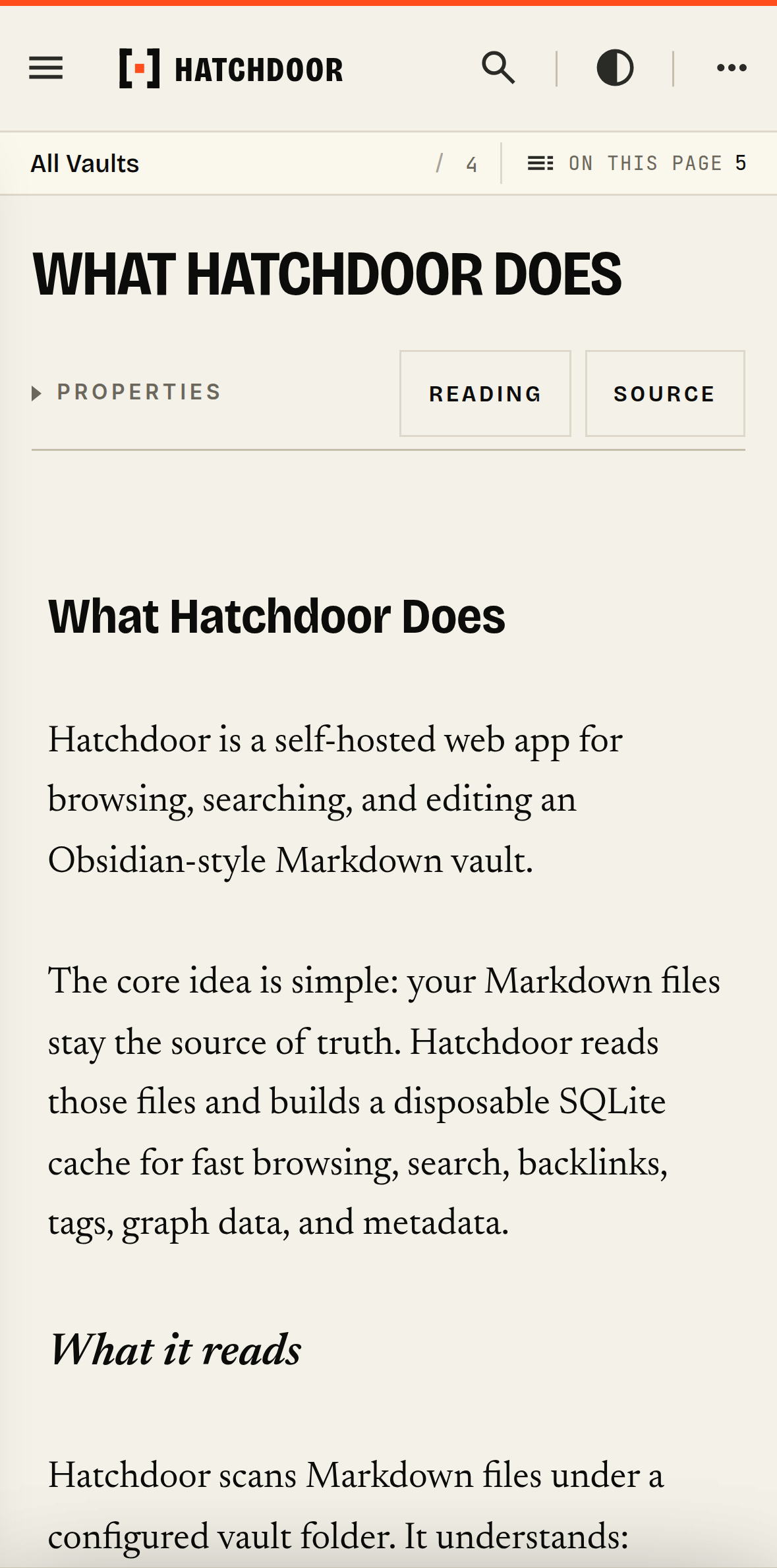
Hatchdoor reads your vault directly from disk, and any folder of Markdown notes works. No Local REST API plugin, no desktop app that has to stay running. Browse, search, and edit your notes in a fast web UI, and point a Model Context Protocol (MCP) client like Claude, Claude Code, Codex, Cursor, or Hermes at the same vault so your agent can read, search (keyword and semantic), create, edit, move, and link notes. One server manages as many vaults as you give it, every write goes through the same atomic vault operations the UI uses, with optimistic concurrency and optional automatic git commit-and-push. The web UI and your agents are two front doors to one vault.
Your Markdown files stay the source of truth. Hatchdoor builds a disposable SQLite read model for fast browsing, links, backlinks, keyword search, semantic search, graph data, and metadata. If the cache is deleted, Hatchdoor rebuilds it from the vault.
Hatchdoor was built with AI coding agents, primarily Claude Code and Codex, under close human review, with tests and a documented safety model.
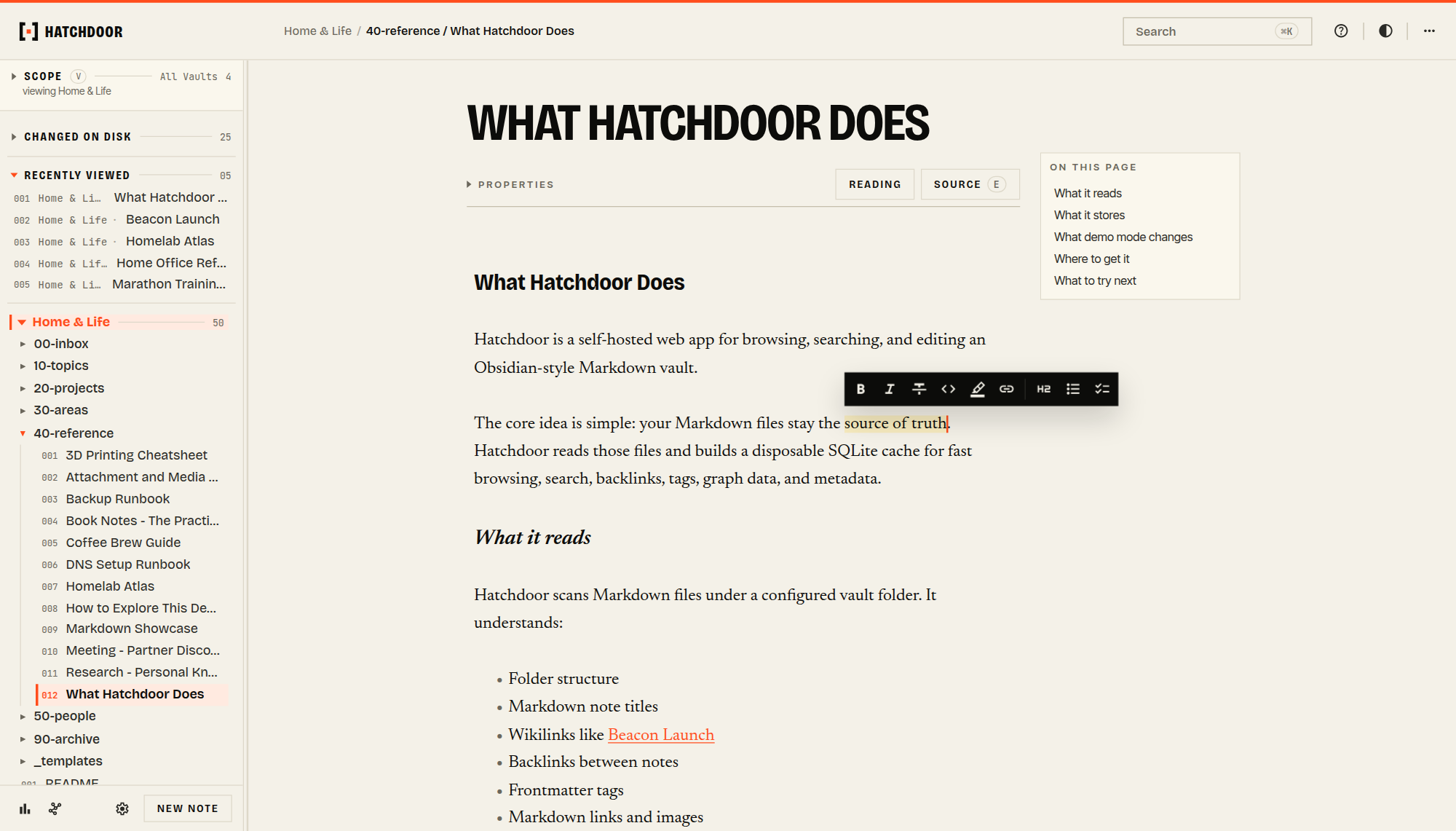
▶ Try the live demo, a read-only public vault, or read the user documentation for setup and usage guides.
Contents
What You Get
- A web UI for browsing folders and Markdown notes.
- Native multi-vault: one instance serves several vaults, each with its own source, git sync, and agent scope.
- Clean note URLs at
/v/<vault-id>/n/<slug>. - Obsidian-style wikilinks for
[[Note]],[[Folder/Note]], and[[Note|Alias]], and Markdown links to.mdfiles, both kept up to date through renames and moves. New links follow each vault's own link style. - Saved queries: a fenced
baseblock in Obsidian's Bases syntax draws a live table of the notes it selects, for people and agents alike. - Markdown rendering with GitHub-flavored Markdown, math, Mermaid diagrams, frontmatter, images, attachments, and broken-link styling.
- Keyword search and semantic search.
- Recent notes, backlinks, outbound links, stats, and graph views.
- A live editor in the browser when the vault mount is writable: the note opens ready to type in, Markdown syntax shows only on the line you are on, and edits save by themselves. It works the way Obsidian's Live Preview does.
- Attachment uploads, local asset serving, and inline previews for linked PDF vault assets.
- A first-class MCP server so AI agents can read, search, create, edit, and link notes with the same safety as the UI, rename or delete a tag across a whole vault in one checked operation, and move attachments of any size through short-lived download and upload links.
- Agent reads sized for a context window: compact search hits, an outline of a long note and just the sections asked for, and an exact-string search that counts every occurrence.
- A setup checklist on a fresh install that goes from an empty instance to an agent searching your notes, with a folder picker in place of container paths.
- The manual built into the app: Help beside whatever you are doing, the same
pages for agents through
read_docsandsearch_docs, and as plain Markdown at/docs/on every instance. - Optional automatic git commits and pushes for Hatchdoor writes, with sync conflicts resolved on your Git host through a recovery branch.
- PWA assets and service worker caching for common read paths.
- Distroless, rootless container image (no shell, runs as
nonroot) that deploys with either Docker or Podman.
Screenshots
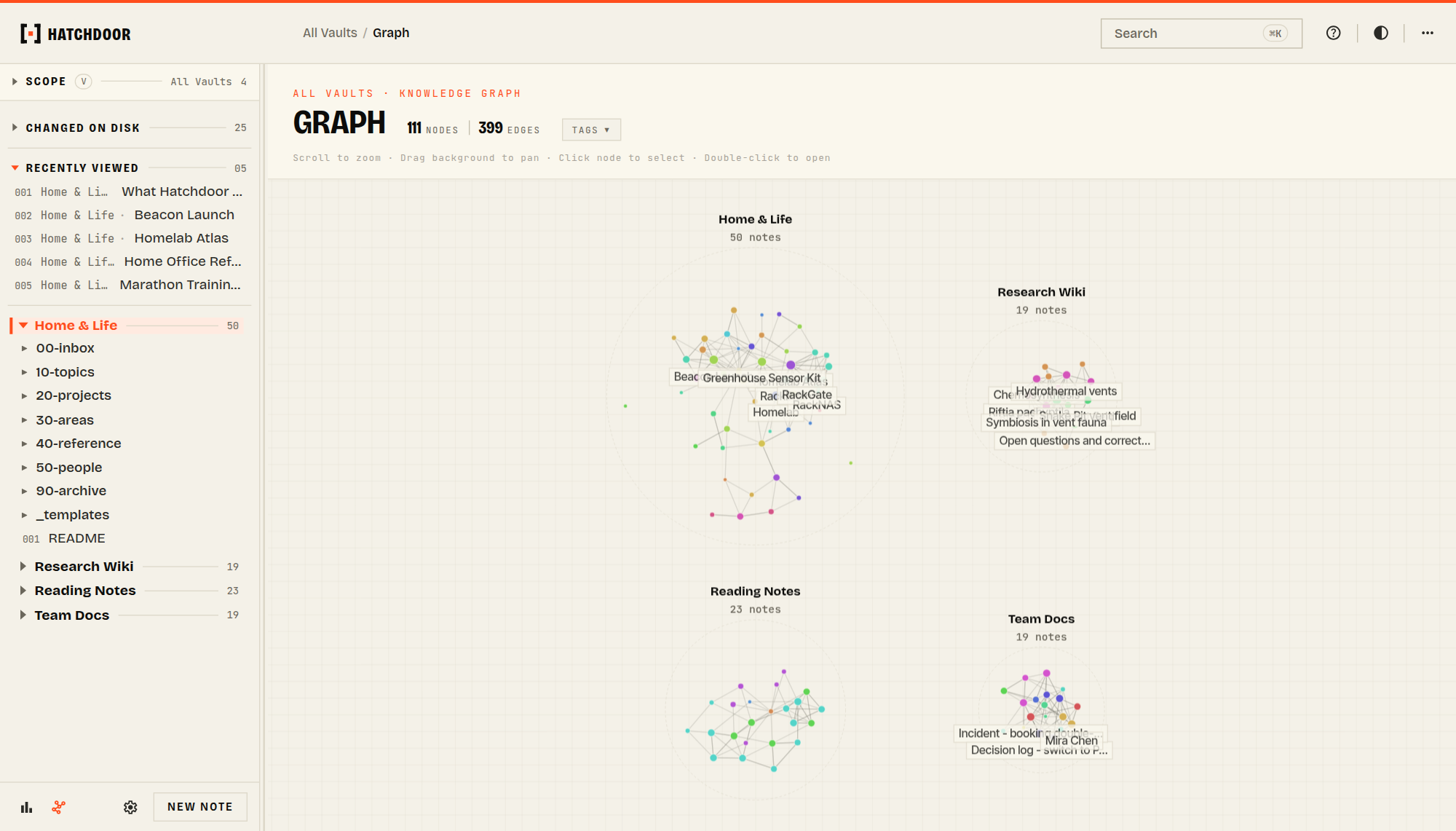
Knowledge graph: notes, links, and tags |
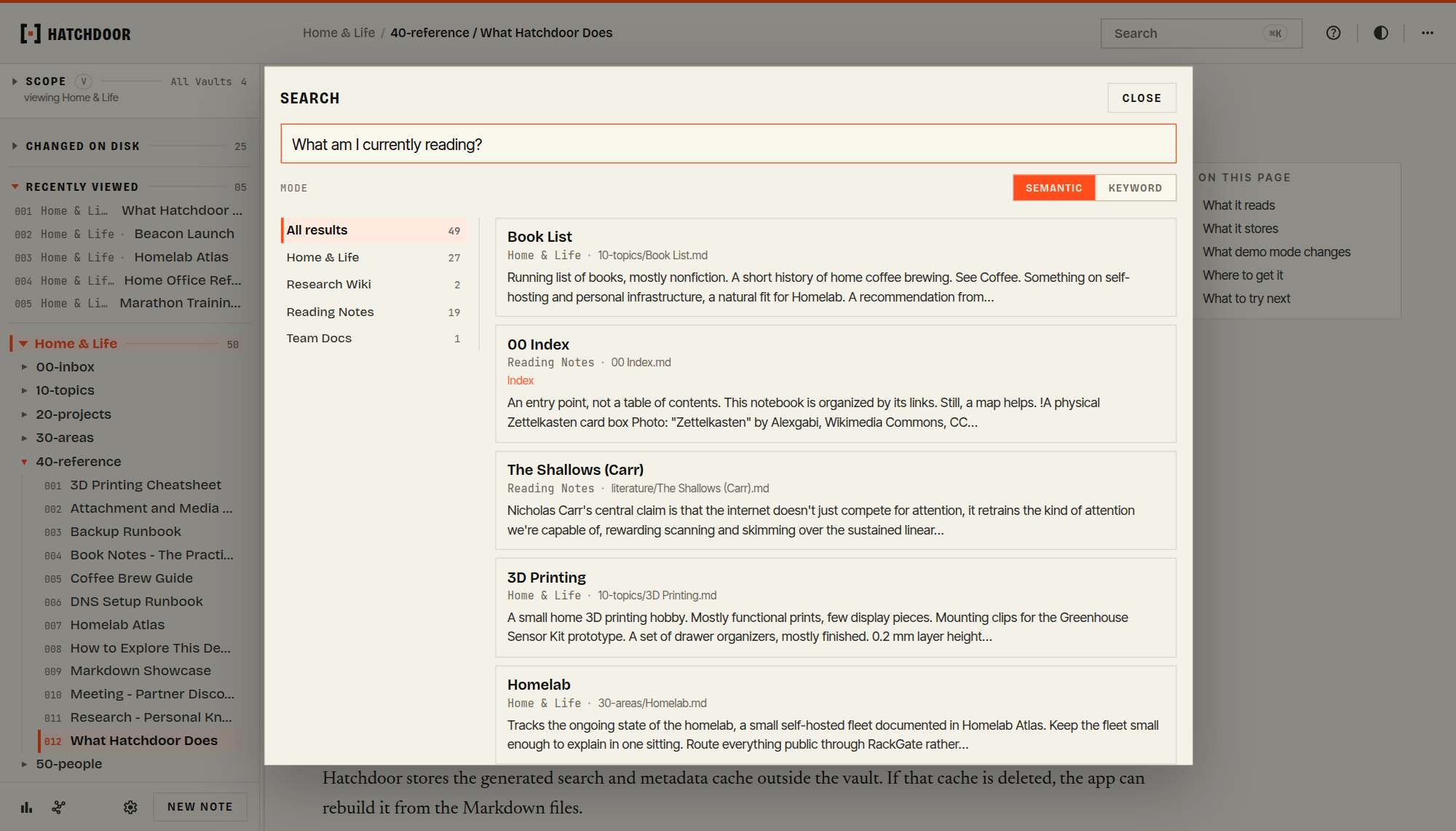
Semantic + keyword search |
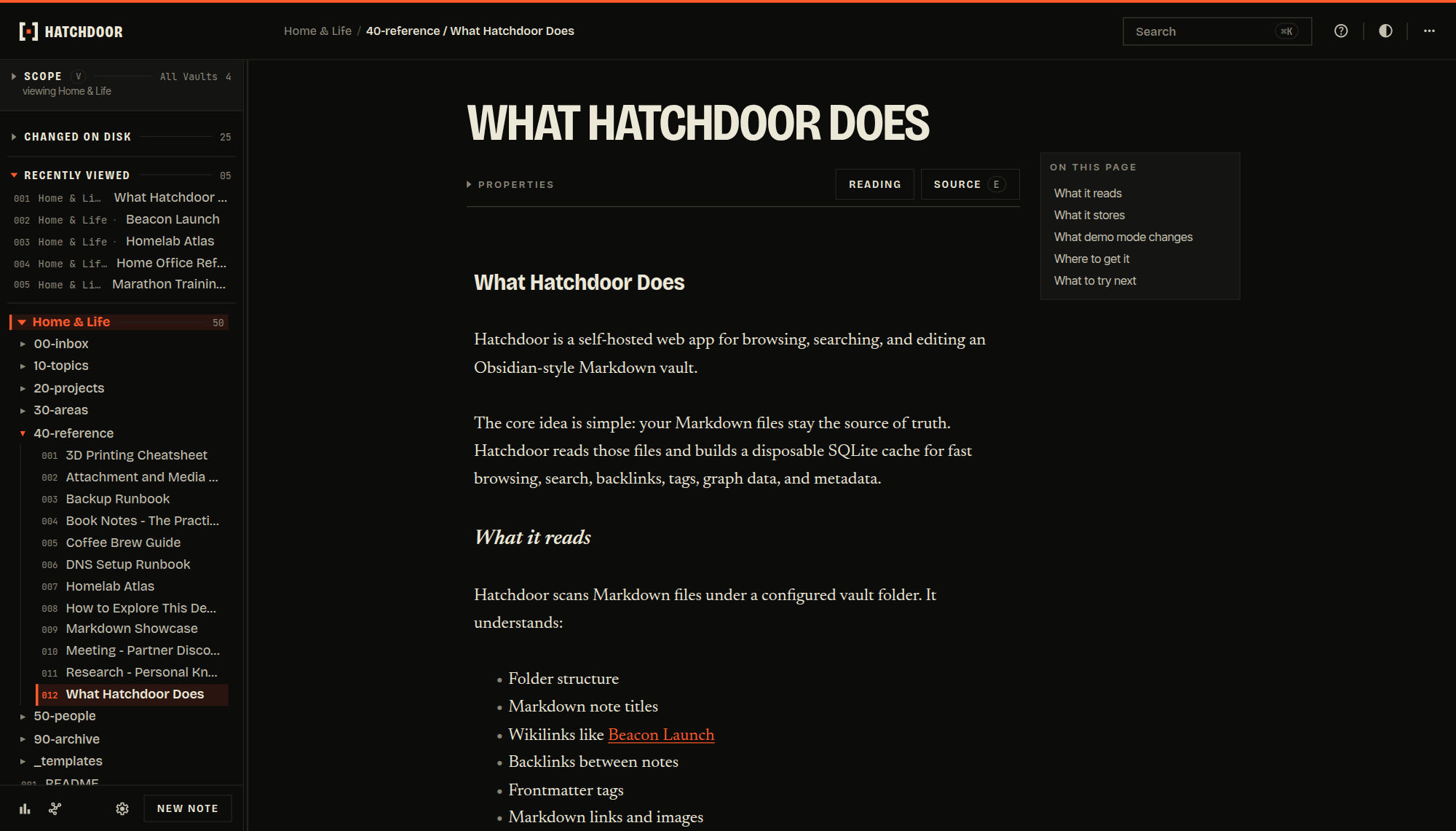
Dark mode |
Responsive & installable (PWA) |
Who It Is For
Hatchdoor is useful if you have a folder of Markdown notes and want a private web interface for them.
It is beginner-friendly enough to run with Docker Compose, but it also includes advanced features for people who want agent access, git-backed vault sync, semantic search, and local development.
Hatchdoor is not a hosted sync service, not a multi-user collaboration platform, and not a replacement for Obsidian. It is a self-hosted companion for a Markdown vault you control.
How Hatchdoor Compares
The MCP-for-Obsidian field is crowded. The honest short version: if you live inside the Obsidian app and want the smallest possible bridge to it, the plugin-based tools are fine. Hatchdoor is for when you want the vault served independently of Obsidian: from a homelab box, for browsers and agents at once, across more than one vault.
| Hatchdoor | mcp-obsidian | Local REST API | Basic Memory | OpenKnowledge | |
|---|---|---|---|---|---|
| What it is | Self-hosted vault server: web UI + MCP | MCP bridge to the REST plugin | The REST plugin itself | AI memory over local Markdown, MCP-first | WYSIWYG Markdown editor with side-by-side AI |
| Works without Obsidian installed | ✅ reads the vault from disk | ❌ needs Obsidian + plugin running | ❌ runs inside Obsidian | ✅ | ✅ own editor |
| Web UI for humans | ✅ self-hosted, live demo | ❌ | ❌ | Paid cloud app | ✅ desktop + local web app |
| Serves multiple vaults | ✅ one server, per-vault git sync | ❌ | ❌ | ✅ projects | ❌ one folder per instance |
| Write safety for agent edits | Atomic writes, optimistic concurrency | Via plugin REST API | — | Overwrite guards | — |
| Deploys as a service | ✅ Docker/Podman, rootless, token auth | ❌ desktop-bound | ❌ | ❌ local process (cloud is paid) | ❌ local CLI app |
Basic Memory and OpenKnowledge are good projects solving adjacent problems (agent memory, an AI-native editor). Hatchdoor overlaps them only where your notes are a vault you want served: one always-on service, for browsers and agents at once.
What Is Next
The next large feature is multi-account handling with permission scoping. Today Hatchdoor assumes a single trusted user on a private deployment, so whoever reaches the instance sees every vault it serves. The plan is to let several people and agents share one instance, each scoped to the vaults they are granted, with an admin role that manages the rest. A household or a small team could then run one Hatchdoor instead of one per person.
v2.5.0 already made vaults independent, addressable things the product manages, including vault scoping for MCP agents. What is missing is the half that was deliberately deferred: accounts, authentication, and an access boundary the server enforces rather than the UI implies. Targeted at v3.
Two other things are wanted but not slotted to a version yet:
- Agent provenance and undo. Which agent changed a note, a before/after diff beside the commit it produced, and one-click revert. Today git is the whole answer, and reading a commit log is not the same as seeing what an agent did to your note.
- Vault integrity checks. A vault-scoped lint for orphaned notes, broken wikilinks, and layer markers whose declaration has vanished, so a vault an agent maintains unattended cannot quietly drift out of shape.
The product roadmap has the full set of workstreams and where each one stands.
Quick Start With Docker
Have an AI agent with a terminal, such as Claude Code or Codex? Give it this one line and it installs Hatchdoor for you, asking a few questions first:
To do it by hand, follow the steps below.
1. Requirements
You need:
- Docker and Docker Compose (Podman and
podman composealso work) - A Markdown vault folder, or an empty folder if you want to start from nothing
2. Create Your Config
Copy the example environment file:
The defaults mount an empty vault folder beside the Compose file. To use an existing vault, uncomment its host path in .env:
What these mean:
HOST_VAULT_PATHis your Markdown vault on the host machine.HOST_CACHE_PATH,HOST_STATE_PATH, andHOST_MODELS_PATHare optional host-side locations for the generated cache, authoritative Vault registry, and downloaded models; Compose defaults them beside the project.
Before the first managed-Vault start, create the default authoritative state
directory with access for the image's numeric nonroot user. Docker otherwise
may create a missing bind source as root, leaving the registry unwritable:
For rootless Podman, use podman unshare chown 65532:65532 data/state instead
of sudo chown. Apply the same ownership rule to a custom HOST_STATE_PATH.
Do not add ordinary Settings values to .env: an unset value can be changed
live in Settings. See Configuration for the few deployment
values that always remain environment-only.
3. Start Hatchdoor
Docker Compose binds Hatchdoor to a non-loopback container interface, so a first run without a web token stops safely and prints a fresh, recoverable token. Retrieve it with:
Copy the printed HATCHDOOR_WEB_BEARER_TOKEN=... assignment into .env, then
start again with docker compose up -d. The token is deliberately not stored
by Hatchdoor; use the one from that refusal or generate a new long random token.
Once the server is running, open http://localhost:42824 and enter it in the
browser prompt.
4. Choose Your Search Model
Hatchdoor images include no model weights. On first launch, before it
downloads anything, Hatchdoor asks you to pick one: Gemma (multilingual,
recommended, requires accepting its terms) or Nomic Embed Text v1.5
(English-only, no terms to accept). Either way the model and its acceptance
receipt stay in HOST_MODELS_PATH and persist across restarts; Hatchdoor
never sends vault content anywhere. Vault features stay unavailable until
setup finishes.
A fresh install has no Vaults. Once the model is ready it opens on the Set up Hatchdoor checklist: add your notes folder as a Vault, connect your agent, and try a search. The ? button in the top bar opens Help, the manual for the version you are running.
5. Container Image And Paths
The image is published on Docker Hub:
The runtime image is distroless and rootless. It is built on
gcr.io/distroless/cc-debian13:nonroot, ships no shell or package manager, and
runs as an unprivileged nonroot user. Hatchdoor also runs unchanged under
Podman (rootless included); swap docker / docker compose for podman /
podman compose and the image tag for podman-latest (or
podman-<version>) — the latest tag above is Docker-only.
Docker Compose mounts:
| Container path | Purpose |
|---|---|
/data/vault | Markdown vault, source of truth |
/data/cache | Generated SQLite cache |
/data/state | Authoritative Vault identities and source definitions |
/models | Downloaded search model and local Gemma terms receipt |
Data And Safety Model
Hatchdoor is designed around a simple rule: your Markdown vault is the source of truth.
- Markdown files live in each Vault's own folder, as recorded in the Vault
registry.
VAULT_PATHis not that location: it is the folder Hatchdoor can see, and nothing in it becomes a Vault until you add one. A fresh install starts with no Vaults. - Vault identities and source definitions live in
/data/state/vaults.json. A Vault's Git HTTPS credential is stored there too, so the file is created with0600permissions on Unix and belongs in a backup you treat as secret. The API never returns it: a Vault reports onlycredential_configured, and an edit that means to keep a stored secret says so withhttps_credentials: {"action": "keep"}rather than resending it. - SQLite is a generated cache and can be rebuilt.
- The SQLite cache should live outside the vault.
- Hatchdoor scans
.mdfiles under the vault while excluding built-in and configured noise paths (including.hatchdoor-trash). - Delete actions move notes, and the assets kept inside their own folder, into
.hatchdoor-trash. - Archive actions move notes under
HATCHDOOR_ARCHIVE_PREFIX. - Browser write actions are available only when the vault is writable.
- MCP is disabled by default.
- MCP requires its own bearer token whenever it is enabled.
- Versioning is off by default; it can keep local Git history or safely sync an existing remote.
A single-Vault deployment from 2.4.x or earlier cannot upgrade to this version directly: upgrade it to a 2.5.0 to 2.7.x release first, which moves its Vault into the registry. Hatchdoor refuses to start on such an install rather than opening it empty. See the legacy single-Vault upgrade guide.
Hatchdoor never writes example notes into a Vault folder. An empty folder opens as an empty Vault until you add Markdown files to it.
For write access: browser writes, MCP writes, attachment uploads, and git sync all require the vault mount, cache directory, and state directory to be writable by the container's non-root runtime user. Read-only browsing works with a read-only vault mount as long as the cache and state directories stay writable. If write features are unexpectedly disabled, check those mount permissions.
Hatchdoor doesn't require any particular vault layout — PARA, Zettelkasten,
Andrej Karpathy's LLM wiki
pattern,
or none of the above all work. The user
documentation compares them, and How
to run an LLM wiki in
Hatchdoor
walks through the layer-based setup (raw sources on a separate
.hatchdoor-layer, default surface for the curated wiki).
Configuration
Copy .env.example to .env. Its values are all commented out: Docker Compose
and Hatchdoor supply the ordinary defaults, and Settings owns live server
configuration. A non-empty value for a server-wide Settings key in .env is
an intentional environment pin: it wins over the saved Settings value for
that process, and shows as Set in .env in Settings until the pin is
removed and the container restarts. Vault definitions themselves are managed
per Vault through Settings, the HTTP API, or MCP, not through .env.
Two defaults worth knowing before you deploy:
- Hatchdoor refuses to start on
HOST=0.0.0.0or another non-loopback bind unlessHATCHDOOR_WEB_BEARER_TOKENis set. On refusal it prints a fresh token and the.envline to add; that's the fix, not a bug. HATCHDOOR_DEMO_MODE=trueruns a read-only, unauthenticated instance for public browsing. It has no rate limiting of its own (search embeds every query, note downloads bundle attachments in memory), so put a rate-limiting reverse proxy in front before exposing it publicly.
One optional setting is left out of .env.example on purpose:
HATCHDOOR_USAGE_REPORT_ENABLED. It is telemetry, and it is off unless you
turn it on, in Settings under Usage report or by setting it to true
in .env. On, Hatchdoor sends its maintainer one small report a day of how
the install is set up, and nothing about your notes, to decide which platforms
to test and which parts of Hatchdoor people rely on. Usage report
reference
lists every field.
Every deployment variable, every live Settings-editable value, layer and exclusion rules, and how the search index and cache work are documented in full in Settings and environment variables reference and The layer system.
MCP Agent Access
The embedded MCP endpoint is disabled by default, at http://127.0.0.1:42824/mcp.
It has its own bearer token, separate from the web token, required even for
read-only access, because /mcp bypasses the web auth layer. Turn it on and
generate a token in Settings → Agent access (MCP); turn on write access
separately, only once you trust what the agent will do with it. Changes apply
to new MCP requests immediately, no restart required.
Full client setup (Claude Code, Codex, OpenClaw, Hermes), the Vault-scope contract every tool call needs, and the attachment-upload paths are in Connect your agent and MCP tools reference.
Versioning and Git Sync
Versioning is configured per Vault, not per server: choose No Git, Local history, Pull-only, or Two-way on that Vault's Settings page. Merge conflicts are always kept for human resolution; Hatchdoor never force-checks out over uncommitted manual vault edits.
See How to set up a Git-backed
Vault
for setup, and
docs/migrations/legacy-single-vault.md
if you're upgrading a pre-registry single-Vault deployment.
Running Without Docker
If just is installed, just dev-start builds
on top of the manual steps below to also track PIDs and prevent duplicate
servers or stale build-cache directories from piling up; just dev-stop shuts
both down cleanly, and just --list shows the rest (dev-status,
dev-clean, prod-check). See the justfile for what each recipe does. Build
artifacts are shared through the primary checkout across linked worktrees;
explicit CARGO_TARGET_DIR, CARGO_HOME, and HATCHDOOR_TMPDIR values can
override the portable defaults.
Otherwise, build the frontend once:
Run the backend:
By default, local source runs bind to 127.0.0.1:42824 and start with no
Vaults. Add one in Settings, or with POST /api/v1/vaults. For a ready-made
set of development Vaults, use just dev-start instead (see AGENTS.md).
For frontend dev mode:
The first-run model choice also applies to local development. Hatchdoor stores
models in ./models by default, so no model-prefetch command is required.
Troubleshooting
Hatchdoor refuses to start on 0.0.0.0
Set HATCHDOOR_WEB_BEARER_TOKEN, bind to 127.0.0.1, or enable
HATCHDOOR_DEMO_MODE=true for a read-only public demo. This is intentional: a
non-loopback bind can expose your vault to the network.
The app opens with no Vaults, or your notes folder is not in the list
A fresh install has no Vaults until you add one: choose Add your notes on the setup checklist, or Settings → Add a Vault. If the folder list is empty or your folder is missing from it, the container almost always mounted an empty directory. Check that HOST_VAULT_PATH in .env is not a typo and that no stale Docker volume shadows the mount.
For write permission issues, MCP 401/403, git sync problems, and more, see
How to troubleshoot common
problems
in the user documentation. Every HTTP endpoint is documented in HTTP API
reference.
Security Notes
- Use a long random
HATCHDOOR_WEB_BEARER_TOKEN. - Do not expose Hatchdoor publicly without HTTPS in front of it.
- Use
HATCHDOOR_DEMO_MODE=trueonly for browse-only public test instances. - Keep MCP disabled unless you need it.
- Treat MCP write mode as powerful: it can create, edit, move, delete, and import content.
- Keep the SQLite cache outside the vault.
- Keep
.envout of git. - Review Docker volume paths before starting the container.
Development
Backend checks:
Frontend checks:
just release-prepare and just release-publish cut a release and publish its Docker images; see the release runbook. A release needs the maintainer's build machine and credentials, so contributors cannot cut one. To build an image locally, see container build targets and Cargo caching.
Project Docs
- User documentation: setup, configuration,
and day-to-day usage guides for running Hatchdoor, hosted in a Hatchdoor
vault itself. Its source is
docs/user-vault, and every install carries the same pages for its own version, in Help and at/docs/. - Live demo: a public, read-only instance with four example vaults.
- Changelog and releases: what changed in each version.
- Documentation index: architecture, collaboration, roadmap, research, maintenance, and historical records.
- Product roadmap: draft overall product direction and the workstreams it breaks into.
- Design system: visual tokens, component patterns, layout rules, and interaction states used by the frontend.
- Semantic search strategy: decision record for shipping pure semantic search instead of hybrid retrieval or a cross-encoder reranker in the runtime path.
License
Hatchdoor is licensed under the GNU Affero General Public License v3.0 only. See LICENSE.
Third-party material — bundled icons, and the embedding models downloaded at runtime — is recorded in THIRD_PARTY_NOTICES.