Japan Seasons MCP README
The full upstream README, mirrored here for reference. Install config, tool schemas, adoption signals, and an original overview live on the Japan Seasons MCP listing page.
🌸 japan-seasons-mcp
Give your AI assistant live Japan travel data — cherry blossom forecasts, autumn leaves, fruit picking, flowers, festivals & more.
1,700+ spots. 17 tools. Live data from Japan Meteorological Corporation.






Screenshots
| Cherry blossom map | Spot detail & weather |
|---|---|
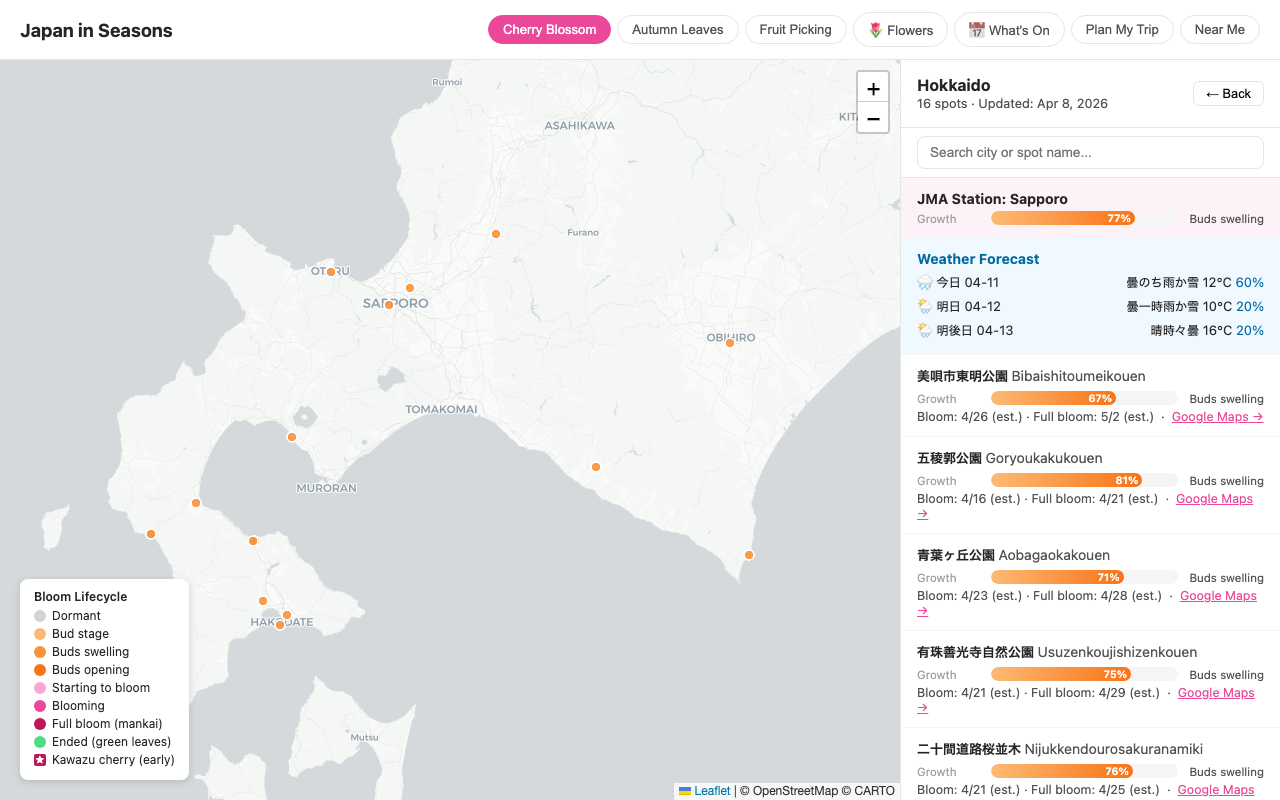 | 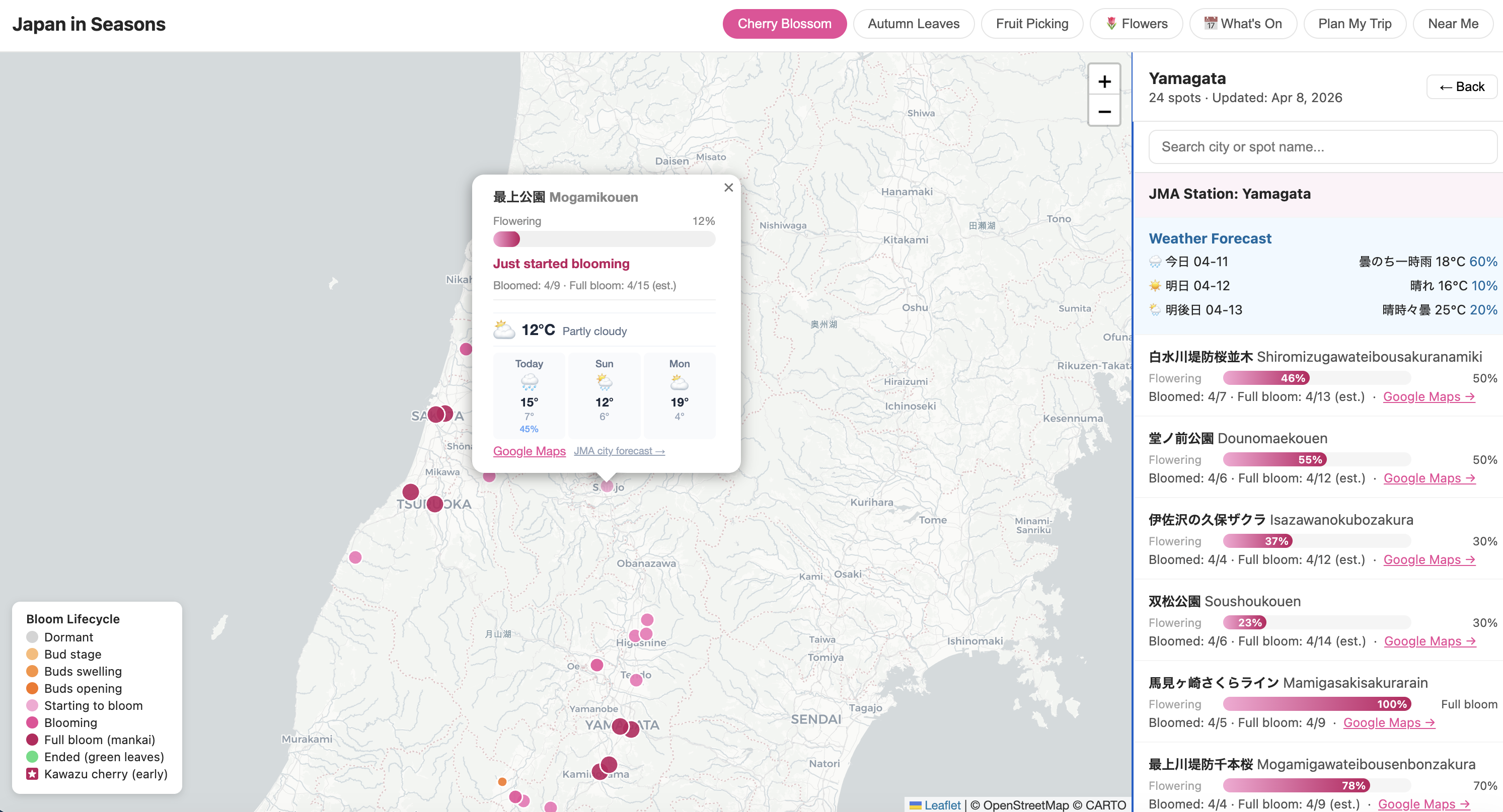 |
| Fruit picking | What's On in Japan |
|---|---|
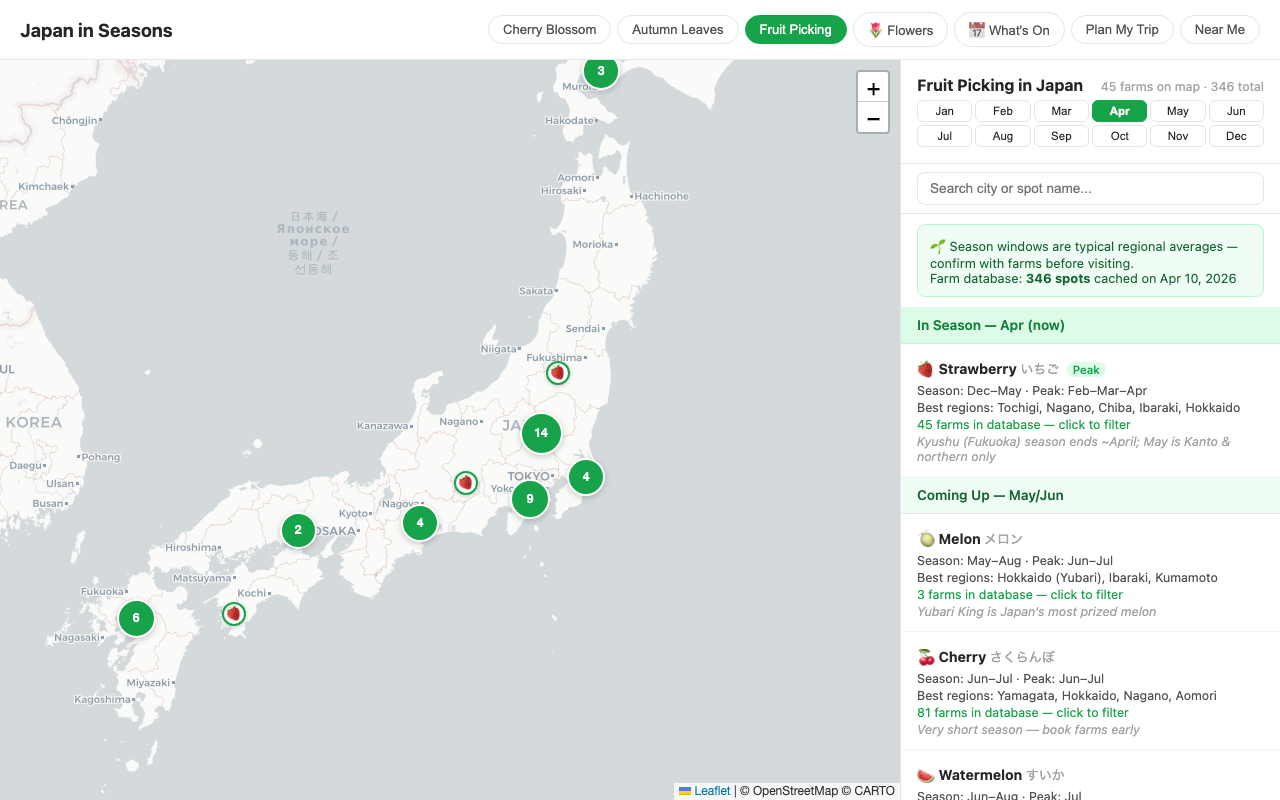 | 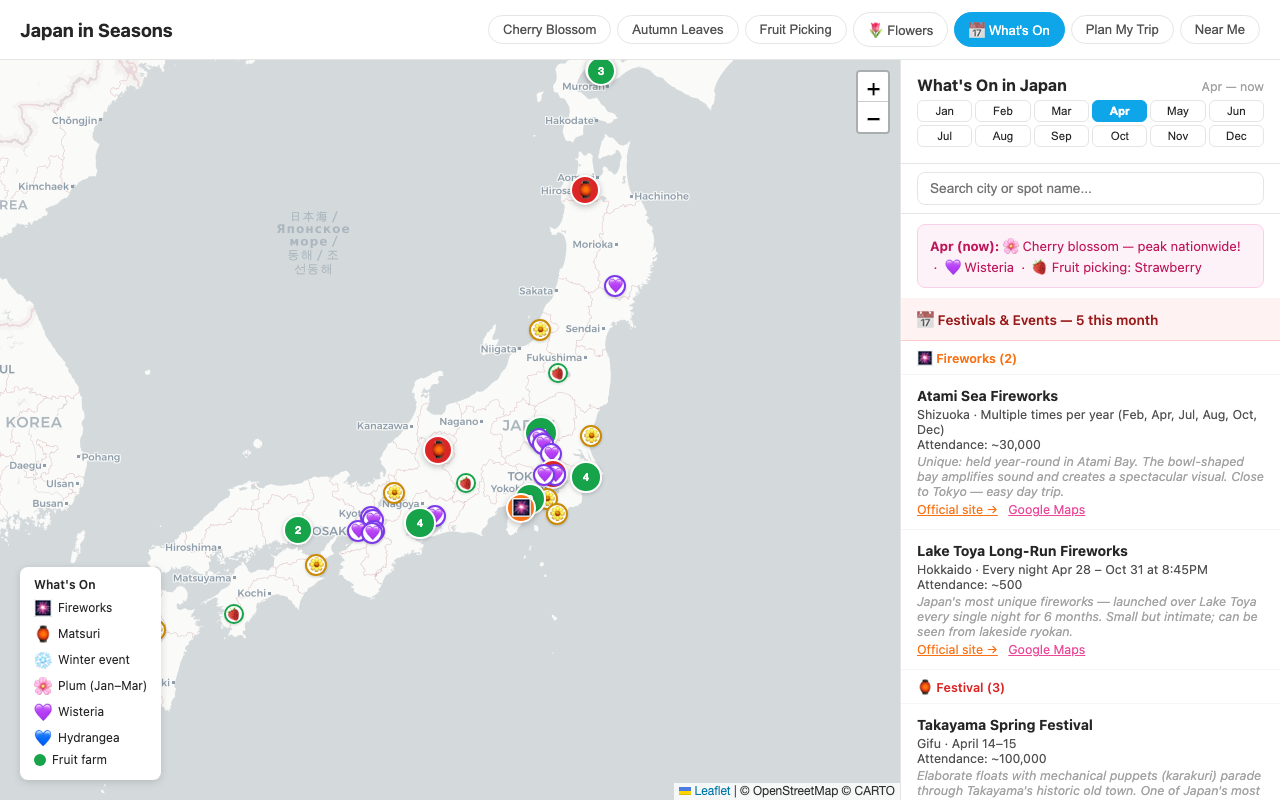 |
| Flowers in season | Mobile |
|---|---|
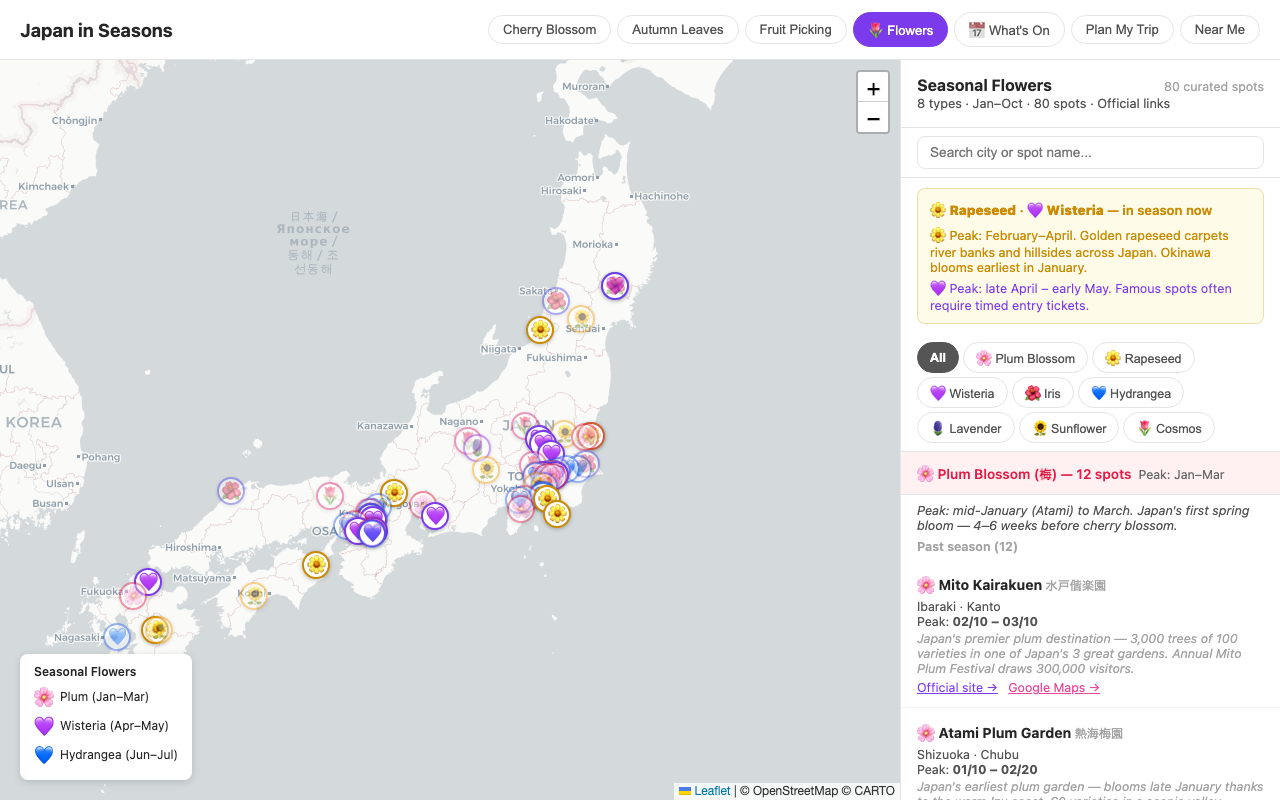 | 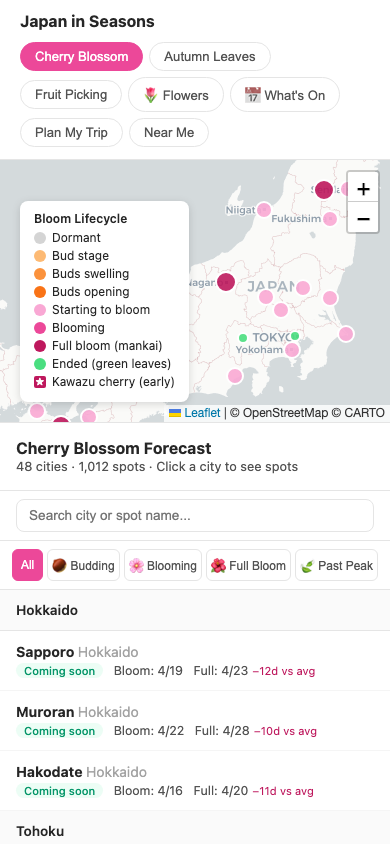 |
The problem
You ask Claude, ChatGPT, or Gemini: "When should I visit Kyoto for cherry blossoms?"
You get "late March to early April" — the same answer every year, based on training data that has no idea what this winter was like.
The actual bloom date shifts by 2–3 weeks depending on temperatures. Tokyo peaked March 29 in 2024, March 22 in 2023, March 28 in 2022 — a 7-day spread in just two years. Your AI is guessing. This MCP server stops the guessing.
The fix
It connects Claude (or any MCP client) to live forecast data from the Japan Meteorological Corporation — the same data that powers SAKURA NAVI and Japan's major cherry blossom forecast sites. Bloom meters update daily at 9 AM JST; spot observations update when JMC reporters file.
Real bloom percentages. Real park names. Real weather.
Use it with AI assistants
There are two different ways an AI assistant can use Japan in Seasons:
- AI search / web browsing can find and cite the public pages, text summaries, and JSON APIs. This is the lowest-friction path for people asking "latest sakura dates" in ChatGPT, Perplexity, Google AI Mode, etc.
- MCP tool use only works after the user or workspace admin connects the MCP server inside an MCP-capable client. Finding this repo in search does not give the assistant permission to run MCP tools.
For AI search, use these crawlable sources:
- Latest sakura text summary:
https://seasons.kooexperience.com/sakura-forecast.txt - Sakura forecast JSON:
https://seasons.kooexperience.com/api/sakura/forecast - Interactive map and forecast pages:
https://seasons.kooexperience.com
Remote MCP endpoint
No package install is needed when the client supports remote/streamable HTTP MCP. Add this as the MCP server/app/connector URL:
For ChatGPT Apps/Connectors, use:
- Name:
Japan in Seasons - Description:
Use this for live Japan seasonal travel data: cherry blossom and sakura dates, autumn leaves, flowers, festivals, fruit picking, and weather. Best for current or date-specific Japan travel questions. - Connector URL:
https://seasons.kooexperience.com/mcp
Claude Desktop / Claude Code / stdio MCP clients
Add this to the client's MCP config:
Optional connection preferences supported by the hosted endpoint:
dateStyle—friendlyorisotemperatureUnit—celsiusorfahrenheitincludeCoordinates—trueorfalsemapLanguage—englishorjapanese
Self-host
Optional durable cache for the hosted web map:
Point JAPAN_SEASONS_CACHE_DIR at a persistent volume, for example a Railway Volume mounted at /data. This stores the warmed national sakura/koyo all-spots JSON across restarts; without it, the app falls back to in-memory cache and still works.
Why ChatGPT may find it but refuse to use it
ChatGPT Search can discover japan-seasons-mcp as a web result, but web discovery is not the same as connecting an MCP server. If the chat only has web search enabled, it should cite the crawlable forecast pages or JSON API. To run tools like sakura_now, sakura_forecast, or sakura_spots, the MCP endpoint must first be added as a ChatGPT app/connector or configured in another MCP client.
What's covered
| Season | Data | Spots | Source |
|---|---|---|---|
| Jan–Feb | Kawazu cherry (early deep-pink variety, Izu Peninsula) | 9 spots | JMC live |
| Jan–Mar | Plum blossoms | 8 spots | curated |
| Mar–May | Cherry blossom (sakura) | 1,012 parks & temples | JMC live, daily |
| Apr–May | Wisteria | 13 spots | curated |
| May–Jun | Iris gardens | 9 spots | curated |
| Jun–Jul | Hydrangea | 15 spots | curated |
| Jun–Jul | Lavender fields | 6 spots | curated |
| Jul–Aug | Fireworks festivals & summer matsuri | 46 events | curated |
| Jul–Aug | Sunflower fields | 7 spots | curated |
| May–Nov | Fruit picking | 346 farms, 14 fruits | Jalan + Navitime |
| Sep–Oct | Cosmos fields | 8 spots | curated |
| Oct–Dec | Autumn leaves (koyo) | 687 viewing spots | JMC live |
| Jan–Feb | Winter events (Sapporo Snow Festival, etc.) | 8 events | curated |
1,700+ GPS-tagged spots across 12 seasonal categories.
Tools
Best first-call tools
japan_seasonal_answer — answer a broad traveler question
Use this when someone asks a normal question instead of naming a dataset: "How is the sakura forecast?", "What is good in Japan in June?", "Where should I see autumn leaves in late November?", or "What seasonal activities match my dates?" It routes to the right live or curated dataset and returns a ready-to-use recommendation.
sakura_now — current cherry blossom answer
The best first call for broad sakura prompts. It summarizes what is good now, what is coming next, or what matched the user's trip dates, using live JMC forecast/observation data, and includes a short list of specific viewing spots when spot data is available.
koyo_now — current autumn leaves answer
The autumn equivalent of sakura_now: current koyo timing, maple/ginkgo peaks, trip-date matches, and next-step guidance for exact spots.
search / fetch — retrieval-friendly access
Provider-friendly search/fetch tools for ChatGPT-style retrieval and deep-research citation flows. search returns result IDs; fetch returns full text with a canonical URL.
Cherry blossom
sakura_forecast — the big picture
All 48 JMA observation cities in one call: this year's forecast, actual dates when observed, and how each city compares to the historical average. Good starting point before you drill into specific spots.
sakura_spots — specific parks and temples
1,012 spots across Japan with current status, bloom percentages, and GPS coordinates. When JMC spot reporters have filed a recent update (within 48 hours), the tool uses that observed status as the primary reading. Otherwise it falls back to the JMC bloom-meter forecast. Stale observations are shown as context, not hidden.
sakura_best_dates — match travel dates to bloom
Give it your start and end dates, get back the cities where full bloom overlaps your window plus a short list of specific viewing spots when spot data is available.
kawazu_forecast — early-season deep-pink variety
Kawazu cherry blooms January–February in Izu Peninsula, months before standard sakura opens anywhere.
Autumn leaves
koyo_forecast — maple and ginkgo timing by city
50+ cities with this year's colour-change dates and how they compare to the historical normal. Maple and ginkgo peak at different times; both are included.
koyo_best_dates — same idea as sakura best dates, for autumn
Match your travel window to cities in peak colour.
koyo_spots — 687 viewing spots by prefecture
Each spot has a peak window (start, peak, end), leaf type, popularity rating, and GPS.
Flowers
flowers_spots — 90 curated spots, 8 flower types, Jan through Oct
| Type | Season | Notable spots |
|---|---|---|
| Plum | Jan–Mar | Atami, Mito Kairakuen |
| Nanohana | Feb–Apr | Chiba coast, Showa Kinen |
| Wisteria | Apr–May | Ashikaga, Kawachi, Kameido Tenjin |
| Iris | May–Jun | Meiji Jingu, Horikiri Shobuen |
| Hydrangea | Jun–Jul | Meigetsu-in, Hasedera, Yatadera |
| Lavender | Jun–Jul | Furano (Hokkaido) |
| Sunflower | Jul–Aug | Zama, Hokuryu |
| Cosmos | Sep–Oct | Showa Kinen, Hitachi Seaside |
Filter by type, prefecture, or month. Each spot has an official URL and verified GPS.
Festivals and events
festivals_list — 46 major recurring events with official URLs and attendance figures
Filter by type (fireworks / matsuri / winter), month, and prefecture.
Fruit picking
fruit_seasons — full-year calendar for 14 fruits
Which fruits are in season and at peak for any given month, with best regions and notes.
fruit_farms — 346 farms with GPS and booking links
Pass month= and it auto-filters to farms with something in season. Add region= to narrow further.
Weather
weather_forecast — 3-day JMA forecast for 51 cities
Temperature, rain probability by 6-hour window, and conditions. Worth checking because rain speeds up petal fall.
Usage
Ask your MCP client for a goal, not a tool name. A few good examples:
Typical workflow:
- Ask for timing first with
sakura_best_dates,koyo_best_dates,sakura_forecast, orkoyo_forecast. - Drill into exact parks, temples, farms, or events with
sakura_spots,koyo_spots,fruit_farms,flowers_spots, orfestivals_list. - Check
weather_forecastif rain or temperature could change the recommendation. - Set optional connection preferences if you want ISO dates, Fahrenheit weather, Japanese map links, or outputs without GPS coordinates.
How it works
Static datasets load at startup and are served from memory with no disk I/O per request. Live JMC data is cached server-side (1–6h TTL). The all-spots payload is pre-gzipped at startup so repeat serving is essentially free.
Bloom scale reference
JMC publishes two separate data products for sakura spots. Both are used:
Spot observations — reported by JMC partners and spot managers, used as primary status when updated within 48 hours:
Bloom-meter forecast (jr_data) — mathematical model used as fallback when no fresh observation exists:
The forecast model stays frozen at full-bloom=100% after peak and cannot detect petal fall or hazakura on its own. Spot observations (states 5–6) are the only way to confirm post-peak status for a specific park.
Peak viewing is typically full bloom ± 3 days. Rain accelerates petal fall.
Web app
seasons.kooexperience.com is the interactive companion to this MCP server. It shows all the same data on a map — 1,012 sakura spots with lifecycle colours (orange bud, pink bloom, green ended), 687 koyo spots, 346 fruit farms grouped by location, and 90 flower spots. There are also focused SEO/citation pages for cherry blossom forecasts, autumn leaves forecasts, and the MCP server. The map includes a "Plan My Trip" mode where you pick cities and see every seasonal activity near each one ranked by distance, and a "Near Me" button that finds spots within 30km of your GPS location.
Development
TypeScript. No external database. No auth required.
Data sources
| Source | What it provides |
|---|---|
| Japan Meteorological Corporation | Sakura and koyo forecasts, bloom percentages, 1,700+ viewing spots |
| Japan Meteorological Agency via tsukumijima | City weather forecasts |
| Jalan / Navitime | Fruit picking farm listings |
| Hand-curated | 90 flower spots, 46 festival entries, each with an official URL and verified GPS |
Contributing
PRs welcome, especially for flower spots, festival entries, and farm corrections. See CONTRIBUTING.md.
Formerly
Previously published as japan-sakura-koyo-mcp (deprecated). Use this package instead:
License
MIT · Built by Haoming Koo