Qai Consultant README
The full upstream README, mirrored here for reference. Install config, tool schemas, adoption signals, and an original overview live on the Qai Consultant listing page.

QAI Consultant
An open-source AI agent that acts as a senior QA Architect — automatically generating a Test Strategy, Risk Register, Effort Estimation Report, and Test Plan from a simple project description, plus deterministic QA Document Quality Review and Test Results Analysis for evaluating what already exists. Also available as an MCP server so Claude Code, Claude Desktop, and claude.ai can ground their own QA work in the same standards and numbers.
🌐 Live demo: quality-ai-consultant.streamlit.app
🔌 New: QAI Consultant is now also an MCP server —
uvx qai-consultant-mcp. No API keys, no Pinecone. See MCP Server below or the package on PyPI.
🤖 Built with Claude Code by Anthropic.






Screenshots
Web UI (Streamlit)
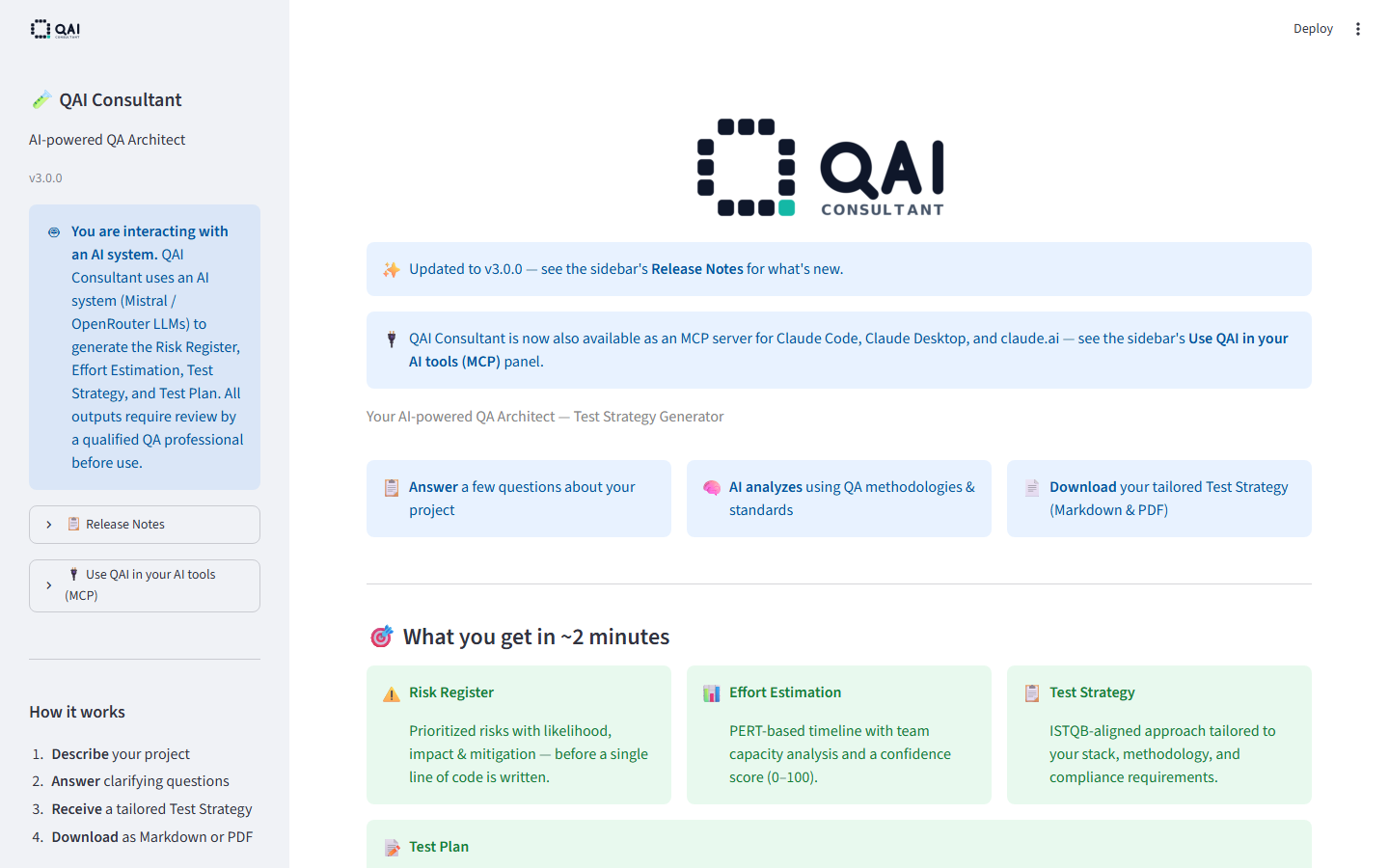
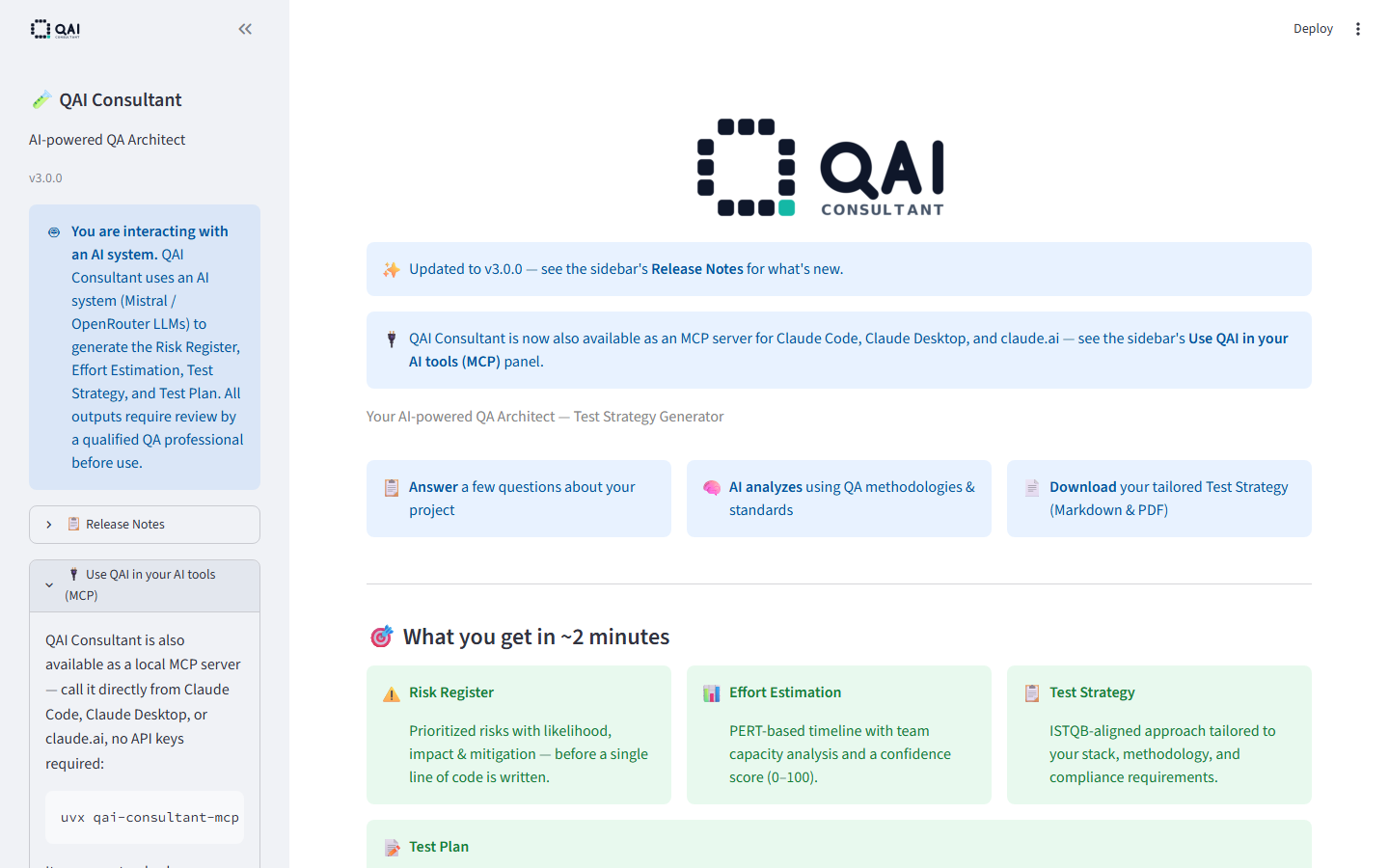
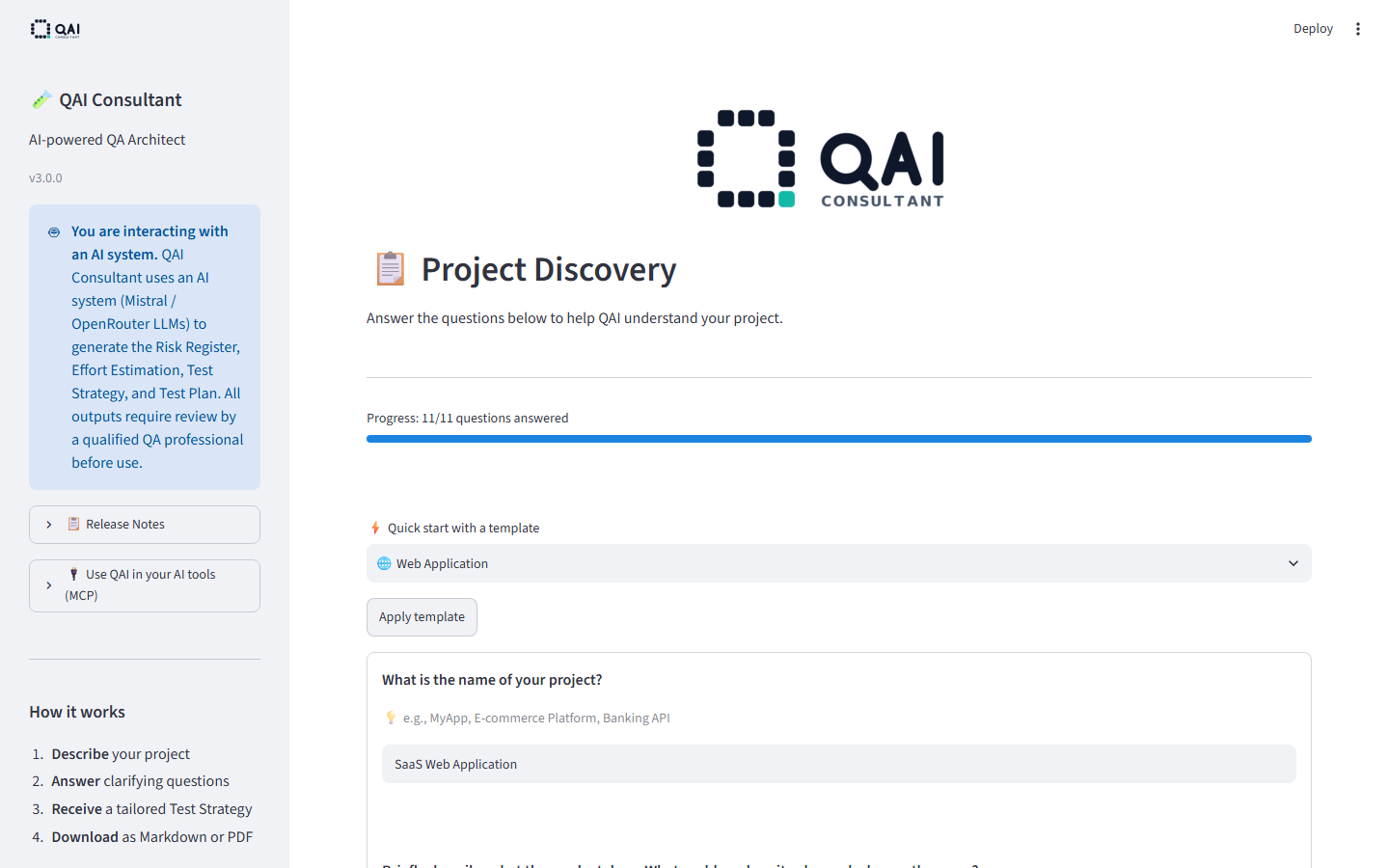
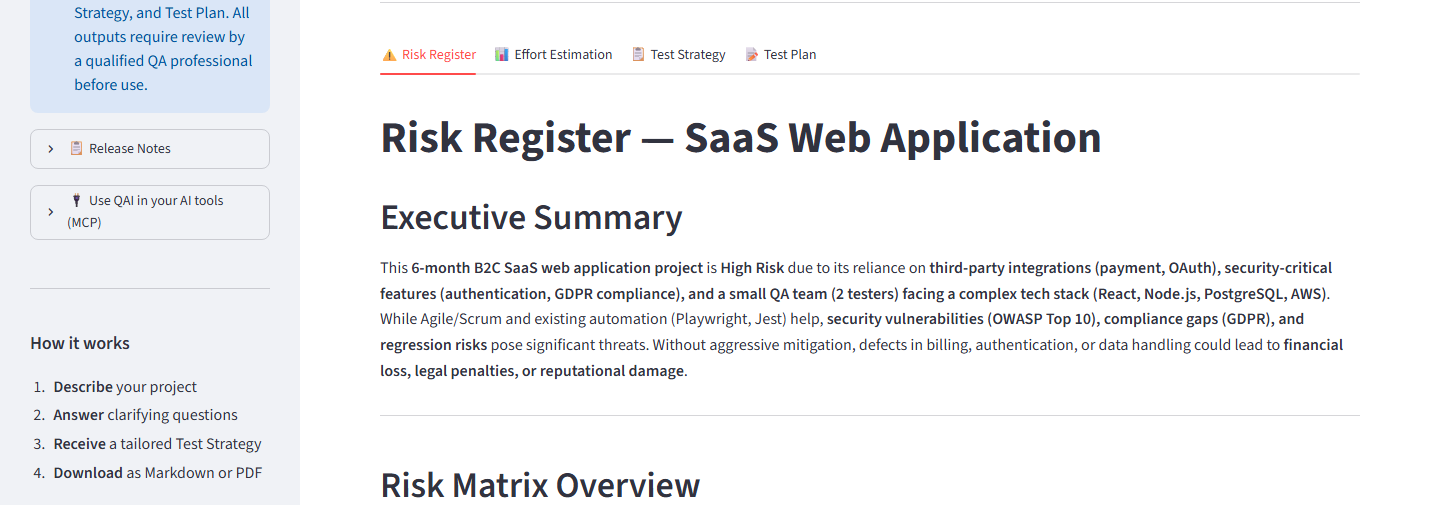
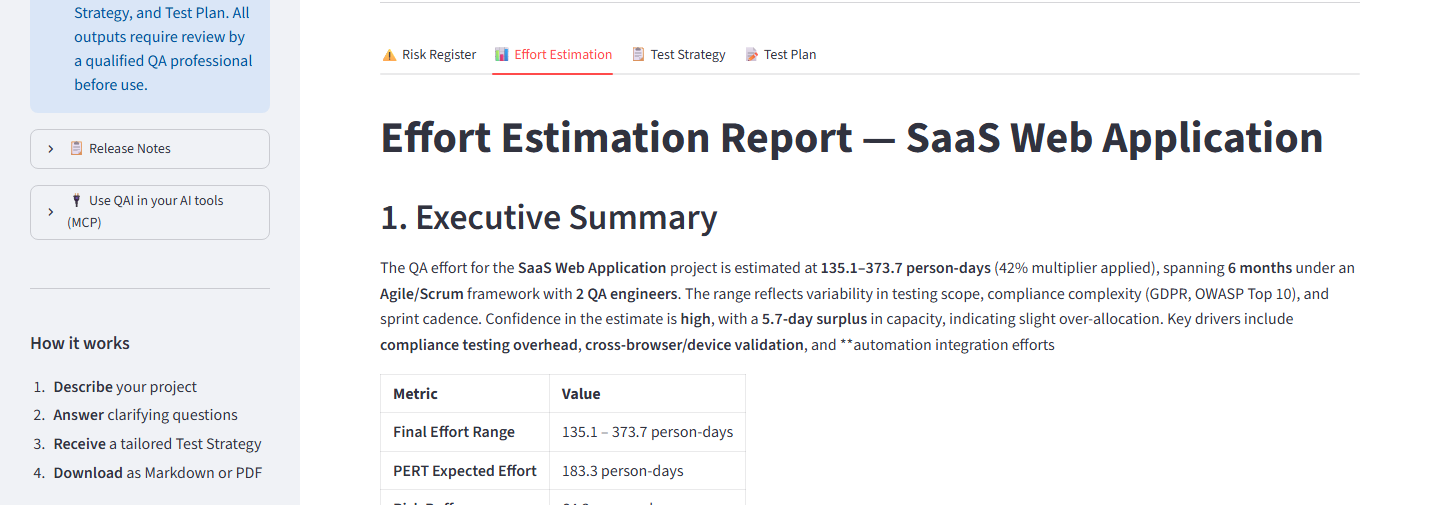
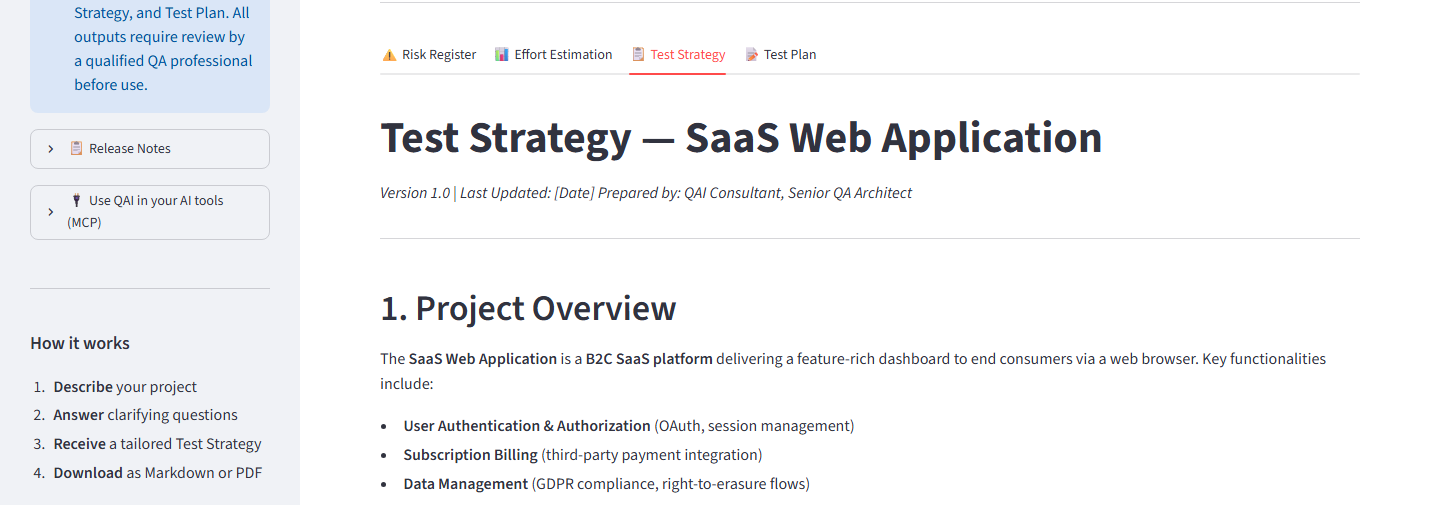
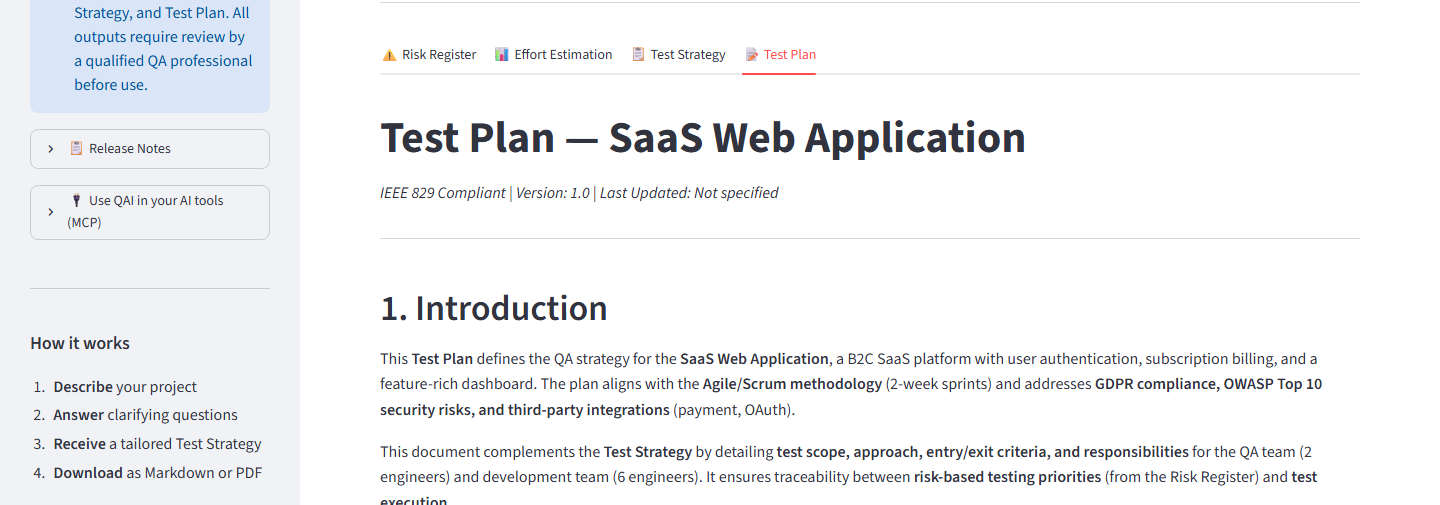
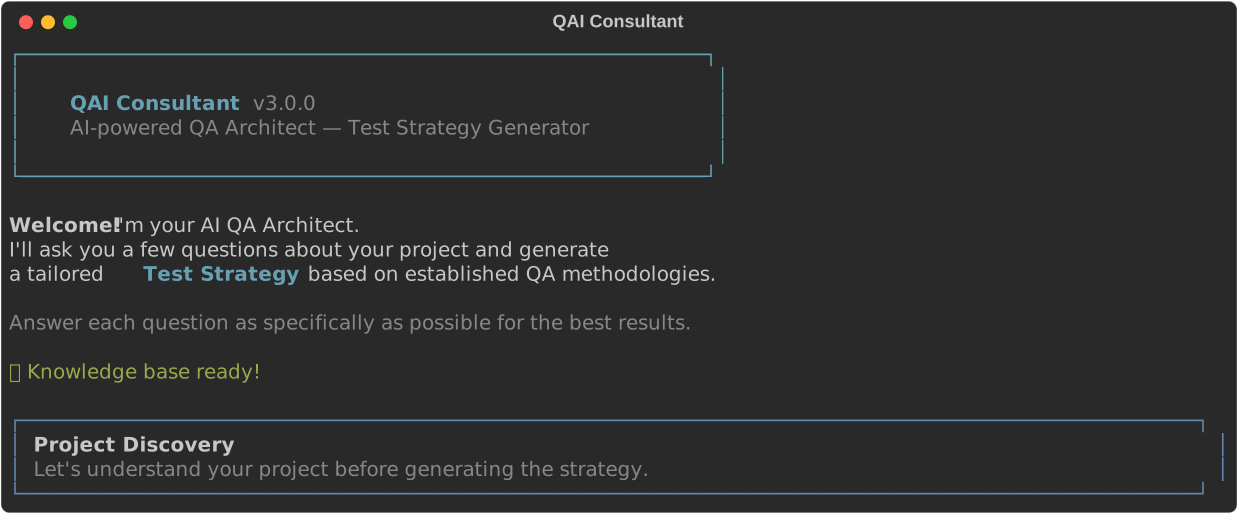
CLI
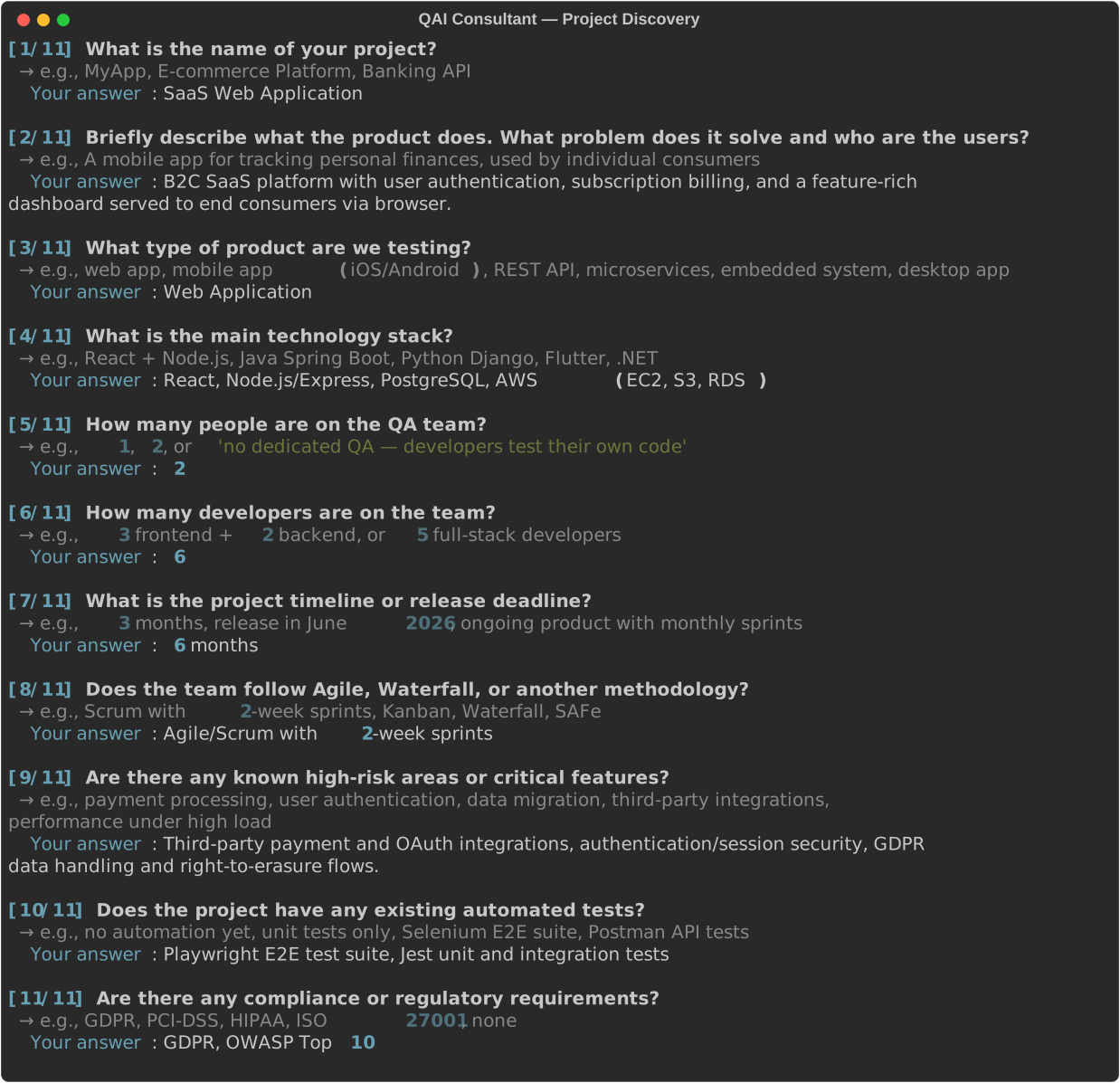
Quick Start
Option A — Use the live app (no setup)
👉 quality-ai-consultant.streamlit.app
Option B — Run locally
📖 Full installation guide: INSTALL.md
The Problem
Creating a Test Strategy from scratch is time-consuming and requires deep QA expertise. Most teams either skip it, do it superficially, or spend days researching methodologies.
QAI Consultant eliminates this bottleneck by combining established QA methodologies, industry standards (ISTQB, OWASP, ISO 26262, A-SPICE), and expert knowledge into an AI agent that thinks like a seasoned QA Architect.
Who Is This For?
- QA Engineers who need structured guidance on test strategy
- Engineering Managers who need effort estimations and resource planning
- Development teams without a dedicated QA Architect
- QA Consultants who want to accelerate their delivery
What QAI Consultant Generates
From a single 11-question dialogue, QAI Consultant automatically generates four documents:
| Document | What it contains |
|---|---|
| ⚠️ Risk Register | Risk matrix, likelihood/impact analysis, mitigations per risk |
| 📊 Effort Estimation Report | PERT-based breakdown, team capacity analysis, confidence score |
| 📋 Test Strategy | ISTQB-aligned strategy tailored to your stack, methodology, and compliance |
| 📝 Test Plan | IEEE 829-aligned plan with entry/exit criteria, schedule, and AI tool oversight |
All outputs are saved as Markdown files and available for PDF download.
Knowledge Base
QAI Consultant's recommendations are grounded in real QA standards and methodologies:
- 📘 ISTQB — 14 certification syllabuses (CTFL, CTAL-TA, CTAL-TM, CTAL-TAE, CT-AI, and more)
- 🔒 OWASP — WSTG v4.2, MASTG, Top 10 2021
- 🚗 ISO 26262 — Automotive functional safety (ASIL levels, HARA, V&V)
- 🏭 A-SPICE — Automotive SPICE process reference model (SWE.4, SWE.5, SWE.6)
- 📋 IEEE 829 — Test documentation standard
- ⚙️ ISO/IEC 25010 — Software product quality model
- 🤖 AI Test Planning — 17 real-world AI SDLC case studies (2024–2025)
- 🧠 Expert Knowledge — Real QA scenarios and lessons learned from practitioners
Prerequisites
QAI Consultant v2.0 runs on cloud APIs — no local GPU or Ollama required.
You need four API keys in a .env file (all have free tiers):
| Key | Where to get it |
|---|---|
MISTRAL_API_KEY | console.mistral.ai → API Keys |
OPENROUTER_API_KEY | openrouter.ai/keys |
PINECONE_API_KEY | pinecone.io → API Keys |
PINECONE_INDEX_NAME | Name of your Pinecone index (e.g. qai-consultant, dimensions: 384, metric: cosine) |
Architecture
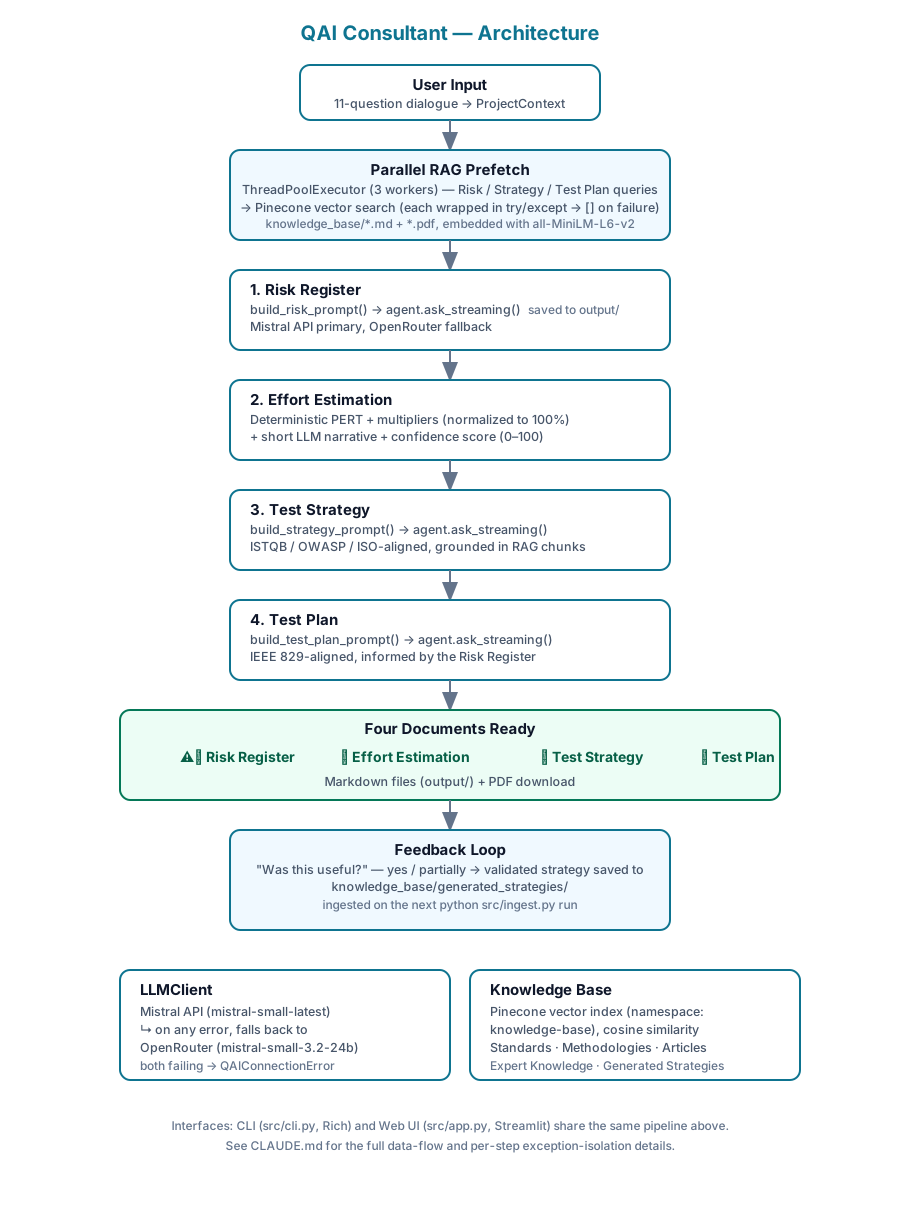
How It Works
LLM calls use Mistral API as the primary provider, with OpenRouter as automatic fallback.
Interfaces
Web UI (Browser — recommended)
Or use the live hosted version: quality-ai-consultant.streamlit.app
CLI (Terminal)
MCP Server (for Claude Code, Claude Desktop, claude.ai)




Listed on the official MCP registry (io.github.gvasile29/qai-consultant-mcp), Glama, and Awesome MCP Servers.
QAI Consultant is also available as a local, fully keyless MCP server —
qai-consultant-mcp. No Pinecone, no Mistral/OpenRouter API keys: it runs a
local embedding index over the same knowledge base and exposes deterministic
QA effort estimation, so your own AI coding assistant can ground its QA
planning directly, no separate LLM call needed.
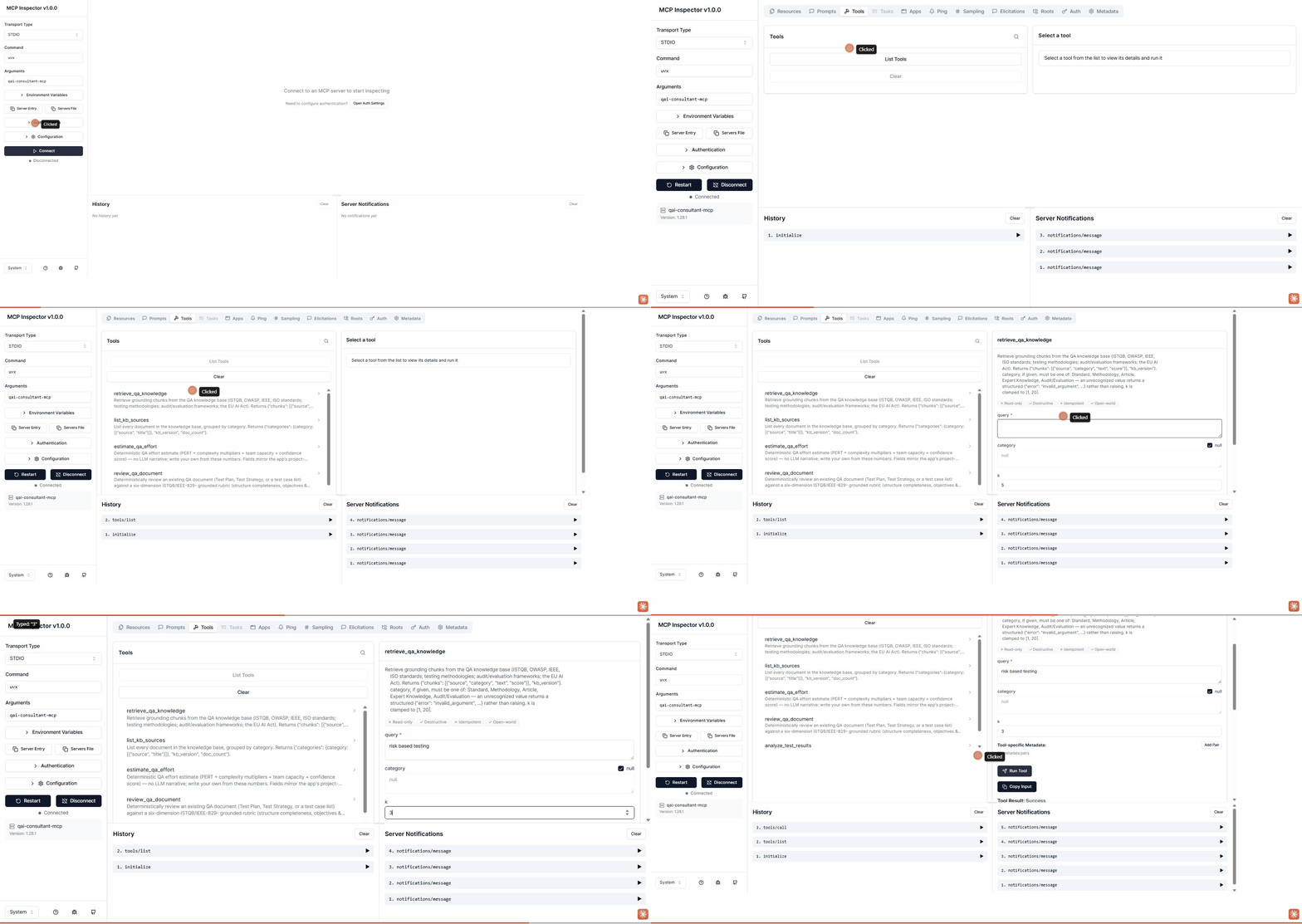
Claude Code:
Claude Desktop (claude_desktop_config.json):
Tools:
| Tool | What it does |
|---|---|
retrieve_qa_knowledge | Grounding chunks from the KB (ISTQB, OWASP, IEEE, ISO, EU AI Act), filterable by category |
list_kb_sources | Every document in the KB, grouped by category |
estimate_qa_effort | Deterministic PERT-based effort estimate (no LLM narrative — you write your own from the numbers) |
review_qa_document | Deterministic 0–100 quality score for an existing Test Plan/Strategy/test case list across six ISTQB/IEEE-829 dimensions, with findings + KB citations |
analyze_test_results | Deterministic health metrics from JUnit XML/CSV test execution data — flaky tests, ever-failing tests, slowest tests, failure clustering |
assess_qa_maturity | Deterministic indicative TMMi process-maturity level (1-3, never a certified 4-5) from a free-text description, plus a conditional EU AI Act Articles 9-15 readiness score when the input signals an AI/ML system |
Prompts: qa_project_interview (the same 11-question intake this app uses), risk_register_structure, test_strategy_structure, test_plan_structure — each grounds the client's generation in retrieve_qa_knowledge with [Source N] citations.
Privacy: usage telemetry is off by default. Set QAI_TELEMETRY=1 to opt in; even then, only tool name/success/duration/category and an anonymous install ID are sent — never your query text or project details.
Feedback Loop
After each generation, QAI asks: "Was this strategy useful?"
- Yes → strategy saved to
knowledge_base/generated_strategies/and included in the next re-ingestion - Partially → strategy saved with your improvement notes
- No → discarded
This creates a feedback loop where QAI learns from validated real-world outputs over time.
Roadmap
- v0.1 ✅ Core agent + CLI + Streamlit Web UI
- v0.2 ✅ Feedback loop — validated strategies grow the knowledge base
- v0.3 ✅ Risk Register — automatic risk analysis alongside Test Strategy
- v0.4 ✅ Effort Estimation Report — PERT-based with team capacity analysis
- v0.5 ✅ Auto re-ingest — file watcher + incremental ingest + manifest tracking
- v0.6 ✅ Confidence level algorithm — score-based (0-100): PERT spread + capacity gap + data quality + multiplier magnitude
- v1.0 ✅ MVP — error handling, input validation, logging, full documentation, tests, Apache 2.0 license
- v2.0 ✅ Cloud migration — Ollama → Mistral API + OpenRouter fallback; ChromaDB → Pinecone; deployed to Streamlit Cloud
- v2.0.1 ✅ Stability — 27 bugs fixed: PERT normalization, template application, PDF caching, session state, filename sanitization, RAG fallback, per-step exception isolation
- v2.0.2 ✅ Stability — release-gate evals (estimate integrity + RAG metrics), 5 estimation/validation defects fixed, session-state crash fix, narrative duplication/truncation fixes, per-step generation isolation from LLM outages
- v2.5.0 ✅ In-app Release Notes — sidebar panel + one-time "what's new" banner
- v2.5.1 ✅ Knowledge base — new
evaluation_audit/pillar: process/test maturity models, audit methodology, security/compliance audit, real public failure case studies - v2.5.2 ✅ EU AI Act Article 50 transparency patch — sidebar AI-interaction notice + visible "AI-generated content" label on every generated document
- v2.6.0 ✅ EU AI Act knowledge base pillar — risk tiers, provider/deployer obligations, Article 50 transparency, Articles 9-15 testing implications, conformity assessment, timeline
- v3.0.0 ✅ MCP server MVP — local, keyless
qai-consultant-mcp(standards-grounded retrieval + deterministic effort estimation), in-app announcement, and machine-readable AI-generated marking (EU AI Act Article 50(2)) - v3.1.0 ✅ Evaluation Package — QA Document Quality Review (deterministic ISTQB/IEEE-829 rubric scoring an existing Test Plan/Strategy/test case list, with an optional AI narrative) and Test Results Analysis (flaky/ever-failing/slowest/failure-clustering metrics from JUnit XML/CSV, grounding the Risk Register in real execution data); available in the web app, CLI (
--review,--results), and the MCP server (review_qa_document,analyze_test_results) - v3.1.1 ✅ Visit counter — a running total of app visits now shows in the sidebar, persisted in Pinecone so it survives redeploys
- v3.1.2 ✅ Fix — the 3.1.1 visit counter never actually incremented (Pinecone rejected its all-zero placeholder vector); now works correctly
- v3.1.3 ✅ Fix — the visit counter's label was in Romanian ("vizite") instead of English; now reads "visits" to match the rest of the app's UI copy
- v3.1.4 ✅ Added the
mcp-namemarker toREADME_MCP.md(PyPI long description) — a prerequisite for listingqai-consultant-mcpin the official Anthropic MCP registry; no functional change - v3.1.5 ✅ Fix —
qai-consultant-mcpfailed to start (ModuleNotFoundError: mcp.server.fastmcp) after the upstreammcpSDK's breaking 2.0.0 release removed theFastMCPmodule the server depends on;mcpis now pinned to>=1.8.0,<2.0.0 - v3.1.6 ✅ Fix —
qai-consultant-mcpcould fail to attach in Claude Desktop on a cold cache (a client-side handshake timeout, since the server used to fully embed the whole knowledge base before responding toinitialize); the full index build is now lazy, deferred until the first real request - v3.2 ✅ CI quality gates completion — a separate, always-green-by-construction nightly workflow exercising real Pinecone/Mistral/OpenRouter contract tests, isolated from the blocking PR checks
- v3.3 ✅ Adopted the EU's official AI-generated-content icon (Code of Practice, AI Act Article 50(4)) in the Streamlit sidebar and all generated-document PDF exports, reinforcing the existing text/metadata disclosure
- v3.3.1 ✅ Fix —
qai-consultant-mcpcould intermittently fail to attach in Claude Desktop because 4 of its 6 runtime dependencies had loose version bounds, lettinguvre-resolve and reinstall on any unrelated upstream release; all dependencies are now exact-pinned - v3.4 ✅ App visual redesign ("Calibration Bench") — token-based color/typography system (IBM Plex fonts, no font CDN) and a reusable "Signal Ledger" score/severity component, applied to Document Review, Effort confidence, Results Analysis, Risk Register, and the Project Discovery question list
- v3.4.1 ✅ Distribution links (official MCP registry, Glama, Awesome MCP Servers) now shown in the app's own MCP panel, not just the READMEs; landing page redesign started (Phase 1 of 3 — see the CHANGELOG)
- v3.4.2 ✅ Interactive flow redesign (Phase 2 of 3 — see the CHANGELOG): the Project Discovery dialogue, review screen, and sidebar now share the landing page's "Power-On Sequence" visual language (animated progress bar, one-time entrance-animated summary tiles, hover feedback)
- v3.4.3 ✅ Output screens redesign (Phase 3 of 3, completing the "Power-On Sequence" redesign — see the CHANGELOG): the Test Strategy results view and the document review screen now share the same visual language (live 4-stage sequence status, entrance-animated score tiles, hover feedback), plus a "What you get in ~2 minutes" addendum on the landing screen
- v3.4.4 ✅ Fix —
qai-consultant-mcpcould again fail to attach in Claude Desktop, this time from an unpinned transitive dependency (scipy, via scikit-learn) picking up a fresh release mid-cache-miss; the entire resolved dependency tree (~99 entries) is now exact-pinned, not just the 6 direct imports - v3.5.0 ✅ QA Maturity Assessment (
assess_qa_maturity) — deterministic TMMi process-maturity signal (10 process areas, indicative level 1-3) plus a conditional EU AI Act Articles 9-15 readiness score for AI/ML projects; available in the web app ("📈 Assess QA Maturity"), CLI (--maturity), and the MCP server (assess_qa_maturity) - v3.5.1 Fix: QA Maturity scoring missed paraphrased evidence (requirement traceability described in prose, progress tracking described as "defect triage"/"pass rate") — found via live browser QA. Yanked from PyPI — see v3.5.2, published the same day, for why
- v3.5.2 ✅ Fix: the v3.5.1 MCP package could not be installed at all (
torch==2.13.0+cpuunresolvable from plain PyPI) — reverted to a plaintorch==2.13.0pin. This is the first working PyPI publish of theassess_qa_maturityMCP tool, since v3.5.0's own publish step was never completed and v3.5.1 was broken - v3.5.3 ✅
qai-consultant-mcp's local index switched fromsentence-transformers/torchtofastembed(ONNX Runtime) for embeddings — same retrieval quality (evals/local_index_parity.py: recall@5=0.91, MRR=0.86, unchanged), ~3x faster cold import, and a much smaller dependency list. Removed the weekly dependency-drift-canary workflow, no longer justified at the smaller scale. SeeCHANGELOG.mdfor details. - v4.0 Remote MCP + distribution — hosted server connectable from claude.ai, registry submissions
Contributing
QAI Consultant is built by the QA community, for the QA community.
Contributions are welcome:
- 📚 Add new knowledge sources to
knowledge_base/ - 🧠 Share expert knowledge using the prompts in
knowledge_base/expert_knowledge/ - 🐛 Report bugs or suggest features via GitHub Issues
- 🔧 Submit pull requests
See CONTRIBUTING.md for detailed guidelines.
Troubleshooting
| Problem | Solution |
|---|---|
| "Missing required secret: 'MISTRAL_API_KEY'" | Add your key to .env or Streamlit Cloud secrets |
| "Missing required secret: 'PINECONE_API_KEY'" | Add your Pinecone key to .env |
| "Knowledge base is empty" | Run python src/ingest.py to push documents to Pinecone |
| "Both Mistral API and OpenRouter are unavailable" | Check API keys are valid and have credits |
📖 Full troubleshooting guide: INSTALL.md