Verify factual claims against live sources: verdict, confidence score, and citations over MCP.
Quick Install
Automated & IDE SetupCopy the AI prompt to install this server into Claude Code, Cursor, or another agent — or use 1-click editor setup below.
Manual Client & Custom JSON ConfigExpand JSON ▾
Client Config & Setup
Choose your client or environment
Target File:
💡 Paste the JSON block into your client's configuration file under mcpServers, then restart the application.
Documentation Overview
Groundcheck

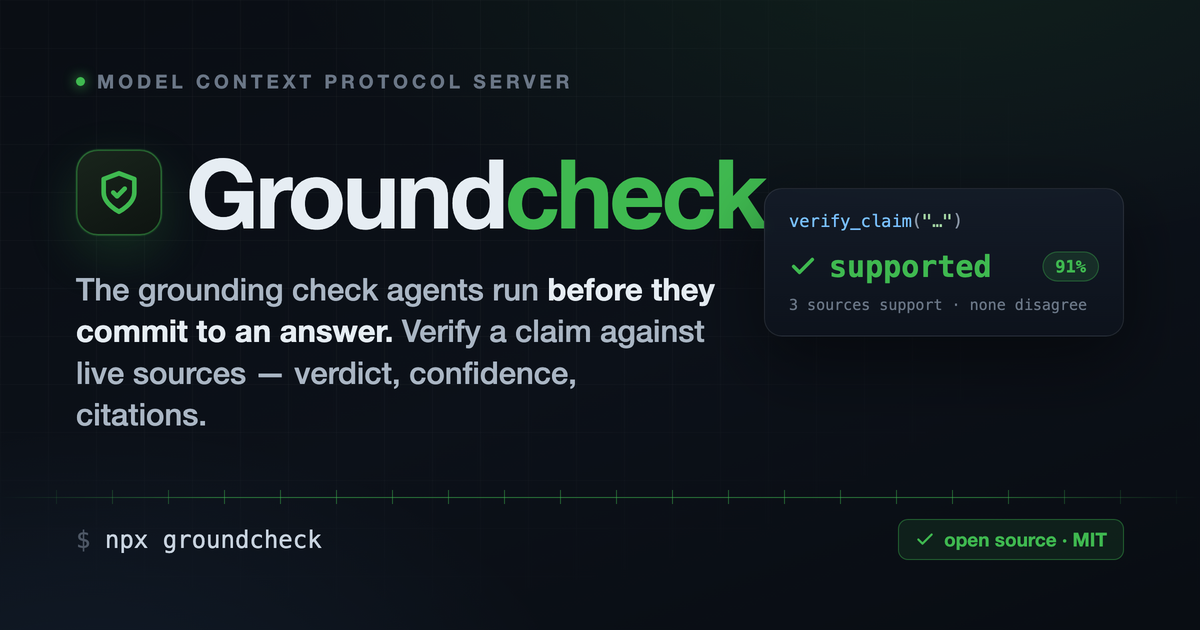
The grounding check agents run before they commit to an answer.
Groundcheck verifies a factual claim against live sources and returns a verdict, a confidence score, and citations. Any agent — Claude Code, Cursor, your own — can call it mid-task, before it states a fact it isn't sure of.
It is also a verification layer for agentic commerce: when an agent pays another
service over x402, attest_delivery verifies what was delivered against what was
advertised and issues a signed, offline-verifiable delivery receipt binding payment →
delivery → grounded content — the neutral accountability trail the a2a-payments
literature calls the missing layer (docs/delivery-attestation.md).
Architecture
Two parts, each in the language that fits it:
The MCP server is spawned by your client over stdio and talks to the engine over HTTP
(GROUNDCHECK_ENGINE_URL, default http://127.0.0.1:8723). The engine is the single source
of truth for how a verdict is reached, and it classifies source stance through the canonical
Python free-llm-router (free-tier providers).
Tools
| Tool | Use it when | Returns |
|---|---|---|
verify_claim(claim, maxSources?) | About to assert a fact you're unsure of | { verdict, confidence, rationale, sources } |
check_citations(text, maxClaims?) | Before publishing an AI-generated draft | per-claim verdict report |
attribution_badge() | Want to mark content as checked | a Markdown badge |
resolve_instrument(query, idType?, maxResults?) | Text names a security and you need to know exactly which one | canonical FIGI records + provenance (Bloomberg open symbology) |
extract_claims(text, maxClaims?) | Want to see which claims a document makes before paying to ground them | atomic checkable claims + a signed receipt bound to the input hash |
attest_delivery(service, response_text, …) | You paid another service over x402 and will act on (or account for) its output | a signed delivery receipt binding payment → delivery → grounded content (docs) |
verdict is one of supported · refuted · unverified. Each verdict also
carries a sufficiency tag (sufficient · insufficient · no_sources ·
no_stance · conflict) so an agent can tell "I found nothing" from "sources
exist but don't establish it" from "sources disagree" — the three ways an
abstention happens carry different meaning and are no longer collapsed
(SURE-RAG).
Compound claims are decomposed. A claim like "Marie Curie won two Nobel
Prizes and was born in Paris" is split into atoms
(Fact in Fragments), each verified on its
own evidence and recombined weakest-link: one false part refutes the whole, one
unproven part blocks a supported. The true half can no longer carry the false
half past the check. The atom breakdown is returned in atoms. (Decomposition
is rule-based and high-precision — it splits only on clean conjunction
boundaries and otherwise leaves the claim whole; disable with
GROUNDCHECK_DECOMPOSE=0.)
Remote MCP (no install): add https://groundcheck.seiche.info/mcp as a remote MCP server (Claude/ChatGPT/Cursor connectors, or a gateway like Smithery/Glama). Speaks streamable-HTTP JSON-RPC; verify_claim is free, the paid tools answer HTTP 402 with an x402 offer.
Quickstart
The MCP server auto-starts the Python engine if one isn't already running, so a single registration is enough — no separate process to babysit.
Already running the engine yourself (make engine or docker compose up -d)? The server
detects and reuses it — and won't touch an engine it didn't start. Set
GROUNDCHECK_NO_SPAWN=1 to stop it from ever spawning one.
Once published to npm, registration becomes
claude mcp add groundcheck -- npx -y groundcheck-mcp. Auto-spawn needs a localengine/+ Python deps; for an npx-only install, run the engine viadocker compose up -dand the server connects to it overGROUNDCHECK_ENGINE_URL.
With no provider key the engine still runs — retrieval works, but every verdict is
unverified. It degrades honestly: a disabled backend, a missing key, or conflicting sources
all flow toward unverified. An unconfigured Groundcheck cannot return supported.
Note: OpenRouter's
:freemodels are quota-throttled (HTTP 429) and make a poor sole provider. Prefer Groq or Cerebras for the fast classification tier.
Why grounded verdicts, not LLM-judgment
Asking an LLM to judge whether a claim is true is unreliable in a way that's easy to miss. In TraderBench (Yuan et al., 2026), the same candidate responses re-scored by three frontier LLM judges swung by ~29 points on the knowledge-retrieval section — while the performance-grounded section, whose scoring is anchored to verifiable computation, swung 0.3. The lesson: the more you constrain a judgment with external evidence, the less it varies.
Groundcheck is built on that principle. It never asks a model "is this true?" from parametric memory. Instead it:
- retrieves sources first, then asks only the narrow, evidence-anchored question — does this cited passage support, refute, or stay neutral on the claim (stance classification);
- refuses on conflict and saturates confidence, so disagreement flows to
unverifiedrather than a confident guess; - returns citations, so the verdict is checkable, not taken on the model's word.
That's the difference between an LLM judge and a grounding check: the judge's discretion is the product; here it's deliberately fenced in by retrieved evidence.
Calibrated verdicts: the "error ≤ α" guarantee
A confidence number without a promise attached is just vibes with decimals. When a
calibration artifact is deployed, Groundcheck attaches a guarantee object to
directional verdicts, built with split conformal prediction (adapted from
Multi-LLM Adaptive Conformal Inference, arXiv:2602.01285):
- Stance classification runs as a panel: up to
GROUNDCHECK_ENSEMBLE_MAXfree providers judge the claim independently (different model families disagree on which claims they get wrong, so the ensemble beats any one of them). Per-source stances are majority-voted; each panelist also emits a probability the claim is true given only the snippets, combined into a weightedensemble_score. scripts/calibrate.pyruns the real pipeline over a labeled claim set and stores finite-sample thresholds per claim group (instrument/general,globalfallback) incalibration/calibration.json.- A verdict is certified (
guarantee.certified: true) only when its score clears the threshold. The math guarantees that, for claims exchangeable with the calibration set, a false claim is certifiedsupportedwith probability ≤ α (default 0.1), and symmetrically forrefuted. No distributional assumptions, exact in finite samples.
Honest degradation, as everywhere else: no artifact → no guarantee is ever claimed; too little calibration data for a given α → the threshold is refused rather than extrapolated. The guarantee is only as good as the exchangeability assumption — recalibrate with domain claims before leaning on it in a new domain.
Configuration (engine)
| Var | Default | Purpose |
|---|---|---|
GROUNDCHECK_SEARCH_BACKEND | (unset) | stub to disable real retrieval |
GROUNDCHECK_SEARCH_URL | Wikipedia | custom JSON search endpoint ({results:[{title,url,snippet,stance?}]}) |
GROUNDCHECK_SEARCH_KEY | — | bearer token for the custom endpoint |
GROUNDCHECK_ROUTER_PATH | sibling checkout | path to the free-llm-router Python package |
GROUNDCHECK_ENGINE_HOST / _PORT | 127.0.0.1 / 8723 | engine bind address |
GROQ_API_KEY (or any router provider key) | — | enables stance classification |
GROUNDCHECK_ENSEMBLE | 1 | multi-provider stance panel (0 = single-router) |
GROUNDCHECK_ENSEMBLE_MAX | 3 | max concurrent panelists per claim |
GROUNDCHECK_CALIBRATION | calibration/calibration.json | conformal artifact path |
Machine-payable hosting (x402)
Related MCP Servers
Reviews
No reviews yet — be the first to share how this listing worked for you.
Frequently Asked Questions about Groundcheck
AllMCPs Directory Badge
Showcase your server listing on GitHub or your project documentation. Embed this dynamic SVG badge to highlight official listing status and live engagement.
Badge Style:
Live Dynamic SVG Preview
Markdown (GitHub README)
[](https://allmcps.com/mcp/groundcheck)HTML Embed
<a href="https://allmcps.com/mcp/groundcheck"><img src="https://allmcps.com/api/badge/groundcheck?style=directory" alt="Groundcheck on AllMCPs" /></a>