Persistent agent memory as a single Go binary: knowledge graph, TUI observability, zero infra.
Quick Install
Automated & IDE SetupCopy the AI prompt to install this server into Claude Code, Cursor, or another agent — or use 1-click editor setup below.
Manual Client & Custom JSON ConfigExpand JSON ▾
Client Config & Setup
Remote HTTPChoose your client or environment
Target File:
💡 Paste the JSON block into your client's configuration file under mcpServers, then restart the application.
Documentation Overview

GrayMatter





AI agents forget everything between sessions. GrayMatter gives them persistent memory, a self-building knowledge graph, and cuts context tokens by 90%.
One binary. Drop it in. Run it. No Docker, no databases, no config files, no cloud accounts, no bullshit.
General-purpose MCP server. Zero vendor lock-in.
Works with Claude Code, Cursor, Codex, OpenCode, Antigravity — and any MCP-compatible client.
Also a plain Go library if you don't use MCP.
Free. Offline. No account required.
Why
Every AI agent is stateless by default. Each run re-injects the full conversation history — and that history grows linearly. Two prompts in and you've already burned half of your daily quota.
That's not just a memory problem. That's a money and performance problem.
Mem0, Zep, Supermemory solve this — but they're Python/TypeScript-only and require a running server. The Go ecosystem has no production-ready, embeddable, zero-dependency memory layer for agents.
That gap is GrayMatter.
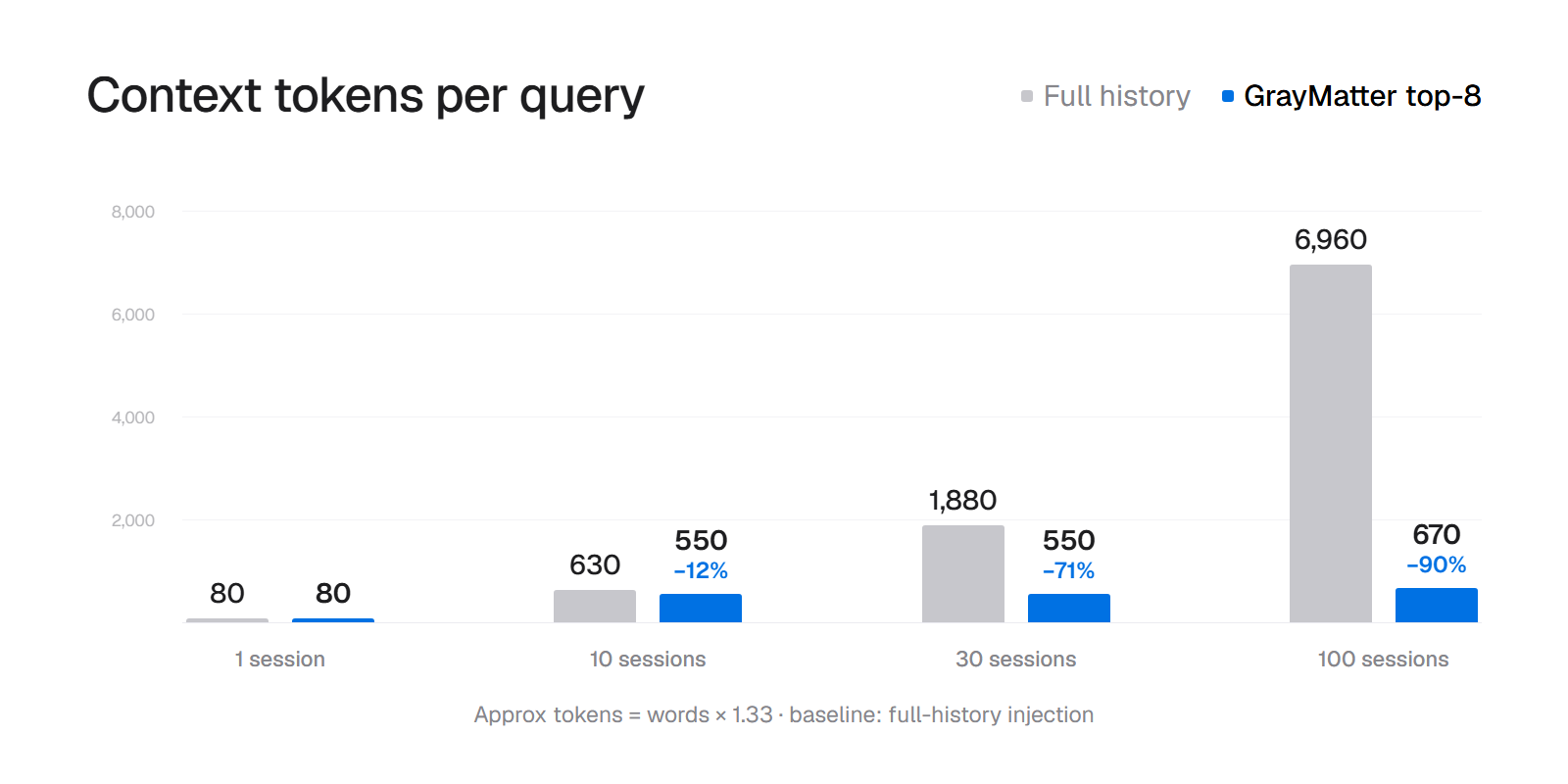
~90% reduction in context tokens — versus full-history injection.
Remembers what a sliding window forgets: facts planted 96 sessions back come back 83% of the time.
Context quality improves over time as consolidation surfaces only what matters.
No Docker. No Redis. No API key required for storage.
Drop it in once. It auto-connects to Claude Code, Cursor, Codex, OpenCode, Antigravity — any MCP-compatible client picks it up automatically.
Knowledge Graph
Your agent doesn't just remember facts — it builds a map of how they connect.
Run the daemon with --kg and every consolidation cycle extracts typed
entities (person, organization, project) and links the ones that appear
together. No manual tagging. No configuration. The graph builds itself from
ordinary use.
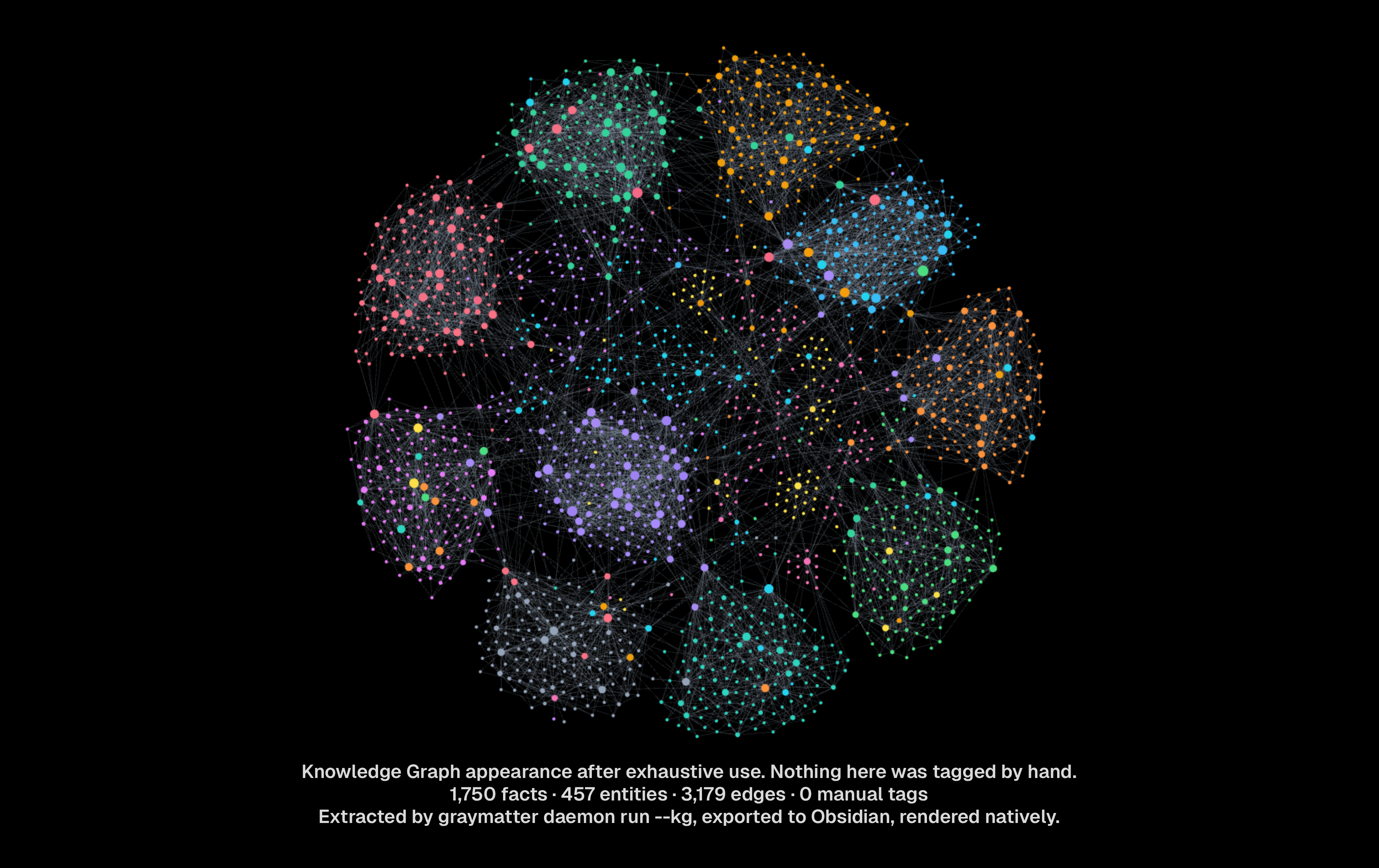
Every edge carries receipts: the fact IDs that produced it.
Export to Obsidian with one command — entities become notes,
connections become wikilinks, and the whole graph renders natively.
The graph as one self-contained page — inline force-directed SVG, zero external assets, works offline. Hover any edge to see the fact IDs that produced it:
Watch it build, one frame per session:
Observability
You can't improve what you can't see.
graymatter tui opens a live terminal dashboard with everything your
agent memory is doing — no extra setup required.
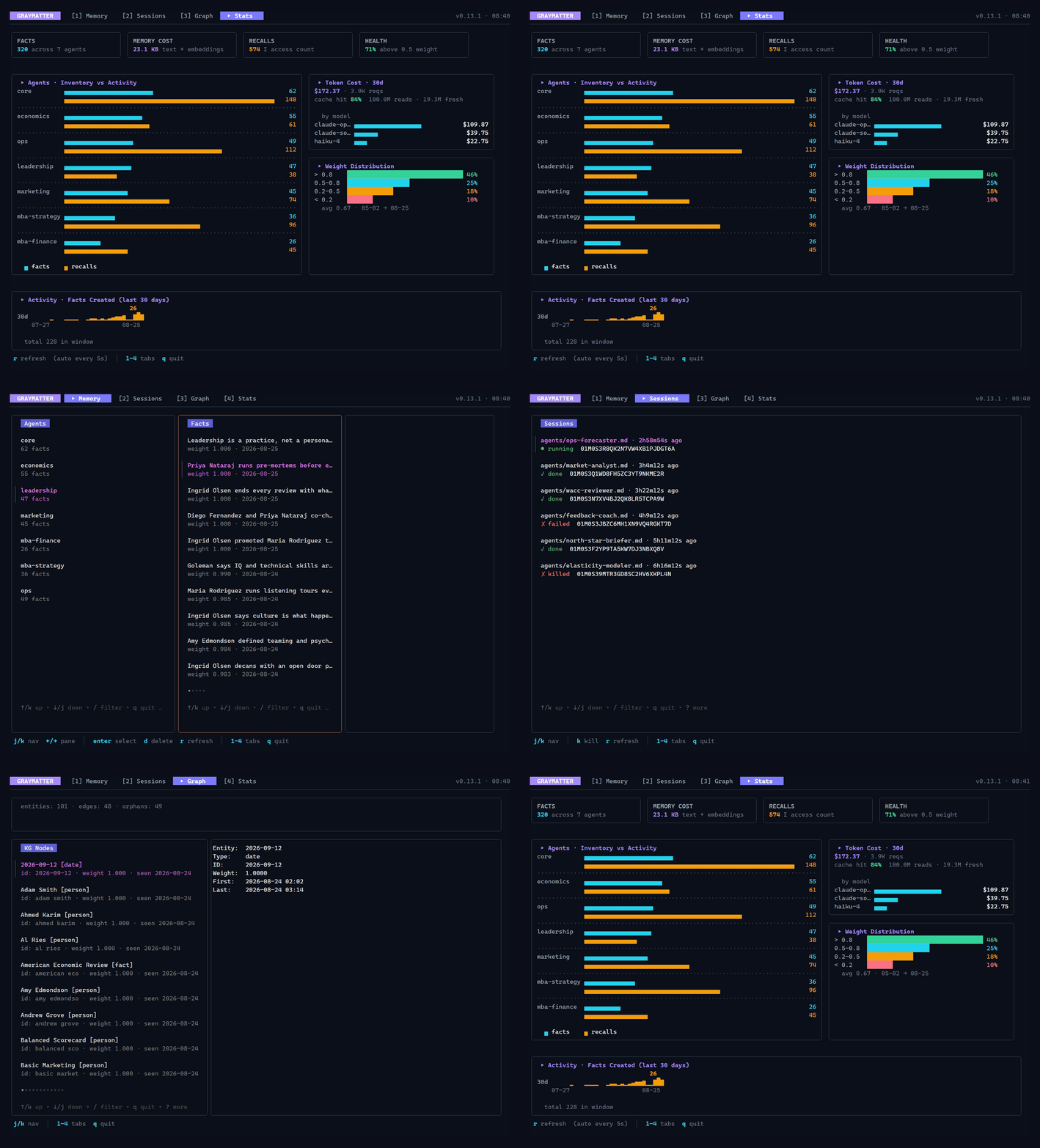
What you get at a glance:
- Facts — total stored, distributed across agents
- Memory cost — KB on disk (text + embeddings), not tokens
- Recalls — cumulative access count across all sessions
- Health — percentage of facts above relevance threshold (weight > 0.5)
- Token cost (30d) — real spend breakdown by model, with cache hit rate
- Agent activity — facts vs recalls per agent, side by side
- Weight distribution — how consolidated your memory is over time
- Activity timeline — facts created per day, last 30 days
The dashboard auto-refreshes every 5 seconds. Press 1–4 to switch tabs,
r to force refresh, q to quit.
graymatter doctor --graph extends visibility to the knowledge graph itself:
hubs by degree, articulation points, orphans, and a declared connectivity
ratio — printed or emitted as JSON.
What GrayMatter gives you
| Persistent memory | Facts survive across sessions. Recall by meaning, not just keyword |
| 90% token reduction | Top-8 relevant facts instead of full-history injection |
| Automatic hooks | Claude Code injects routine recall every turn; MCP remains available for writes and focused searches (graymatter hooks install) |
| Receipts, not vibes | recall --explain returns why each fact ranked: per-signal ranks, fused score, provenance |
| Knowledge graph | Typed entities and co-mention edges, auto-populated from ordinary use |
| Self-curation | memory_reflect lets the agent add, update, forget, and link its own memories |
| Context block | Projects top facts into CLAUDE.md / AGENTS.md inside a token budget (context-sync) |
| Free auditor | doctor --audit measures tokens, duplicates, staleness, and marker conflicts in any instruction file |
| Deterministic decay | 30-day half-life; facts fade when nothing touches them. Tombstones, never deletes |
| Single binary | ~10 MB static. No Docker, no Redis, no config files, no cloud accounts |
Quick start
Install and see it working in under a minute — no API keys, no Ollama:
graymatter init --global still performs that normal setup in the current
directory. It additionally installs the managed memory instructions in Claude
Code and OpenCode's home-scoped instruction files. It does not globalize
project-scoped MCP configs: each repository must be wired separately with
graymatter init or manual client configuration. Codex is the exception in
the table below because its MCP config is already home-scoped.
graymatter demo seeds a scratch store, runs consolidation, and opens the
TUI — then graymatter kg render --out kg-graph.html shows the graph it
built. Restart your editor. Seven memory tools are live.
Package managers — Homebrew, Scoop, Nix
Pre-built binaries — Linux, macOS, Windows
MCP client wiring — Claude Code, Cursor, Codex, OpenCode, Antigravity, and anything else
graymatter init auto-wires every supported client at once. Existing entries
from other MCP servers are merged, never overwritten.
| Client | Config file | Scope |
|---|---|---|
| Claude Code | .mcp.json | project |
| Cursor | .cursor/mcp.json | project |
| Codex (OpenAI) | ~/.codex/config.toml | home |
| OpenCode | opencode.jsonc | project |
| Antigravity (Google) | mcp_config.json | opt-in |
| Windsurf | .windsurf/mcp.json | project |
| VS Code Copilot Agent | .vscode/mcp.json | project |
Related MCP Servers
Reviews
No reviews yet — be the first to share how this listing worked for you.
Frequently Asked Questions about GrayMatter
AllMCPs Directory Badge
Showcase your server listing on GitHub or your project documentation. Embed this dynamic SVG badge to highlight official listing status and live engagement.
Badge Style:
Live Dynamic SVG Preview
Markdown (GitHub README)
[](https://allmcps.com/mcp/graymatter)HTML Embed
<a href="https://allmcps.com/mcp/graymatter"><img src="https://allmcps.com/api/badge/graymatter?style=directory" alt="GrayMatter on AllMCPs" /></a>Technical Specs & Signals
CategoryMonitoring
43Quality signal: Fair · 43/100How this signal is calculated ▾
Server availabilityNot measured
Not scored for repo-hosted servers — we can't reach the running server, only its GitHub page. Hosted MCP endpoints are health-checked live.
Verified ownership10/20
Documentation & tools16/30
Adoption & activity6/15
Community engagement0/10
A guidance signal from public completeness & health data — not a user rating. New listings start lower and rise as they add docs, get verified, and grow adoption. Signals we can't observe for a listing are skipped, not counted against it.
Own this project?
This directory is pre-filled from public sources. Claim via GitHub README, site badge, or DNS TXT to unlock edit access and the Official badge — proof is checked automatically, then reviewed by our team.
Free dofollow backlink: add your website and place the AllMCPs badge on it — no claim needed. We detect it automatically and keep it verified as long as the badge stays live.
Claim & get free dofollowShare & Embed
Add our SVG badge (dark/light directory styles) or embeddable widget to your site.