code-graphjavascripttypescriptrefactoringdeveloper-tools
Indexes TypeScript and JavaScript repositories into an evidence-backed code graph for structural queries over MCP.
Quick Install
Automated & IDE SetupCopy the AI prompt to install this server into Claude Code, Cursor, or another agent — or use 1-click editor setup below.
Not yet automatically verified
We haven't yet run this listing's install command through our automated sandbox check. This isn't a red flag — we're steadily working through the catalog.
Manual Client & Custom JSON ConfigExpand JSON ▾
Client Config & Setup
Choose your client or environment
Target File:
💡 Paste the JSON block into your client's configuration file under mcpServers, then restart the application.
Overview
Use cases
Index a TypeScript or JavaScript repository for agent queries
Find callers and callees of a symbol
Assess the impact of changing a symbol
Limit impact analysis to files changed since a commit or branch
Keep the graph current with watch mode
Key features
Local MCP server over stdio
TypeScript and JavaScript structural indexing
Caller, callee, symbol-location, and blast-radius queries
File:line@sha evidence anchors
Branch-aware differential impact analysis
Worktree-aware separate indexes
Capabilities & Tool Schemas
Inspect callable tools, capabilities, and parameters exposed to AI agents by Graphpilot.
Extracted Tool Capabilities
Local MCP server over stdio
TypeScript and JavaScript structural indexing
Caller, callee, symbol-location, and blast-radius queries
File:line@sha evidence anchors
Branch-aware differential impact analysis
Worktree-aware separate indexes
Documentation Overview

GraphPilot
Structural memory for coding agents.
A refactor-safe, branch-aware, evidence-backed code graph that runs entirely on your machine.





Quickstart · Tools · How it works · Editor setup · Limitations · Benchmarks

What it is
GraphPilot is a local CLI + MCP server that indexes your TypeScript/JavaScript repo into a structural graph (symbols, callers, callees, blast radius) and exposes it to coding agents — Claude Code, Cursor, Cline, Windsurf, Continue — so they stop re-grepping the same files every conversation.
The problem it solves: agents burn tokens, hallucinate function names, and miss structural relationships ("what calls this?", "what breaks if I rename it?") because each session starts from zero. GraphPilot is the persistent structural memory in between.
Token cost drops. Hallucinations drop. Refactors get safer.
Put a real coding agent (claude-sonnet-4-5) on 40 structural questions about fastify — a ~300-file Node.js framework — and give it nothing but file reads. Then hand it GraphPilot's four tools and ask the same 40. The agent with GraphPilot uses 61 % fewer tokens, costs $3.68 instead of $8.88 — $5.20 saved per session — and gets more of them right, not fewer (37 correct vs 33). Same model, same questions, same repo; the only change is whether the structural index is there. Reproduce it →
A separate correctness benchmark backs the savings with precision: on 10 standardized structural queries GraphPilot scores F1 0.89 vs grep's 0.42 while reading 99.9 % fewer bytes (721 B vs 528 KB), and the byte-cost win holds at scale — indexing microsoft/TypeScript (601 files, 17 k symbols, 70 k call edges in 10 s) gives sub-millisecond queries and a 99.99 % bytes-read reduction. Full methodology →
One binary, two modes
GraphPilot ships as a single npm package (@graphpilot-oss/graphpilot) with two runtime modes — most users run both.
| Mode | Command | What it does |
|---|---|---|
| CLI | graphpilot index <path> | Walks your repo, builds the structural graph, writes it to ~/.graphpilot/ |
graphpilot watch <path> | Keeps the graph fresh (~10 ms per file save) | |
graphpilot status <path> | Health probe — when the graph was last refreshed, file/symbol/edge counts | |
| MCP server | graphpilot mcp | Speaks MCP over stdio — your coding agent calls into this to query the graph |
The flow: the CLI builds the index once (and watch keeps it warm). The MCP server is what your coding agent talks to — you never invoke it yourself, you just point your agent's MCP config at graphpilot mcp once and the agent spawns it on every session.
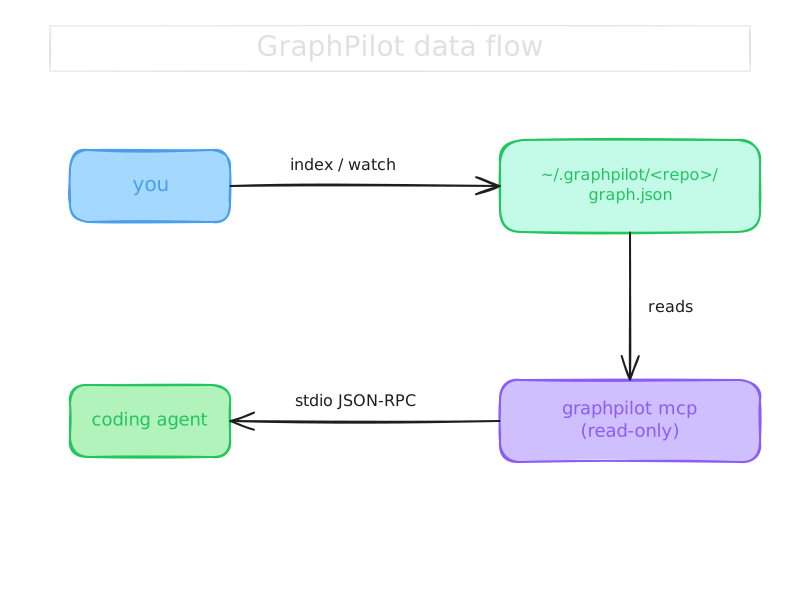
If you only want CLI access to your code graph (no agent), run graphpilot index and then graphpilot stats / inspect graph.json directly. If you only want the agent integration, you still need to run graphpilot index once — the MCP server is read-only against the on-disk graph.
What makes it different
Other code-graph tools treat your repo as a static blob: index once, query forever, no branch awareness, no proof of where an answer came from. GraphPilot is built around three properties none of them ship:
- 🔍 Evidence anchors. Every tool response carries
file:line @ shaon every symbol and call site. The agent can quote the anchor verbatim and you can verify it instantly — hallucinations get exposed the moment you jump to the line. - 🌿 Differential impact. Pass
since: <commit|branch>togp_impactand the result is filtered to files your branch actually touches. PR-scoped refactor analysis in one call instead ofgit diff | xargs grep. - 🪵 Worktree-aware by default. Two
git worktree add-ed branches naturally produce two separate indexes — no manual config. Rungraphpilot index ./src/featurefrom a subdir and it transparently re-roots to the worktree top. Opt out with--no-worktree.
Add to that: local-first (no telemetry, no remote calls, enforced by an ESLint policy on src/ itself), deterministic (same repo → same graph), sub-second incremental updates via watch mode.
Quickstart
Prerequisites
- Node.js ≥ 20 (
node --versionto check) - An MCP-capable coding agent (Claude Code, Cursor, Cline, Windsurf, or Continue)
- A TypeScript or JavaScript repo to index
End-to-end time: ~3 minutes.
1. Install the CLI
Verify it landed on your PATH:
If you see command not found: graphpilot, your global npm bin is not on PATH. Run npm config get prefix and add <prefix>/bin to your shell's PATH, or use the npx form above.
2. Build the structural index for your repo
Run this once per project. It walks your source tree, parses each TS/JS file with tree-sitter, extracts symbols + call edges, and writes the graph to ~/.graphpilot/<repo-id>/graph.json.
Expect a one-line summary like indexed 412 files · 3,981 symbols · 7,204 edges · 1.8s.
3. Wire it into your coding agent
GraphPilot speaks MCP over stdio. Add this server entry to your agent's MCP config — every supported client uses the same two-line shape:
Where this file lives depends on the client (~/.cursor/mcp.json, ~/.claude.json, Cline's settings panel, etc.). Pre-made configs with the exact file path for each agent are in examples/ — copy the one for your client.
Restart the agent. It now has four new tools: gp_recall, gp_callers, gp_impact, gp_index — see The four tools below for what each one does and when the agent should reach for it.
4. Try it
Ask your agent a structural question instead of letting it grep:
"Use gp_impact to show me everything that breaks if I rename
parseToken."
You should see a response with file:line @ sha anchors you can click straight to. If the agent doesn't reach for the tool, prompt explicitly: "use the gp_ MCP tools." If it can't see them at all, the MCP config wasn't picked up — run graphpilot doctor to pinpoint why (or see docs/troubleshooting.md), then restart the agent.
5. Keep the index fresh as you edit (optional but recommended)
Sub-10 ms incremental updates on each file save. Leave it running in a terminal tab.
6. Drop per-editor routing rules into your repo (optional)
Auto-detects which editors you have installed (Cursor, Claude Code, Cline, Windsurf, Continue) and writes the matching rules file (.cursorrules, CLAUDE.md, etc.) to the current directory. The rules teach the agent to reach for gp_* tools before grep.
Full 5-minute walkthrough with screenshots: docs/quickstart.md.
The four tools
GraphPilot exposes four MCP tools. Each one answers a structural question your agent would otherwise solve by grepping and reading files.
gp_recall — find a symbol by name
Use this when the agent asks "where is X defined?" or needs to locate a function before reasoning about it.
- Input:
{ query, limit?, substring?, path? } - Returns: symbols matching the name (exact case-insensitive by default;
substring: truefor partial matches), each withfile:line @ sha. - Replaces:
grep -rn "function X"plus reading each hit to find the real definition.
gp_callers — list callers (or callees)
Related MCP Servers
Adoption & maintenance
Factual signals from GitHub, npm, and our automated checks — not a rating.
GitHub stars
15
Stargazers on the source repository.
npm downloads
182
Package downloads in the last 30 days.
Last commit
1mo ago
Most recent push to the default branch.
Directory activity
2 views
Config copies, upvotes, and views on AllMCPs.
Reviews
No reviews yet — be the first to share how this listing worked for you.
Frequently Asked Questions about Graphpilot
AllMCPs Directory Badge
Showcase your server listing on GitHub or your project documentation. Embed this dynamic SVG badge to highlight official listing status and live engagement.
Badge Style:
Live Dynamic SVG Preview
Markdown (GitHub README)
[](https://allmcps.com/mcp/graphpilot-oss-graphpilot)HTML Embed
<a href="https://allmcps.com/mcp/graphpilot-oss-graphpilot"><img src="https://allmcps.com/api/badge/graphpilot-oss-graphpilot?style=directory" alt="Graphpilot on AllMCPs" /></a>Technical Specs & Signals
CategoryKnowledge & Memory
PricingFree
11/11 checks healthy over the last 32d
56Quality signal: Good · 56/100How this signal is calculated ▾
Server availabilityNot measured
Not scored for repo-hosted servers — we can't reach the running server, only its GitHub page. Hosted MCP endpoints are health-checked live.
Verified ownership10/20
Documentation & tools25/30
Adoption & activity7/15
Community engagement0/10
A guidance signal from public completeness & health data — not a user rating. New listings start lower and rise as they add docs, get verified, and grow adoption. Signals we can't observe for a listing are skipped, not counted against it.
Supply-chain signal
No high-severity advisories surfaced by our automated scan.
Critical 0High 0Medium 0Low 0
Scanned 22d ago via OSV.dev · @graphpilot-oss/graphpilot (npm)
Own this project?
This directory is pre-filled from public sources. Claim via GitHub README, site badge, or DNS TXT to unlock edit access and the Official badge — proof is checked automatically, then reviewed by our team.
Free dofollow backlink: add your website and place the AllMCPs badge on it — no claim needed. We detect it automatically and keep it verified as long as the badge stays live.
Claim & get free dofollowShare & Embed
Add our SVG badge (dark/light directory styles) or embeddable widget to your site.