Privacy-first Google Health API MCP server for health, sleep, activity and HR agents
Quick Install
Automated & IDE SetupCopy the AI prompt to install this server into Claude Code, Cursor, or another agent — or use 1-click editor setup below.
Not yet automatically verified
We haven't yet run this listing's install command through our automated sandbox check. This isn't a red flag — we're steadily working through the catalog.
Manual Client & Custom JSON ConfigExpand JSON ▾
Client Config & Setup
Choose your client or environment
Target File:
💡 Paste the JSON block into your client's configuration file under mcpServers, then restart the application.
Capabilities & Tool Schemas (18)
Inspect callable tools, capabilities, and parameters exposed to AI agents by Google Health Fitbit MCP.
google_health_connection_statusLocal config, token, scope and MCP-client readiness — no Google call
google_health_quickstartPersonalized 3-step setup walkthrough that adapts to your current state
google_health_data_inventorySupported domains, scopes, data-type naming and recommended agent flow
google_health_list_data_typesThe 39 kebab-case data-type slugs with units, scopes and supported verbs
google_health_demoRealistic synthetic payloads so agents see the contract before real calls
google_health_get_identity/v4/users/me/identity` — Google Health + legacy Fitbit identity mapping
Documentation Overview
Google Health Fitbit MCP
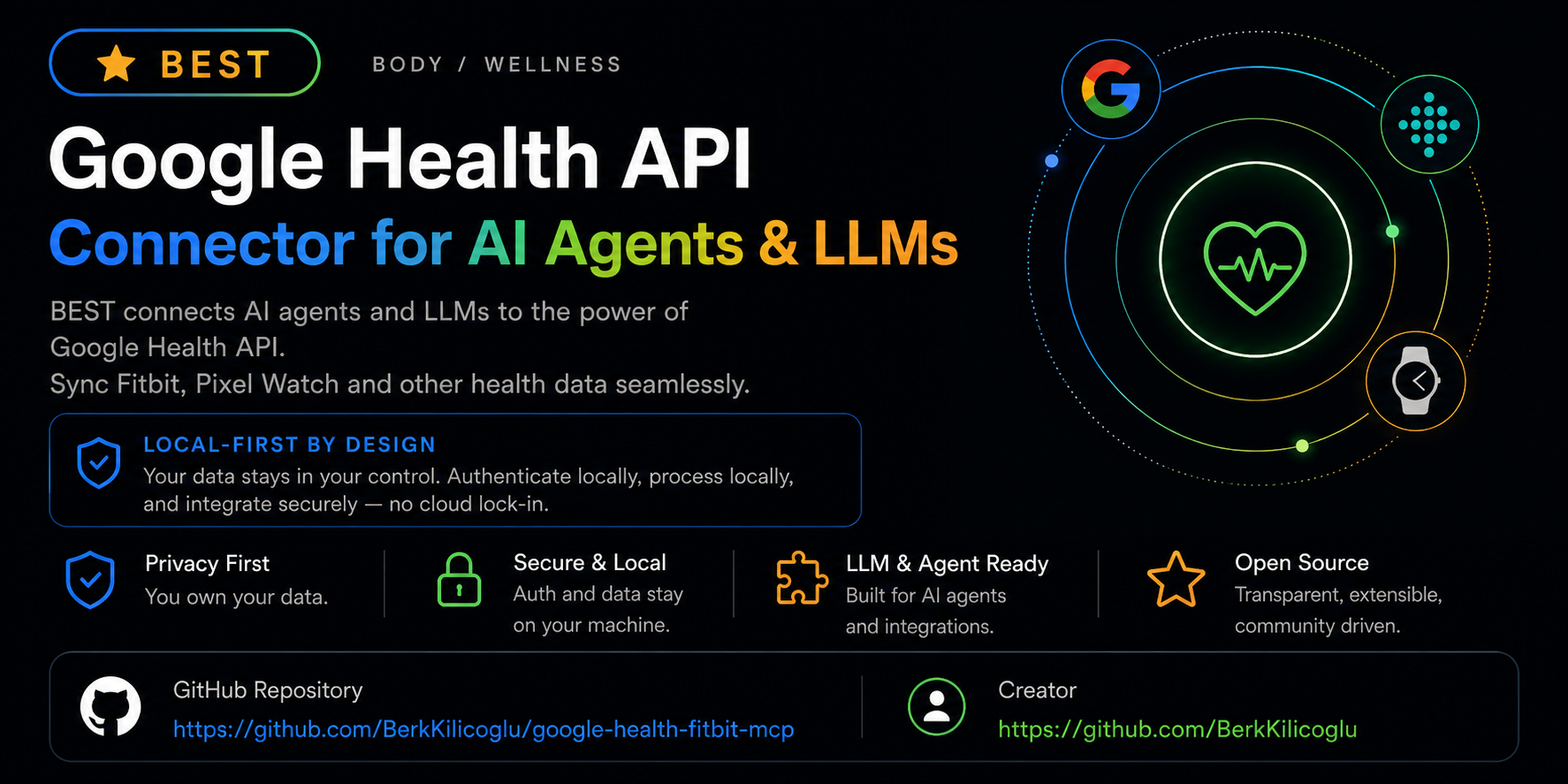
Query your own Google Health API data — Fitbit, Pixel Watch and connected partner sources — over local OAuth. Beta.
Everything runs on your own machine — your credentials never leave your device.





An MCP server that runs locally and hands your AI agent your own Google Health API data — from Fitbit trackers, Pixel Watch and supported partner sources — through OAuth.
- Install in one command —
npx -y google-health-fitbit-mcp setup - Run it in Claude Desktop · Claude Code · Cursor · Windsurf · Hermes · OpenClaw — see client examples.
- On your machine — OAuth tokens are stored locally with
0600permissions and are never returned by any tool (privacy). - Read-only by default — every shipped data tool is a read. Writes are a gated, opt-in, dry-run-first design that is not enabled.
Beta status: Google Health API is available to developers but the surface is still moving. Because Google's release notes keep listing scope and data-type changes after launch, this connector remains in beta and steers testers toward safe read-only validation before any production use.
Independent, community-built connector — no affiliation with, endorsement from or support by Google, Fitbit or Alphabet. Not a medical device or medical advice; treat the data as trend context only.
⚡ Quick Connect
Prerequisite: a Google Cloud OAuth client (type: Desktop) with the Google Health API enabled and the redirect
http://127.0.0.1:3000/callbackregistered — details in Install.
Step 1 — Install & authorize (once):
🔑 First time? Get your Google Client ID & Secret (~2 min)
setup asks for a Client ID and Client Secret. You create these once, for free, in Google Cloud:
- New project — open console.cloud.google.com/projectcreate, name it (e.g.
health-mcp), click Create, then select it. - Enable the API — open the Google Health API page and click Enable.
- Consent screen — go to OAuth consent screen, choose External, and fill in the required app name / email fields. Under Test users, add your own Google account — skip this and sign-in fails with
403: access_denied. - Create the client — go to Credentials → + Create credentials → OAuth client ID → Application type: Desktop app → Create.
- Copy the Client ID (ends in
…apps.googleusercontent.com) and the Client secret, then paste each one whensetupprompts you.
Redirect URI: Desktop-app clients allow the
http://127.0.0.1:3000/callbackloopback automatically — you don't register it anywhere. Just press Enter to accept the default whensetupasks. For every othersetupprompt (scope preset, privacy mode), pressing Enter picks a sensible default.
Heads-up — the 7-day rule: while the consent screen sits in Testing publishing status, Google revokes refresh tokens after 7 days. Around once a week the next request fails with
invalid_grant, which is normal and not a bug in this server. It reopens the consent flow for you (see Staying connected); approving takes a couple of seconds. Publishing the app removes the expiry entirely — check what your scopes require on the consent screen before switching.
Step 2 — Connect your app:
Claude Code
Claude Desktop
Settings → Developer → Edit Config, then add to claude_desktop_config.json:
Restart Claude Desktop — the tools appear under the 🔌 connectors menu.
Cursor
Add the same mcpServers block to .cursor/mcp.json (per-project) or ~/.cursor/mcp.json (global), or use Settings → MCP → Add new server.
Windsurf
Add the same mcpServers block to ~/.codeium/windsurf/mcp_config.json.
Hermes
Then reload with /reload-mcp or hermes mcp test google_health.
Step 3 — Test it. Ask your agent:
Why this exists
The Google Health API is the successor to the Fitbit Web API: new OAuth, new base URL (https://health.googleapis.com), a streamlined endpoint schema, standardized kebab-case data types, reconciled cross-source streams and daily/physical-time rollups.
It gives agents a clean path to explore the API, verify their setup, sign in locally and pull data — with no need to paste tokens into prompts or agent configs.
Try it with your agent
Three good opening prompts, built around tools this connector genuinely ships:
Tools
29 tools, all read-only except the two explicitly gated local-profile/auth actions noted below.
Start here
| Tool | What it does |
|---|---|
google_health_connection_status | Local config, token, scope and MCP-client readiness — no Google call |
google_health_quickstart | Personalized 3-step setup walkthrough that adapts to your current state |
google_health_data_inventory | Supported domains, scopes, data-type naming and recommended agent flow |
google_health_list_data_types | The 39 kebab-case data-type slugs with units, scopes and supported verbs |
google_health_demo | Realistic synthetic payloads so agents see the contract before real calls |
Data reads (Google Health API)
| Tool | Endpoint |
|---|---|
google_health_get_identity | /v4/users/me/identity — Google Health + legacy Fitbit identity mapping |
google_health_get_profile | /v4/users/me/profile |
google_health_get_settings | /v4/users/me/settings — units, timezone |
google_health_list_paired_devices | /v4/users/me/pairedDevices — your Fitbit trackers and Pixel Watches, and which device produces which data |
google_health_get_irn_profile | /v4/users/me/irnProfile — irregular-rhythm (AFib) notification engagement status |
google_health_list_data_points | /v4/.../dataPoints — intraday detail for any data type |
google_health_get_data_point | /v4/.../dataPoints/{id} — one specific sleep session, exercise or measurement |
google_health_reconcile_data_points | /v4/.../dataPoints:reconcile — one clean stream across sources (all-sources, google-wearables, google-sources) |
google_health_daily_rollup | /v4/.../dataPoints:dailyRollUp — civil-day aggregates |
google_health_rollup | /v4/.../dataPoints:rollUp — physical-time window aggregates |
Summaries & wellness context
Related MCP Servers
Adoption & maintenance
Factual signals from GitHub, npm, and our automated checks — not a rating.
GitHub stars
16
Stargazers on the source repository.
Last commit
1mo ago
Most recent push to the default branch.
Tools exposed
18
Callable tools this server registers over MCP.
Reviews
No reviews yet — be the first to share how this listing worked for you.
Frequently Asked Questions about Google Health Fitbit MCP
AllMCPs Directory Badge
Showcase your server listing on GitHub or your project documentation. Embed this dynamic SVG badge to highlight official listing status and live engagement.
Badge Style:
Live Dynamic SVG Preview
Markdown (GitHub README)
[](https://allmcps.com/mcp/google-health-fitbit-mcp)HTML Embed
<a href="https://allmcps.com/mcp/google-health-fitbit-mcp"><img src="https://allmcps.com/api/badge/google-health-fitbit-mcp?style=directory" alt="Google Health Fitbit MCP on AllMCPs" /></a>Technical Specs & Signals
CategoryDeveloper Tools
11/13 checks healthy over the last 45d
53Quality signal: Good · 53/100How this signal is calculated ▾
Server availabilityNot measured
Not scored for repo-hosted servers — we can't reach the running server, only its GitHub page. Hosted MCP endpoints are health-checked live.
Verified ownership10/20
Documentation & tools25/30
Adoption & activity5/15
Community engagement0/10
A guidance signal from public completeness & health data — not a user rating. New listings start lower and rise as they add docs, get verified, and grow adoption. Signals we can't observe for a listing are skipped, not counted against it.
Supply-chain signal
No high-severity advisories surfaced by our automated scan.
Critical 0High 0Medium 0Low 0
Scanned 1d ago via OSV.dev · google-health-fitbit-mcp (npm)
Own this project?
This directory is pre-filled from public sources. Claim via GitHub README, site badge, or DNS TXT to unlock edit access and the Official badge — proof is checked automatically, then reviewed by our team.
Free dofollow backlink: add your website and place the AllMCPs badge on it — no claim needed. We detect it automatically and keep it verified as long as the badge stays live.
Claim & get free dofollowShare & Embed
Add our SVG badge (dark/light directory styles) or embeddable widget to your site.