Google E Commerce (GA4, Search Console, Merchant Center) README
The full upstream README, mirrored here for reference. Install config, tool schemas, adoption signals, and an original overview live on the Google E Commerce (GA4, Search Console, Merchant Center) listing page.
google-ecommerce-mcp
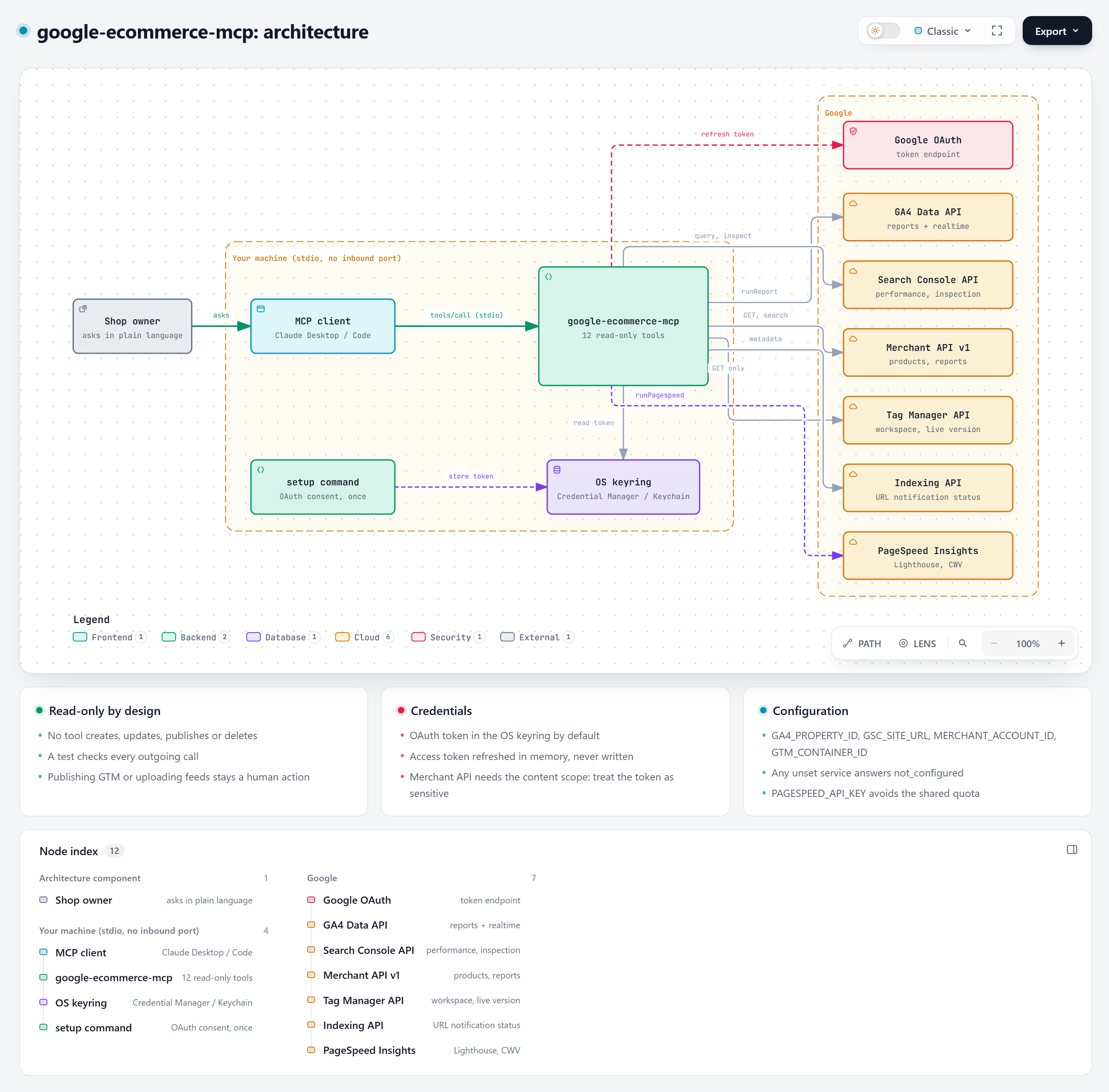
One read-only MCP server for the Google services an online shop lives on: GA4, Search Console, Merchant Center, Tag Manager, Indexing API and PageSpeed.
Ask your AI assistant "how much organic traffic did we get this month?", "which products are disapproved in Merchant Center?" or "is GA4 loaded twice on my site?" and it answers from your own Google accounts.
Built by MoonEyes, a small French shop selling 3D-printed tabletop terrain, because no existing MCP server covered GA4, Search Console and Merchant Center together.



Documentation
| Page | What is in it |
|---|---|
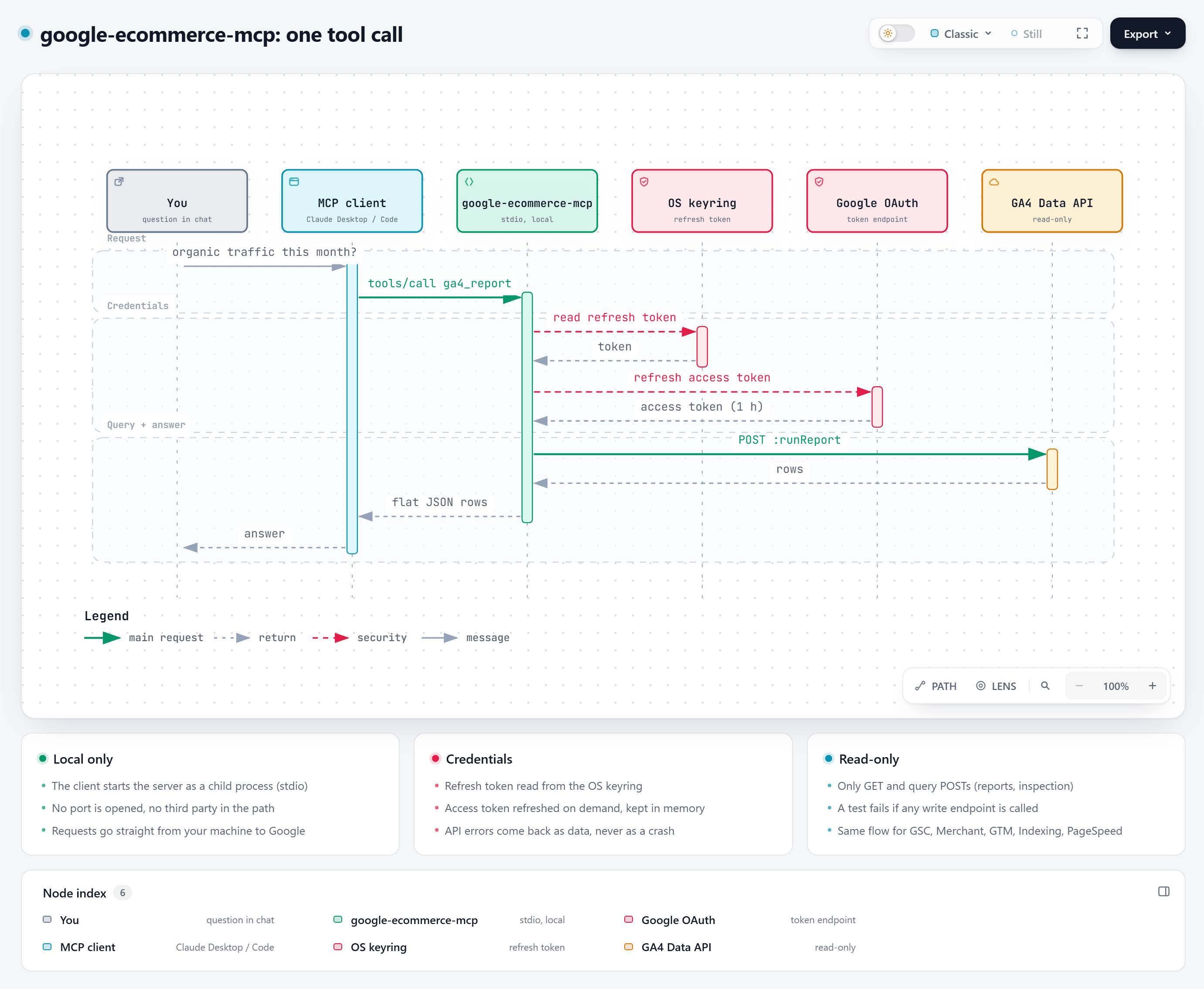
| Architecture | Components, a tool call step by step, design choices, sequence diagrams |
| Tool reference | Every tool: parameters, output, example questions |
| Google Cloud setup | OAuth client, APIs to enable, where to find each id |
| Security model | Scopes, token storage, threats, how to revoke |
| Troubleshooting | Every error we have met and its fix |
| Example prompts | Questions that work well, by use case |
| Client configs | Claude Desktop (one or two shops), Claude Code |
Why this one
- All-in-one for e-commerce. Other MCP servers cover one or two of these services. This one covers the six a shop owner checks every week.
- Read-only by design. No tool creates, updates, publishes or deletes anything. A test enforces it.
- Token in your OS keyring. The OAuth token goes to Windows Credential Manager, macOS Keychain or Secret Service, not to a plain file (a file is still possible if you prefer).
- Answers a model can read correctly. Reports return the top rows plus totals over everything, the unit and definition of each metric, and dates resolved in the property's timezone with a flag when the last days can still change.
- No third party. Requests go straight from your machine to Google.
Tools
| Tool | Service | What it answers |
|---|---|---|
server_status | All | Which services are configured, does the token work |
ga4_report | GA4 | Any report: channels, landing pages, purchases, revenue, by period |
ga4_realtime | GA4 | Last 30 minutes, e.g. to check a page view is counted once |
ga4_properties | GA4 | Every GA4 account and property you can read, to find a property id |
gsc_performance | Search Console | Clicks, impressions, CTR, position by query, page, country, device, date |
gsc_inspect_url | Search Console | Is this URL indexed, which canonical did Google pick, last crawl |
gsc_sitemaps | Search Console | Declared sitemaps, last download, errors |
merchant_data_sources | Merchant Center | Feeds, labels, countries, fetch URLs |
merchant_product_issues | Merchant Center | Products with disapprovals or warnings, all pages |
merchant_report_query | Merchant Center | Any Merchant Query Language report |
gtm_inventory | Tag Manager | Tags, triggers, variables, live version |
indexing_status | Indexing API | What Google knows about a submitted URL |
pagespeed | PageSpeed Insights | Lighthouse performance and SEO scores, Core Web Vitals |
Quick install
Create your Google OAuth client first (step 1 below), then run the installer. It installs uv if needed, asks your ids, opens the Google consent screen and adds the server to Claude Desktop (your previous config is backed up). It installs the exact package version it was released with (google-ecommerce-mcp==0.3.1).
Recommended: download, read, run. The URLs name an exact commit, not a branch, so the script cannot change under you.
Windows (PowerShell):
macOS / Linux:
SHA-256 of the pinned scripts:
install.ps1:eb1adb179991fa9574d91948ffd639a4253094f1601a7ced2ea3ffd1225c4110install.sh:e69dfb3e9e86aea30848c7012259325e811da159fa00b4cdea291730b9cb6c57
One line, if you accept to run it without reading (same pinned commit, so the SHA-256 above still applies):
Then quit Claude Desktop completely and reopen it. To pass options, save the script first, for example .\install.ps1 --ga4 123456789 --gsc sc-domain:example.com --client-secret client_secret.json. Run google-ecommerce-mcp install --help for every option. Maintainers: each release bumps the version in both scripts, then refreshes the commit in these URLs and the checksums (tests/test_installer_scripts.py fails until they match).
Setup, step by step
If you used the quick install, you only need step 1. The steps below are the manual path.
1. Google Cloud (once, about 10 minutes)
Full walkthrough with every click explained: docs/SETUP-GOOGLE-CLOUD.md. Short version:
- In Google Cloud Console, create or pick a project.
- Enable the APIs you need: Google Analytics Data API, Google Analytics Admin API, Google Search Console API, Merchant API, Tag Manager API, Web Search Indexing API, PageSpeed Insights API.
- Configure the OAuth consent screen (External, add yourself as a test user).
- Create an OAuth client of type Desktop app and download its JSON file.
- Merchant API only: register your Cloud project with your Merchant Center account.
- Optional: create an API key restricted to PageSpeed Insights (the anonymous quota is shared and often exhausted).
2. Install and authorize
Latest development version: uvx --from git+https://github.com/MoonEyes/google-ecommerce-mcp google-ecommerce-mcp.
Your browser opens the Google consent screen. The token is then stored in your OS keyring. Check everything with google-ecommerce-mcp check.
3. Add it to your MCP client
Claude Desktop (claude_desktop_config.json):
Claude Code:
Every variable is optional: a tool for a service you did not configure simply answers not_configured.
| Variable | Example | Used by |
|---|---|---|
GA4_PROPERTY_ID | 123456789 (numeric property id) | GA4 tools |
GSC_SITE_URL | sc-domain:example.com or https://www.example.com/ | Search Console tools |
MERCHANT_ACCOUNT_ID | 1234567890 | Merchant tools |
GTM_CONTAINER_ID | GTM-XXXXXXX | gtm_inventory |
PAGESPEED_API_KEY | API key | pagespeed |
GOOGLE_TOKEN_FILE | ~/.config/google-ecommerce-mcp/token.json | store the token in a file instead of the keyring |
How a call works
Security notes
Details: docs/SECURITY.md.
- Read-only is enforced, not just declared: every request is checked against an allow-list before it is sent, and CI fails if any tool tries an endpoint outside it.
readOnlyHintis only a hint. setuprequests read-only scopes only. Google has no read-only scope for Merchant Center (content) or the Indexing API (indexing); they are requested only with--with-merchant/--with-indexing, andserver_statusflags them when present.- Every result carries
fetched_atandfreshness; report tools return thedate_rangequeried, resolved in the data's timezone, withdata_complete. - Revoke access at any time from your Google account permissions.
Limitations
- The Merchant API is recent and Google keeps changing it; the older Content API for Shopping is being shut down. Open an issue if a call breaks.
- One site, Merchant account and container per server instance; GA4 tools accept any readable
property_id. Run several instances for several shops. - GA4 Data API quotas apply to
ga4_report.
Contributing
See CONTRIBUTING.md. Security reports: SECURITY.md.
Development
Tests run offline with a fake HTTP session; no Google account needed.
License
MIT, see LICENSE.