GitWarren README
The full upstream README, mirrored here for reference. Install config, tool schemas, adoption signals, and an original overview live on the GitWarren listing page.

GitWarren





Code review for your own git repositories, on your own machines. Your machines, your agents, no one else's server — and no account.
Built for the moment a coding agent — Claude Code, Codex, or anything else that edits files on your disk — has just finished, and its work is sitting in your worktree uncommitted. Read that diff here, on your own machine, before it becomes a commit.
gitwarren.com has downloads for macOS, Windows and Linux.
What it does
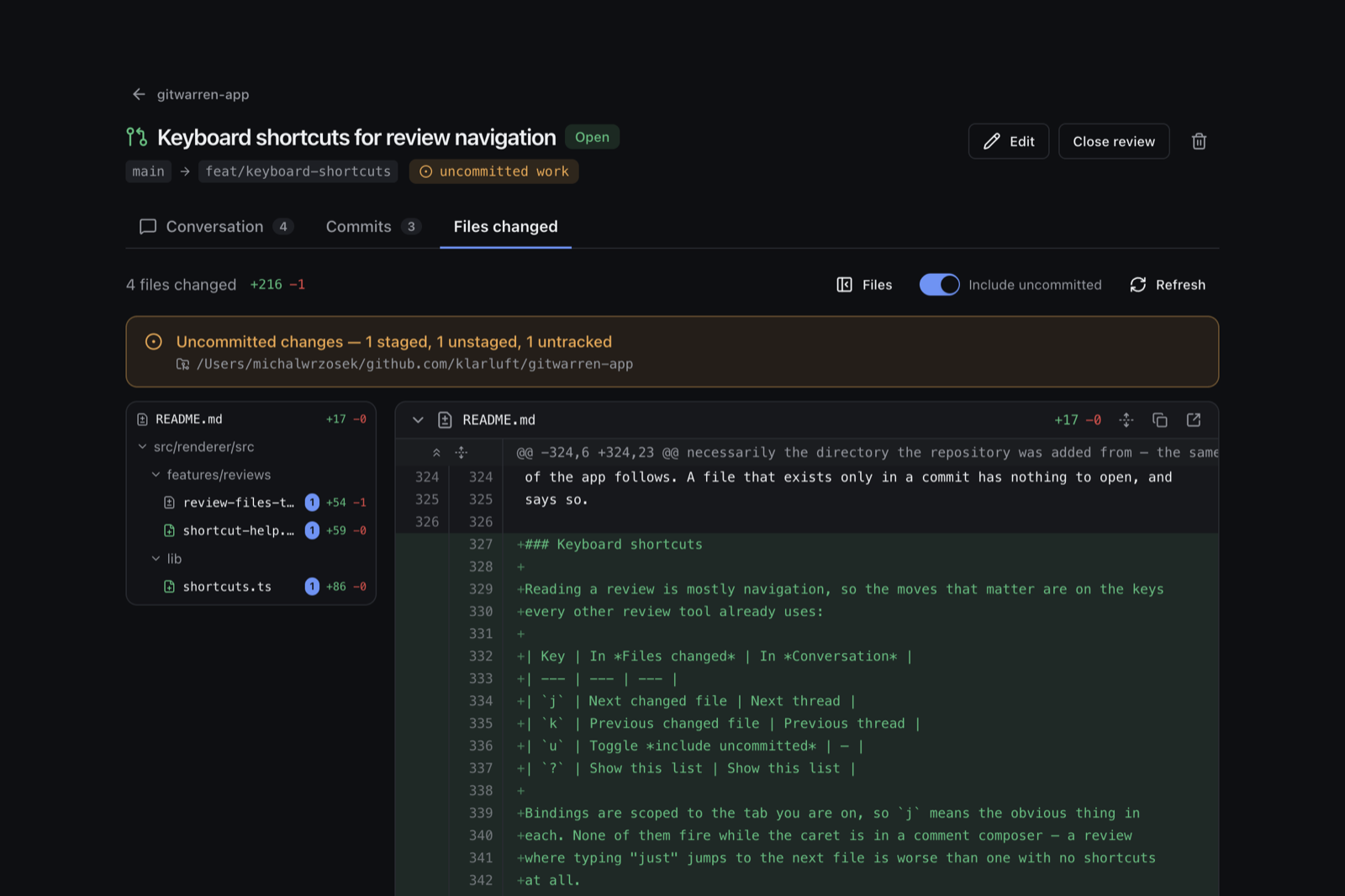
Tell GitWarren which local git repositories you care about, then open reviews against them — a review is a comparison of two refs, presented the way a pull request is, with conversation, commits and files changed tabs.
- Review work before it is a commit. If the branch you are reviewing is checked out in a worktree, GitWarren finds that worktree — wherever it is — and folds its staged, unstaged and untracked changes into the diff. That is exactly when review is most useful, and it is the part that makes this worth having.
- Nothing is cached. Every branch name, commit and diff on screen is read from git at the moment it is shown.
- Nothing leaves your machine. Reviews live in one SQLite file in your application-data directory. No account, no telemetry; the desktop app's one outbound request is the update check.
- Agents are first-class. Local AI agents get the same capabilities through an MCP server over stdio — they open reviews, read your comments, reply in a thread and resolve what they fixed.
- Desktop app or browser. It runs as an Electron app on macOS, Windows and Linux, or as a command that serves the same review UI into a browser tab. Same renderer either way; the shell is the only thing that differs.
- Your other machines too. A machine with no screen at all — a VPS, a WSL
distro, a box an agent works on — runs the headless half and is reviewed from
somewhere else, over SSH, over
wsl.exe, or over your own tailnet. Reviews live on the machine the code is on and stay there; nothing is replicated or relayed anywhere but the computers you already own.
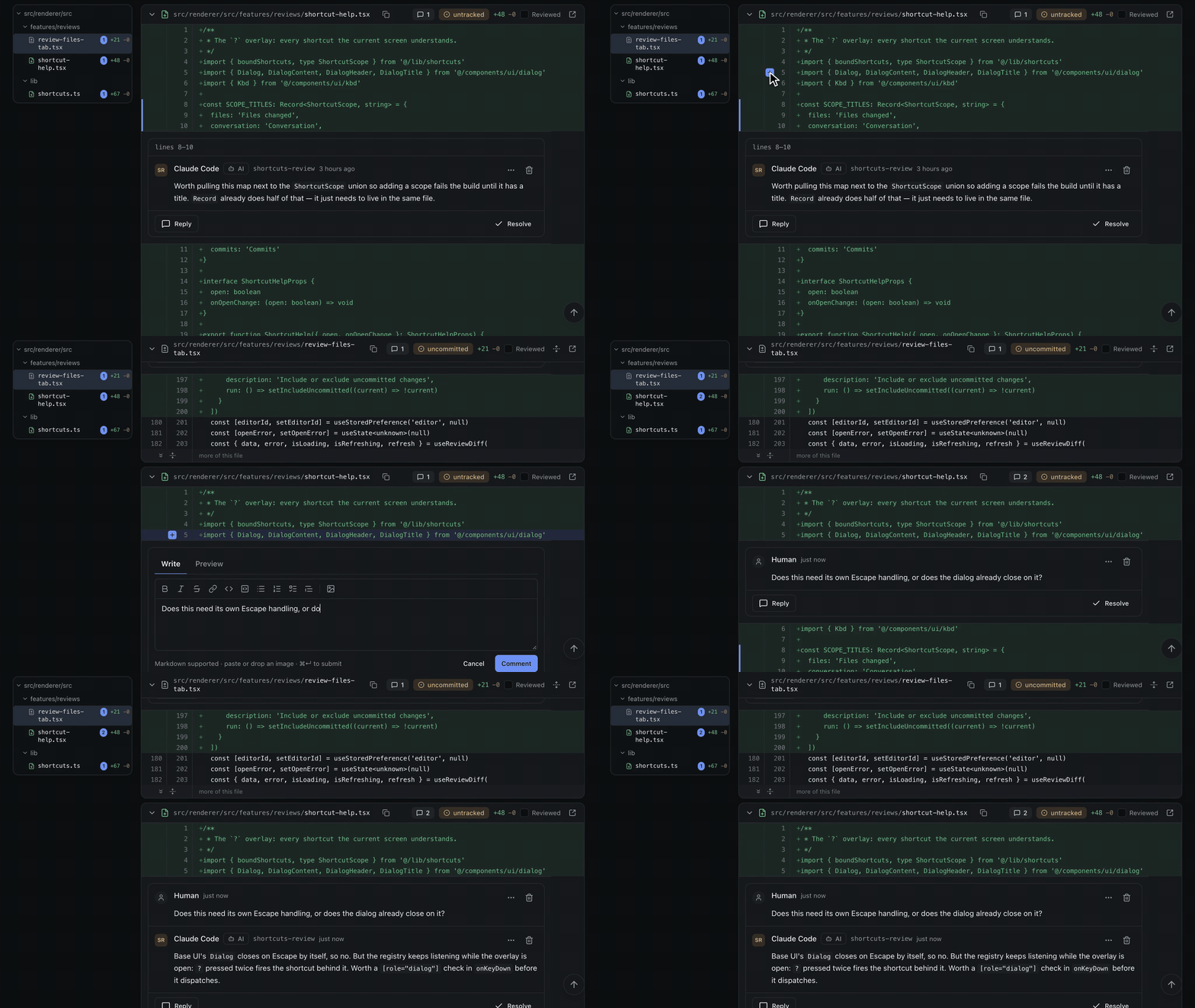
Comments go on the line, the way a pull request does them. The agent that wrote the code answers in the same thread, while you are still reading the diff:
Install
The desktop app
Download it from gitwarren.com, or on macOS:
The command line
Serves the same review UI in a browser instead of an Electron window — for a machine that will not have the app on it, or one with no screen at all:
Then gitwarren serve --open. See
The gitwarren command line.
Into a coding agent
If you arrive from a coding agent, start here instead. The plugin brings the MCP server and a note that teaches the agent when to open a review and how to answer your comments:
Cursor, Codex, VS Code and Kiro read the same repository from their plugin screens. See Installing it as a plugin.
Documentation
| Guide | What is in it |
|---|---|
| Reviews | What a review is, how uncommitted work is found, reading and navigating a large diff, marking files reviewed, opening a file in your editor |
| Agent access (MCP) | The MCP tools, installing the plugin, how an agent links you back into the app, comment threads, images |
The gitwarren command line | serve, service install, the four ways to install the CLI, updating and removing it |
| Your other machines | Reaching a repository over SSH, over wsl.exe from Windows, on your tailnet, and from a phone |
| Architecture | The stack, the shared service layer both surfaces call, and what is and is not stored |
| Development | Running from source, the project layout, database migrations |
| Releasing | Cutting a release, auto-update, code signing and notarization |
| The Glama build spec | The fields Glama's admin page actually reads, and why they say what they say |
| Known limitations | What GitWarren does not do, and why |
| GitWarren across hosts | The design plan behind the remote-host model |
Agents setting GitWarren up on a user's machine should read llms-install.md.
Contributing
Contributions are welcome. Anything larger than a bug fix starts as a discussion in Ideas, so the shape can be agreed before you spend time on it; once it is settled it becomes an issue. See CONTRIBUTING.md for the development workflow, the two design constraints that changes need to respect, and what a good pull request looks like here.
Before a first contribution can be merged you will be asked to sign the Contributor License Agreement. A bot handles it on your pull request; it takes about ten seconds and only happens once. The CLA keeps copyright in the codebase in one place, which is what makes it possible to offer GitWarren under a commercial licence alongside the GPL, or to change licence later, without having to track down every past contributor. You keep full ownership of your work and can use it elsewhere however you like.
Support and privacy
Questions, ideas and setups worth copying go to Discussions — Q&A if you are stuck on something, Ideas for a feature, and Show and tell for an agent or remote-machine arrangement other people should steal. Bugs you can describe — what GitWarren does, and when — go to issues. Anything you would rather not post publicly goes to contact@klarluft.com.
GitWarren keeps everything on your machine: reviews live in one SQLite file in your application-data directory, the diff is read from your git worktree, and there is no account and no telemetry. The desktop app's one outbound request is the auto-update check against this repository's GitHub Releases. The website's privacy policy covers gitwarren.com itself.
License
GitWarren is free software, licensed under the GNU General Public License, version 3 or (at your option) any later version. The full text is in LICENSE.
In short: you may use, study, modify and redistribute it, including commercially. If you distribute a modified version, or a program that incorporates this one, you must release that under the GPL as well and make the source available. That reciprocity is the point — it keeps GitWarren and anything built on it open.
The copyright is held by Klarluft B.V. (Rotterdam, The Netherlands · KVK 86875590), and every contribution is covered by the CLA. Because the copyright sits in one place rather than being spread across contributors, a licence other than the GPL — for embedding GitWarren in a closed-source product, for instance — can be granted on request: email contact@klarluft.com.
Michal Wrzosek (michal@wrzosek.pl) is the creator of GitWarren and currently its main maintainer.