
GDD — Giggly-Dazzling-Duckling
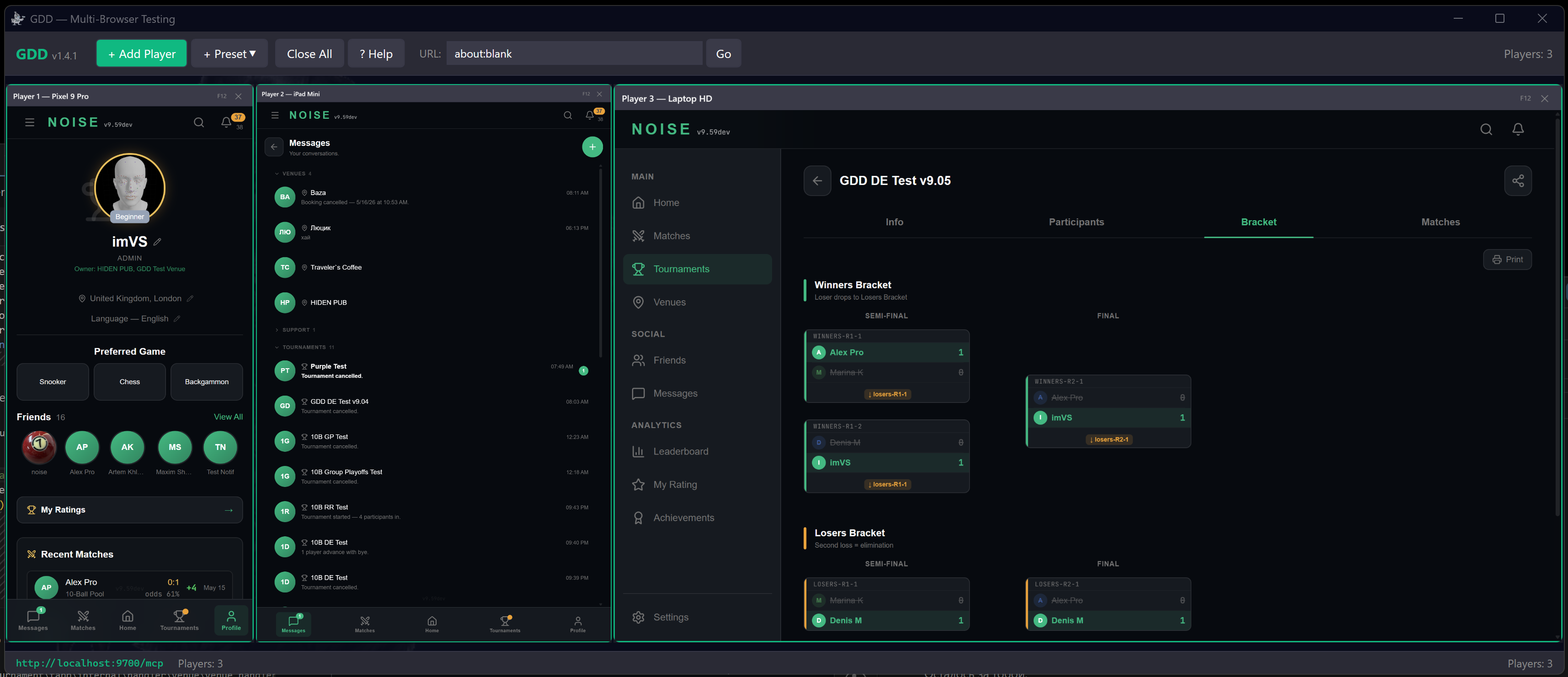
AI-controlled browser farm on your machine
Simulate multiple real users across 22 device types — test your site like it's launch day.







How It Works
You: Open 3 iPhones and a desktop, navigate to myapp.com, test the signup form on all devices
Claude Code creates 4 browsers with device emulation, navigates each to your app, fills in the form, takes screenshots, checks console for errors — all in parallel.
GDD runs N isolated Chromium instances, each with its own profile, cookies, device emulation, geolocation, and network conditions. It exposes 39 MCP tools via HTTP on localhost:9700.
Install
GDD comes in two flavours. The Server is headless — it's just the MCP backend, runs anywhere (including boxes with no display), and is all you need for pure AI automation. The Desktop app adds a GUI: a live grid of browser thumbnails you can click into to take over a session by hand. The Server runs on port 9700, the Desktop app on 9800 — so you can run both side by side.
Server (headless) — the MCP backend:
| Platform | Download | Run |
|---|---|---|
| Linux | GDD-Server-Linux.tar.gz | chmod +x GDD.Headless && ./GDD.Headless |
| macOS ARM | GDD-Server-macOS-ARM.tar.gz | bash Scripts/setup-macos.sh && ./GDD.Headless |
| macOS Intel | GDD-Server-macOS-Intel.tar.gz | bash Scripts/setup-macos.sh && ./GDD.Headless |
| Windows | GDD-Server-Windows.zip | .\GDD.Headless.exe |
| Docker | ghcr.io/cap-of-tea/gdd | docker run -p 9700:9700 ghcr.io/cap-of-tea/gdd |
| Claude Desktop | Win / Mac ARM / Mac Intel (.mcpb) | Open .mcpb file — installs as desktop extension |
Desktop app (GUI) — a live grid of browser thumbnails you can click into:
| Platform | Download | Run |
|---|---|---|
| Windows | GDD-Desktop-Windows.zip | Extract, run GDD.exe (WebView2 required) |
| Linux | GDD-Desktop-Linux.tar.gz | bash Scripts/install-deps.sh && ./GDD.Desktop |
| macOS ARM | GDD-Desktop-macOS-ARM.tar.gz | bash Scripts/setup-macos.sh && ./GDD.Desktop |
| macOS Intel | GDD-Desktop-macOS-Intel.tar.gz | bash Scripts/setup-macos.sh && ./GDD.Desktop |
The Windows app uses WebView2; the Linux/macOS app (built with Avalonia) drives real Chromium windows parked off-screen. Self-contained binary, ~70 MB. No .NET installation needed. Chromium downloads automatically on first launch.
One-liner (Linux):
Docker
The Docker image runs in headless mode with all Chromium dependencies pre-installed.
By default, browsers launch in headed mode (visible windows). Add --headless for CI/CD. Other flags: --stealth and --stealth-max for anti-bot masking, --update to self-update, --version and --help. The Configuration section below lists every flag and environment variable.
Connect to Your AI Client
Add to .mcp.json and restart your AI client:
That's it. Start GDD, tell Claude or Cursor to test your app.
Claude Desktop users: Download the
.mcpbfile from Releases and open it — GDD installs as a one-click desktop extension. No manual config needed.
Config file locations
| Client | Project config | Global config |
|---|---|---|
| Claude Code | <project>/.mcp.json | ~/.claude/.mcp.json |
| Cursor | <project>/.cursor/mcp.json | ~/.cursor/mcp.json |
| VS Code / Windsurf / Antigravity | <project>/.vscode/mcp.json | IDE settings.json |
Global and project configs are merged — servers from both are available simultaneously. Changes are picked up only when restarting the AI client session.
VS Code-based IDEs (Windsurf, Antigravity, Copilot)
VS Code-based IDEs use a different config format than Claude Code / Cursor.
Project config — .vscode/mcp.json:
Global config — open via Cmd+Shift+P → "Open User Settings (JSON)":
Global settings.json location: macOS — ~/Library/Application Support/<IDE>/User/settings.json, Linux — ~/.config/<IDE>/User/settings.json, Windows — %APPDATA%/<IDE>/User/settings.json. Replace <IDE> with your editor name (Code, Windsurf, Antigravity, etc.).
stdio-proxy alternative (.vscode/mcp.json):
Permissions (Claude Code)
By default, Claude Code asks for confirmation on every MCP tool call. To allow GDD tools without prompts, add to ~/.claude/settings.json:
This single wildcard covers all 39 GDD tools. Restart Claude Code after editing.
Auto-launch via stdio proxy (alternative)
Proxy scripts start GDD automatically when your AI client connects:
Windows:
Linux / macOS:
Add "--headless" to the args array for CI/CD.
Tip: On first launch, GDD downloads Chromium (~80 MB). If your AI client times out, run GDD manually first, then reconnect.
Autostart as service (macOS / Linux)
macOS (launchd):
Manage: launchctl list | grep gdd / bash Scripts/install-launchd.sh --uninstall
Linux (systemd):
Direct HTTP (without AI client)
GDD uses standard JSON-RPC 2.0 — works with curl, Python, Node.js, or any HTTP client.
Features
- Multi-device — Run N isolated Chromium instances with 22 device presets (phones, tablets, desktops)
- AI-native — 39 MCP tools for Claude Code, Cursor, or any MCP-compatible client
- Cross-platform — Native GUI with a live video wall on Windows, Linux & macOS, plus a headless server for CI/CD
- Full interaction — Navigate, tap, type, press keys and shortcuts, drag, swipe, scroll, hover, handle dialogs, take screenshots
- Real keyboard — Typing sends genuine, trusted keystrokes (the full keydown→input chain), so input masks, autocomplete and
maxlengthbehave exactly as they do for a real user, and rich-text (contenteditable) editors work;gdd_presshandles single keys and shortcuts like Enter, Tab, Escape and Ctrl+A - Physical keyboard layouts — Keystrokes carry the real
code/keyCodeof the emulated locale's keyboard: Russian ЙЦУКЕН puts «а» on the physicalKeyF, French AZERTY and German QWERTZ remap their keys, dead-key accents and AltGr symbols work. The layout followsgdd_set_languageautomatically (US, RU, DE, FR) - Human-like input —
humanize=truedrives a continuous cursor path (cubic Bézier with easing and micro-jitter) that carries over between clicks, hovers and drags; taps fire a single device-appropriate input (touch or mouse), never both - Anti-bot stealth — opt-in
--stealthmasks the usual automation tells (navigator.webdriver, etc.);--stealth-maxadds headless/datacenter evasions (coherent user-agent client hints, a plausible WebGL vendor, realistic device metrics) — on a headless container this halved CreepJS's headless score - Proxy support — Route every browser through an upstream proxy with
GDD_PROXY(with optional auth) - Header rewriting —
gdd_set_headerscan stripX-Frame-Options/CSPframe-ancestorsto load a site in an iframe, or add/replace response headers - Device emulation — Screen size, DPR, touch, user agent, geolocation, timezone, language
- Network control — Simulate 4G, Fast 3G, Slow 3G, or offline per browser
- Diagnostics — Console errors, network traffic, performance metrics, push notifications
- Error beacon — Every tool response warns about JS errors across all browsers automatically
- Docker-ready — Official image on GHCR (
ghcr.io/cap-of-tea/gdd), listed on the MCP Registry - Self-updating — Built-in version check and one-command update
MCP Tools (39)
Player Management
| Tool | Description |
|---|---|
gdd_add_players | Add N browser instances with optional device preset |
gdd_remove_player | Remove a browser instance by player ID |
gdd_list_windows | List all active browsers with current state |
Navigation
| Tool | Description |
|---|---|
gdd_navigate | Navigate to a URL |
gdd_wait | Wait for a CSS selector to appear (with timeout) |
gdd_reload | Reload page (hard=true bypasses cache) |
gdd_back | Navigate back |
gdd_forward | Navigate forward |
Interaction
| Tool | Description |
|---|---|
gdd_tap | Tap element by CSS selector or coordinates; sends a single device-appropriate input (touch on touch devices, mouse on desktop), never both. humanize=true adds a continuous human-like cursor path |
gdd_swipe | Swipe gesture (up/down/left/right) |
gdd_drag | Drag an element to (x, y) or onto another element via real pointer events (drives dnd-kit & HTML5 drag-and-drop) |
gdd_scroll | Scroll page or element |
gdd_type | Type text with real, trusted keystrokes (CDP dispatchKeyEvent — masks, autocomplete and maxlength behave as for a real user; works on contenteditable). Physical key codes follow the emulated layout (US/RU/DE/FR); humanize=true adds per-key jitter; paste=true inserts in one shot |
gdd_press | Press a single key or shortcut (Enter, Tab, Escape, Arrow keys, F1–F12, or a character) with optional modifiers (Control/Alt/Shift/Meta); character keys follow the emulated layout |
gdd_hover | Hover over element. humanize=true adds a continuous human-like cursor path |
gdd_select | Select option from <select> dropdown |
gdd_dialog | Handle JS alert/confirm/prompt dialogs |
Reading & Screenshots
| Tool | Description |
|---|---|
gdd_read | Read text content of an element |
gdd_read_all | Read text from all matching elements |
gdd_screenshot | Capture JPEG screenshot at CSS pixel resolution |
Emulation
| Tool | Description |
|---|---|
gdd_set_device | Set device preset (22 devices: phones, tablets, desktops) |
gdd_set_viewport | Set custom viewport dimensions |
gdd_set_location | Set geolocation, timezone, and locale |
gdd_set_network | Set network conditions (4G, 3G, offline) |
gdd_set_language | Set browser language |
gdd_set_headers | Rewrite response headers — strip X-Frame-Options/CSP to allow framing |
State & Diagnostics
| Tool | Description |
|---|---|
gdd_get_state | Browser state: URL, title, device, auth status |
gdd_get_console | Console output and uncaught exceptions |
gdd_get_network | Network requests with timing and status |
gdd_get_notifications | Received push notifications |
gdd_get_performance | Performance metrics (JS heap, DOM nodes, FPS) |
gdd_clear_logs | Clear console and/or network logs |
Auth & Execution
| Tool | Description |
|---|---|
gdd_quick_auth | Auto-register and login with generated credentials |
gdd_execute_js | Execute JavaScript and return result |
Browser Storage
| Tool | Description |
|---|---|
gdd_storage | Read/write/clear localStorage/sessionStorage |
gdd_cookies | Read or clear browser cookies |
Help & Updates
| Tool | Description |
|---|---|
gdd_get_manual | Full GDD manual for AI self-learning |
gdd_check_update | Check for newer versions |
gdd_update | Download and install update (restarts GDD) |
Device Presets (22)
Phones (11)
| Device | Resolution | Scale | Touch |
|---|---|---|---|
| iPhone SE | 375 x 667 | 2.0x | Yes |
| iPhone 14 | 390 x 844 | 3.0x | Yes |
| iPhone 15 Pro | 393 x 852 | 3.0x | Yes |
| iPhone 15 Pro Max | 430 x 932 | 3.0x | Yes |
| iPhone 16 Pro | 402 x 874 | 3.0x | Yes |
| iPhone 16 Pro Max | 440 x 956 | 3.0x | Yes |
| Pixel 9 | 412 x 915 | 2.625x | Yes |
| Pixel 9 Pro | 412 x 915 | 2.625x | Yes |
| Galaxy S24 | 360 x 780 | 3.0x | Yes |
| Galaxy S24 Ultra | 412 x 915 | 3.0x | Yes |
| OnePlus 12 | 412 x 915 | 3.5x | Yes |
Tablets (6)
| Device | Resolution | Scale |
|---|---|---|
| iPad Mini | 744 x 1133 | 2.0x |
| iPad Air | 820 x 1180 | 2.0x |
| iPad Pro 11" | 834 x 1194 | 2.0x |
| iPad Pro 13" | 1024 x 1366 | 2.0x |
| Galaxy Tab S9 | 800 x 1280 | 2.0x |
| Pixel Tablet | 800 x 1280 | 2.0x |
Desktops (5)
| Device | Resolution | Scale |
|---|---|---|
| Laptop HD | 1366 x 768 | 1.0x |
| Laptop HiDPI | 1440 x 900 | 2.0x |
| Desktop 1080p | 1920 x 1080 | 1.0x |
| Desktop 1440p | 2560 x 1440 | 1.0x |
| Desktop 4K | 3840 x 2160 | 2.0x |
Architecture
Editions
GDD ships as three apps over one shared core. The two GUIs differ only in the desktop toolkit (WebView2 on Windows, Avalonia on Linux/macOS); all three expose the same 39 MCP tools.
| Windows GUI | Desktop GUI | Server | |
|---|---|---|---|
| Binary | GDD.exe | GDD.Desktop | GDD.Headless (add --headless for no windows) |
| Engine | WebView2 | Playwright (headed) | Playwright (headed/headless) |
| UI | WPF video wall | Avalonia video wall | none — HTTP API only |
| MCP port | 9700 | 9800 | 9700 |
| Platforms | Windows | Linux, macOS | Windows, Linux, macOS |
Tech Stack
| Layer | Technology |
|---|---|
| Runtime | .NET 8.0 (self-contained) |
| UI (Windows) | WPF + CommunityToolkit.Mvvm |
| UI (Linux/macOS) | Avalonia + CommunityToolkit.Mvvm |
| Browser (Windows GUI) | Microsoft WebView2 |
| Browser (Desktop GUI + Server) | Microsoft Playwright |
| Protocol | MCP (Model Context Protocol) |
| Browser Control | Chrome DevTools Protocol (CDP) |
| Logging | Serilog |
Project Structure
Configuration
appsettings.json next to the executable:
| Key | Description | Default |
|---|---|---|
FrontendUrl | Default URL for new browsers | about:blank |
BackendUrl | Backend API for auth service | http://localhost:8080/api/v1 |
BotToken | Telegram bot token (for TG testing) | — |
McpPort | MCP server port (auto-fallback +1..+9) | 9700 |
DataFolderRoot | Browser profile storage root | %LOCALAPPDATA%\GDD\Profiles (Win), ~/.local/share/GDD/Profiles (Linux/macOS) |
Headed | Visible browser windows | true (override with --headless) |
Stealth | Opt-in anti-bot masking — launches Chromium with AutomationControlled disabled and hides the usual automation tells (navigator.webdriver, etc.). Playwright engines (GDD.Desktop, GDD Server) only | false |
Command-line flags
| Flag | Description |
|---|---|
--headed | Visible browser windows (default) |
--headless | No UI — for CI/CD |
--stealth | Enable anti-bot masking (same as GDD_STEALTH=true) |
--stealth-max | Full stealth — client-hints UA metadata, WebGL/device/timezone spoofing; implies --stealth (same as GDD_STEALTH_MAX=true) |
--update | Check for a newer version and install it if available |
--version | Print the version and exit |
--help | Show usage and exit |
Environment variables
Handy for Docker and CI, where an appsettings.json file is awkward:
| Variable | Description |
|---|---|
GDD_STEALTH | true/1 to enable anti-bot masking (same as --stealth) |
GDD_STEALTH_MAX | true/1 for full stealth (same as --stealth-max) |
GDD_PROXY | Upstream proxy for every browser, e.g. http://host:3128 or socks5://host:1080 (Server / Playwright engines) |
GDD_PROXY_USER / GDD_PROXY_PASS | Credentials for an authenticated proxy |
GDD_CHROME_CHANNEL | Launch an installed Chrome build (e.g. chrome, chrome-beta) instead of bundled Chromium |
GDD_TRACE | true/1 for verbose trace logging |
Documentation
- GDD-MANUAL.md — Full usage manual with workflow examples
- GDD-ARCHITECTURE.md — Architecture deep-dive
- GDD-PROMPT.md — Claude agent instructions for MCP integration
- DEPLOY-RAILWAY.md — Host GDD as a remote MCP server on Railway (behind a token-auth proxy)
- CONTRIBUTING.md — Contribution guidelines
Privacy
Privacy Policy
GDD runs entirely on your local machine. No telemetry, no analytics, no data collection.
- No data leaves your machine — all browser profiles, screenshots, logs, and cookies stay in local storage
- Browser profiles — stored in
%LOCALAPPDATA%\GDD\Profiles(Windows) or~/.local/share/GDD/Profiles(Linux/macOS) - No third-party services — GDD does not contact any external APIs except GitHub Releases for optional update checks
- Update checks —
gdd_check_updatemakes a single read-only request toapi.github.com. Opt out by not calling the tool, or setCheckForUpdates: falseinappsettings.json - MCP server — listens on
localhostonly (default port 9700), never exposed to the network
Contact: 2vsmirnov@gmail.com
License
imVS©, free for personal use.
Source Available — Non-Commercial. Free for personal use, education, and research. Commercial use requires a paid license. See LICENSE for full terms.
Commercial licensing: 2vsmirnov@gmail.com