Pool 18 LLM providers through MCP: ask, panel, tokenmax, route, models, quota, and stats.
Quick Install
Automated & IDE SetupCopy the AI prompt to install this server into Claude Code, Cursor, or another agent — or use 1-click editor setup below.
Not yet automatically verified
We haven't yet run this listing's install command through our automated sandbox check. This isn't a red flag — we're steadily working through the catalog.
Manual Client & Custom JSON ConfigExpand JSON ▾
Client Config & Setup
Choose your client or environment
Target File:
💡 Paste the JSON block into your client's configuration file under mcpServers, then restart the application.
Documentation Overview
freellmpool
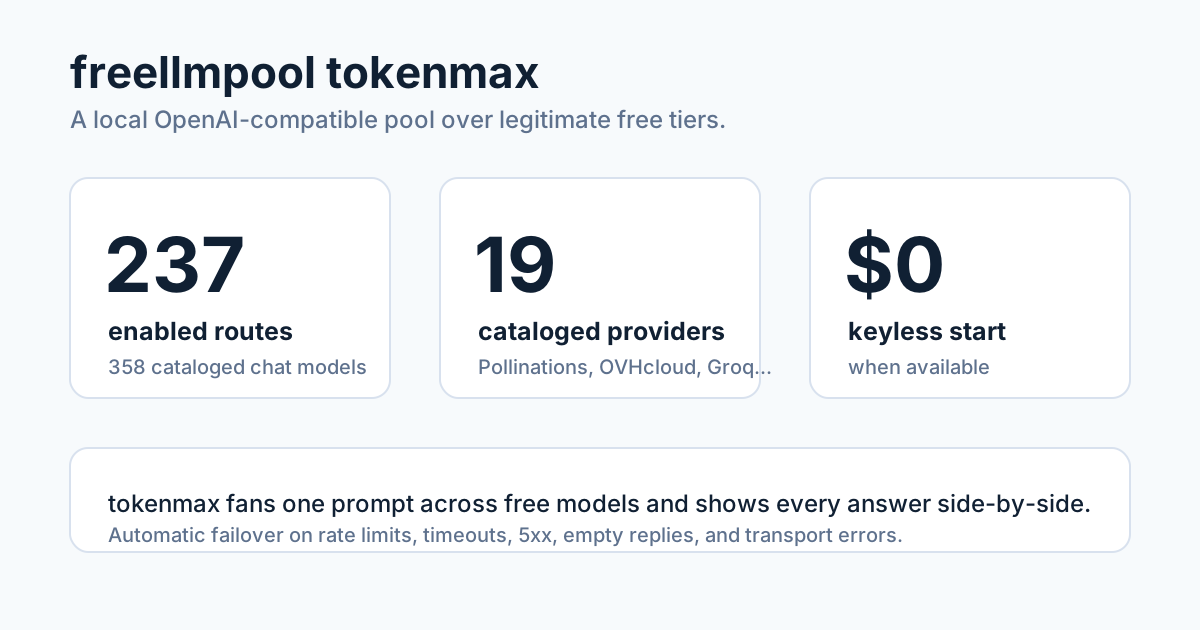
freellmpool catalogs 22 LLM providers as distinct groups spanning recurring free tiers, keyless endpoints, finite trials, pin-only routes, and disabled candidates. It exposes 178 enabled chat routes and 431 cataloged chat models, and automatically pools only enabled routes you can access behind one OpenAI-compatible endpoint — as a CLI, a Python library, or a local proxy. It can start without credentials when an enabled keyless route is available.



FAQ: where prompts go, ToS posture, failover, bans, and comparisons.
Release and distribution status
-
Latest release: 0.13.0. The GitHub release and PyPI package are both 0.13.0;
pip install freellmpoolanduvx freellmpoolinstall the audited provider catalog, bounded streaming and sentinel hardening, Hermes profile, proxy readiness/provider APIs,spreadrouting, and OpenCode registry-readiness hardening. -
Registry publication status: pending.
opencode-freellmpoolandopencode-freellmpool-tuiare tested but not published on npm as of 2026-08-29. Use their repository-local installation instructions for now.
30-second quickstart
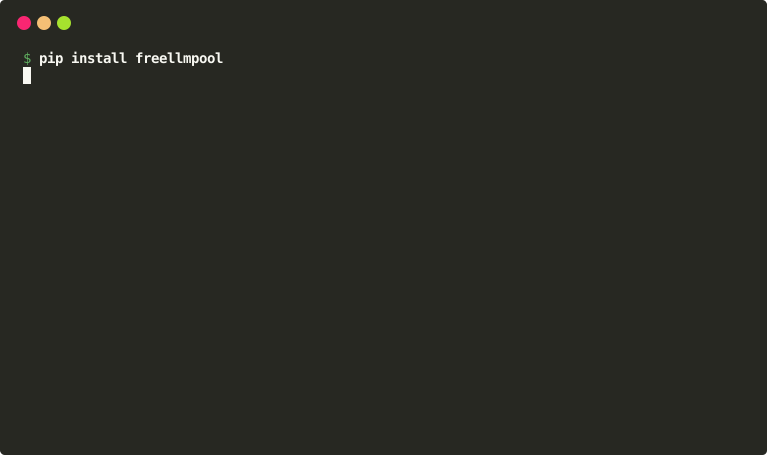
Fresh install to first free-model reply is measured at about 19 seconds under the 30-second target on a clean Linux/Python 3.12 environment, with no API keys when a keyless provider is up:
Portable virtual-environment path:
CI runs the same path from this checkout with
FREELLMPOOL_QUICKSTART_PACKAGE=. scripts/quickstart-test.sh.
The catalog covers provider-operated free tiers, keyless routes, and a few explicit finite-trial or disabled candidates. Eligibility and limits differ by provider. freellmpool automatically uses only enabled routes you can access, fails over when one is rate limited or down, and tracks local per-day usage.
Several providers (Pollinations, OVHcloud, and Kilo Gateway) need no API key, and LLM7 works without one, so the quickstart can answer without signup when a keyless provider is available.
To inspect your local provider keys, agent CLIs, proxy config, and Tailscale state before wiring tools, run the print-only init wizard:
Add keys for the other providers to unlock more models and higher limits.
Local runtimes (explicit, pin-only)
LM Studio, Ollama, and llama.cpp can be previewed from a fixed list of literal loopback endpoints without scanning your LAN or processes:
Discovery is read-only. Import is a separate affirmative step, writes no
credential, and keeps every imported model out of automatic routing
(auto = false). freellmpool local remove local_lm_studio --yes reverses only
the block managed by the importer. Custom endpoints must be canonical literal
loopback URLs such as http://127.0.0.1:1234/v1; hostnames, LAN addresses,
redirects, and broad network scans are rejected.
First-run setup with freellmpool init
freellmpool init inspects provider keys, installed agent CLIs, Tailscale
state, and proxy config, then prints one copy-pastable next step without editing
files. Run it detect-only first:
--json emits the same detection as versioned JSON for scripts and agents.
Tailnet / remote agent gateway
Serve the proxy on your Tailscale 100.x address with a generated API key:
From a remote machine:
Both sides support --api-key <shared-secret> if you want to pin a key instead
of using a generated token. Tailnet serving requires auth by default; do not
run unauthenticated over non-loopback interfaces.
Metaswarm agent lanes
This project uses one Umans/Kimi K2.7 worker lane, one MiniMax M3 lane, Codex as escalation, and Claude Opus only for final pre-ship review. The installable Metaswarm profile mirrors that posture: one free/cheap worker lane through the local proxy, one larger freellmpool reviewer lane, and Codex/Opus as explicit user-owned paid escalation/final-review lanes only (never silent).
Run a coding agent on free models
freellmpool's proxy speaks the OpenAI API and includes an experimental Anthropic-compatible path, so coding agents can run against pooled free tiers — just point them at the proxy:
The Hermes profile prints (and never writes) this supported custom-endpoint
block; hermes model provides the interactive equivalent:
Claude Code gateway mode can also be launched directly:
Existing OpenAI-compatible apps work the same way: set
OPENAI_BASE_URL=http://localhost:8080/v1 and keep your code unchanged.
Anthropic-compatible tools can use the experimental bridge with
ANTHROPIC_BASE_URL=http://localhost:8080.
Text-only /v1/responses and /v1/messages requests stream incrementally from
the selected provider. Tool calls and richer content intentionally stay on the
buffered compatibility path. The browser dashboard and playground share one
public, data-free shell; when proxy auth is enabled it prompts for the bearer
token and keeps it only in page memory while protected status, inventory,
model, and battle calls continue to require the Authorization header.
OpenCode gets a deeper integration in 0.12.0: a live in-editor dashboard (routing mode,
estimated savings, tokens served free, provider race, latency), per-request
agent routing via the model picker (freellmpool/agent|spread|auto|fast|quality|fair), and freellmpool_status
/ freellmpool_models tools — see integrations/opencode-tui
and the guide.
The plugin registers its routing aliases automatically on supported OpenCode
versions without rewriting user configuration. Restart OpenCode and check
opencode models freellmpool.
The package tarballs are validated in CI, but npm publication remains pending;
the linked local-file instructions remain the working install path.
New in 0.11: capacity tools — freellmpool capacity status shows which free
tiers are usable right now, freellmpool providers health live-probes them, and
freellmpool keys add walks you through configuring more (see
Capacity & provider health and
docs/CAPACITY.md).
New in 0.10: an async API (AsyncPool), an MCP server (freellmpool mcp),
latency-aware routing with freellmpool benchmark, observability hooks, and a
plugin system for custom providers. See the changelog.
Install
Only dependency is httpx. Python 3.11+.
Docker and Open WebUI
The published container runs the local proxy as an unprivileged user. Persist quota, stats, route-health, cache, and configuration state in a named volume:
Omit --env GROQ_API_KEY if you want a credential-free start; the proxy can
answer only while an enabled keyless route is available. Keep the published
port on loopback. If you deliberately expose it, set
FREELLMPOOL_PROXY_KEY and require that Bearer token from clients.
For the bundled Open WebUI stack, place any provider credentials in .env and
run docker compose up -d. Compose waits for the proxy health check and keeps
both freellmpool and Open WebUI state in named volumes; open
http://localhost:3000 after both services are healthy.
Command line
Related MCP Servers
Adoption & maintenance
Factual signals from GitHub, npm, and our automated checks — not a rating.
GitHub stars
109
Stargazers on the source repository.
Last commit
6d ago
Most recent push to the default branch.
Reviews
No reviews yet — be the first to share how this listing worked for you.
Frequently Asked Questions about Freellmpool
AllMCPs Directory Badge
Showcase your server listing on GitHub or your project documentation. Embed this dynamic SVG badge to highlight official listing status and live engagement.
Badge Style:
Live Dynamic SVG Preview
Markdown (GitHub README)
[](https://allmcps.com/mcp/freellmpool)HTML Embed
<a href="https://allmcps.com/mcp/freellmpool"><img src="https://allmcps.com/api/badge/freellmpool?style=directory" alt="Freellmpool on AllMCPs" /></a>Technical Specs & Signals
CategoryDeveloper Tools
11/14 checks healthy over the last 45d
45Quality signal: Fair · 45/100How this signal is calculated ▾
Server availabilityNot measured
Not scored for repo-hosted servers — we can't reach the running server, only its GitHub page. Hosted MCP endpoints are health-checked live.
Verified ownership10/20
Documentation & tools16/30
Adoption & activity8/15
Community engagement0/10
A guidance signal from public completeness & health data — not a user rating. New listings start lower and rise as they add docs, get verified, and grow adoption. Signals we can't observe for a listing are skipped, not counted against it.
Supply-chain signal
No high-severity advisories surfaced by our automated scan.
Critical 0High 0Medium 0Low 0
Scanned 2d ago via OSV.dev · freellmpool (PyPI)
Own this project?
This directory is pre-filled from public sources. Claim via GitHub README, site badge, or DNS TXT to unlock edit access and the Official badge — proof is checked automatically, then reviewed by our team.
Free dofollow backlink: add your website and place the AllMCPs badge on it — no claim needed. We detect it automatically and keep it verified as long as the badge stays live.
Claim & get free dofollowShare & Embed
Add our SVG badge (dark/light directory styles) or embeddable widget to your site.