Persistent code knowledge graph + 9 composite MCP tools for AI coding agents.
Quick Install
Automated & IDE SetupCopy the AI prompt to install this server into Claude Code, Cursor, or another agent — or use 1-click editor setup below.
Not yet automatically verified
We haven't yet run this listing's install command through our automated sandbox check. This isn't a red flag — we're steadily working through the catalog.
Manual Client & Custom JSON ConfigExpand JSON ▾
Client Config & Setup
Choose your client or environment
Target File:
💡 Paste the JSON block into your client's configuration file under mcpServers, then restart the application.
Documentation Overview
forensic-deepdive
forensic-deepdive gives an AI coding agent forensic understanding of an unfamiliar codebase — a persistent knowledge graph, an MCP server, and five durable markdown artifacts, so your agent stops re-discovering the same architecture from scratch every session.
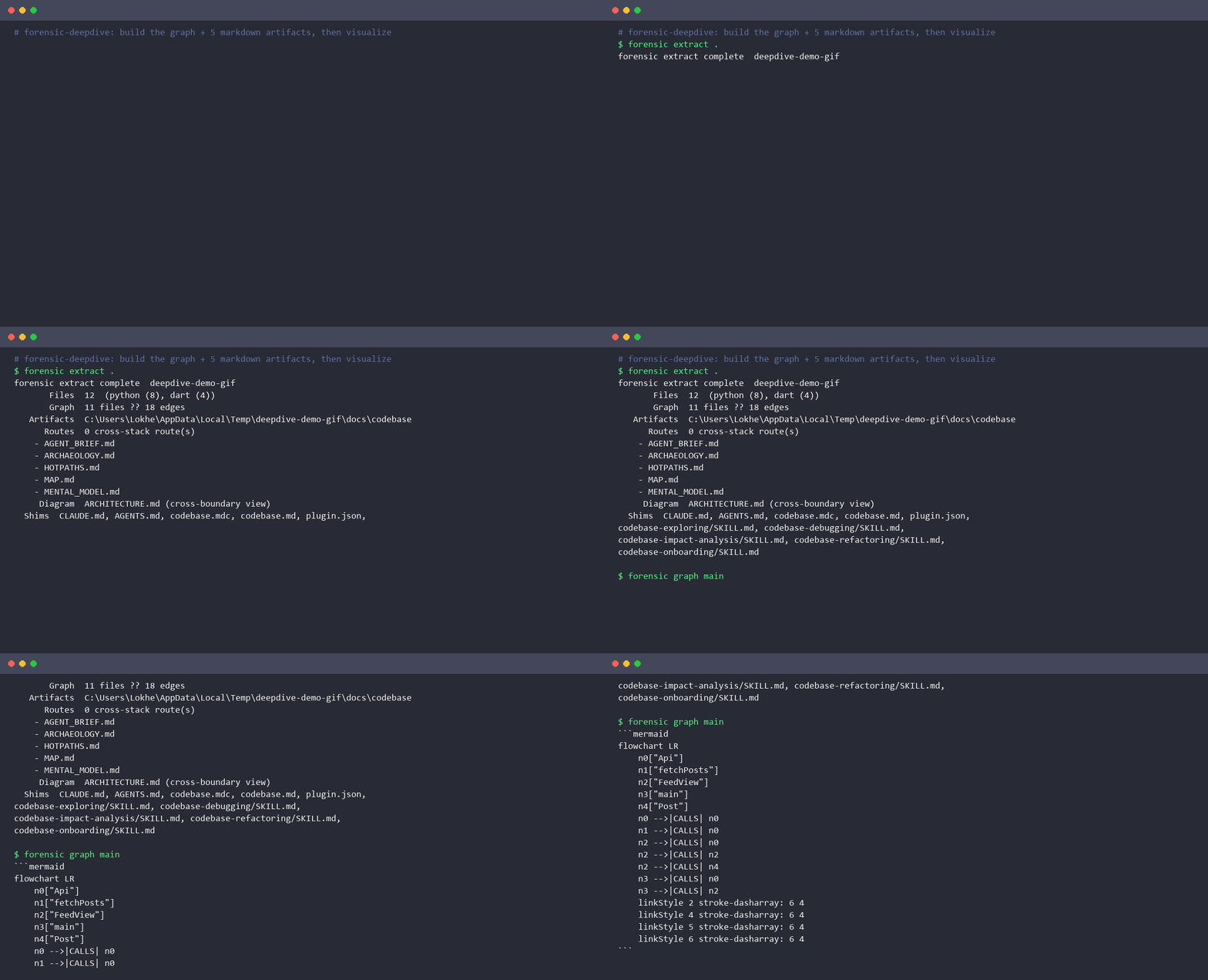
Why this is different: every edge and every emitted claim carries a confidence tag —
EXTRACTED (deterministic fact) / INFERRED (a heuristic resolved cleanly) / AMBIGUOUS
(multiple candidates, shown, not guessed) — so your agent knows what to trust before it
acts on it. Nothing else in this category tags confidence at all.
Why not GitNexus / CodeGraphContext / DeepWiki / Sourcegraph
| forensic-deepdive | GitNexus | CodeGraphContext | DeepWiki | Sourcegraph | |
|---|---|---|---|---|---|
| License | Apache-2.0 | PolyForm Noncommercial | MIT | proprietary (open variant: MIT) | partial |
| Persistent code knowledge graph | ✅ LadybugDB | ✅ LadybugDB | partial | ❌ | partial |
| MCP server | ✅ 9 composite tools | ✅ 16 tools | partial | ❌ | ❌ |
| Per-edge confidence taxonomy | ✅ EXTRACTED / INFERRED / AMBIGUOUS | ❌ | ❌ | ❌ | ❌ |
| Git archaeology as a first-class layer | ✅ | ❌ | ❌ | ❌ | partial |
| Durable committed markdown artifacts | ✅ 5 files | partial | partial | ✅ (wiki) | ❌ |
Agent-insight layer (record_insight / recall_insights) | ✅ | ❌ | ❌ | ❌ | ❌ |
| Multi-platform skill emission | ✅ 10 shims | partial | partial | ❌ | ❌ |
| Local-only (no cloud required) | ✅ co-equal | ✅ | ✅ | ❌ | ❌ |
GitNexus is the runaway leader in this category — but its PolyForm Noncommercial
license locks every commercial user out. forensic-deepdive is the Apache-2.0
alternative: same persistent-graph-plus-MCP shape, plus honest confidence tags, git
archaeology, persistent agent memory, and the 5 markdown artifacts as a fallback for any
agent that doesn't speak MCP — with a license your employer's legal team will actually
sign off on.
What it produces
forensic-deepdive analyzes any codebase (9 languages, polyglot) and produces:
- A persistent embedded graph at
<repo>/.deepdive/graph.lbug— File, Symbol, Module, Commit, Author, Endpoint, and DbTable nodes plus DEFINES, MEMBER_OF, IMPORTS, CALLS, EXTENDS, IMPLEMENTS, TOUCHED_BY_COMMIT, AUTHORED_BY, CO_CHANGES_WITH, and the cross-boundary HANDLES / CALLS_ENDPOINT / ROUTES_TO / INJECTS / PERSISTS_TO edges. Every edge carries a confidence tag (EXTRACTED/INFERRED/AMBIGUOUS) — no hidden heuristics. The singleEndpointjoin node unifies five cross-boundary protocols (HTTP, MCP tools, registry-dispatch, gRPC, messaging/AMQP), so a frontend call resolves to its backend handler across the stack as oneROUTES_TOedge. - An MCP server (
forensic serve) exposing 9 composite tools (impact,context,archaeology,flow,query,record_insight,recall_insights,visualize,trace) consumable by Claude Code, Cursor, Codex, Continue, Cline, Windsurf — and any other MCP-aware agent. - Five durable markdown artifacts under
<repo>/docs/codebase/, regenerated from the graph on every extract:MAP.md— what's where, ranked by centrality.HOTPATHS.md— the dependency hot spots, with a per-row confidence-mix column so you see exactly how cleanly each symbol resolves.ARCHAEOLOGY.md— why the code looks the way it does (git history, top authors with %, bus factor, co-change clusters, defect proximity).MENTAL_MODEL.md— the doc the original author would write to onboard a new hire.AGENT_BRIEF.md— ≤5 KB of assertive Never/Always rules with per-rule confidence tags. Drop-inCLAUDE.mdfor any project.
- Ten shims into the target repo — 4 editor rule files (
CLAUDE.md,AGENTS.md,.cursor/rules/codebase.mdc,.continue/rules/codebase.md), 5 single-intent Claude skills under.claude/skills/codebase-{exploring,debugging,impact-analysis,refactoring,onboarding}/, and a.claude-plugin/plugin.jsonmanifest. All write-if-absent — hand-edited files are never overwritten. - An agent-insight layer —
record_insight/recall_insightsMCP tools backed by<repo>/.deepdive/insights.jsonlby default (zero dependencies, human-readable, git-friendly). The optional[graphiti]extra upgrades to a temporal knowledge graph backend above a 2-of-5 repo-size threshold.
Extract also regenerates ARCHITECTURE.md — a system-level Mermaid view of the cross-boundary graph (ROUTES_TO / INJECTS / PERSISTS_TO, confidence-styled), a separate human-validation surface (not one of the five contract artifacts, exactly like forensic visualize and serve --ui). Regenerate it on its own with forensic diagram --repo <repo>. Use it to sanity-check the graph — a wrong edge there is a wrong edge everywhere.
Add --emit-vault to also write an Obsidian-friendly vault under <output>/vault/ — every artifact gets summary:/tags: frontmatter, cross-references become [[wikilinks]], and an INDEX.md MOC ties them together (with a .obsidian/ config). A local-first second brain for humans (graph view, backlinks) and agents (triage by summary: without opening files, a traversable index). Opt-in; off by default.
Status
v0.10.0 "The Upgrade Path" — an integrity release. v0.9 shipped correct, and then its findings run caught --refresh-shims being structurally unable to refresh half its targets, with 909 tests green over it. The cause wasn't the fix — it was that every test in the suite wrote into an empty directory, so only the first run had ever been tested. Everyone who isn't a new user lives on the untested path.
So 0.10 adds almost no surface. It makes the guarantees already made real: running Deepdive over a repo that already carries a previous release's output now provably converges (and provably leaves your hand-edited files alone), extract tells you when generated shims are stale instead of waiting for you to know the flag exists, and a stale examples/ fails CI rather than being caught by eye mid-release. New: forensic extract --timings, per-phase wall clock.
It also contains a cancelled feature, which is the more useful story. The planned performance work targeted PageRank. The profile required before touching it measured PageRank at 0.04 % of a large extract, and the already-batched store writes at 79–87 %. The optimization was disproven before it was written — see docs/findings/v0.10/PROFILE.md. Confirming a known technique had been applied had been mistaken for confirming it was fast.
The engine, the graph, the contract layer and the 5-artifact + 9-MCP-tool contract are unchanged from 0.9, and emitted content is byte-identical but for the version footer.
⚠ If you installed 0.8.0 or 0.9.0 and
forensic servestopped working — this is why. Those releases declaremcp>=1.27.1with no upper bound.mcp2.0.0 removedmcp.server.fastmcp, which the MCP server imports, so a fresh install of 0.8.0 or 0.9.0 today resolves tomcp2.0.0 and fails on import. Our development lockfile pinned 1.27.1, so every local check stayed green and only the clean-environment wheel smoke in CI could see it. Fix: upgrade to 0.10.0 (which capsmcp<2), or pinmcp<2yourself. Nothing else about those releases is affected.
What's proven, and what isn't — the honest-framing section moved to
docs/findings/HONEST.md (unchanged content, DEC-119). Short
version: proven usable with real agent auto-discovery; not proven to make
autonomous issue resolution measurably faster end-to-end (hardware-gated). This is an
assisted-analysis tool, and it is not overclaimed as more.
Quick start
Related MCP Servers
Adoption & maintenance
Factual signals from GitHub, npm, and our automated checks — not a rating.
GitHub stars
2
Stargazers on the source repository.
Last commit
1mo ago
Most recent push to the default branch.
Directory activity
1 views
Config copies, upvotes, and views on AllMCPs.
Reviews
No reviews yet — be the first to share how this listing worked for you.
Frequently Asked Questions about Forensic Deepdive
AllMCPs Directory Badge
Showcase your server listing on GitHub or your project documentation. Embed this dynamic SVG badge to highlight official listing status and live engagement.
Badge Style:
Live Dynamic SVG Preview
Markdown (GitHub README)
[](https://allmcps.com/mcp/forensic-deepdive)HTML Embed
<a href="https://allmcps.com/mcp/forensic-deepdive"><img src="https://allmcps.com/api/badge/forensic-deepdive?style=directory" alt="Forensic Deepdive on AllMCPs" /></a>Technical Specs & Signals
CategoryDeveloper Tools
7/7 checks healthy over the last 45d
37Quality signal: Fair · 37/100How this signal is calculated ▾
Server availabilityNot measured
Not scored for repo-hosted servers — we can't reach the running server, only its GitHub page. Hosted MCP endpoints are health-checked live.
Verified ownership10/20
Documentation & tools15/30
Adoption & activity3/15
Community engagement0/10
A guidance signal from public completeness & health data — not a user rating. New listings start lower and rise as they add docs, get verified, and grow adoption. Signals we can't observe for a listing are skipped, not counted against it.
Supply-chain signal
No high-severity advisories surfaced by our automated scan.
Critical 0High 0Medium 0Low 0
Scanned 2d ago via OSV.dev · forensic-deepdive (PyPI)
Own this project?
This directory is pre-filled from public sources. Claim via GitHub README, site badge, or DNS TXT to unlock edit access and the Official badge — proof is checked automatically, then reviewed by our team.
Free dofollow backlink: add your website and place the AllMCPs badge on it — no claim needed. We detect it automatically and keep it verified as long as the badge stays live.
Claim & get free dofollowShare & Embed
Add our SVG badge (dark/light directory styles) or embeddable widget to your site.