Every number in an AI answer traces back to the rows that produced it.
Quick Install
Automated & IDE SetupCopy the AI prompt to install this server into Claude Code, Cursor, or another agent — or use 1-click editor setup below.
Not yet automatically verified
We haven't yet run this listing's install command through our automated sandbox check. This isn't a red flag — we're steadily working through the catalog.
Manual Client & Custom JSON ConfigExpand JSON ▾
Client Config & Setup
Choose your client or environment
Target File:
💡 Paste the JSON block into your client's configuration file under mcpServers, then restart the application.
Documentation Overview
Footnote

Claim-level provenance for AI over business data. Every number in an answer traces back to the rows that produced it — clickable at read time, exportable for an auditor, and tamper-evident.
An MCP server, a provenance store, and a demo UI showing what the combination looks like.
Node 22.5+ required (uses the built-in node:sqlite, so there is no database to install).
Postgres is opt-in. The same schema, seed and query set run against it, and the same suite has to pass on both:
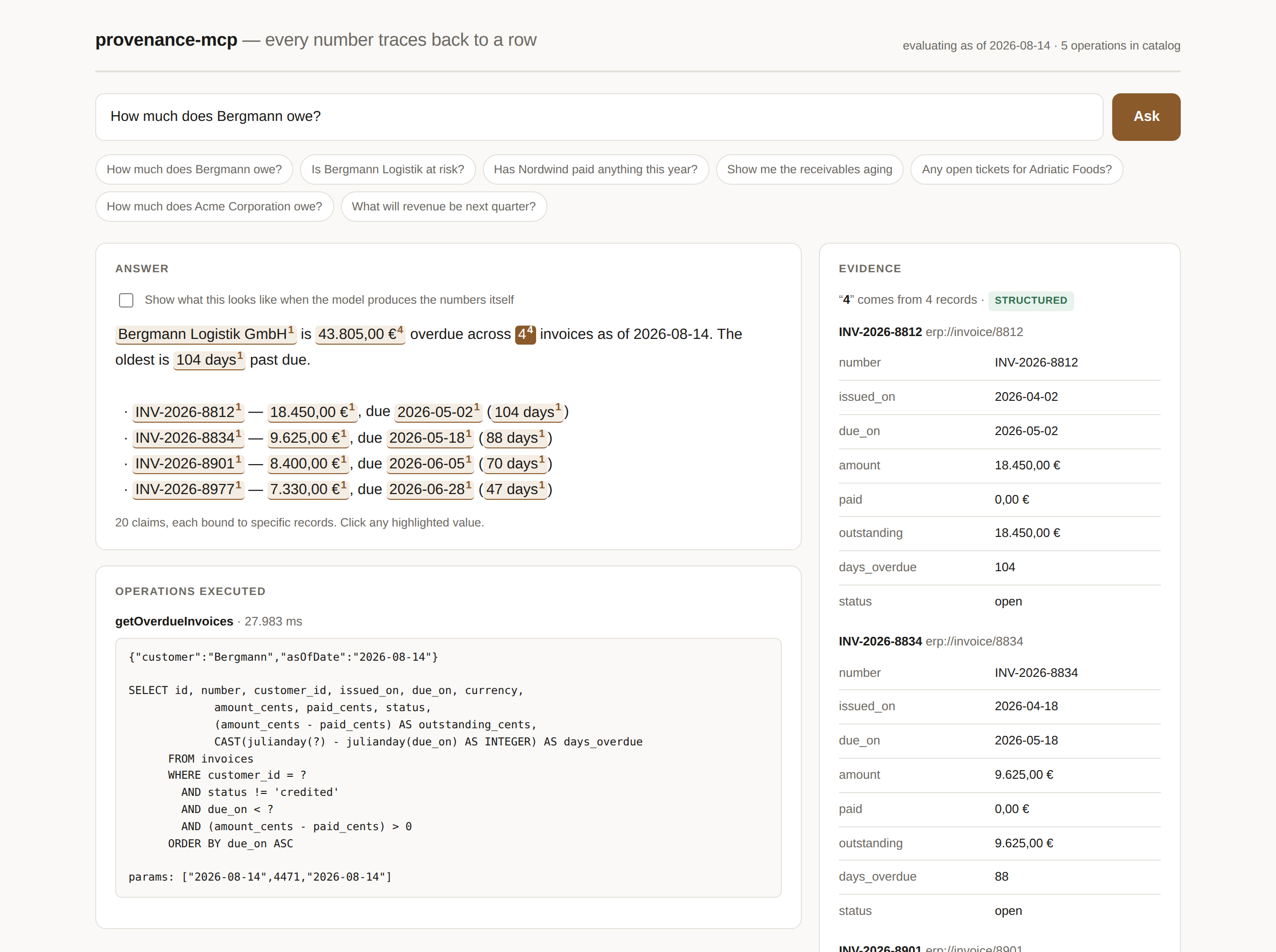
The problem
Language models produce plausible continuations, not true ones. Point one at a business database and it will confidently report a number that no query produced — and the fabricated figure is indistinguishable from the real one, because both come out of the same machinery.
The usual answers don't hold up here. Uncertainty signals catch the fuzzy cases, not the fluent ones. A verifier built from the same model can confirm a fabrication as easily as catch it. And in finance, inventory or procurement, "the model said so" is not an answer anyone can act on.
What does work is structural: never let the model produce the number.
The architecture
The model handles translation and phrasing — the two things it is reliable at. Numbers come from the system of record.
What it enforces
These are tests, not guidelines. npm test fails if any of them breaks.
No number is generated. Values are copied verbatim from an operation's structured output into template slots. A test asserts every monetary figure in an answer is covered by a claim with evidence behind it, and that the stated total equals the sum of the records it cites.
Entities are validated before any query runs. A fabricated customer produces a recoverable error listing real alternatives — not a silent empty result the model narrates around.
Aggregation happens in SQL. The model chooses which aggregation to run, never what it equals.
Empty results are handled in code. This is the single biggest fabrication trigger: hand a model an empty result set mid-sentence and it invents something to finish the sentence. Operations set an explicit emptyReason instead.
Unroutable questions are refused. "What will revenue be next quarter?" maps to no operation, so no answer is produced. Refusal is a first-class outcome, not a failure.
Provenance is written server-side. The model never reports its own provenance. Provenance that depends on the model choosing to cite is worthless.
The log is tamper-evident. Each record carries the hash of its predecessor. npm run verify walks the chain and reports the first record that was modified after it was written.
Interpretations, not just figures
The harder case is judgement. "Bergmann is at risk" is a conclusion with no row to check it against — and an ungrounded interpretation is more dangerous than an ungrounded number, because it reads as insight and survives review.
The answer here states the conclusion and then lays out each premise as a separately cited fact:
A human can disagree with the reasoning while trusting the inputs.
Provenance record format
origin is the field that matters. structured means the value was copied from an operation's output. generated means a model produced it — which for a number is exactly what this project exists to prevent.
MCP details
The server uses the parts of the protocol that carry this work:
| Feature | Use |
|---|---|
inputSchema | The model gets a typed catalog, not a query language |
structuredContent | Values return as validated JSON beside the prose, so figures never have to survive a round trip through generated tokens |
resource_link | Every record touched comes back as an erp:// URI — the deep-link primitive behind a clickable citation |
annotations.audience | Record links are marked user-facing |
_meta | Carries the provenance record ID and hash so a host can fetch the full trace |
isError | A fabricated entity is a recoverable tool error the model can correct, not a protocol failure |
What MCP does not give you, and what this repo adds: nothing in the protocol binds this claim to that evidence. The protocol hands you links; the claim-to-evidence mapping and its rendering live in the host. That binding is the actual product.
Run standalone over stdio:
From a clone, before the package is published:
Try these in the demo
| Question | What it shows |
|---|---|
| How much does Bergmann owe? | Every figure clickable to the invoice behind it |
| Is Bergmann Logistik at risk? | An interpretation with separately cited premises |
| Show me the receivables aging | Portfolio aggregation, computed in SQL |
| How much does Acme Corporation owe? | Fabricated entity → refusal with real alternatives |
| What will revenue be next quarter? | Unroutable → refusal rather than improvisation |
Toggle "show what this looks like when the model produces the numbers itself" for the contrast: identical formatting, fluent prose, every figure wrong, nothing in the output marking which.
Layout
Only operations.ts writes ERP SQL, in one dialect, with ? placeholders.
PostgresDb rewrites those to $1..$n, and the single expression that genuinely
differs between the engines — whole days between two dates, julianday() on
SQLite, date subtraction on Postgres — is named daysBetween on the Db
interface rather than inlined. That is the one place a port can silently change
a number, so it is isolated and the suite asserts the same day counts on both.
Status and limits
v0, and honest about scope.
Related MCP Servers
Reviews
No reviews yet — be the first to share how this listing worked for you.
Frequently Asked Questions about Footnote
AllMCPs Directory Badge
Showcase your server listing on GitHub or your project documentation. Embed this dynamic SVG badge to highlight official listing status and live engagement.
Badge Style:
Live Dynamic SVG Preview
Markdown (GitHub README)
[](https://allmcps.com/mcp/footnote)HTML Embed
<a href="https://allmcps.com/mcp/footnote"><img src="https://allmcps.com/api/badge/footnote?style=directory" alt="Footnote on AllMCPs" /></a>Technical Specs & Signals
CategoryDeveloper Tools
40Quality signal: Fair · 40/100How this signal is calculated ▾
Server availabilityNot measured
Not scored for repo-hosted servers — we can't reach the running server, only its GitHub page. Hosted MCP endpoints are health-checked live.
Verified ownership10/20
Documentation & tools15/30
Adoption & activity5/15
Community engagement0/10
A guidance signal from public completeness & health data — not a user rating. New listings start lower and rise as they add docs, get verified, and grow adoption. Signals we can't observe for a listing are skipped, not counted against it.
Own this project?
This directory is pre-filled from public sources. Claim via GitHub README, site badge, or DNS TXT to unlock edit access and the Official badge and attach your website — proof is checked automatically, then reviewed by our team.
Free dofollow backlink: add your website and place the AllMCPs badge on it — no claim needed. We detect it automatically and keep it verified as long as the badge stays live.
Claim & get free dofollowShare & Embed
Add our SVG badge (dark/light directory styles) or embeddable widget to your site.