Folio README
The full upstream README, mirrored here for reference. Install config, tool schemas, adoption signals, and an original overview live on the Folio listing page.
Folio
The vibe-coded, open-source alternative to Notion and Confluence. Your team's wiki lives in Git. People write in the browser, together, in real time. AI agents read and write the same pages. One command to run it yourself.
Website: https://foliowiki.online · Featured in Self-Host Weekly (9 Oct 2026)
👉 Try the live demo
No install, no sign-up: open it and pick Sam on the sign-in screen. Shared login, data resets every 24 hours; don't enter personal data or API keys.
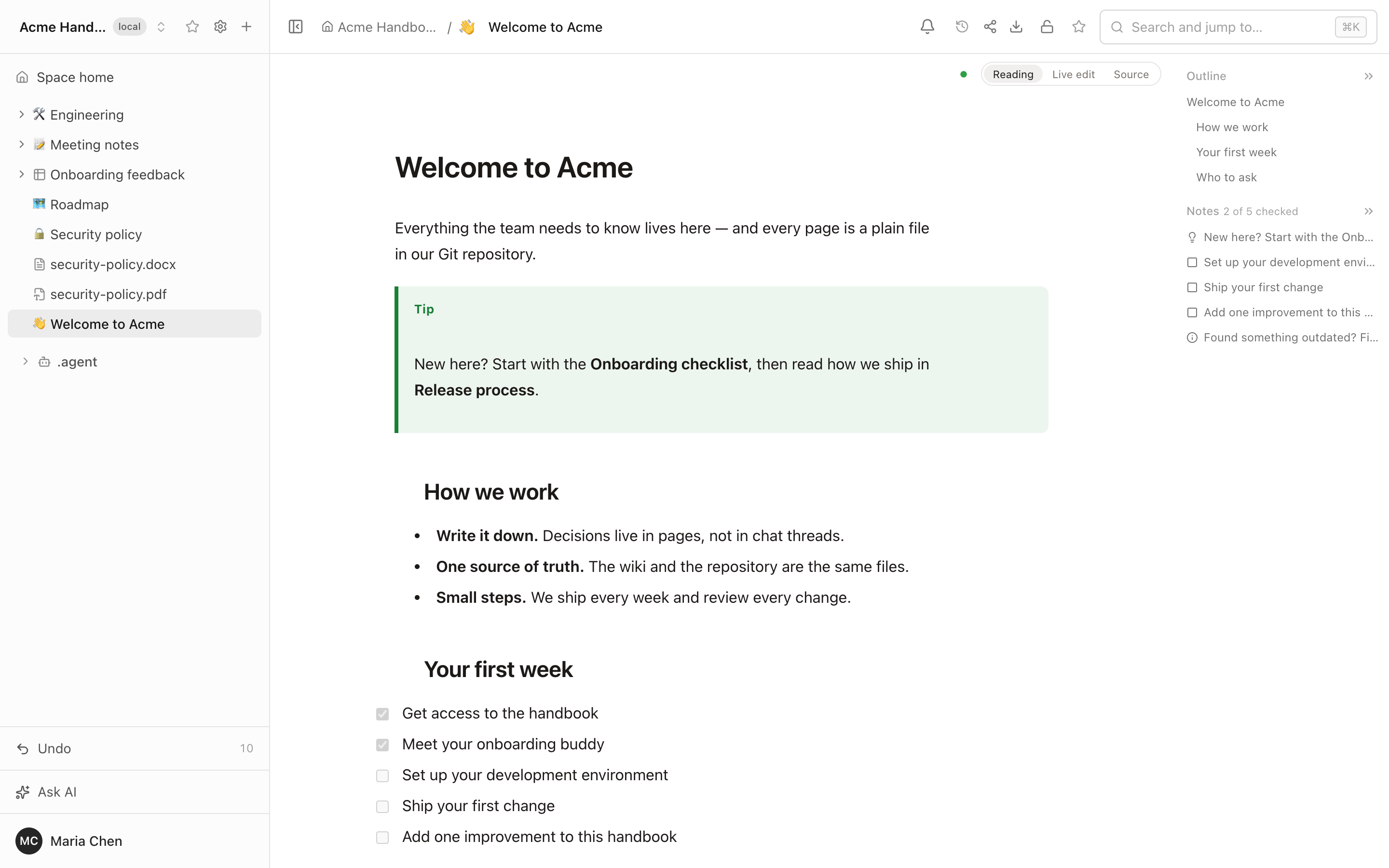
Folio was built to replace Confluence and Notion for a real team — and it was built by AI agents, in the open. The plans, specs and hand-off notes the agents work from are in this repository, next to the code they wrote. More on that below.
Open http://localhost:4870, create the first account, start writing.
Not ready to install? Try the live demo first.
Why Folio
- You own the content. Every page is a plain file in a Git repository you control. No export step, no lock-in: stop using Folio tomorrow and the files are still there, readable in any editor.
- It works the way a wiki should. Real-time editing, a page tree, search, access rights, history, sharing — and it keeps working offline.
- Agents are first-class users. Not a chatbot bolted on the side: a built-in assistant, your own agent in every space, a full MCP server, and Markdown links made for agents.
- Documents, tables, whiteboards, diagrams and files in one tree. A roadmap table next to the spec, next to the architecture board, next to the signed PDF.
- Publish what should be public. Turn a space into a read-only website, with search and an optional "Ask AI", on your own domain.
- One command to run. Docker, and nothing to configure for a first start.
See it in action
Short walkthroughs, no slides. The voice in the videos is synthetic.
- A team wiki that lives in Git — edit a page in the browser, press Sync, and it is a real Git commit; a teammate edits from the terminal and the change shows up on the page (0:37)
- An AI agent updates your wiki over MCP — one request: the agent reads the release process, writes release notes and adds a roadmap row (0:53)
- Onboarding a sales rep with Folio AI — answers from the team's own pages with sources, a weekly check as a form, and the results in a table (1:22)
- Whiteboards that live in Git — draw together, embed the board in a document, and keep every version in history (0:51)
- The editor and Mermaid diagrams — live Markdown, a source view of the same page, and diagrams you edit visually or as code (1:04)
- Is your wiki's AI assistant helping? Folio AI analytics — instance admins see rated conversations and unanswered questions, add the missing page, and the same question gets an answer with its source (1:21)
Git-first, all the way down
Most wikis keep your content in a database and offer Git as an export. Folio does the opposite: the Git repository is the wiki. The database holds the index, access rights and the state of live editing — never the only copy of your words.
This is what a space looks like on disk:
And this is its history — ordinary commits, with the people who made the changes as authors:
What that gives you:
- Edit anywhere. Change a page in the browser or in your IDE and push — both land in the same history. Links between pages are ordinary relative Markdown links, not a private dialect.
- Bring your own repository. Start with an empty space, clone an existing repository, or connect one later. Several spaces can share one repository, each in its own folder — so documentation can live right next to the code.
- Review like code. Merge requests, blame, diff and revert work on your wiki because it is a repository.
- Docs-as-code friendly. Front matter written by Docusaurus, MkDocs, Hugo or
Jekyll is kept byte for byte; a space bound to a folder such as
docs/writes no ids into your files; images can be stored in the repository next to the page and linked by a relative path, so GitHub shows them; and moving a page rewrites the links that point to it and the ones inside it, in one commit. - Nothing is lost quietly. Sync state is always visible — clean, ahead, behind, conflict — and conflicts are listed for the whole space. "Take the version from Git" resets a space to the remote branch and saves what was there into a backup branch first.
- Readable formats. A whiteboard is an SVG that opens in any browser and still carries the editable scene. A data table is one Markdown file — the column types and saved views in the front matter, the rows as a table you can read:
Write together
Documents, data tables and whiteboards are edited by several people at once. You see who is on the page and where their cursor is; changes appear as they are typed. When the page goes quiet, Folio commits — with the person who edited as the author.
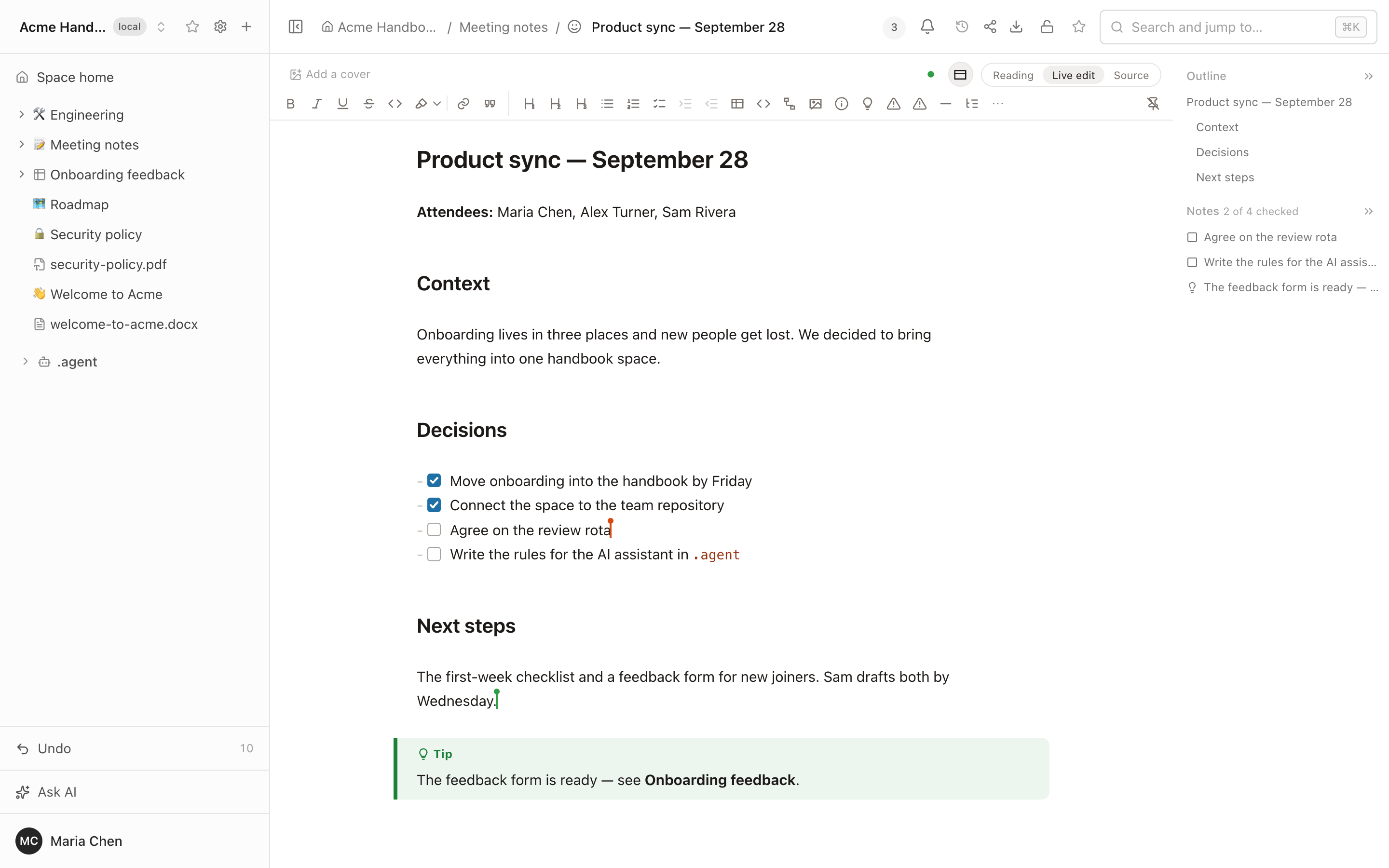
What you type is not lost between Live edit and Reading: the browser keeps a local copy until the server confirms it has your edits. If it cannot confirm them, the header says Not saved and closing the tab asks first.
Works offline
On a train, on a plane, on bad hotel Wi-Fi — keep writing.
- Pages and whiteboards you have opened stay editable without a connection.
- New pages and whiteboards can be created offline and appear in the tree straight away.
- Everything is kept on the device and reaches the server by itself when the connection returns — at the same address, with no duplicates.
- Nothing is lost if you switch pages or close the tab.
- An indicator in the header shows what is waiting to be sent.
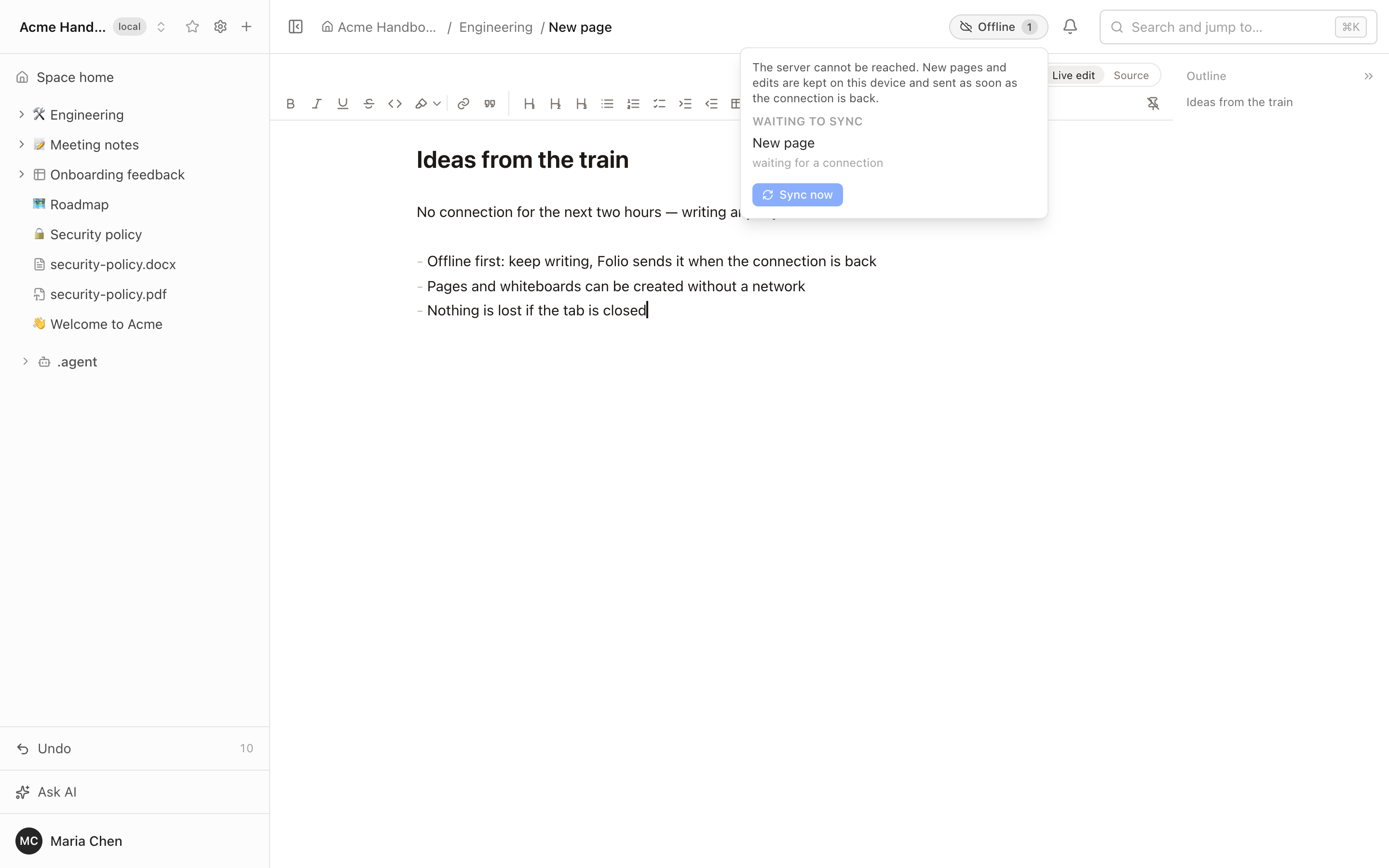
Data tables, forms and file uploads need a connection.
Documents
A Markdown editor that does not make you think about Markdown. Three modes — Reading, Live edit and Source — so that writers and engineers are both at home.
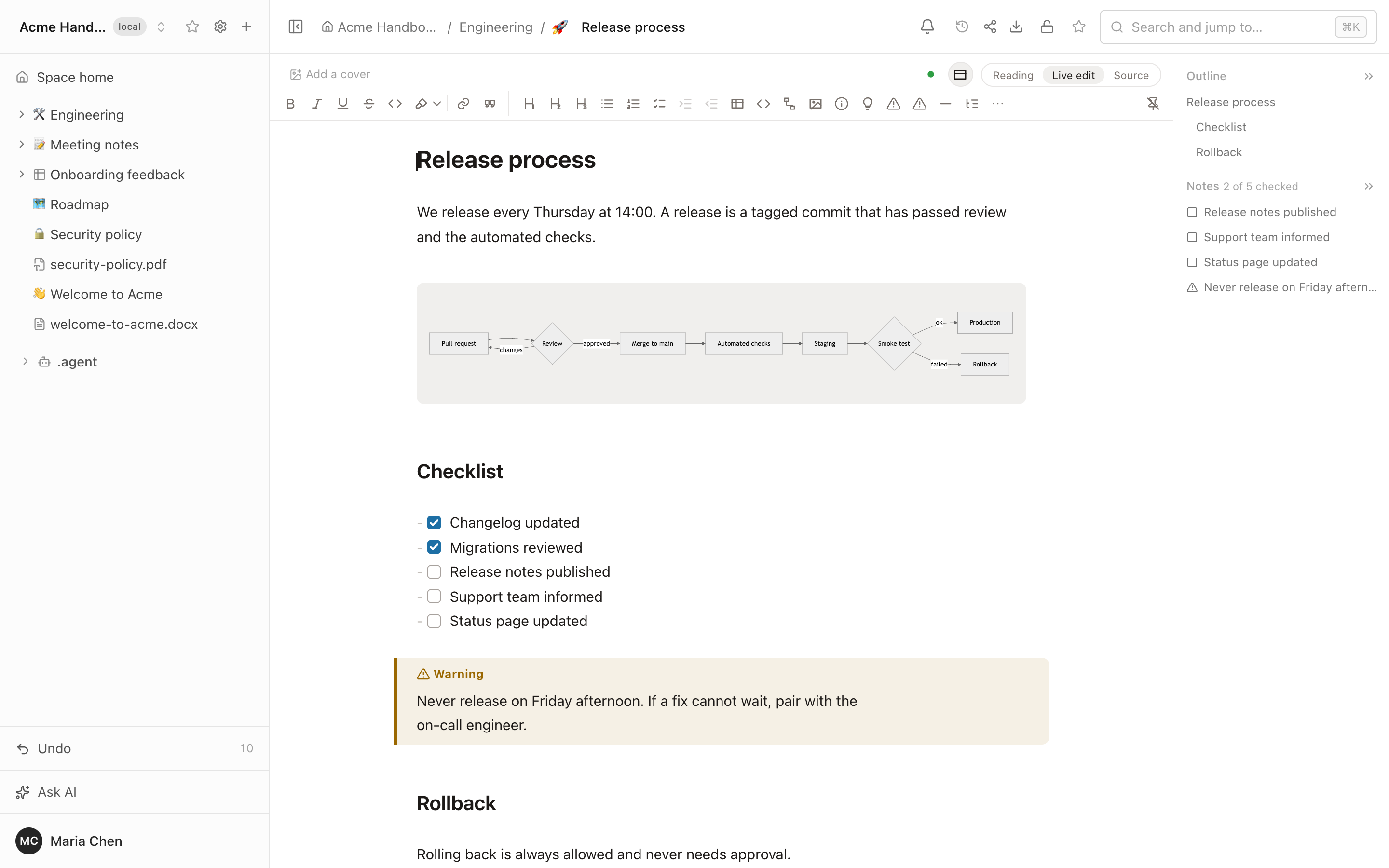
- Callouts, checklists, tables with merged cells and colors, code blocks,
collapsible sections, highlights,
++underline++, and coloured status tags like:status[Done]{color=green}. - Paste from Excel and Google Docs keeps tables and formatting; copying out of Live edit keeps it too.
[[links a page,@mentions a person,/inserts anything.::pagetreeputs a live tree of child pages right into the text.- Outline and notes panel, backlinks, page icons and covers, templates, glossary terms with hover cards.
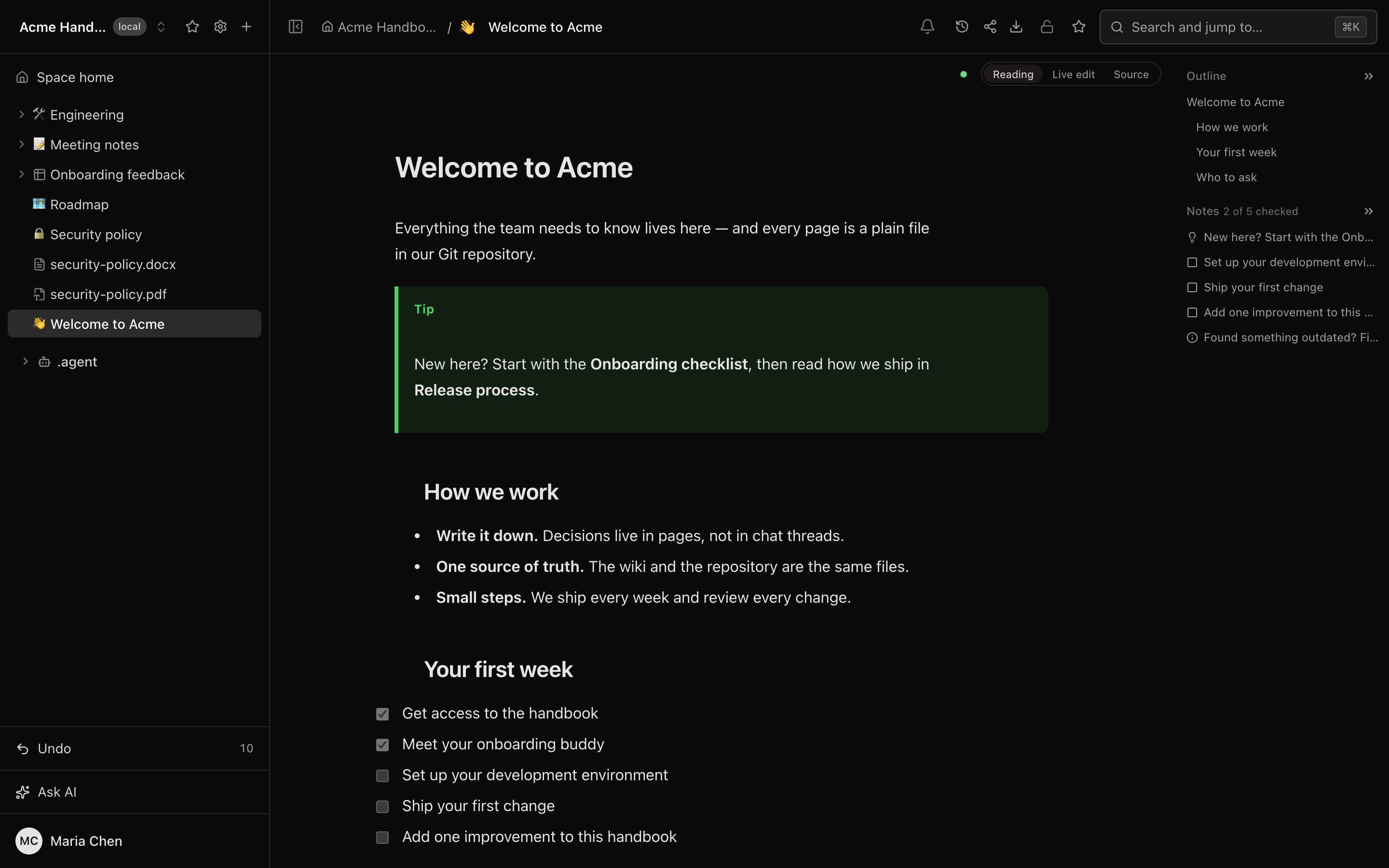
- Light and dark themes, following the system or chosen by hand.
Diagrams you draw, not type
Mermaid diagrams come with a visual editor. You build the diagram on a canvas, and Folio writes the Mermaid code for you — or you type the code and watch the canvas follow. Both sides stay in sync.
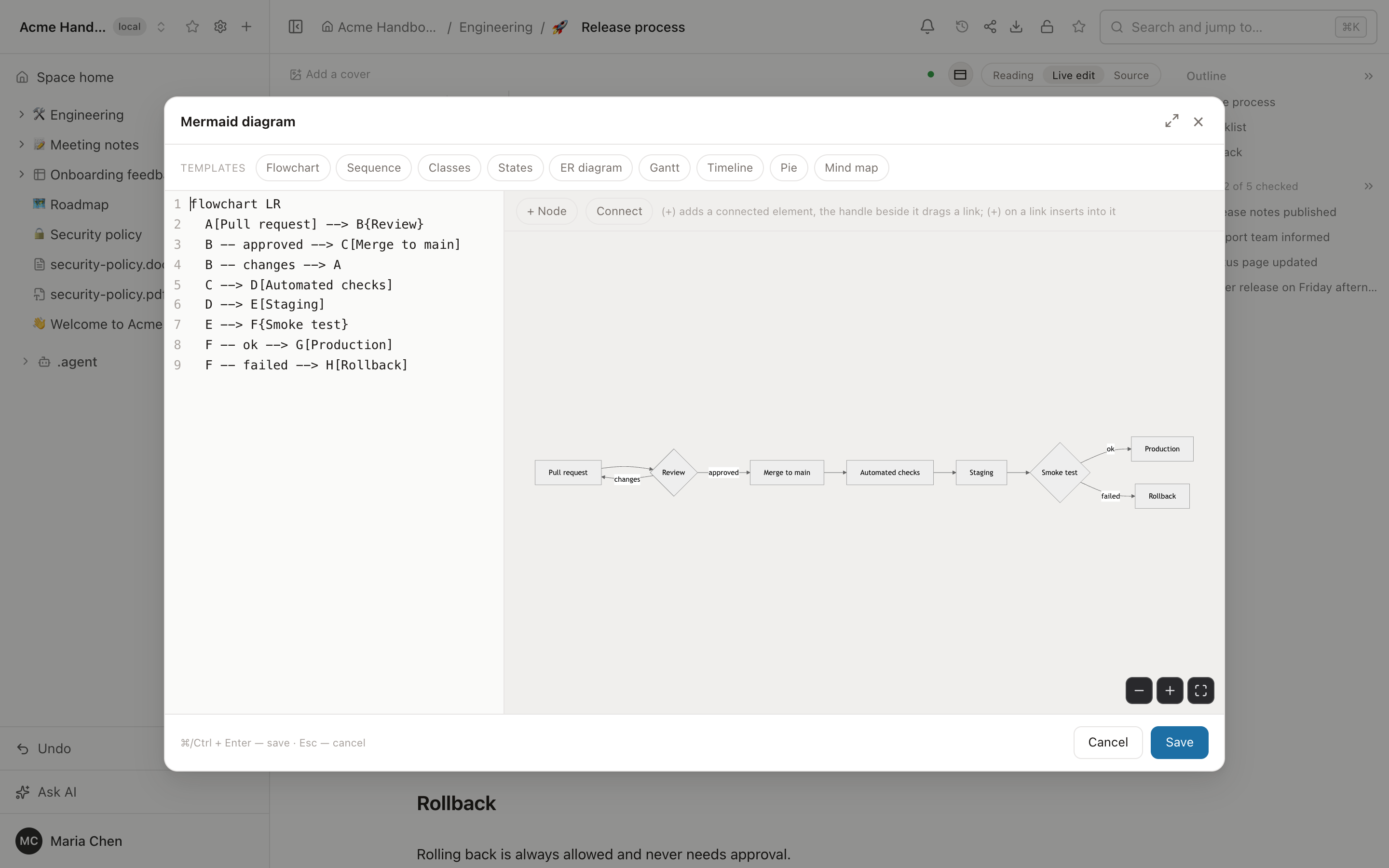
- Click to build. A plus on a node adds a connected one, a plus on a link inserts a node into it, a handle drags a new link from node to node.
- Nine diagram types from templates: flowchart, sequence, classes, states, ER, Gantt, timeline, pie, mind map.
- Code and canvas side by side, full screen when you need room, and a readable message instead of a broken picture when the syntax is wrong.
- Still plain Markdown. The diagram is stored as an ordinary
mermaidcode block, so GitHub and GitLab render it too.
Data tables
Spreadsheets that belong to the wiki: typed columns, saved views, filters and sorting — a small database you can link from any page and query from any agent.
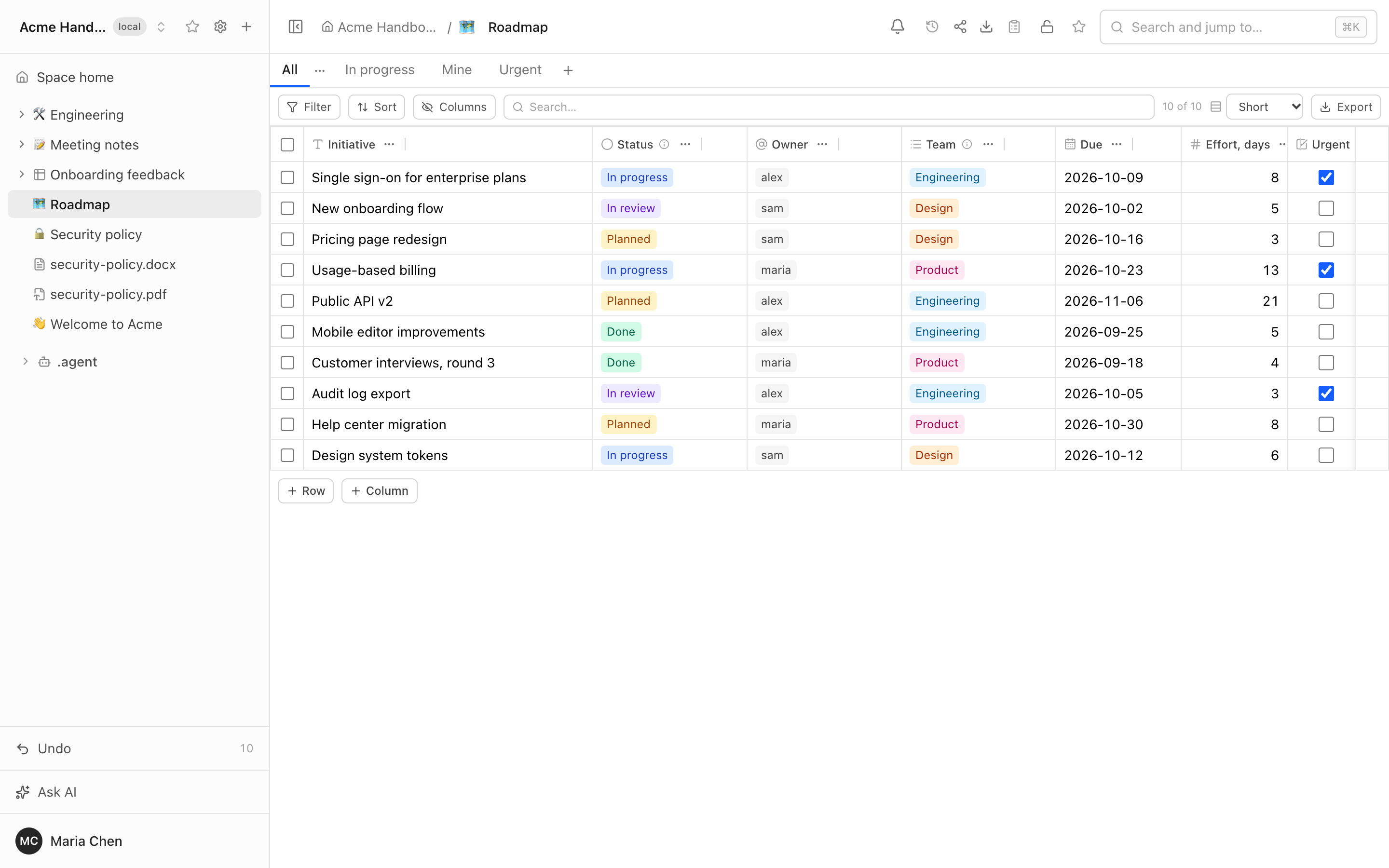
- Column types: text, long text, number, date, checkbox, select, status, user, link.
- Views as tabs, each with its own columns, order, widths, multi-column sort
and
and/orfilters — including "me", "today", "this week". - Edited together in real time, stored as one readable file in Git.
- Import and export; up to 20,000 rows per table.
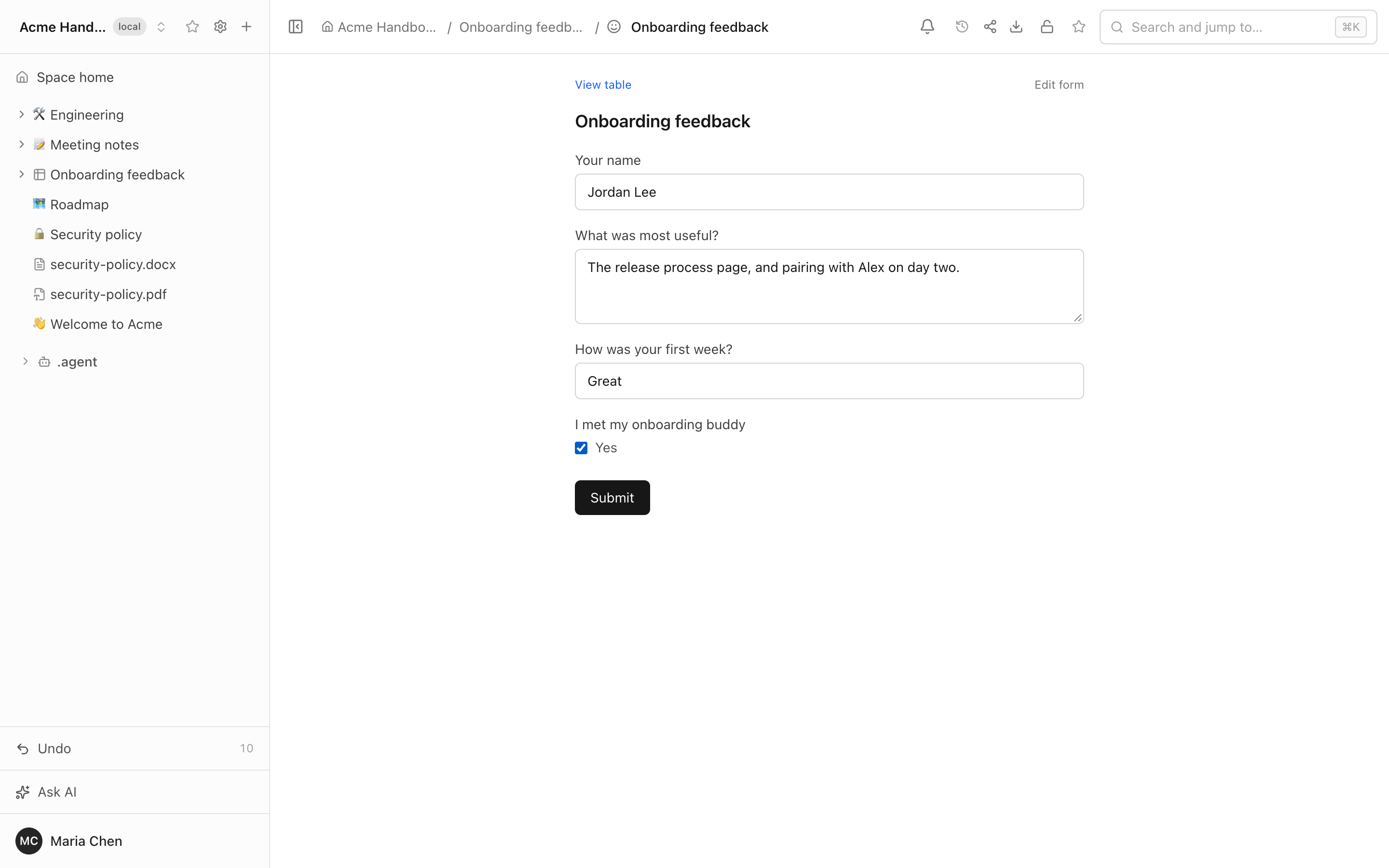
Forms turn a table into a questionnaire: every answer becomes a row. A form can be public, so people answer without an account.
Whiteboards
Excalidraw boards inside the wiki — architecture, flows, workshops. Drawn together in real time and saved as SVG files that render anywhere.
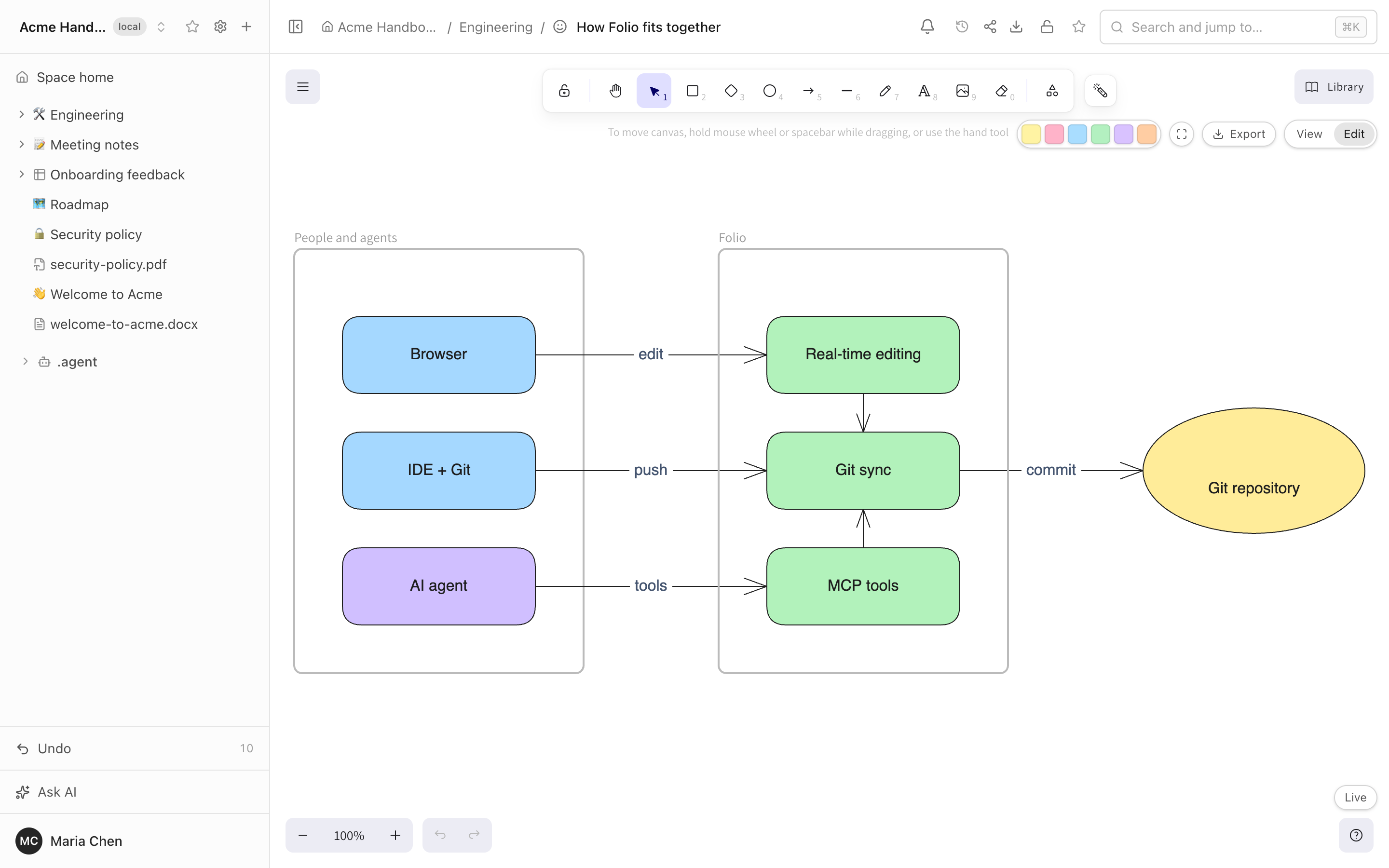
The board above was not drawn by hand. An agent created it through MCP from a short description of boxes and arrows; people then keep editing it like any other board.
Reactions. Select a shape in Edit mode and a small button appears at the corner of its selection frame: pick an emoji (✅ ❌ 🔧 for yes, no and in progress, or 👍 ❤️ 😂 🎉 🤔 👀 🔥 👏) and a counter chip shows under the shape. Click a chip to add or remove your own; point at it to see who reacted. Reactions are live for everyone on the board, and people who can only view it (or are in View mode) see them too but cannot click them. They are kept with the board's live state, not in its SVG file.
Document preview
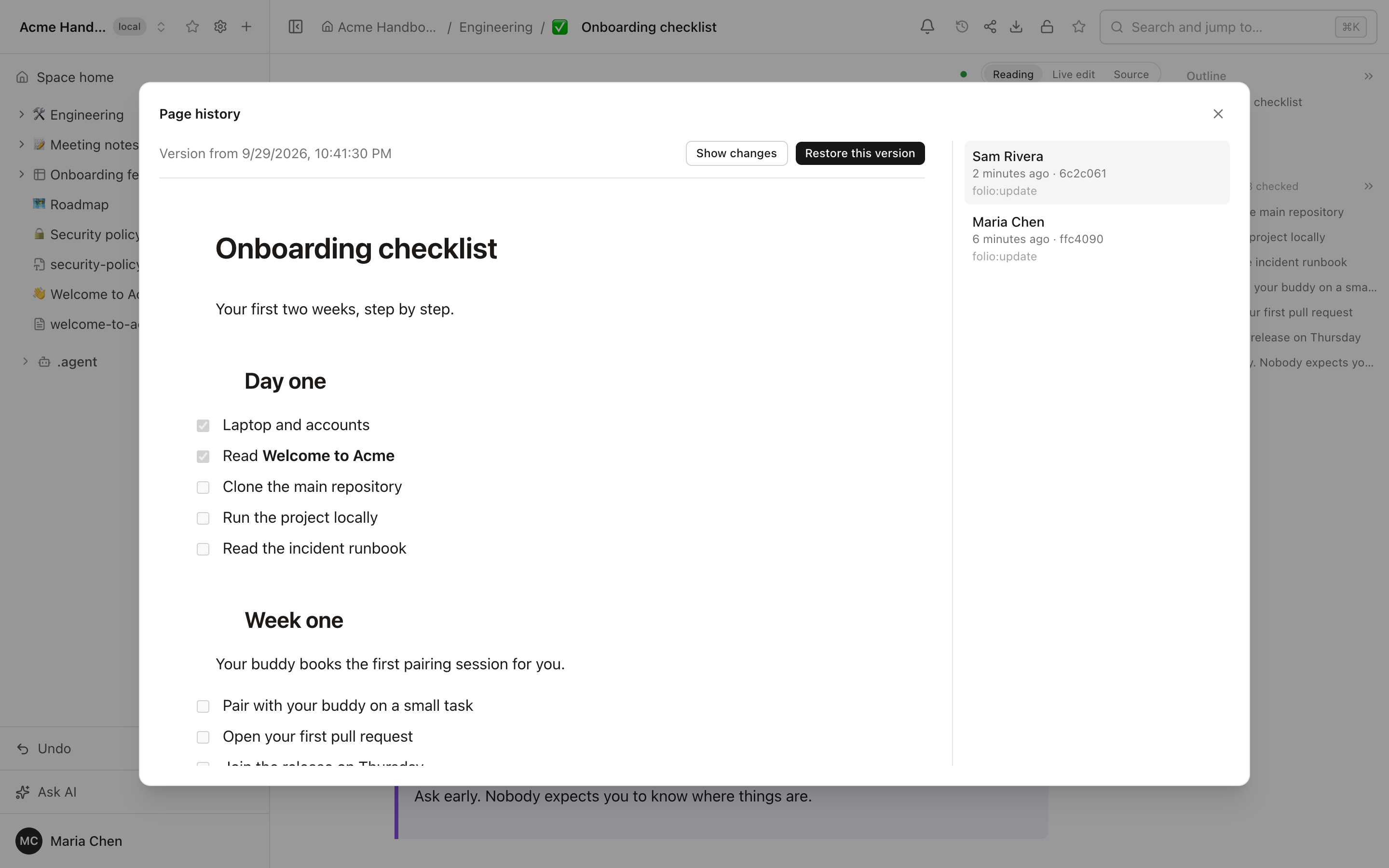
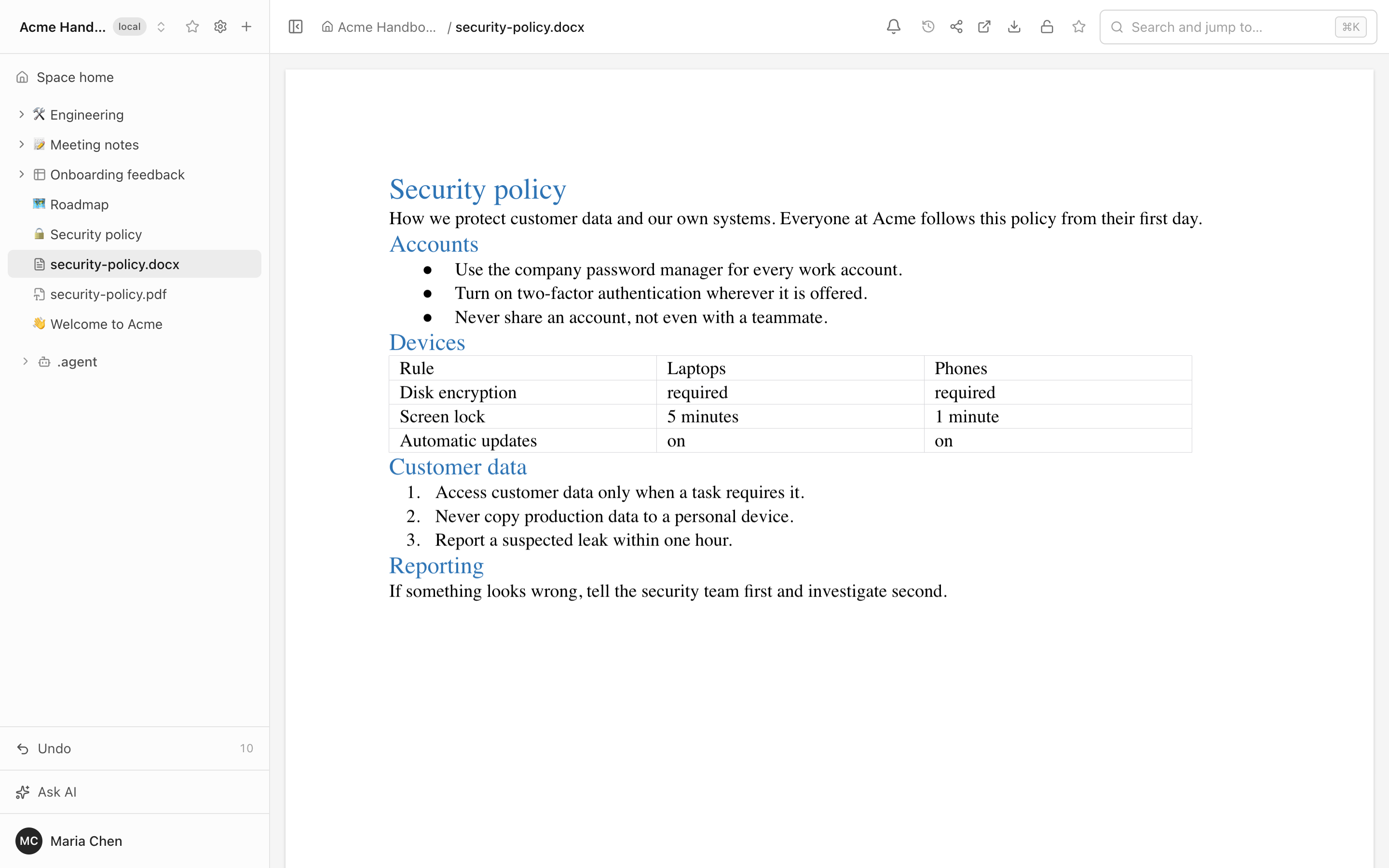
PDF, Word, Excel and PowerPoint files are pages too. Drop one into the tree and it opens right inside Folio — no download, no other application, no conversion on the server.
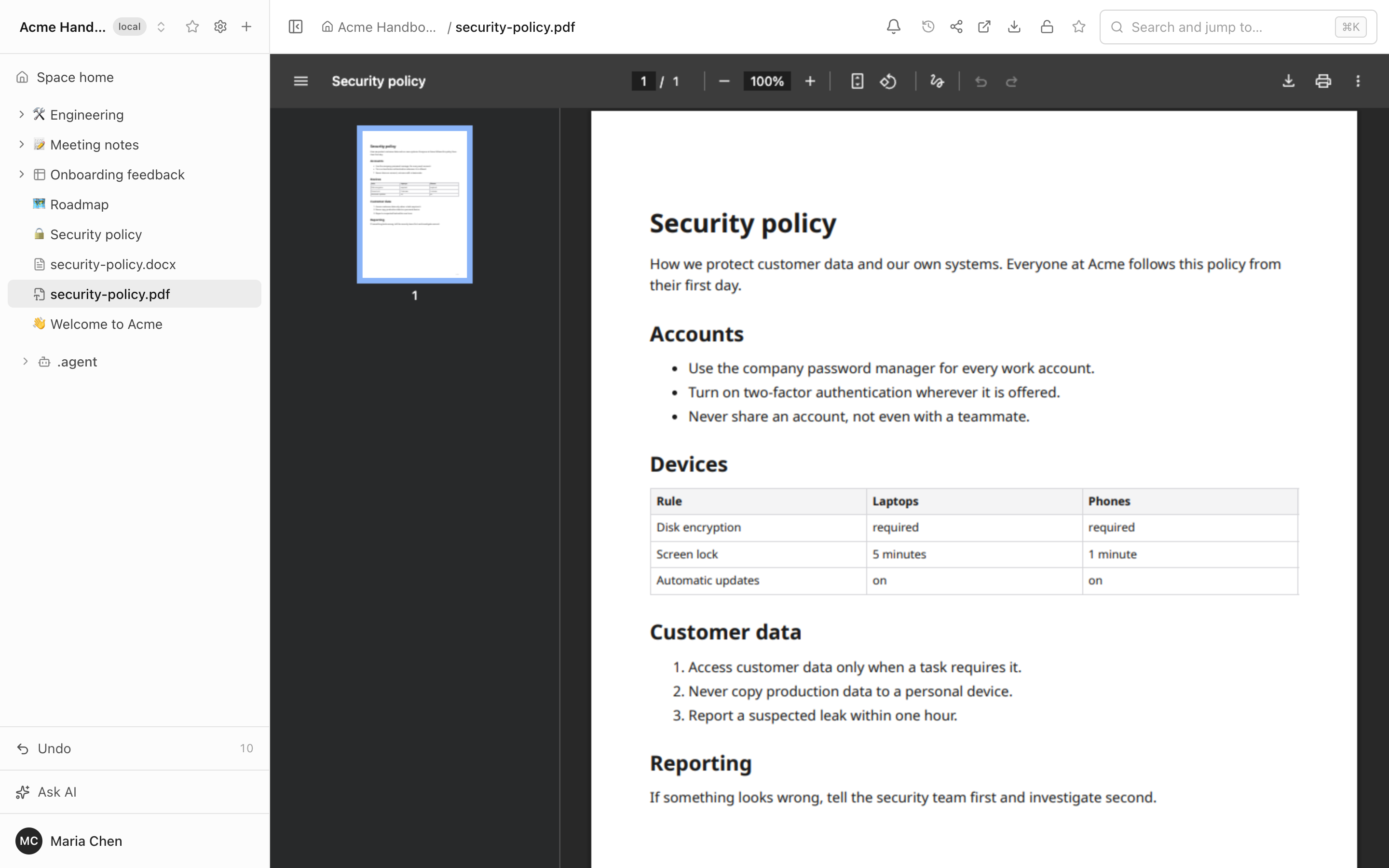
- PDF in the browser's own viewer: thumbnails, zoom, search, print.
- Word, Excel and PowerPoint rendered in the browser.
- The file sits in the space's Git repository next to the pages about it, in the same tree, under the same access rights.
- Open in a new tab or download with one click.
- Folio never rewrites your file: what you uploaded is byte for byte what is stored.
- A new version of the file, same page. "Replace with new version…" in the tree menu, the button in the page header, or drag a file onto the open page. The page keeps its link, place in the tree and access; the new file may even be another type (a deck that became a PDF), and links to it from other pages are rewritten. A toast offers Undo.
- Every version stays. Each replace is its own commit. The page history lists the versions with their file name and size, lets you download any of them (or preview a PDF) and restore one, which adds one more commit rather than rewriting anything.
These files are for viewing: they are not edited in Folio, and search finds them by title.
Folio AI
An assistant in the side panel that works with your wiki, not next to it.
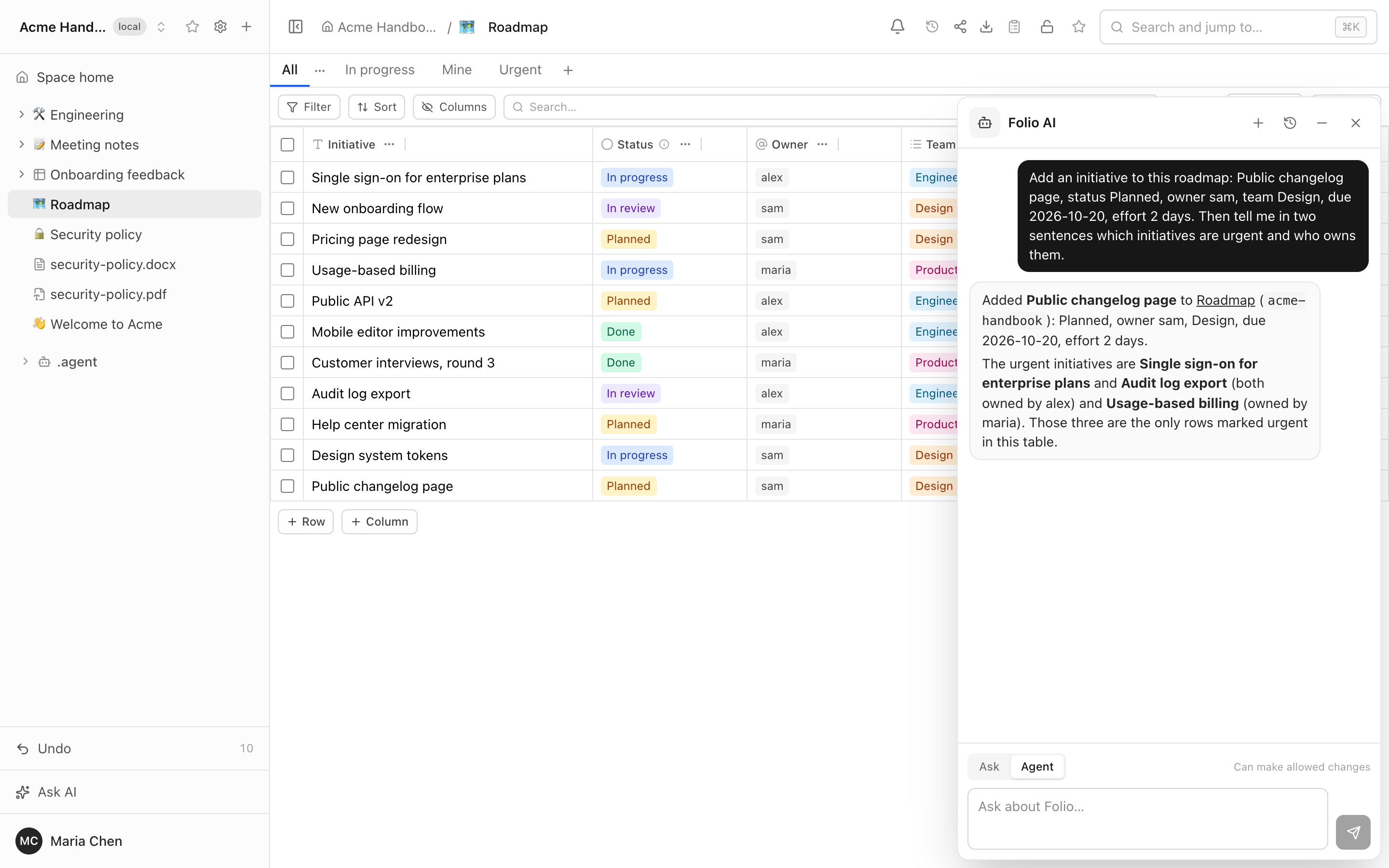
In the screenshot the assistant was asked to add an initiative to the roadmap and say which ones are urgent. It read the table's schema, inserted the row — it appears in the table on the left — and answered from the data.
- Ask — read-only. Find, summarize, compare, explain across the pages you have access to.
- Agent — reads and writes. Drafts a page, updates a table, draws a board, restructures a section — inside your rights, never beyond them.
- Runs live on the server. Close the browser and the work continues; come back and pick up where it was.
- The same tools as everyone else. The assistant works through the very tools an outside agent gets over MCP — there is no second, weaker implementation, and in Ask mode the write tools are switched off on the server, not just hidden.
Is the assistant actually helping?
Folio collects three signals about answer quality, without asking anyone to fill in a form:
- 👍 / 👎 on an answer. Every saved assistant answer can be rated "Helpful answer" or "Not helpful". One rating per answer, and you can change or remove it.
- A short survey. After every third answer in a conversation the panel asks "Did the assistant solve your question?" — Yes, Partly, No or Not now — with an optional comment.
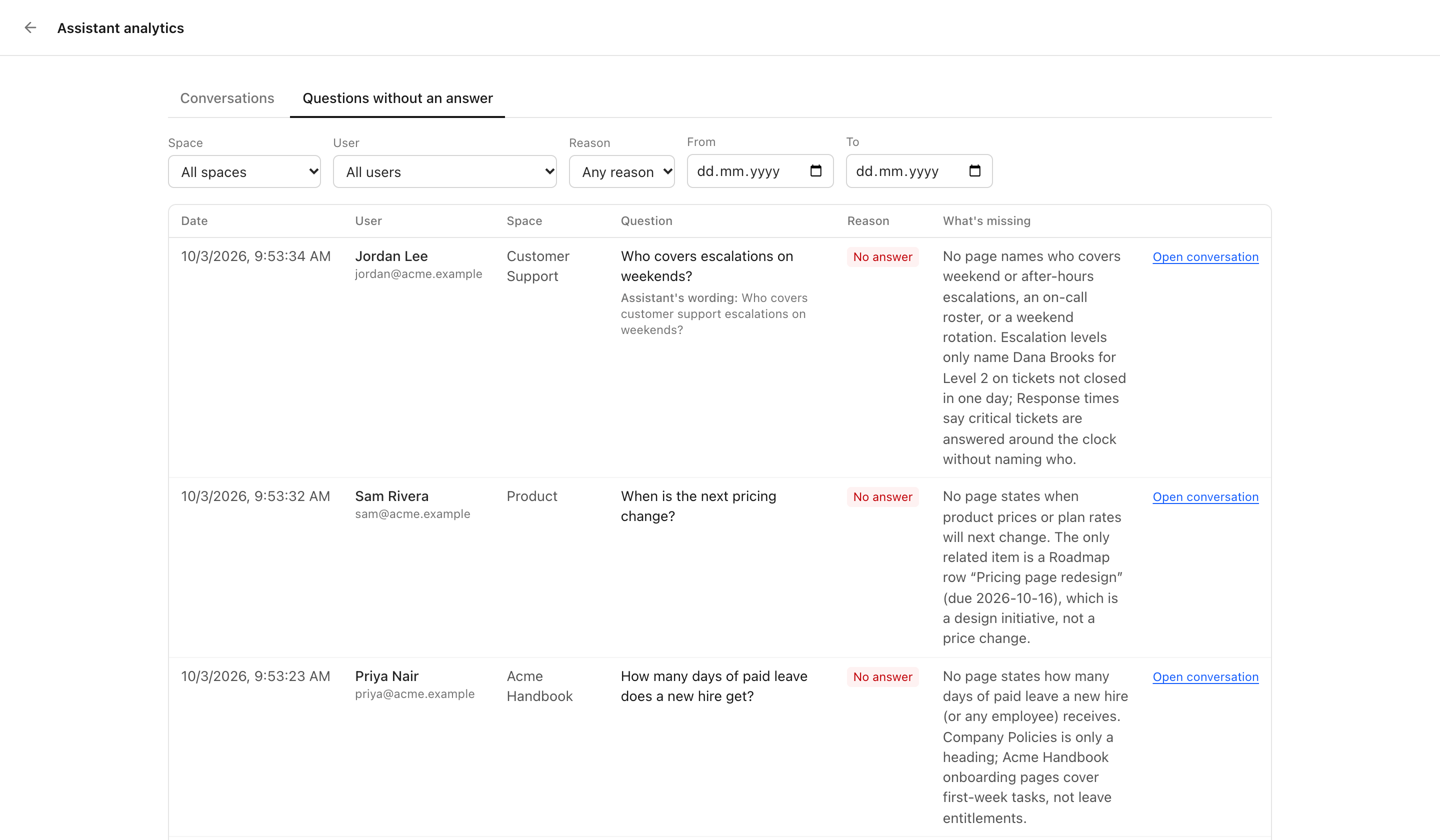
- Questions without an answer. When the pages do not contain the answer, or the assistant is not sure of it, it records the question and what was missing — briefly, with links to the pages it did read — then still answers the person plainly.
Instance administrators see all of it on one page, Assistant analytics
(/admin/assistant, from the account menu): the conversations with their
ratings and survey results, and a second tab, "Questions without an answer",
which is a ready list of what your documentation is missing — the person's own
words first, the assistant's restatement below, and links to the pages
the assistant read. Both tabs filter by space,
user and date. A space administrator sees the same page limited to the spaces
they administer: only conversations that ran there, and only the messages of
those runs. An administrator can open a conversation to read it; the
conversation page lists who opened it and when, and every opening is written
to the audit log. Other people do not see this page.
Your own agent in every space: .agent
Every space has a .agent folder. Whatever you put there becomes the
assistant's instructions for that space — and it is written as ordinary
Folio pages, not as configuration.
- Build an agent by writing pages. Its role, its tone, the glossary, the rules it must follow, the templates it should use, the process it should walk people through.
- A different agent for every team. The support space gets an agent that answers like support. The engineering space gets one that knows the release process. Legal gets one that never improvises. Same Folio, different agents.
- Versioned like everything else. The instructions live in Git: you can see who changed the agent's behavior, review the change, and roll it back.
- Owned by administrators. Only space administrators see and edit
.agent; everyone else just gets a better assistant.
The instructions apply to every run in the space, in Ask and Agent modes alike.
Bring your own subscription
Folio does not resell AI and does not mark it up. You connect the subscription you already pay for, and the assistant runs on it.
| Provider | Status |
|---|---|
| Cursor | available — each person connects their own key, or an administrator provides one for a space or for the whole instance |
| Others | coming soon |
Who pays. A run uses the first key that exists: the person's own key, then
the key of the space, then the key of the instance, then CURSOR_API_KEY from
the server environment. A space administrator sets a space's key (space menu,
"Folio AI key"); an instance administrator sets the instance key and can turn
personal keys off, so everyone uses the shared one. Shared keys are stored
encrypted and are never shown again after saving; every change is in the audit
log. Visitors of a public site have no key of
their own, so their questions run on the key of the space, of the instance or
of the server environment, in that order.
Without a subscription everything else in Folio works as usual.
Built for agents
MCP server. 23 tools over /mcp with personal access tokens: list and
search spaces, read and write pages, create and edit whiteboards, query and
update data tables, read history.
Ready-made setups. Files for Claude Code (a plugin and a skill), Cursor, VS Code, Codex, n8n (two importable workflows), Open WebUI, ChatGPT and Claude live in integrations/: configs with placeholders, rules for the agent and step-by-step instructions.
Markdown for an agent. Any page — with its child pages, if you want — is one link that returns clean Markdown. No scraping, no HTML, no login flow:
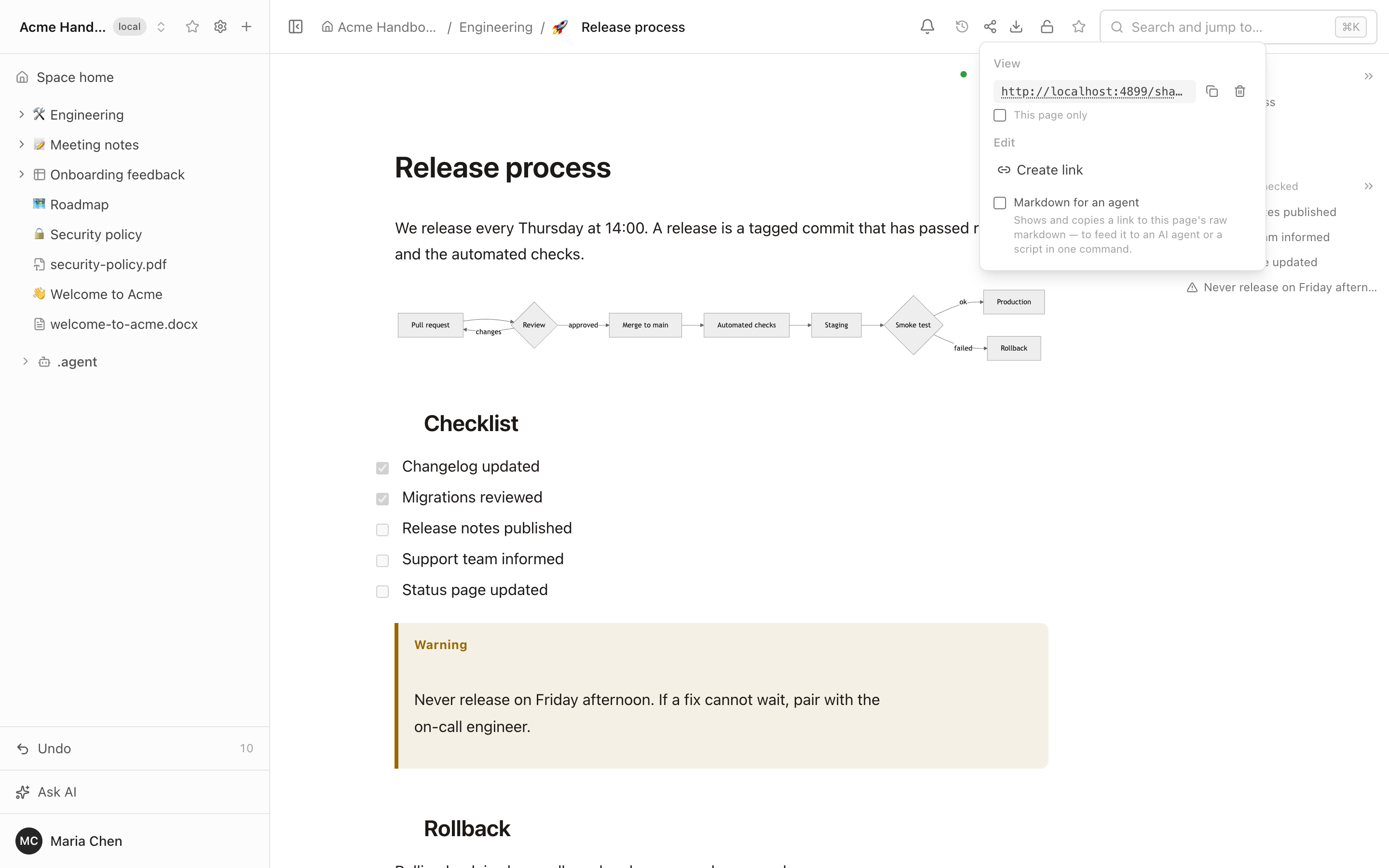
Export in the formats agents and people need: Markdown, YAML, PDF, DOCX, or a zip of a whole space.
Safe by design. A token never has more rights than its owner, a read
token cannot write, and administrative actions are not available to tokens at
all. Details: docs/MCP.md.
Moving from Confluence
Point Folio at a Confluence page or a whole tree and it brings the pages over as Markdown — with images, code, checklists, and panels converted into callouts. Pages come from Confluence Cloud and from on-premises installations; whiteboards from Confluence Cloud become Excalidraw boards.
Run a test import first: not every macro has an equivalent. What is not there yet is written down honestly.
Access management
Who sees what is decided in one place, and it is visible at a glance.
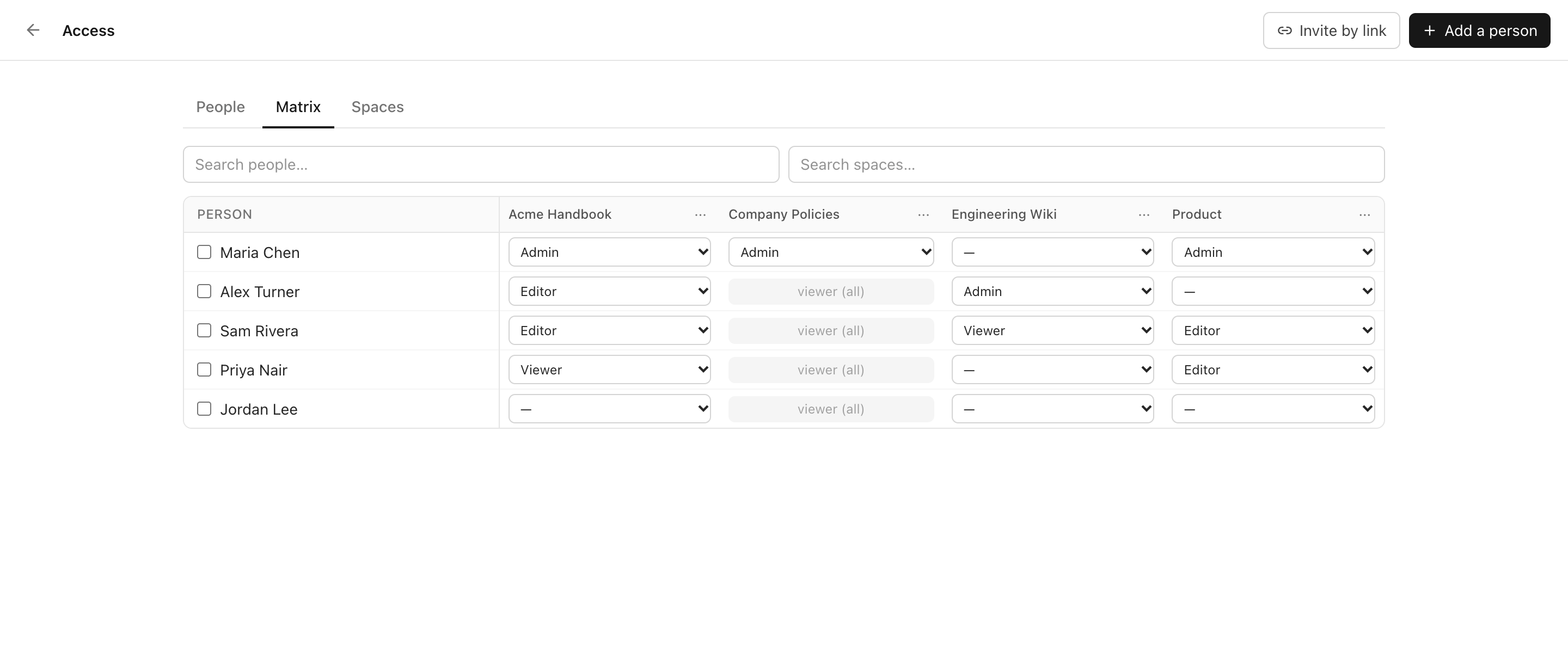
- Roles per space: administrator, editor, viewer.
- Private, open or public spaces. A private space is visible to its members only. A space open to the instance gives every signed-in person read access, and edit rights still have to be granted. A public space is also readable by anyone on the internet as a website, see Publish a space as a website.
- The access matrix. People down the side, spaces across the top, a role in every cell. Change one cell or many at once.
- An administrator is not a reader. The instance administrator manages people and access but does not see the content of a private space they are not a member of. They can grant access to themselves — and that is written to the audit log and marked for everyone to see.
- Audit log. Every grant, revoke and visibility change is recorded with who did it and when.
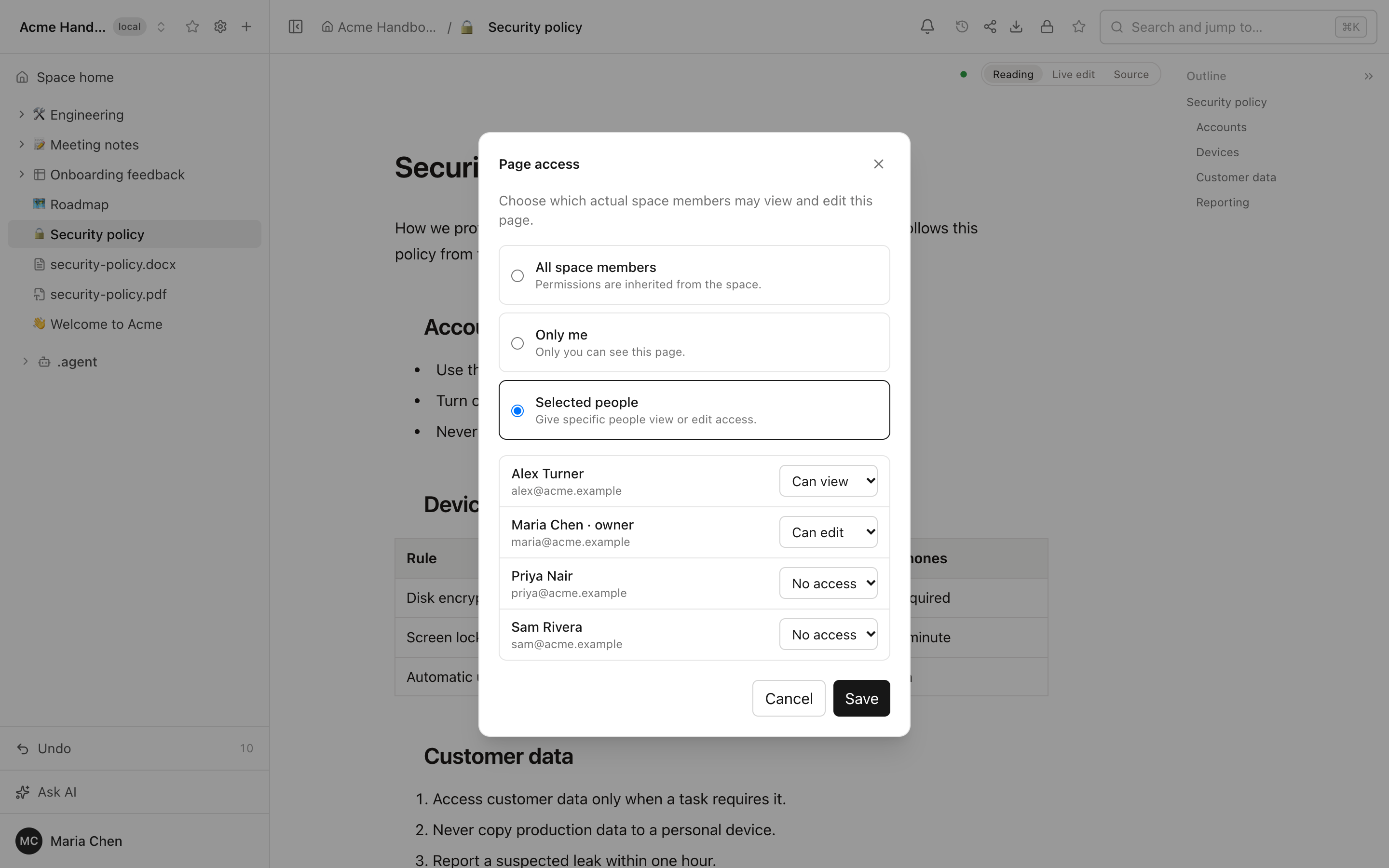
Page-level access. Any page can be narrower than its space: open to all members, to you only, or to selected people with view or edit rights.
Getting people in
- Invitations by link with preset spaces and roles, an expiry date and a usage limit.
- Access requests. Someone who opens a space they cannot see can ask for access; administrators are notified at once and choose the role.
- Sign in with Google, limited to the email domains you list. A new person gets an account and no access until someone grants it.
- Deactivate an account without deleting what the person wrote.
Sharing outside
- Share links for people without an account: view or edit, one page or a whole subtree (pages with their own access restrictions are left out), revocable at any time.
- Forms that accept answers without an account.
For agents and scripts
- Personal access tokens with
readorwritescope. A token never has more rights than its owner, and administrative actions are not available to tokens at all. - The
.agentfolder is visible to space administrators only.
Publish a space as a website
One setting turns a space into a read-only website for people without an account. Open the space menu, choose Publish as website and make the space public. It is the same space, not a copy: edit a page and the site shows the change. Signed-in people read a public space the way they read any space that is open to the instance.
| Address | When it works |
|---|---|
https://wiki.example.com/public/<space> | Always, as soon as the space is public. Nothing to set up. |
https://<label>.sites.example.com | When the operator sets PUBLIC_SITES_DOMAIN=sites.example.com and the space administrator picks a label. Needs wildcard DNS, a wildcard certificate and a reverse proxy that routes those hosts to Folio. |
https://docs.example.com | A custom domain for one space: a CNAME to the host of your Folio, and the reverse proxy routing that host to Folio, with a certificate for it. |
- What visitors get. The page tree, search inside the space, documents, data tables (live, read-only), whiteboards as pictures, forms (view only) and PDF and Office files, with breadcrumbs and a layout for phones.
- Downloads as Markdown, PDF or DOCX, switched on per space.
- Ask Folio AI, switched on per space: visitors ask questions and the assistant answers in Ask mode only, from the public pages of that one space, on the key of the space or the instance. It cannot change anything, and questions are rate limited per address and per site.
- What is never published. Pages with their own access restrictions, the
.agentfolder and templates. A restriction is not inherited by child pages, so check the tree before you publish and lock every page that must stay closed. - Who can publish. Space and instance administrators, from the browser; the settings live in the database, not in Git. The public demo cannot publish.
- Not yet. Folio does not generate
robots.txtor a sitemap for these sites, and the rate limits are counted per server process.
What the operator sets up for subdomains and custom domains: docs/INSTALL.md. Limits: docs/LIMITATIONS.md.
Run it
You need Docker and Git. Nothing else.
The first start builds the application and takes a few minutes. Then open http://localhost:4870 and create the first account — it becomes the administrator.
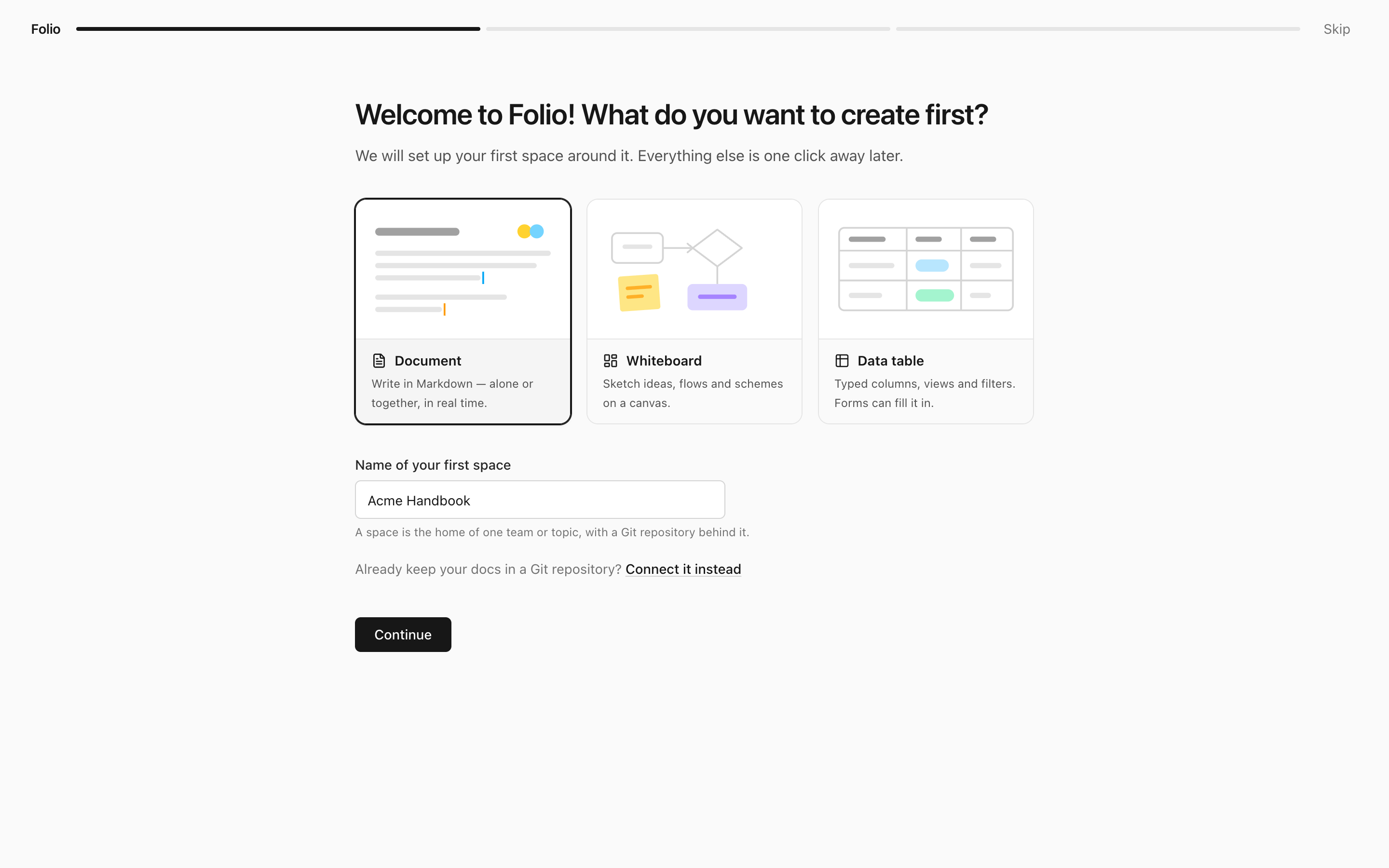
A short welcome takes it from there: pick what to create first — a document, a whiteboard or a data table — look through what Folio can do, and land in your first space with that page open. Connecting an existing Git repository is one link away on the same screen.
| Where | How |
|---|---|
| Your computer | docker compose up -d |
| A server or VPS | one command from the published image: deploy/vps, or the compose file above plus --profile https for automatic HTTPS |
| Coolify, Railway, Render, DigitalOcean, Dokploy, CapRover, Easypanel, Portainer, Fly.io | ready-made kits in deploy/, see One-click and PaaS |
| Any other container platform | from the Dockerfile, with PostgreSQL, Redis and a persistent volume — see requirements |
| Vercel, Netlify and other serverless hosting | not supported — Folio is a long-running server that keeps Git repositories on disk and holds live connections |
One click on Railway: 
Domains, HTTPS, updates and backups: docs/INSTALL.md.
No telemetry. A Folio you run sends nothing about its use to anyone: no
analytics library is loaded and no connection is opened to the Folio authors or
to a third party. There is one opt-in exception for people who run a public
demo: set FOLIO_POSTHOG_KEY to a PostHog project of your own and Folio sends
anonymous events (page kinds, space slugs, never content). Without that key
nothing happens. Details: docs/INSTALL.md.
Vibe-coded, and not hiding it
Folio is written by AI coding agents. A human product owner decides what to build, tries every change in the browser and decides what ships; agents plan the work, write the code and the tests, and document what they did.
From the first commit on August 21, 2026 to version 0.1.0 on September 29, 2026 took 39 days and more than 400 commits upstream. Version 0.2.0 followed on October 14, 2026, 54 days in. Today that is roughly 110,000 lines of TypeScript and another 70,000 lines of tests. It runs in production for a real team.
We publish how it is made, not only what was made:
| File | What it is |
|---|---|
| AGENTS.md | How the work is organized and the rules agents follow in this repository |
| docs/HANDOFF.md | The current state: how Folio is put together, what must never break, what is open, and the lessons that cost us something to learn |
| DEV-PLAN.md | What has been built, in the order it was built, and what comes next |
If you are building with agents yourself, this repository is a worked example of a non-trivial product made that way. If you only want a wiki, none of it gets in your way.
Documentation
- Website: foliowiki.online
- Public demo: demo.foliowiki.online — shared login, resets every 24 hours
- Free tools, no sign-up: Confluence to Markdown converter · Mermaid live editor
- Markdown templates: meeting notes, PRD, SOP, runbook, postmortem, onboarding checklist and more (CC0)
- Alternatives, compared honestly: Confluence · Notion · self-hosted wikis
- Installation, HTTPS, updates, backups
- Features
- What is not there yet
- MCP and REST for agents
- Changelog
Development
Node.js 22.12 or newer (22.13 or newer for the assistant). See CONTRIBUTING.md — and AGENTS.md if your contributor is an agent.
Help and security
Questions and bug reports: SUPPORT.md. Please report vulnerabilities privately, as described in SECURITY.md.