FlowSentry README
The full upstream README, mirrored here for reference. Install config, tool schemas, adoption signals, and an original overview live on the FlowSentry listing page.
FlowSentry



Security scanner for n8n workflows — 18 rules, zero dependencies, CI-ready.
FlowSentry parses your n8n workflow JSON exports and flags the failures we keep seeing in
the wild: unauthenticated webhooks, hardcoded secrets, SSRF to cloud metadata, shell
injection through Execute Command, eval-style code nodes, SQL built from user input,
over-scoped credentials and more. Output: terminal, JSON, SARIF 2.1.0 (GitHub Code
Scanning) and a self-contained HTML report.
- Zero runtime dependencies (pure Python stdlib, Python 3.9+)
- 18 rules mapped to the OWASP Agentic Top 10 (2026)
- SARIF output → upload straight to GitHub Code Scanning
- Exit code 1 on findings → drop it into CI as a quality gate
PyPI: https://pypi.org/project/flowsentry/ · or install straight from GitHub:
pip install git+https://github.com/vasilicasijarvis/flowsentry.git
No install at all:
Why
n8n webhooks are unauthenticated by default. Most self-hosted instances sit behind a
single reverse proxy, and one exported workflow is enough to leak a hardcoded API key or
an Execute Command node that interpolates request data straight into a shell.
We scanned 10 real, public n8n workflow files from GitHub with FlowSentry v0.1:
| File (source repo) | Critical | Medium | Notable finding |
|---|---|---|---|
AI_Bot.json (AnaamRasool/WhatsApp-Bot) | 1 | 4 | WhatsApp webhook with authentication: none, replies echo full node output |
00485-library-install.json (DragonJAR/n8n-workflows-esp) | 2 | 1 | Bash script interpolating {{$json.library}} into shell |
n8n/w1.json (Finfra/dockers) | 1 | 2 | Webhook authentication: 'none' |
workflows/103.json (n8n-io/test-workflows) | 4 | 2 | echo 'test' > /tmp/{{$node["Set"].json["filename"]}} |
subagente-citas.json (santifer/jacobo-workflows) | 1 | 9 | Public appointment-booking webhook, no auth |
nl2sql.json (Wilsonoonn/n8n_nl2sql) | 1 | 9 | Natural-language-to-SQL behind an unauthenticated webhook |
api-authentication.json (yorrickjansen/n8n-webhook-security) | 1 | 5 | Demo webhooks themselves accept unauthenticated requests |
AIDA Preisalarm, nl2sql helper, openwebui-pipe (3 more files) | 0 | 7 | code nodes, missing error handling, response modes |
Totals: 11 critical, 39 medium across 10 files. 100% of files had at least one finding.
These are public workflow exports shared by their authors for learning/demo purposes — nothing was exploited and no instance was accessed. FlowSentry is defensive tooling: it reads JSON files, it does not send requests.
Real findings, verbatim
1. Shell injection via Execute Command (n8n official test workflow):
2. Unauthenticated webhooks (5 of 10 files):
3. What the other rules catch (crafted example from the test suite):
Rules FS002–FS004, FS011–FS013 and FS015–FS018 (secrets, SSRF/IMDS, SQL injection,
plain http, community nodes, exfil sinks) did not fire on this particular sample but are
fully covered by the 40-test suite in tests/test_rules.py.
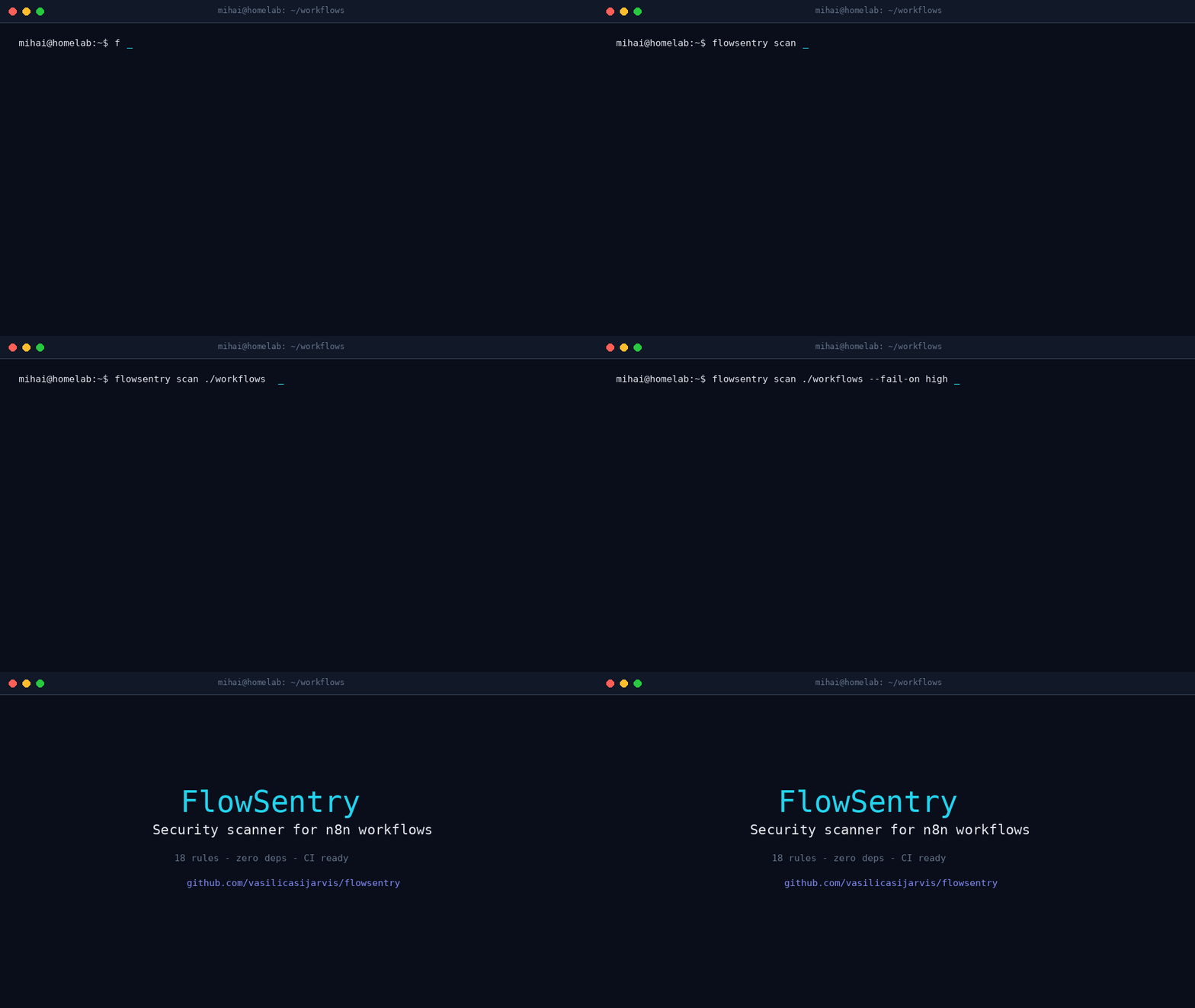
Real run, 2026-09-06 — flowsentry scan examples/real on the 10 public workflow
exports (exit code 1 as expected on critical findings):
Full machine-readable results: examples/scan_report.json,
examples/scan_report.sarif and
examples/scan_report.html.
Rules (v0.1)
| Rule | Severity | Detects |
|---|---|---|
| FS001 | critical | Webhook endpoint without authentication |
| FS002 | critical | Hardcoded secret in node parameters |
| FS003 | high | Hardcoded secret in HTTP header/query |
| FS004 | critical | SSRF / cloud metadata endpoint access (IMDS 169.254.169.254, GCP, Alibaba) |
| FS005 | critical | Execute Command node without guardrails |
| FS006 | medium | Code node without sandbox hardening (no task runners) |
| FS007 | critical | Dynamic code construction (eval, new Function, child_process, os, subprocess, dynamic $()) |
| FS008 | medium | Credential over-scoping (admin/root/owner names, unusual types) |
| FS009 | critical | Expression-based command injection ({{$json...}} into shell) |
| FS010 | medium | Missing error handling (no errorWorkflow, no Error Trigger) |
| FS011 | high | Raw SQL built from expressions |
| FS012 | high | HTTP node over plain http:// |
| FS013 | medium | Exposed trigger (Form/Telegram/IMAP accepting unauthenticated input) |
| FS014 | medium | Credential reuse across 5+ nodes |
| FS015 | medium | Community/unknown node packages |
| FS016 | medium | Data sent to exfil-style sinks (webhook.site, pastebin, ngrok…) |
| FS017 | medium | Webhook response mode echoing internal data |
| FS018 | medium | Set node storing secrets in plaintext |
Usage
GitHub Actions
Scan an n8n export bundle
Demo
Development
Re-fetch the public example workflows used in the README scan:
Roadmap
- v0.2 — live scanning via the n8n REST API, drift detection (workflow changed since last scan)
- v1.0 — FlowSentry Cloud: continuous monitoring, alerting, multi-instance dashboard
- v1.5 — MCP server config auditing (tool poisoning, auth gaps, unpinned versions)
- v2.0 — compliance evidence packs (OWASP Agentic Top 10, EU AI Act, SOC 2)
The hosted, continuous version is in the works — join the early list: flowsentry.vercel.app
License
Apache-2.0. Scan your own workflows or exports you have permission to analyze.