Figma MCP Go
Figma MCP server with full read/write access via plugin — no API token, no rate limits. 73 tools.
Install Figma MCP Go
Pick your client, then add it in one click or paste the config.
~/Library/Application Support/Claude/claude_desktop_config.json{
"mcpServers": {
"figma-mcp-go": {
"command": "npx",
"args": [
"-y",
"@tunglt1810/figma-mcp-go@latest"
]
}
}
}
Settings → Developer → Edit Config, merge this into mcpServers, then fully quit and reopen Claude Desktop.
Automated check passed— started and listed 60 tools correctly (6d ago).
Overview
Tools60
What Figma MCP Go lets your agent do. Expand a tool for its parameters.
Security & health
What it can reach and how reliably it runs — from our own checks, not the maintainer’s claims.
Recent health check succeeded.
What it can do
From the 60 tools this server returned when we ran it; 60 declare their own safety hints.
Observed 2026-10-17 in an isolated sandbox. A description of reach, not a security audit.
Supply-chain signal
No high-severity advisories surfaced by our automated scan.
Scanned 6d ago via OSV.dev · @tunglt1810/figma-mcp-go@latest (npm)
Adoption & maintenance
Factual signals from GitHub, npm, and our automated checks — not a rating.
From the project README
figma-mcp-go
Figma MCP — Local Plugin Integration 


Open-source Figma MCP server with full read and write access through a Figma plugin. Turn text into designs and designs into code. Works with Claude, Cursor, GitHub Copilot, and any MCP client.
Highlights
- Runs locally through the Figma Plugin API. No REST API token needed.
- Reads and edits the open Figma file live — 60 tools.
- Covers styles, variables, components, prototypes, text, and multi-step batches with undo.
- Built-in prompts such as
read_design_strategyanddesign_strategy. - Lean on tokens: short tool descriptions, capped node trees, and images returned as images.
Styles, Variables, Components, Prototypes, and Content
https://github.com/user-attachments/assets/eae41471-fc72-4574-8261-4f42c38b8c99
Text to Design, Design to Code
https://github.com/user-attachments/assets/17bda971-0e83-4f18-8758-8ac2b8dcba62
Why this exists
Most Figma MCP servers use the cloud Figma REST API. AI tools make hundreds of quick calls per session, and every cloud round trip adds delay.
This server talks to a Figma plugin on your own machine instead. You get fast, live read and write access to the open file, with no API token.
Setup
Install with npx or bunx. No build step. Watch the setup video or follow the steps below.
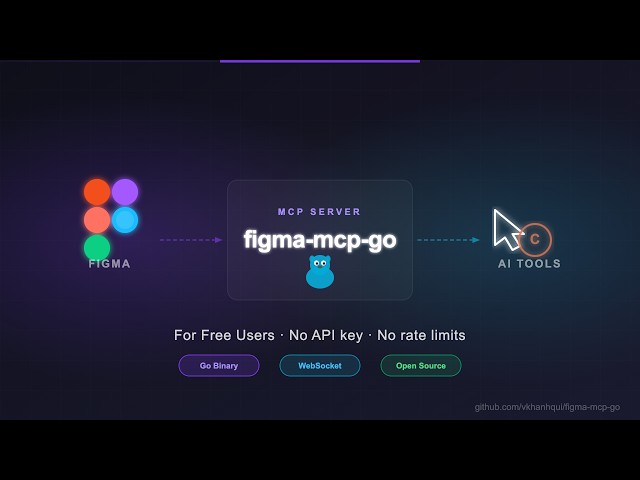
1. Add the server to your AI tool
Claude Code CLI
# via npx
claude mcp add -s project figma-mcp-go -- npx -y @tunglt1810/figma-mcp-go@latest

# or via bunx
claude mcp add -s project figma-mcp-go -- bunx @tunglt1810/figma-mcp-go@latest
Codex CLI
# via npx
codex mcp add figma-mcp-go -- npx -y @tunglt1810/figma-mcp-go@latest

# or via bunx
codex mcp add figma-mcp-go -- bunx @tunglt1810/figma-mcp-go@latest
.mcp.json (Claude and other MCP-compatible tools)
{
  "mcpServers": {
    "figma-mcp-go": {
      "command": "npx",
      "args": ["-y", "@tunglt1810/figma-mcp-go"]
    }
  }
}
.vscode/mcp.json (Cursor / VS Code / GitHub Copilot)
{
  "servers": {
    "figma-mcp-go": {
      "type": "stdio",
      "command": "npx",
      "args": [
        "-y",
        "@tunglt1810/figma-mcp-go"
      ]
    }
  }
}
2. Install the Figma plugin
- In Figma Desktop: Plugins → Development → Import plugin from manifest
- Pick
manifest.jsonfrom plugin.zip - Run the plugin in any Figma file
3. Use more than one AI tool (optional)
Each AI tool starts its own server, but only one can hold the plugin connection on a port.
Same file: change nothing. The first server takes port 1994; the others forward their calls to it. If it stops, another takes over in a few seconds.
Different files: give each tool its own port, and set the same port in that file's plugin (settings gear):
{
  "mcpServers": {
    "figma-mcp-go": {
      "command": "npx",
      "args": ["-y", "@tunglt1810/figma-mcp-go", "--port", "1995"]
    }
  }
}
The plugin remembers the last port for all files, so check it when you open the plugin elsewhere.
--ip 0.0.0.0 accepts connections from other machines.
Security: the plugin connection has no login. On the default
127.0.0.1only your machine can reach it. On any other address, anyone who can reach the port can read and edit your open file. The server warns you and the plugin turns onconfirmmode. Prefer an SSH tunnel.
4. Read-only mode (optional)
Add --read-only to offer only the 17 tools that cannot change the Figma file. These are the read tools, export_screenshots, export_frames_to_pdf, and get_image_bytes. The tool list that the AI loads is about 84% smaller.
{
  "mcpServers": {
    "figma-mcp-go": {
      "command": "npx",
      "args": ["-y", "@tunglt1810/figma-mcp-go", "--read-only"]
    }
  }
}
The flag limits one server only. Another AI tool on the same port can still edit the file, unless it also uses the flag.
Plugin panel
The panel shows the connected file, the selection, and what the AI is doing.
| Control | What it does |
|---|---|
| Guard | off (default) runs everything. confirm asks before deletes and bulk changes. read-only blocks all changes. |
| Undo | Undoes the last change. A whole batch_execute_pipeline run is one undo step. |
| Log | Shows every request with tool, time, and error. Copy exports it for bug reports. |
| Pin | Saves the current selection. get_selection(source: "pinned") returns it even after the user clicks elsewhere. |
Settings and panel size are saved per machine. The panel follows Figma's light and dark theme.
Dev Mode
set_codegen_result saves code on a node. It shows in Dev Mode's Code panel for everyone on the file. Code on a component shows for all its instances. The Language menu filters blocks; if a language has no block, all blocks show.
How it works
The first server to start becomes the leader and holds the only WebSocket to the plugin. Other servers are followers and forward their calls to the leader.
flowchart LR
    client([MCP client]) -- stdio --> tools
    client2([2nd MCP client]) -- stdio --> follower[Follower]

    subgraph leaderProc [Leader process]
        tools[tools<br/>60 tools, Check] -- Send --> leader[cluster.Leader<br/>:1994 /rpc /ws /ping]
        leader --> bridge[bridge<br/>request/response match]
    end

    follower -. POST /rpc .-> leader

    subgraph plugin [Figma plugin]
        ui[Plugin UI<br/>Svelte iframe] -- postMessage --> main[Plugin main<br/>dispatch handlers]
    end

    bridge == WebSocket ==> ui
    main -- read / write --> figma[(Figma document)]
One tool call, end to end:
sequenceDiagram
    participant C as MCP client
    participant T as tools
    participant L as cluster
    participant B as bridge
    participant U as Plugin UI
    participant M as Plugin main
    participant F as Figma

    C->>T: tools/call (stdio)
    T->>L: Send after Check
    Note over L: A follower first sends POST /rpc to the leader
    L->>B: forward
    B->>U: WebSocket request
    U->>M: postMessage
    M->>F: read / write nodes
    F-->>M: nodes
    M-->>U: response
    U-->>B: WebSocket reply
    B-->>L: matched by id
    L-->>T: (any, error)
    T-->>C: tool result
Tools
Read
| Tool | What it does |
|---|---|
get_document | Node tree of the selection, page, or whole file. Stops at 500 nodes by default; depth, maxNodes, detail, dedupe_components control size |
get_nodes_info | Full details of nodes by ID. Unknown IDs go in missing; depth and maxNodes limit children |
get_selection | Selected nodes, or pinned ones with source: "pinned" |
get_metadata | File name, current page, and all pages |
search_nodes | Find nodes by name and/or type on a page, in a node, or in the whole file |
get_viewport | View center, zoom, and visible area |
get_styles | Paint, text, effect, and grid styles |
get_variable_defs | Variable collections, modes, and values |
get_local_components | All components and component sets |
get_instance_overrides | An instance's component properties and values |
get_annotations | Dev Mode annotations |
get_fonts | Fonts on the current page, most used first |
get_reactions | A node's prototype reactions |
Export
| Tool | What it does |
|---|---|
export_screenshots | Export nodes as images: saved to a file with outputPath, or returned (PNG/JPG as image, SVG as text). No items = the selection |
export_frames_to_pdf | Save frames as one multi-page PDF |
get_image_bytes | Original image files from image fills, as base64 |
export_tokens | Variables and paint styles as JSON or CSS |
set_export_settings | Set a node's Export presets |
Create
| Tool | What it does |
|---|---|
create_node | FRAME, RECTANGLE, ELLIPSE, STAR, POLYGON, LINE, or SECTION |
create_text | Text node (loads the font) |
create_vector | Vector from SVG, e.g. an icon |
import_image | Image from a URL or base64, as a new rectangle or into a node |
create_component | Turn a frame into a component |
create_component_instance | Instance of a local or library component |
combine_as_variants | Combine components into a variant set |
manage_component_properties | Add, edit, delete, or bind component properties |
create_connector | Connector line. This tool operates only in a FigJam file |
boolean_operation | UNION, SUBTRACT, INTERSECT, or EXCLUDE shapes |
flatten_nodes | Merge nodes into one vector |
outline_stroke | Turn a stroke into a filled shape |
Edit
Reviews
No reviews yet — be the first to share how it worked for you.
Frequently Asked Questions about Figma MCP Go
Related MCP servers
Add a badge to your READMEShow it’s listed — live SVG, Markdown or HTML.
AllMCPs Directory Badge
Showcase your server listing on GitHub or your project documentation. Embed this dynamic SVG badge to highlight official listing status and live engagement.
[](https://allmcps.com/mcp/figma-mcp-go)<a href="https://allmcps.com/mcp/figma-mcp-go"><img src="https://allmcps.com/api/badge/figma-mcp-go?style=directory" alt="Figma MCP Go on AllMCPs" /></a>