Lock TypeScript dependency assumptions through MCP; revalidate them deterministically in CI.
Quick Install
Automated & IDE SetupCopy the AI prompt to install this server into Claude Code, Cursor, or another agent — or use 1-click editor setup below.
Manual Client & Custom JSON ConfigExpand JSON ▾
Client Config & Setup
Choose your client or environment
Target File:
💡 Paste the JSON block into your client's configuration file under mcpServers, then restart the application.
Documentation Overview
Evidrift — replay-verified JSON reductions and API drift evidence





Failures arrive noisy. APIs drift quietly. Evidrift turns both into deterministic evidence.
Evidrift has two deliberately separate workflows:
- ReproMin repeatedly removes JSON data, replays each candidate against a disposable local HTTP target, and keeps only reductions that still match the selected failure identity.
- Contract drift records an exact TypeScript call signature or repository JSON value as a content-addressed Receipt, then makes CI recompute it before merge.
Local-first CLI. STDIO MCP server for contract recording only. No account, cloud backend, telemetry, or LLM judge.
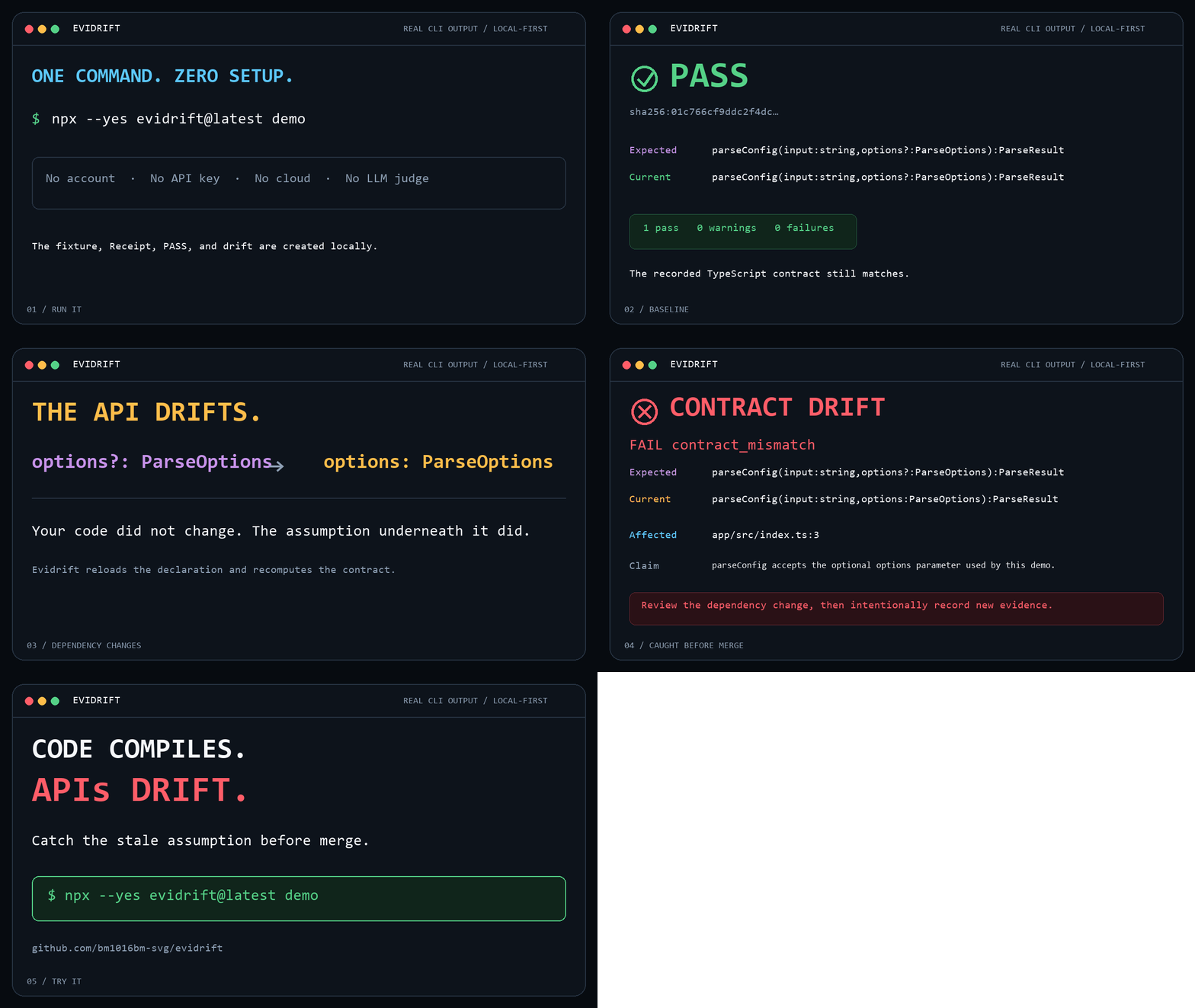
The animation is rendered from a captured CLI transcript. The PASS, changed signatures, affected file, and deterministic FAIL come from an actual local evidrift demo run; only the scene headings are editorial.
Quick Start — Minimize a Failing Request
Requires Node.js 22 or newer. The zero-setup demo starts a disposable loopback server, verifies one HTTP failure, minimizes its JSON request, verifies the result again, and shuts the server down:
The result is not selected by an LLM. Every accepted reduction is actually replayed and must match both the expected HTTP status and error identity.
For your own local endpoint:
Then replay the content-addressed artifact once:
See the complete ReproMin fixture, guarantees, and replay safety boundary.
Quick Start — See Drift in One Command
Requires Node.js 22 or newer. Nothing to install globally:
The command creates a disposable local fixture, records the optional options parameter on parseConfig, checks it successfully, changes the fixture so options is required, then proves that evidrift check catches the mismatch. It runs no downloaded package code.
If that is a failure you want caught before merge, star Evidrift on GitHub.
Real-world Lab — React 19 useRef
The synthetic demo is fast; this source-repository lab proves the same workflow against a real,
documented ecosystem change. React's official upgrade guide says React 19 makes the first
useRef argument required. Evidrift records the no-argument overload from
@types/react@18.3.12, upgrades only that type package to @types/react@19.0.1, and reports the
missing overload:
Both package versions are exact and verified after installation. The lab disables dependency
lifecycle scripts, and its final evidrift check must return a deterministic contract mismatch.
See the reproduction and complete trust boundary and the
official React 19 upgrade guide.
Supported Today
| Surface | Deterministic evidence | Status |
|---|---|---|
| Loopback HTTP JSON failure | Replayed reduction matching status plus error identity | CLI only |
| Installed TypeScript dependency | Selected call signature, parameter, package version, and declaration | Supported |
| Repository OpenAPI / JSON Schema | Canonical value selected through an RFC 6901 JSON Pointer | Supported for JSON |
| Contract CLI and local STDIO MCP | The same record and revalidation core | Supported |
Remote replay, cURL import, YAML, remote $ref | None; Evidrift refuses these inputs instead of guessing | Not supported |
Installation — Add It to a Repository
Initialize the current repository without a global install, account, API key, or cloud backend:
To add an idempotent pull-request workflow with file-and-line annotations:
The initializer detects npm, pnpm, or Yarn, adds scripts.evidrift:check, and creates
.github/workflows/evidrift.yml. Existing scripts and workflows are reported and preserved
instead of being overwritten.
To pin Evidrift for a team or CI workflow:
That is the product: make an AI assumption reviewable now, then make CI check the same contract later.
Use It in a Repository
The dependency must already be installed inside the target repository, and the affected code path must name a real file.
When --code includes a line containing an overloaded call, Evidrift asks TypeScript which overload that call actually resolves to. --overload <number> remains an explicit fallback for incomplete or non-compiling call sites.
Lock one value from a repository-local OpenAPI or JSON Schema document:
JSON Pointer follows RFC 6901, including ~1 for / and ~0 for ~. Evidrift reads .json files only; it never fetches URLs or resolves remote references.
Coding agents call the same core through evidrift_record and evidrift_record_json_pointer. Minimal Codex, Claude Code, and Cursor setup is included.
How It Works
The CLI and MCP server are thin entry points over the same core. The complete component map, check policy, resource bounds, and trust boundary are documented in Architecture.
The Files
Evidrift writes one lock and one immutable JSON file per Receipt:
There is no .evidrift/receipts.json. evidence.lock contains only content-addressed Receipt IDs:
Each Receipt stores the claim and affected code plus one deterministic contract: an installed TypeScript symbol signature, or a repository JSON path, pointer, canonical value, and hashes. See the Receipt schema.
Add It to CI
Generate the package script and read-only pull-request workflow:
The generated package script pins the current Evidrift release:
Run the same pinned check locally with npm run evidrift:check.
The generated workflow installs locked repository dependencies with lifecycle scripts disabled, then runs the Marketplace Action. Contract mismatches and integrity failures become PR errors at the affected file and line; source-change and unavailable-evidence results become warnings.
With --format json, GitHub workflow commands are written to standard error so standard output
remains valid JSON. The complete GitHub Actions setup documents the generated
workflow, permissions, package-manager behavior, and manual setup.
Related MCP Servers
Reviews
No reviews yet — be the first to share how this listing worked for you.
Frequently Asked Questions about Evidrift
AllMCPs Directory Badge
Showcase your server listing on GitHub or your project documentation. Embed this dynamic SVG badge to highlight official listing status and live engagement.
Badge Style:
Live Dynamic SVG Preview
Markdown (GitHub README)
[](https://allmcps.com/mcp/evidrift)HTML Embed
<a href="https://allmcps.com/mcp/evidrift"><img src="https://allmcps.com/api/badge/evidrift?style=directory" alt="Evidrift on AllMCPs" /></a>Technical Specs & Signals
CategoryDeveloper Tools
27Quality signal: Emerging · 27/100How this signal is calculated ▾
Server availabilityNot measured
Not scored for repo-hosted servers — we can't reach the running server, only its GitHub page. Hosted MCP endpoints are health-checked live.
Verified ownership8/20
Documentation & tools11/30
Adoption & activity1/15
Community engagement0/10
A guidance signal from public completeness & health data — not a user rating. New listings start lower and rise as they add docs, get verified, and grow adoption. Signals we can't observe for a listing are skipped, not counted against it.
Own this project?
This directory is pre-filled from public sources. Claim via GitHub README, site badge, or DNS TXT to unlock edit access and the Official badge and attach your website — proof is checked automatically, then reviewed by our team.
Free dofollow backlink: add your website and place the AllMCPs badge on it — no claim needed. We detect it automatically and keep it verified as long as the badge stays live.
Claim & get free dofollowShare & Embed
Add our SVG badge (dark/light directory styles) or embeddable widget to your site.