Euclid MCP README
The full upstream README, mirrored here for reference. Install config, tool schemas, adoption signals, and an original overview live on the Euclid MCP listing page.
Euclid-MCP






MCP server for logical reasoning — turns facts into formal proofs.
Euclid-MCP is a hybrid cognitive architecture: a lightweight LLM describes the world in facts, and a deterministic engine performs the actual deduction. The LLM never needs to reason — it only needs to describe.
With Euclid-MCP, an 8B model can solve reasoning tasks that stump even 400B+ cloud models — because the engine handles deduction deterministically. Every answer comes with a proof tree, so you can trace why a conclusion holds, not just what it is. Use it to enforce RBAC policies, audit cloud compliance, validate loan eligibility rules, or reason over any domain where answers must be explainable and verifiable.
Euclid-MCP is written in Python and uses Euclid-IR, a human-readable intermediate language designed for both AI agents and humans. It uses SWI-Prolog as its primary inference engine — and, where SWI-Prolog is not available (e.g. minimal containers), a pure-Python native engine that interprets Euclid-IR directly (see docs/NATIVE_ENGINE.md).
It can be consumed in multiple ways: via MCP by AI agents (OpenCode, Claude, Cursor), via HTTP by tools and automation platforms (n8n, Zapier, Make), and via Python API for direct integration. Euclid-IR rules can also be used to augment RAG pipelines with deterministic policy enforcement.
How it works
- Receive facts, rules, and a query in a simple intermediate language
- Translate into Prolog with a meta-interpreter for proof tree capture
- Execute via a persistent SWI-Prolog engine process (JSON-lines protocol on stdin/stdout; the workspace is reloaded per call, no process spawn overhead)
- Return solutions + proof trees as structured JSON
Additional tools (explain, diagnose, what_if, check_kb) extend this core flow with natural-language explanations, analysis, scenario testing, and validation.
LLMs describe. Euclid MCP proves.
Knowledge Base
For small knowledge bases, facts and rules can be provided with each request.
A knowledge base can be loaded at server startup and reused across calls, so agents only pass the session-specific facts for the current query. This minimizes token usage, improves performance, and allows small LLMs to reason over large rule sets without reconstructing the entire knowledge base for every request.
Intermediate Language
Even if currently Euclid-MCP uses a Prolog Engine, no Prolog syntax is required.
Euclid-IR (Intermediate Representation) is a declarative intermediate representation for logical inference.
Variables use $name, implication is IF, conjunction is AND.
Text format:
YAML format:
Full language reference: docs/EUCLID_IR.md
Euclid-IR Syntax Reference
| Element | Syntax | Example |
|---|---|---|
| Facts | predicate(args) | parent(tom, bob) |
| Variables | $name (lowercase) | $who, $x, $count |
| Implication | IF | mortal($x) IF human($x) |
| Conjunction | AND | p($x) AND q($x) |
| Negation | NOT | NOT active($user) |
| Boolean literals | true / false in rule bodies | merchant($m) IF false |
| Query | ? predicate | ? ancestor(tom, $who) |
| String literals | "..." or '...' | "alice@example.com" |
| Multi-line rules | Body on next line | rule($x) IF\n body($x) |
Arithmetic Comparisons
Rules support arithmetic comparisons that are evaluated during deduction:
Supported operators: >, >=, <, <=, ==, is, !=
Multi-line Rules
Rules can span multiple lines for readability:
Conjunctions in Queries
Queries can combine multiple predicates:
This returns solutions where both conditions are satisfied simultaneously.
Why External Inference?
The external inference gives several advantages:
- deterministic
- explainable
- verifiable
- inexpensive
- replaceable backend
In the current implementation Euclid-MCP uses Prolog.
Prolog is a 50-year-old battle-tested logic engine. Using it as a "deduction coprocessor" lets small LLMs perform complex multi-step reasoning without needing larger, more expensive models. The intermediate language strips away Prolog's syntax quirks while keeping its logical core.
A specific benchmark demonstrate the difference: with 1 000+ facts, LLMs alone score 2/5 while Euclid-MCP scores 5/5 — and runs 7× faster while outputting 14× fewer tokens.
Tools
Euclid-MCP exposes 8 tools, each with a specific purpose:
| Tool | Purpose |
|---|---|
reason | Main deduction — get solutions + proof trees |
explain | Readable, natural-language reasoning steps |
diagnose | Understand why a query succeeds or fails |
what_if | Test modifications before applying them |
check_kb | Validate KB consistency before reasoning |
register_kb | Register a named KB under a kb_id |
unregister_kb | Remove a named KB from the registry |
list_kbs | List registered named KBs (metadata) |
reason
Main tool for verifiable deterministic reasoning.
| Parameter | Type | Default | Description |
|---|---|---|---|
knowledge | string? | — | Facts & rules in text or YAML format |
kb_id | string? | — | Reference a KB registered via register_kb |
delta_knowledge | string? | — | Session-specific facts appended to the kb_id base |
query | string? | — | Override query (optional) |
max_solutions | int | 5 | Max solutions to return |
max_depth | int | 30 | Max proof tree depth |
Returns ReasonResult with solutions[] — each containing variable bindings and a proof tree.
explain
Deterministic proof-tree → natural-language reasoning steps. No LLM involved: it
walks the proof tree of each solution and renders every step in plain language,
citing the rule ID (# RULE: <id>) when a rule has one. Use it to turn a proof
into an auditable, human-readable explanation.
| Parameter | Type | Default | Description |
|---|---|---|---|
knowledge | string? | — | Facts & rules in text or YAML format |
kb_id | string? | — | Reference a KB registered via register_kb |
delta_knowledge | string? | — | Session-specific facts appended to the kb_id base |
query | string? | — | Override query (optional) |
max_solutions | int | 5 | Max solutions to return |
max_depth | int | 30 | Max proof tree depth |
Returns ExplanationResult with explanations[] — each containing variable
bindings, an ordered list of natural-language steps, and language-independent
structured_steps (typed kind/goal/rule_id/body, ready for localized
rendering in a UI).
diagnose
Query analysis — understand why a query succeeds or fails.
| Parameter | Type | Default | Description |
|---|---|---|---|
knowledge | string? | — | Facts & rules in text or YAML format |
kb_id | string? | — | Reference a KB registered via register_kb |
delta_knowledge | string? | — | Session-specific facts appended to the kb_id base |
query | string | — | Query to diagnose |
mode | string | why | One of: why, why_not, what_needs |
max_solutions | int | 5 | Max solutions to return |
max_depth | int | 30 | Max proof tree depth |
Modes:
why— explain why a query holds (or that it doesn't)why_not— explain why a query fails (missing facts/rules)what_needs— suggest what would make a false query true
Returns DiagnosisResult with holds, findings[], conclusion, and optionally proof.
what_if
Scenario analysis — apply modifications to a knowledge base and compare results.
| Parameter | Type | Default | Description |
|---|---|---|---|
base_knowledge | string? | — | Base facts & rules |
kb_id | string? | — | Reference a KB registered via register_kb |
delta_knowledge | string? | — | Session-specific facts appended to the kb_id base |
modifications | string | — | + fact(...) to add, - fact(...) to remove |
query | string | — | Query to evaluate |
max_solutions | int | 5 | Max solutions to return |
max_depth | int | 30 | Max proof tree depth |
Returns WhatIfResult with before_count, after_count, delta, solutions_before, solutions_after, conclusion.
check_kb
Knowledge base validator — check for consistency before running deduction.
| Parameter | Type | Default | Description |
|---|---|---|---|
knowledge | string? | — | Facts & rules in text or YAML format |
kb_id | string? | — | Reference a KB registered via register_kb |
delta_knowledge | string? | — | Session-specific facts appended to the kb_id base |
Returns KBCheckResult with valid, errors[], warnings[], facts_count, rules_count, predicates_count, and predicates[] — the predicate inventory (name → arities, facts, rules counts) that doubles as the contract for LLM extraction.
KB identity in results
Every tool result — ReasonResult, ExplanationResult, DiagnosisResult,
WhatIfResult, and KBCheckResult — carries two identity fields:
| Field | Value |
|---|---|
content_hash | sha256 of the KB text payload (the exact source that was reasoned over) |
version | the @version directive of the KB, or null when absent |
The fields are present on every return path, including error branches, so a
result can always be pinned to the exact KB it was computed from: anyone with
the .euclid text and Euclid-MCP can recompute the hash and verify it. This is
the foundation for KB versioning, signatures, and audit trails built on top of
the engine.
KB Preload
A knowledge base can be loaded once at server startup and reused across calls, so agents only pass the session-specific facts for the current query.
Preload a KB by file path, via the EUCLID_KB_PATH environment variable or a
--kb-path CLI flag:
Behavior:
- The file is validated with
check_kbat startup and the server fails fast with a clear message if the file is missing, unreadable, oversized, or invalid. knowledge/base_knowledgeonreason,explain,diagnose,what_if, andcheck_kbbecome optional: an explicit value always wins, an empty value falls back to the preloaded KB. With neither, tools return a clear "No knowledge provided" error.- A markdown digest of the preloaded KB (fact/rule/predicate counts, predicate inventory, rules with their IDs) is appended to the server instructions, so agents can see what the KB covers without extra tool calls.
Backward compatible: passing knowledge explicitly behaves exactly as before.
Named KBs (kb_id + delta_knowledge)
A KB can also be registered once under a kb_id and then referenced on
every call without resending the text — the in-memory registry is per
server instance, so replicas re-register their KBs on startup (matching the
scale-out model of the HTTP API). Up to 32 KBs per instance; register_kb
overwrites an existing kb_id (update semantics for idempotency).
register_kb(kb_id, knowledge)— validates thekb_id(allowlist[a-z0-9_-]{1,64}) and the KB (check_kb), then stores it. Returns the record:registered,kb_id,content_hash,version,facts,rules,predicates. Unknown ids are rejected; a full registry returns an error.unregister_kb(kb_id)— removes the KB; returnsremoved: true/false.list_kbs()— lists registered KBs (metadata only, no source text).
Resolution precedence on reason, explain, diagnose, what_if,
check_kb: explicit knowledge/base_knowledge wins → else kb_id
(unknown id → Unknown kb_id: <id>; delta_knowledge is concatenated to the
registered source) → else the EUCLID_KB_PATH preload → else a clear
"No knowledge provided" error. delta_knowledge without a kb_id is an
error. content_hash/version on a kb_id result are computed from the
effective source (base + delta), so a result can always be pinned to the
exact text reasoned over.
The HTTP API exposes the same flow as POST /register-kb,
POST /unregister-kb, and POST /list-kbs.
Installation
pip
From source
Docker
No local SWI-Prolog installation needed — the image bundles everything.
See Docker in Integrations for full details.
Usage
Via MCP (OpenCode, Claude, etc.)
Via Python
Via CLI
The euclid-cli command wraps the five reasoning tools (reason, explain,
diagnose, what_if, check_kb) for the terminal. It reads
the KB from a .euclid file (-f), inline (--knowledge), or falls back to
EUCLID_KB_PATH/preload, and selects the backend with --backend
(auto | prolog | native). Queries come from --query or from the ?
lines inside the KB file.
Run with no subcommand to open an interactive Euclid-IR REPL — type
facts, rules and ? query lines directly, like you would in swipl or
psql. The session knowledge base accumulates across queries.
REPL meta-commands: :check, :kb, :load <file>, :explain [query],
:diagnose <query> [why|why_not|what_needs], :what-if <mods>, :reset,
:quit. Multi-line rules continue after IF/AND (prompt becomes ... >).
Piped input runs the same loop as a batch script without prompts:
Exit codes: 0 on success, 1 when the tool reports an error (including an
invalid KB from check), 2 on usage errors.
Full CLI reference (all flags, backends, JSON output): docs/CLI.md
Example output
Rules can carry an audit-trail ID via a trailing # RULE: <id> comment; the ID
is surfaced as rule_id on the rule nodes of the proof tree, so a decision
can be cited ("this derives from rule GEN-2").
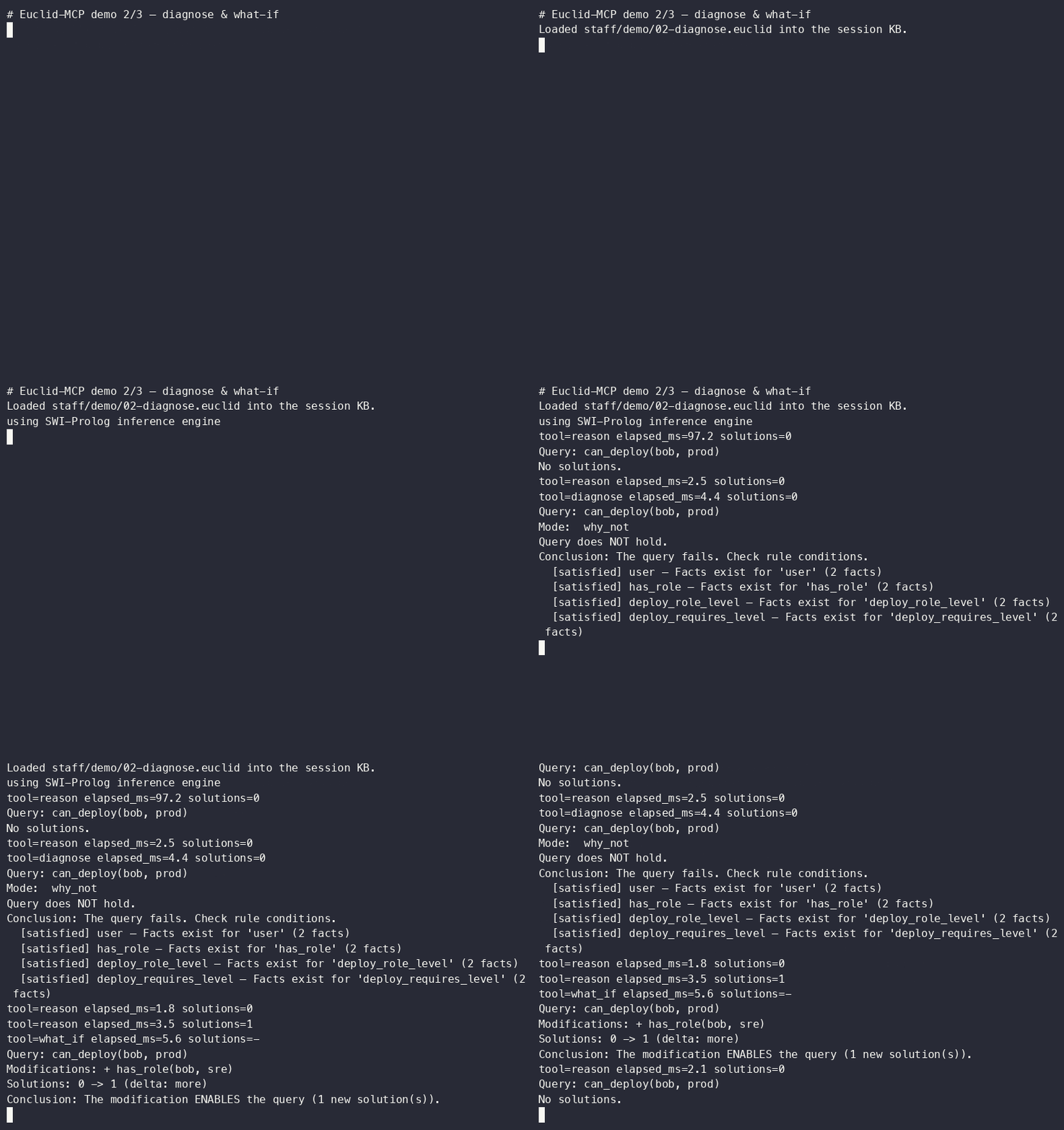
Diagnose output
What-if output
Explain output
Use cases
- Small LLM reasoning: Offload deduction from LLMs (3-8B) to a deterministic engine
- Explainable decisions: Every answer comes with a proof tree which allows explanation, reasoning trace, and justification
- Business rules: Validate logic chains (permissions, workflows, compliance)
- Dependency analysis: Circular dependency detection, topological ordering
- Education: Interactive logic tutoring with visible proof chains (see
docs/DIDACTIC.md, a step-by-step teaching guide built around theeuclid-cliREPL) - Knowledge preload: Complex business rules can be loaded in Euclid instead of using a vector database
- Query diagnosis: Understand why queries fail and what facts/rules are missing
- Scenario analysis: Test "what-if" modifications before applying them to production
- KB validation: Check knowledge bases for consistency before reasoning
Real-world examples
There are several examples provided as samples: Genealogy, RBAC, Classification, Loan Eligibility, Cluedo Detective, IT Security & Compliance, LLM vs Euclid-MCP, ... Most interesting ones are the IT Security & Compliance (with CIS, AWS, IAM Standards enforcement, Company Policies implementation, hundreds of Data Facts) and side-by-side LLM vs Euclid-MCP.
Examples full description: docs/EXAMPLES.md
Integrations
OpenCode
Euclid-MCP includes a pre-configured agent in .opencode.json:
n8n / Zapier / Make
Run the HTTP API:
| Endpoint | Method | Purpose |
|---|---|---|
/reason | POST | Deduction with proof trees |
/explain | POST | Natural-language reasoning steps |
/diagnose | POST | Query failure analysis |
/what-if | POST | Scenario testing |
/check-kb | POST | KB validation |
/register-kb | POST | Register a named KB (kb_id) |
/unregister-kb | POST | Remove a named KB |
/list-kbs | POST | List registered named KBs |
/health | GET | Health check (deep: pings the engine; 503 only when wedged) |
/metrics | GET | Prometheus metrics (open, read-only, never KB content) |
Docker
The Docker image bundles SWI-Prolog + Python, so no local prerequisites are needed.
Base image: swipl:stable (Debian Bookworm).
Two modes via docker-compose:
Standalone usage:
Docker image size: ~370 MB (SWI-Prolog + Python 3.11 + dependencies).
Native-only (slim): a smaller image with the pure-Python Euclid-IR engine
and no SWI-Prolog (EUCLID_BACKEND=native). Best for containers with limited
space or as the default for small knowledge bases.
Base image: python:3.12-slim.
CLI pipeline
See integrations/README.md for full details.
Scalability
Euclid-MCP engine is persistent: a single long-lived SWI-Prolog process per server instance, reloaded per request over a JSON-lines pipe instead of booting Prolog for every call. A single instance handles one request at a time. Requests stay stateless: each one brings its own knowledge base (or uses the preloaded one), so instances share nothing.
This makes Euclid-MCP horizontally scalable:
- HTTP API — run any number of instances behind a load balancer (nginx, a Kubernetes Service, …). No session affinity needed: any instance can serve any request.
- MCP stdio — each MCP client spawns its own instance by design, giving natural isolation and parallelism across clients.
- Resource footprint — one
swiplprocess per instance (~tens of MB) instead of one short-lived process per request, so a single instance serves many requests cheaply.
Reference production architecture — load balancing, resource limits, security
hardening, and monitoring for a replica battery behind HAProxy:
docs/PRODUCTION.md.
Development
Requirements: Python ≥ 3.10, SWI-Prolog.
The CI workflow (.github/workflows/ci.yml) runs these
same checks on push and pull request, across Python 3.10–3.14.
Logging & tracing
Every tool call is logged with its name, elapsed time, and outcome. Enable
structured logs by setting EUCLID_LOG_LEVEL (one of DEBUG, INFO,
WARNING, ERROR, CRITICAL) — e.g. EUCLID_LOG_LEVEL=INFO. Without the
variable, only warnings and errors are emitted.
The HTTP API also supports request tracing: send an X-Request-Id header and
it is echoed back on the response and included in the access logs.
Monitoring & metrics
The HTTP API exposes Prometheus metrics on GET /metrics (open, read-only,
never carries KB content): per-tool call/error counters and latency
histograms, engine requests/restarts/timeouts, HTTP traffic, solutions
returned, auth failures and process uptime — always on, zero dependencies
(euclid_mcp/metrics.py). GET /health is a deep check that pings the
engine and reports its workspace stats (503 only when a wedged engine exists).
For a full stack (Prometheus + Grafana + cAdvisor, dashboard and alert rules
included): monitoring/README.md.
What is Prolog?
Prolog (from PROgrammation en LOGique) is a declarative logic programming language: instead of telling the machine how to compute an answer, you state facts and rules and let it find what follows from them, using unification and backtracking. Born in the early 1970s, it remains one of the most battle-tested tools for symbolic reasoning.

Euclid-MCP uses SWI-Prolog as its inference engine. SWI-Prolog is a mature open-source implementation — continuously developed and freely available since 1987 — widely used in industry, academia, and research. You write your rules in Euclid-IR; the translator compiles them to Prolog, and SWI-Prolog performs the deduction and produces the proof trees that make every Euclid-MCP answer verifiable.
How is Euclid?
Euclid was an ancient Greek mathematician. Living and teaching in Alexandria, he built the foundations of geometry and number theory using rigorous logical proofs.
Euclid-MCP is not:
- an LLM
- a knowledge base
- a vector database
- an agent framework
- a planner
Euclid-MCP is a deterministic inference engine that can be used by any of them.
Euclid-MCP allows deterministic and explainable replies from small LLMs on Edge hardware too.
License
Apache 2.0