MCP server for the ESET ecosystem - Connect cloud + PROTECT On-Prem, multi-tenant, RO/RW
Quick Install
Automated & IDE SetupCopy the AI prompt to install this server into Claude Code, Cursor, or another agent — or use 1-click editor setup below.
Manual Client & Custom JSON ConfigExpand JSON ▾
Client Config & Setup
Choose your client or environment
Target File:
💡 Paste the JSON block into your client's configuration file under mcpServers, then restart the application.
Documentation Overview
ESET-MCP



A Model Context Protocol server for the entire ESET management surface: ESET Connect (cloud, all regions), ESET PROTECT On-Prem, ESET Inspect, and ESET Cloud Office. Drive any of them from any MCP host (Claude Desktop, Claude Code, or a custom agent) through tools, resources, and prompts.
Built as a single hub for any number of ESET deployments. One process fronts cloud and on-prem consoles at the same time; clients pick the target per request via headers. As long as MCP receives valid credentials (Basic auth, plus an optional URL override and optional Cloudflare Access service token) it routes the call to the right backend, mints its own tokens, and keeps tenants isolated in the pool.
⚠️ Just to be clear, fellas
This is an independent, community-driven open-source project and is not affiliated with, officially supported by, or endorsed by ESET, spol. s r.o. ESET and its product names are registered trademarks of their respective owners.While every effort has been made to ensure this software is safe and robust (including the strict Read-Only mode gate), this code is provided "AS IS", without any warranty of any kind. You are solely responsible for how you use this tool and any changes made to your ESET environment.
Table of contents
- Features
- Architecture at a glance
- Security
- Quick start
- Configuration
- Multi-tenant deployment (basic-auth mode)
- On-prem ESET PROTECT support
- Production deployment (HTTPS via Caddy)
- Tools, resources & prompts
- Architecture
- Tests
- Refreshing the OpenAPI specs
- License
Features
Complete API coverage
- 102 tools auto-generated from 16 official ESET Connect OpenAPI 3.0.1 specs, covering application-management, asset-management, automation, device-management, identity, incident-management, installer-management, mobile-device-management, network-access-protection, patch-management, policy-management, quarantine-management, user-management, vulnerability-management, and web-access-protection.
- 4 high-level composites that fold 3-6 raw calls into one:
eset_search,device_full_profile,incident_full_context,latest_detections.
Read-only / read-write modes
ESET_MODE=RO→ catalog exposes only read-only tools (51 total). Write tools are hidden fromlist_toolsentirely.ESET_MODE=RW→ all 106 tools advertised; mutating tools carrydestructiveHint: truein their MCP annotations.- Independent of the ESET account's underlying permissions.
- A defence-in-depth in-memory gate rejects RW tool names in RO mode before any HTTP request is sent.
Authentication
ESET_AUTH_MODE=env- single tenant, credentials from.env.ESET_AUTH_MODE=basic- multi tenant, clients passAuthorization: Basic <base64(user:password)>per request (plus optionalX-ESET-Regionfor a different cloud region, orX-ESET-Server-URLto route the request to an on-prem PROTECT console). One server fronts many ESET accounts and can mix cloud + on-prem in the same process.- Per-tenant OAuth tokens, pooled and isolated by
(user, password_hash, deployment, region-or-server-url, cf_secret_hash). Rotating a password or Cloudflare Access service token mints a fresh client; cloud and on-prem clients for the same user never share a pool entry.
Transports
- stdio - JSON-RPC over stdin/stdout for local hosts.
- Streamable HTTP - the current MCP transport (Nov 2025 spec).
Multi-region
eu / de / us / ca / jpn. Fixed via ESET_REGION in env mode;
per-request via X-ESET-Region in basic mode.
Cloud + on-prem in one process
In addition to the cloud regions, a single MCP server can front
customer-hosted ESET PROTECT On-Prem consoles. The on-prem auth wire
format (POST /GetTokens with a camelCase response) and per-host URL
structure are handled transparently; clients pick the target per request
via the X-ESET-Server-URL header. See
On-prem ESET PROTECT support.
Cloudflare Access (optional)
When the on-prem console sits behind a Cloudflare Access tunnel, MCP
authenticates as a service token
(env-default or per-request X-ESET-CF-Access-Client-Id /
X-ESET-CF-Access-Client-Secret) and rides through to the origin. The
CF token is an extra ingress layer in front of - not a replacement for -
the ESET account credentials. Cloud requests never carry these headers.
Resilience
- OAuth2 with proactive refresh ~5 min before token expiry and a forced refresh + retry on 401.
- 429 retries with exponential backoff (up to 3 attempts, honours
Retry-After). - Pagination (
nextPageToken) walked transparently. - 202 long-polling with the
response-idheader, up to 10 minutes.
Response shaping (context-window protection)
A single uncapped list_* call can return hundreds of KB - enough to
overflow a model's context. Two transformations are applied to every
tool response:
fieldsprojection - every GET tool exposes an optionalfields: [string]parameter that filters each list-item down to the requested keys (e.g.["uuid", "displayName"]). Applied server-side after fetch.- Byte cap (
ESET_MCP_RESPONSE_BYTES_MAX, default 100 KB) - if a payload still exceeds the budget, the longest list is trimmed while every top-level field (nextPageToken,totalSize, …) is preserved, and a_cappedmetadata block is attached with an actionable hint on how to continue. Agents retain full access to the data through pagination.
Agent-friendly errors
HTTP errors are mapped to readable hints: 403 → check Permission Sets in ESET PROTECT Hub; 401 → server refreshes the token automatically; 429 → back off; 5xx → retry shortly.
Observability (logs + Prometheus)
- Structured logs to stderr. Text (default) for dev, JSON Lines for
prod log shippers via
ESET_MCP_LOG_FORMAT=json. Every tool call, token refresh, HTTP retry and pool eviction emits a typedeventrecord with low-cardinality fields (tool, deployment, status, duration_ms, response_bytes, ...). - Prometheus metrics at an opt-in
/metricsendpoint (ESET_MCP_METRICS_ENABLED=true, requirespip install eset-mcp[metrics]). Counters for tool calls, token refreshes, HTTP retries, cap hits; histograms for tool duration and response sizes; gauge for client pool size. - What never enters logs or metrics: passwords,
Authorizationheaders, CF Access secrets, request/response bodies, query strings, substituted path parameters (which can leak UUIDs). A defensive deny-list in the logger strips known-sensitive keys before any formatter sees them. - Failure isolation: telemetry emission is wrapped in a try/except so
a broken metrics registry or formatter can never turn a successful
tool call into an error to the agent.
/metricsreturns 500 (not 503) if exposition ever raises - the worker stays up. - Quieting in production: set
ESET_LOG_LEVEL=WARNINGto mute the per-call INFO events but keep retries / errors visible; setESET_LOG_LEVEL=ERRORto silence everything but hard failures. Disable metrics entirely withESET_MCP_METRICS_ENABLED=false(default). The three knobs are independent.
Architecture at a glance
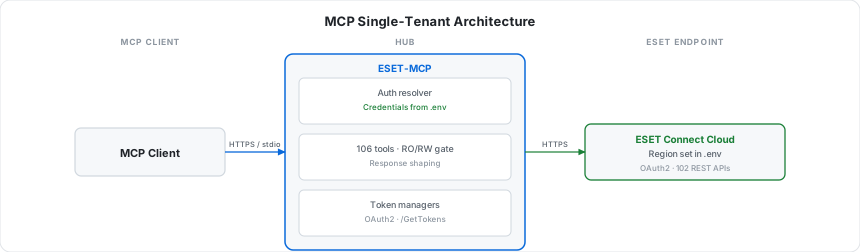
The simplest setup: credentials in .env, one MCP host, one ESET cloud
region. Good for personal use, a single team, or a desktop AI client like
Claude Desktop or Claude Code.
For real multi-tenant or enterprise deployments, put a credentials manager in front of ESET-MCP. The diagram below shows one such pattern using IBM mcp-context-forge as the "creds management" layer - any equivalent MCP gateway (or your own auth proxy) works the same way:
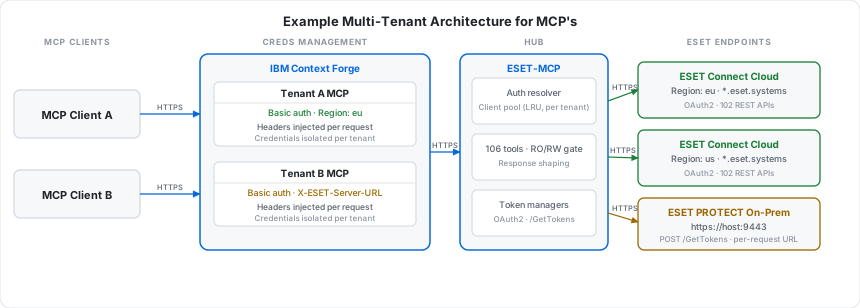
The forge holds per-tenant secrets and injects Authorization: Basic,
X-ESET-Region, X-ESET-Server-URL, and X-ESET-CF-Access-* headers per
request. ESET-MCP routes each request to the right backend (cloud region,
on-prem PROTECT console, or on-prem behind Cloudflare Access) and the
per-tenant LRU client pool keeps OAuth tokens fully isolated between
tenants. This is a working pattern, not aspirational - the headers, pool
keys, and routing rules described here are all in the test suite under
tests/test_concurrency.py and tests/test_onprem.py.
Security
Credentials
- In
envmode the password is read once at startup and kept in memory. - In
basicmode the password is on the wire only for the duration of the request, and in memory only while the per-tenant client is hot in the LRU pool. It is never logged. - The pool key uses a SHA-256 hash of the password rather than the password itself.
- OAuth access/refresh tokens are held per-tenant; tokens never cross tenant boundaries within a single session.
Authentication modes & transport
Related MCP Servers
Reviews
No reviews yet — be the first to share how this listing worked for you.
Frequently Asked Questions about Eset MCP
AllMCPs Directory Badge
Showcase your server listing on GitHub or your project documentation. Embed this dynamic SVG badge to highlight official listing status and live engagement.
Badge Style:
Live Dynamic SVG Preview
Markdown (GitHub README)
[](https://allmcps.com/mcp/eset-mcp)HTML Embed
<a href="https://allmcps.com/mcp/eset-mcp"><img src="https://allmcps.com/api/badge/eset-mcp?style=directory" alt="Eset MCP on AllMCPs" /></a>Technical Specs & Signals
CategoryDeveloper Tools
27Quality signal: Emerging · 27/100How this signal is calculated ▾
Server availabilityNot measured
Not scored for repo-hosted servers — we can't reach the running server, only its GitHub page. Hosted MCP endpoints are health-checked live.
Verified ownership8/20
Documentation & tools11/30
Adoption & activity1/15
Community engagement0/10
A guidance signal from public completeness & health data — not a user rating. New listings start lower and rise as they add docs, get verified, and grow adoption. Signals we can't observe for a listing are skipped, not counted against it.
Own this project?
This directory is pre-filled from public sources. Claim via GitHub README, site badge, or DNS TXT to unlock edit access and the Official badge and attach your website — proof is checked automatically, then reviewed by our team.
Free dofollow backlink: add your website and place the AllMCPs badge on it — no claim needed. We detect it automatically and keep it verified as long as the badge stays live.
Claim & get free dofollowShare & Embed
Add our SVG badge (dark/light directory styles) or embeddable widget to your site.