Repository-owned engineering pattern intelligence - 17 MCP tools over stdio.
Quick Install
Automated & IDE SetupCopy the AI prompt to install this server into Claude Code, Cursor, or another agent — or use 1-click editor setup below.
Not yet automatically verified
We haven't yet run this listing's install command through our automated sandbox check. This isn't a red flag — we're steadily working through the catalog.
Manual Client & Custom JSON ConfigExpand JSON ▾
Client Config & Setup
Choose your client or environment
Target File:
💡 Paste the JSON block into your client's configuration file under mcpServers, then restart the application.
Documentation Overview

Connect findings. Inspect the evidence.
Repository memory for engineering agents.
The board is the memory. Markdown is the record.






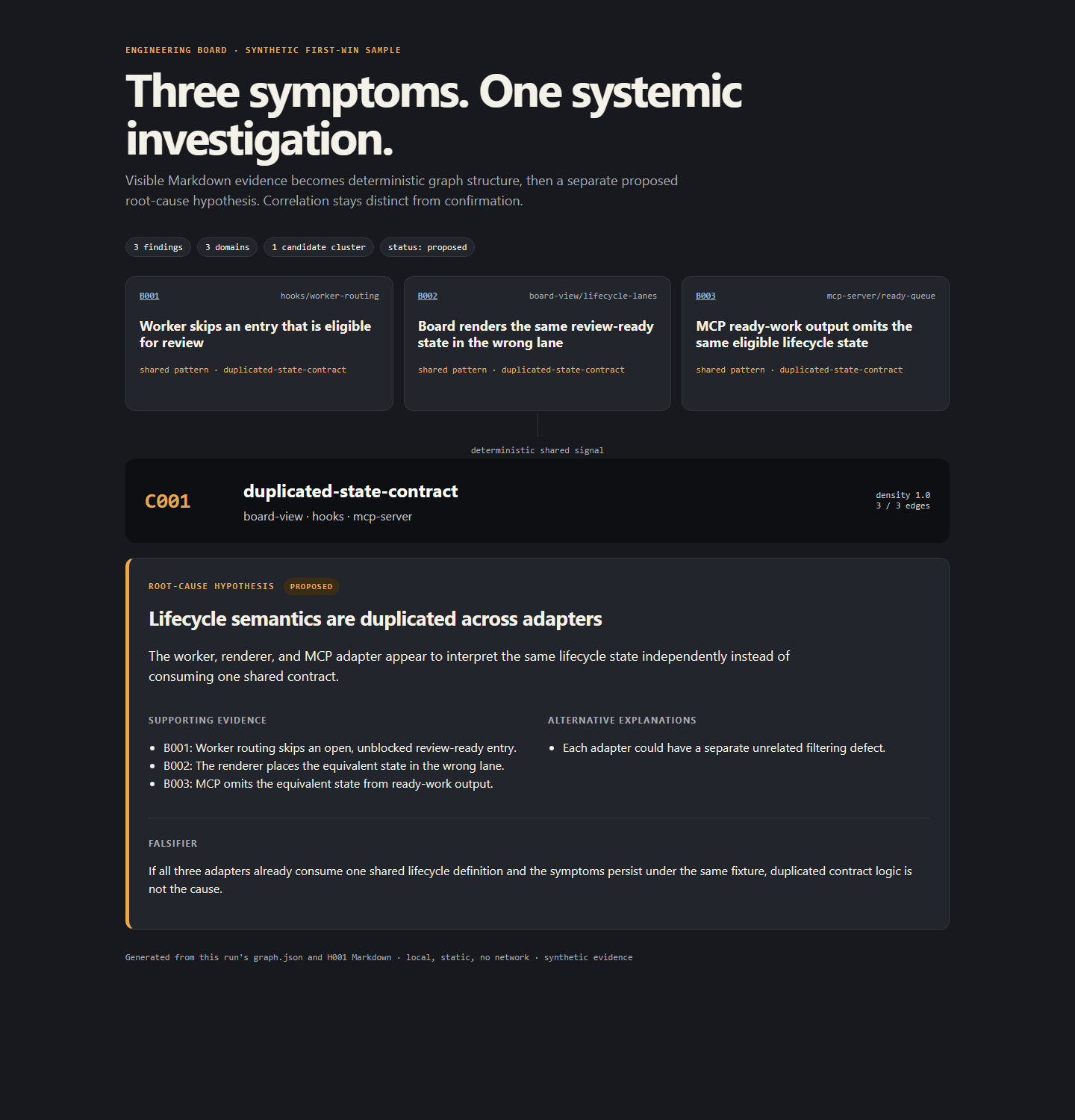
Explore the example · Start with Codex · Open the real project board
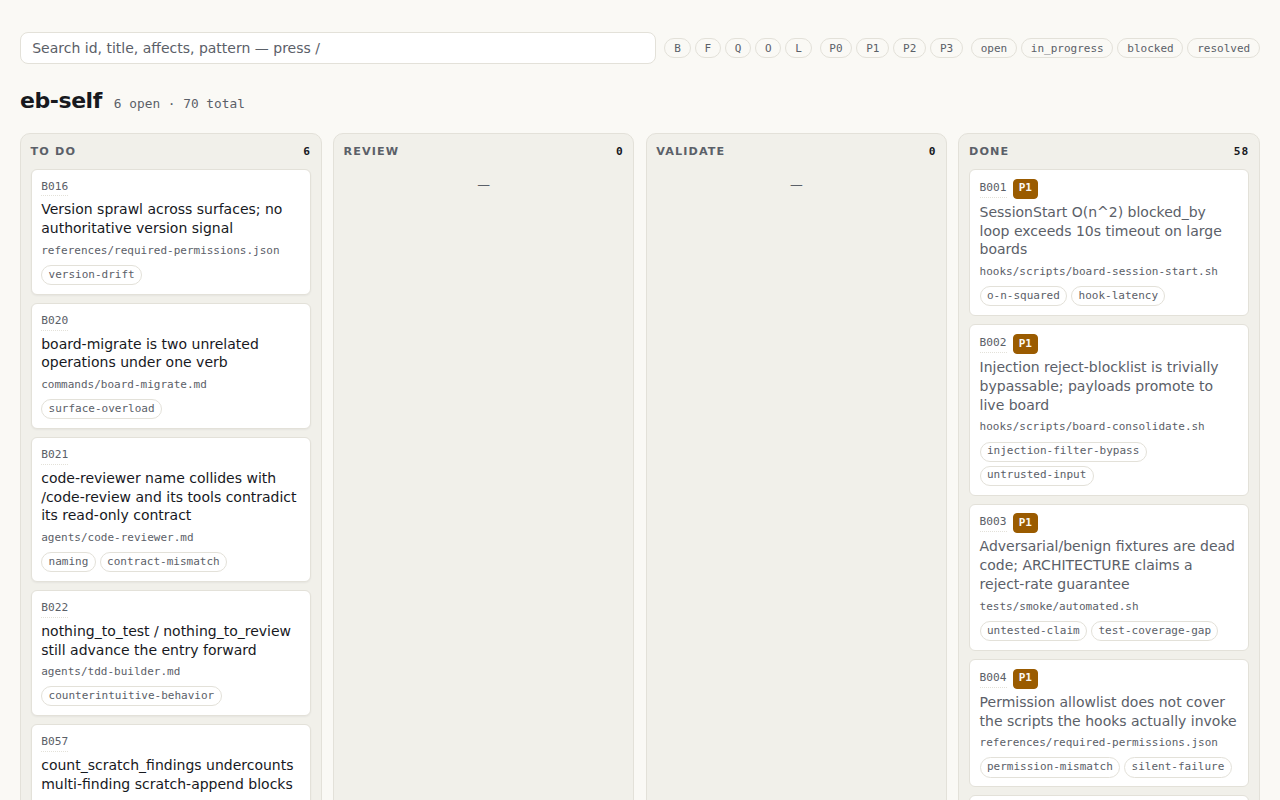
Validation evidence and real project board
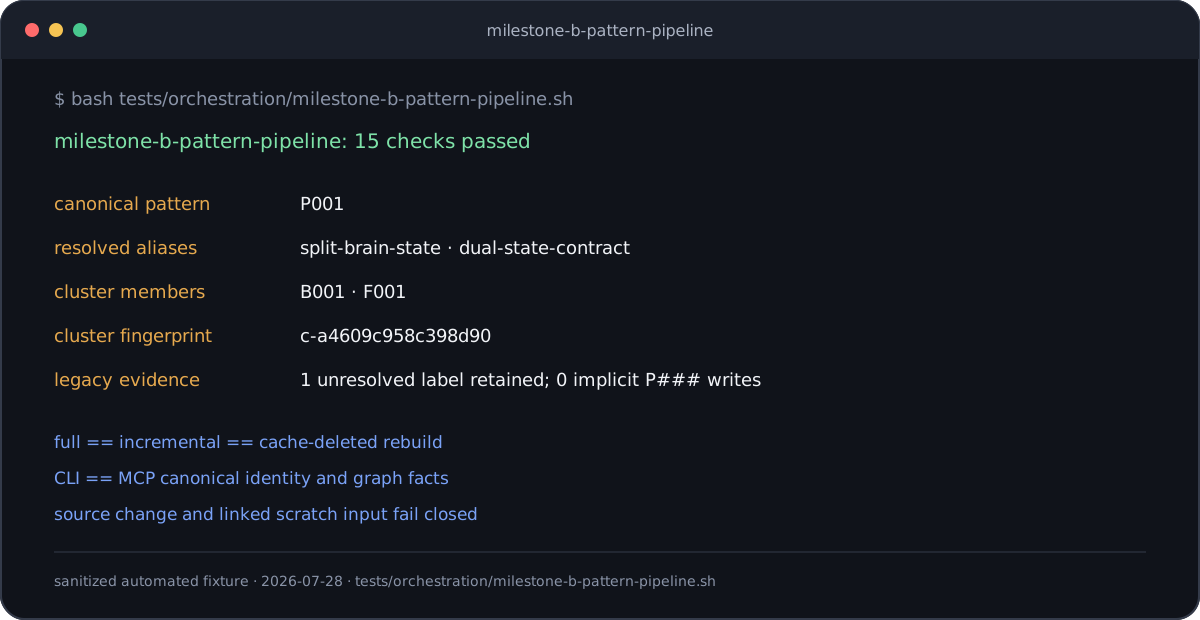
This visual shows deterministic fixture output for the pattern pipeline.
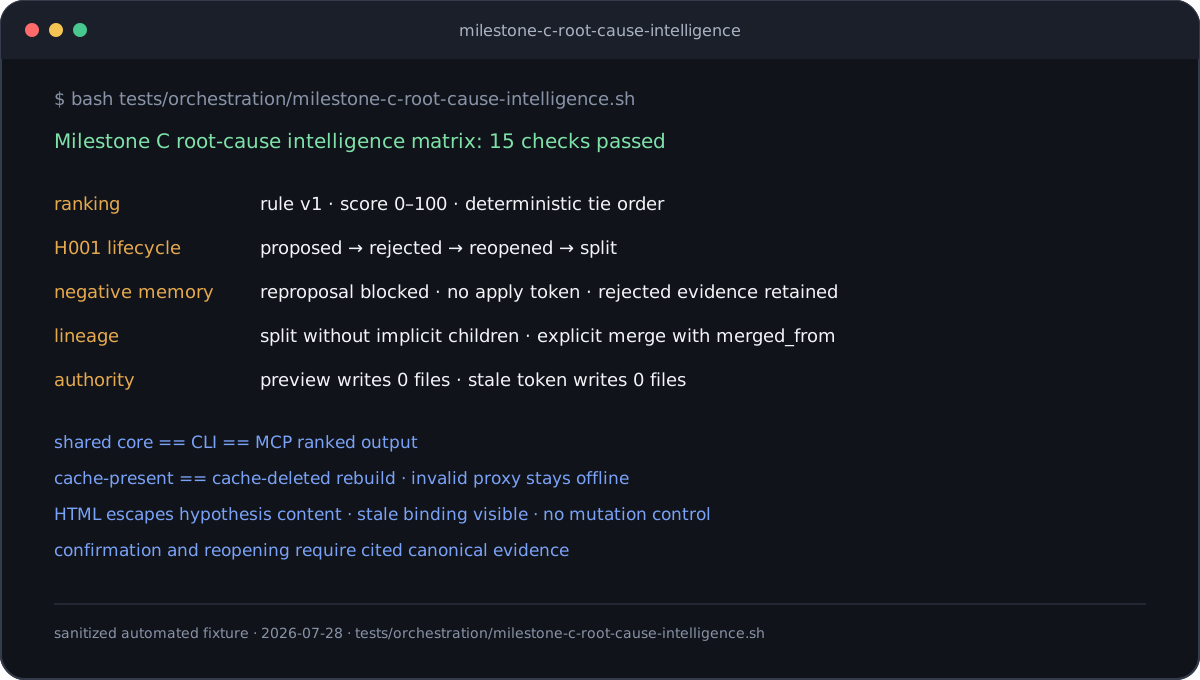
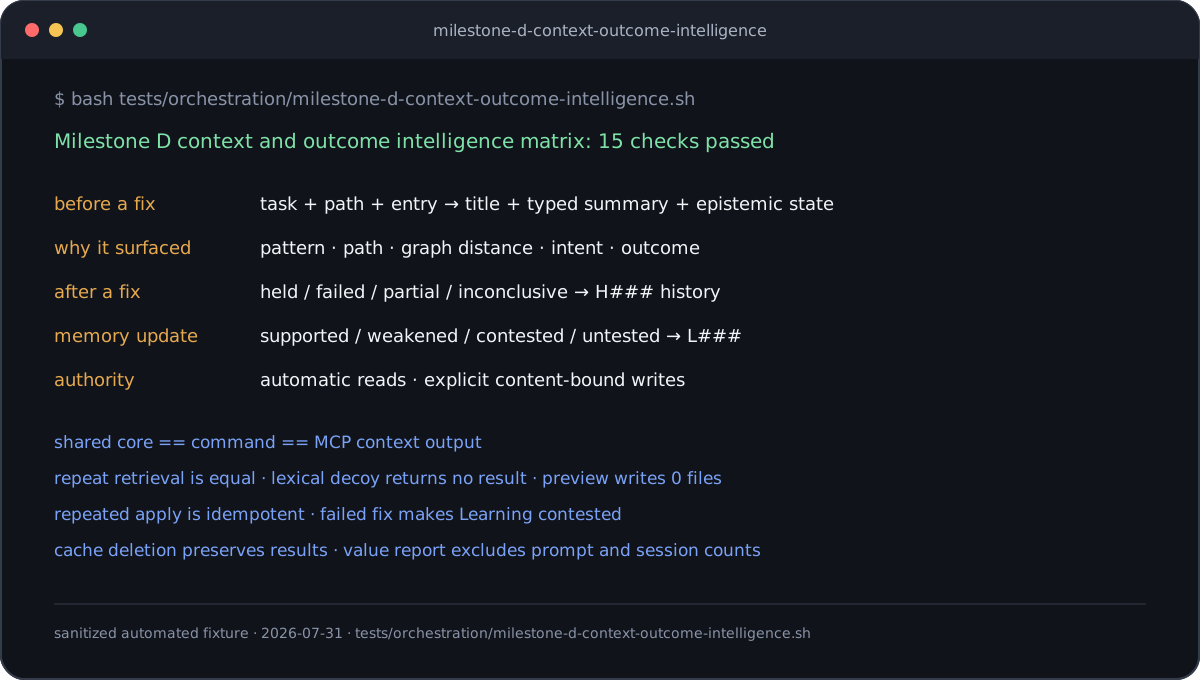
These visuals retain their recorded validation facts; they are not current product-effect claims.
Product description
Engineering Board is a repository-owned pattern-intelligence system for engineering agents.
The system records bugs, features, questions, and observations as Markdown evidence. It connects recurring findings in a deterministic graph.
The graph helps an agent investigate a shared cause across different domains. This method reduces repeated corrections of individual symptoms.
Markdown is the canonical record. A pull request can show each change to this record.
BOARD.md, GRAPH.yml, JSON analysis, and HTML are derived views. The system
can build these views again from the canonical record.
A hypothesis is separate from a deterministic graph fact. Only investigation evidence or fix evidence can confirm a hypothesis.
The optional tdd → review → validate loop can test a fix. This loop supports
the pattern memory, but it does not define the product.
Milestone C adds:
- A transparent investigation score from 0 through 100
- A durable H### hypothesis lifecycle
- Negative memory for a rejected claim.
Each score component is visible. A score does not prove that a cause is true.
Milestone D puts this memory in the agent's decision path:
board_contextretrieves relevant clusters, hypotheses, negative memory, and Learnings before the agent selects a fix.- Each result shows a stable title, a typed summary of at most 2,000 characters, the epistemic state, structural signals, score components, match reason, and canonical sources.
board_get_entryopens a retrieved H### record in full, including its alternatives and falsifier. Reading preserves its status; it does not confirm a proposed cause or record an outcome.- A task-only miss tells the caller to add a file, entry identifier, or current directory. Task words do not bypass structural eligibility.
board_outcomesrecords an explicit fix result against an H### hypothesis.- Structured outcomes update Learning state and confidence through a separate preview and apply operation.
- A derived value report counts verified reuse and systemic fix evidence. It does not count prompts, sessions, or other activity.
Milestone D.1 adds a repository-only evaluation harness and eight sanitized cases. The default contract prepares 24 isolated baseline/context pairs for a Codex reference run. Other clients can run as optional replications without changing the product gate. Protocol and package tests establish supported client surfaces without requiring provider accounts. The first Codex run scored 100 percent in both positive baseline and context arms, so the corpus was retained as a non-scored calibration set. A separate locked evidence corpus excludes declared scoring oracles and requires rejected memory in its lexical-decoy contexts. Its reference run scored 100 percent for context and 83.33 percent for baseline. The 16.67-point difference did not meet the required 25-point improvement. The project does not claim that the context improves agent diagnoses.
The unlocked version 4 proposal now limits each positive case to one visible
current incident. It also requires a positive classification to connect that
incident to prior repository evidence. A non-scored proposal preflight found
that v1.11.0 ranks the expected memory but does not include the memory title,
cause, or summary in the returned result. Context contract version 2 added
that bounded canonical content with its separate epistemic state, match
reason, and sources. Current contract version 3 preserves those limits and
adds confidence for moment-of-need Learning delivery. A current-source,
one-repetition preflight then produced zero qualifying cross-incident first
causes in both the four baseline arms and the four context arms. The expected
memories ranked first or second, but the responses did not connect their
current incident to the prior incident. This is not a scored product-effect
result. A later source-locked C04 diagnostic tested raw JSON versus shipped
prompt-guard prose, each before and after case evidence. All four treatments
again produced current-incident-only first causes, so presentation format and
position are not sufficient for C04 under that bounded current-client test.
The proposal remains unlocked, and the exact baseline decision remains with
the product owner. See
evaluation/README.md for the proof boundary and
operator commands.
Product differences
Some Git boards show visible state but have little analysis. Some memory systems have useful analysis but keep the source outside the repository.
Engineering Board combines these properties:
- Repository evidence that a pull request can review
- A cross-domain pattern graph with evidence links
- H### records with alternatives and falsifiers
- Negative memory for rejected claims
- Atomic claims for parallel agents
- Passive capture
- Codex and Claude Code plugins
- An MCP server.
Native Claude Code Tasks and Engineering Board have different purposes.
Native Tasks store personal task state in ~/.claude/tasks/. This state is not
part of a project pull request.
Engineering Board stores shared project memory in the repository. Use Native Tasks for temporary personal work. Use Engineering Board for durable project knowledge.
Install the Codex plugin
Add the repository marketplace:
Install the plugin:
The Codex marketplace installs the repository root from the immutable Git tag that matches the advertised plugin version. Refresh the marketplace before installing a newer released version.
Start a new Codex session. The plugin supplies five board skills and starts the
19-tool Engineering Board MCP server. It does not require a model-provider
account. The Codex manifest explicitly selects hooks/codex-hooks.json, which
contains no automatic hooks. Codex therefore uses the skills and MCP server
without loading the Claude Code hook workflow from hooks/hooks.json.
Ask Codex to initialize Engineering Board in the active repository. The agent
passes the absolute repository root to board_init and uses the MCP tools for
capture, promotion, context, graph, hypothesis, outcome, claim, and lifecycle
operations.
Install the Claude Code plugin
Add the repository marketplace:
Install the plugin:
Set up a board:
/board-setup creates the board structure. It also checks the required
permissions.
Run the contained demonstration:
The command creates a synthetic run in
.engineering-board/demo/pattern-intelligence/.
The command connects three findings from different domains. It then requests one hypothesis that cites the evidence.
The hypothesis has status: proposed. It includes an alternative explanation
and a falsifier.
Related MCP Servers
Reviews
No reviews yet — be the first to share how this listing worked for you.
Frequently Asked Questions about Engineering Board
AllMCPs Directory Badge
Showcase your server listing on GitHub or your project documentation. Embed this dynamic SVG badge to highlight official listing status and live engagement.
Badge Style:
Live Dynamic SVG Preview
Markdown (GitHub README)
[](https://allmcps.com/mcp/engineering-board)HTML Embed
<a href="https://allmcps.com/mcp/engineering-board"><img src="https://allmcps.com/api/badge/engineering-board?style=directory" alt="Engineering Board on AllMCPs" /></a>