Open source accounting data infrastructure on your own Postgres, acting as the user under RLS.
Quick Install
Automated & IDE SetupCopy the AI prompt to install this server into Claude Code, Cursor, or another agent — or use 1-click editor setup below.
Not yet automatically verified
We haven't yet run this listing's install command through our automated sandbox check. This isn't a red flag — we're steadily working through the catalog.
Manual Client & Custom JSON ConfigExpand JSON ▾
Client Config & Setup
Choose your client or environment
Target File:
💡 Paste the JSON block into your client's configuration file under mcpServers, then restart the application.
Documentation Overview
Ekwo OS
Ekwo OS is free and open source data infrastructure for accounting, finance and tax, under AGPL-3.0: a schema, the rules of each country as data, and tools, for businesses and their accountants. Install it on your own Supabase project and own your accounting data, forever. It is software — not an accounting firm, and not accounting, tax or financial advice (DISCLAIMER.md). Built and maintained by Ekwo. A fully managed edition — your own instance, operated for you, with the AI agents you configure acting on your instructions — is available at ekwo.ai.
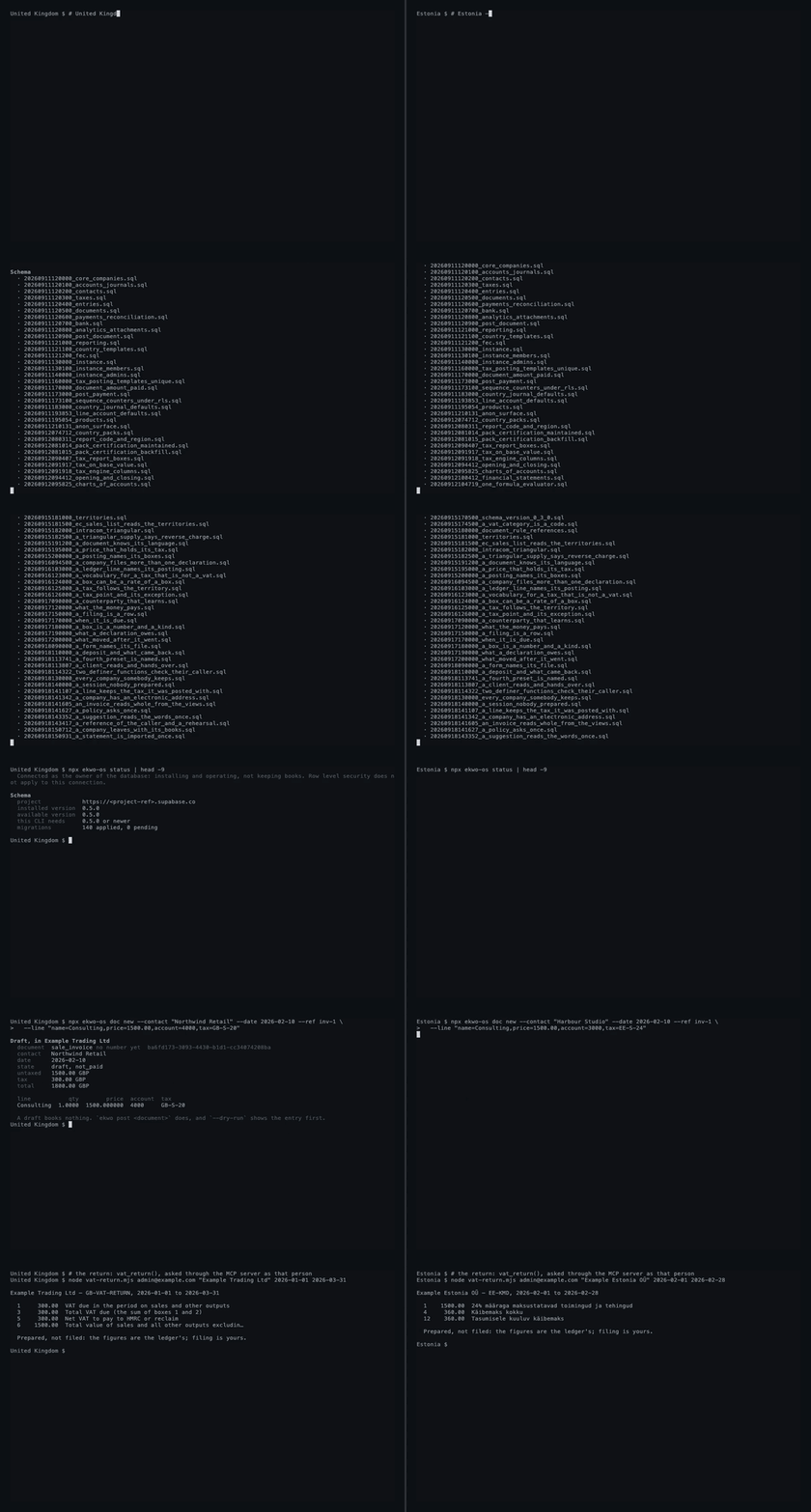
An empty Supabase project to a prepared VAT return, for two countries side by
side, with the published ekwo-os 0.5.0. How it was recorded, and a longer
cut: docs/demo/.
Try it on your own books. Already using Claude? Start with Claude goes from a free Supabase project to your own books taken over, questioned and your next VAT return prepared — Claude Desktop or Claude Code, about twenty minutes — or open the same books in the web application, Ekwo Cloud.
Why Ekwo
The long version — financial autonomy for every business, accounting as a commons, a network rather than a vendor — is in MANIFESTO.md.
Accounting software has settled into two shapes, and both take something from you. The SaaS keeps your books on its servers, behind its API and its price list, and leaving means exporting a PDF. The open-source ERP gives you the code but keeps the parts that save time — bank feeds, automatic matching, invoice recognition — for the paid edition and a network of integrators.
Ekwo is built on a different premise: the data belongs to the business, and the work of keeping the books can be done by software that the business also owns. So the whole accounting core is open, the data sits in a Postgres database that you control, and the interface is designed for machines as much as for people. A REST API and an OpenAPI description come free with Supabase, and an MCP server sits on top of them, so an AI agent can book a purchase, match a payment, prepare a VAT return or produce a FEC on your own data — as you, under your own row level security, without the data ever leaving your account.
What we are building, in order:
- This repository — the core. Schema, posting rules, VAT, reports, the FEC, and the country packs. Done, tested, installable today.
npx -y ekwo-os@latest init— point it at your own Supabase project and it applies the schema, seeds the country rules, creates the first administrator and the first company, in one command. Done; seepackages/cli.- The MCP server —
npx @ekwo-ai/mcp, so any AI agent can operate the books: read the ledger, raise an invoice, post it, match a payment, pull the VAT return or the FEC. Done; seepackages/mcp. The web application is Ekwo Cloud, and it opens an instance you run yourself as well as one we host. - Any country as a versioned pack of data, with one golden test per
country. Every folder of
packs/ships today — the list is under What is in this repository — and more arrive every week. The plan is indocs/international.md. - Format libraries as independent MIT packages, in
packages/formats/, organised by format and never by country: the French FEC, Factur-X, XBRL for the NBB, the Belgian VAT return, Peppol BIS Billing 3.0, four recapitulative statements and three readers of bank statements — camt.053, CODA and CFONB 120 — exist today; MT940 waits for somebody who needs it.
Who it is for: a company that wants to keep its own books with an AI at the keyboard; an accounting firm that runs several companies inside one installation; a developer who needs a real double-entry core with VAT rules as data rather than as code; and anyone who wants to leave a proprietary system with the books intact.
What we sell, so that this stays free: a managed edition at ekwo.ai where the same schema runs on your own Supabase project, and Ekwo operates the application, the AI agents you set up, the bank connections, the Peppol access point and the channels to the administrations. It is infrastructure, not a service that keeps the books: the books and the filings stay the business's and its accountant's. The Community edition stands on its own, with us or without us, for as long as its owner wants it to. That is the test every feature has to pass before it lands here.
What is in this repository
A double-entry accounting core for Postgres. It is the schema, the posting rules and the reports, as migrations you apply to a database you control. There is no server to run: Supabase turns the schema into a REST API with an OpenAPI description, and row level security decides who sees what.
- Double entry, enforced by the database. Amounts are positive, a reversal flips the side, an entry cannot be posted unless it balances, and a locked period refuses writes at the trigger — not in a form validator.
- Documents and entries are two layers, joined by a foreign key. An invoice answers to EN 16931 and Peppol; an entry answers to the chart of accounts and to the FEC. Keeping them apart keeps both honest.
- Country rules are data. A tax points at the ledger accounts it posts to and at the boxes of the VAT return it feeds. Adding a régime is a row, not a release.
- Every label is data, in every language the country pack publishes.
Identifiers and error codes are English and never move; what a person reads
is a row. Belgium ships its chart of accounts, its journals, its VAT codes,
its declaration boxes and its annual accounts in French, Dutch, German and
English, and a company keeping its books in Dutch reads Dutch throughout.
docs/languages.mdis the mechanism. - Every country a pack, out of the box. United Arab Emirates (
ae), Albania (al), Argentina (ar), Austria (at), Australia (au), Bosna i Hercegovina (ba), Belgium (be), Burkina Faso (bf), България (bg), البحرين (bh), Bénin (bj), Bolivia (bo), Canada (ca), République démocratique du Congo (cd), Centrafrique (cf), Congo (cg), Schweiz (ch), Côte d’Ivoire (ci), Chile (cl), Cameroun (cm), 中国 (cn), Colombia (co), Costa Rica (cr), Cyprus (cy), Czechia (cz), Germany (de), Danmark (dk), Dominican Republic (do), Algérie (dz), Ecuador (ec), Estonia (ee), مصر (eg), España (es), Finland (fi), France (fr), Gabon (ga), United Kingdom (gb), საქართველო (ge), Ghana (gh), Guinée (gn), Guinée équatoriale (gq), Ελλάδα (gr), Guatemala (gt), Guinée-Bissau (gw), Hong Kong (hk), Croatia (hr), Magyarország (hu), Indonesia (id), Ireland (ie), Israel (il), India (in), Ísland (is), Italia (it), 日本 (jp), Kenya (ke), Comores (km), 대한민국 (kr), Қазақстан (kz), Lietuva (lt), Luxembourg (lu), Latvija (lv), Maroc (ma), Moldova (md), Crna Gora (me), Северна Македонија (mk), Mali (ml), Malta (mt), México (mx), Malaysia (my), Niger (ne), Nigeria (ng), Nederland (nl), Norge (no), New Zealand (nz), Oman (om), Panamá (pa), Perú (pe), Philippines (ph), Polska (pl), Portugal (pt), Paraguay (py), Romania (ro), Srbija (rs), Rwanda (rw), Saudi Arabia (sa), Sverige (se), Singapore (sg), Slovenia (si), Slovensko (sk), Sénégal (sn), Tchad (td), Togo (tg), ประเทศไทย (th), Tunisie (tn), Türkiye (tr), 臺灣 (tw), Tanzania (tz), Україна (ua), Uganda (ug), United States (us), Uruguay (uy), Việt Nam (vn), Kosova (xk) and South Africa (za) — each with its chart of accounts, its tax codes, its declaration boxes and its annual accounts, and each installed byekwo init. The United Kingdom was the first that is not a Member State of the European Union; the United States, with the sales and use taxes of three states and no value added tax, the first without a VAT; Senegal and Côte d'Ivoire the first on the SYSCOHADA chart the OHADA member States share, written once inpacks/ohada/. The version and the certification of each are indocs/packs.md. - The French FEC. Eighteen columns, the arrêté du 29 juillet 2013, with the reconciliation letter and the sub-ledger code the format requires.
- Modules, one Postgres schema each. Fixed assets and budgets ship with
this release, in
assetsandbudgets. A module depends on the socle by foreign key, reaches the ledger only through one function, and is enabled per company. The socle ignores its modules. - Tested on real Postgres. The test suite runs the migrations, the seeds, the accounting scenarios, the installer and the MCP server against Postgres compiled to WebAssembly.
Modules
The socle is public. Beside it, a module is a schema of its own with its own
migrations, its own row level security and its own tests.
Related MCP Servers
Reviews
No reviews yet — be the first to share how this listing worked for you.
Frequently Asked Questions about Ekwo OS
AllMCPs Directory Badge
Showcase your server listing on GitHub or your project documentation. Embed this dynamic SVG badge to highlight official listing status and live engagement.
Badge Style:
Live Dynamic SVG Preview
Markdown (GitHub README)
[](https://allmcps.com/mcp/ekwo-os)HTML Embed
<a href="https://allmcps.com/mcp/ekwo-os"><img src="https://allmcps.com/api/badge/ekwo-os?style=directory" alt="Ekwo OS on AllMCPs" /></a>