Droste README
The full upstream README, mirrored here for reference. Install config, tool schemas, adoption signals, and an original overview live on the Droste listing page.
Droste
See your codebase as a living galaxy — and give your agents causal memory of it.
Droste indexes any repo into a fractal, zoomable map of its symbols, wires them together with their real call / import / DB edges across languages, and serves an agent the causal slice of code it actually needs — not just keyword matches.
Local-first · zero-config · polyglot · MCP-native




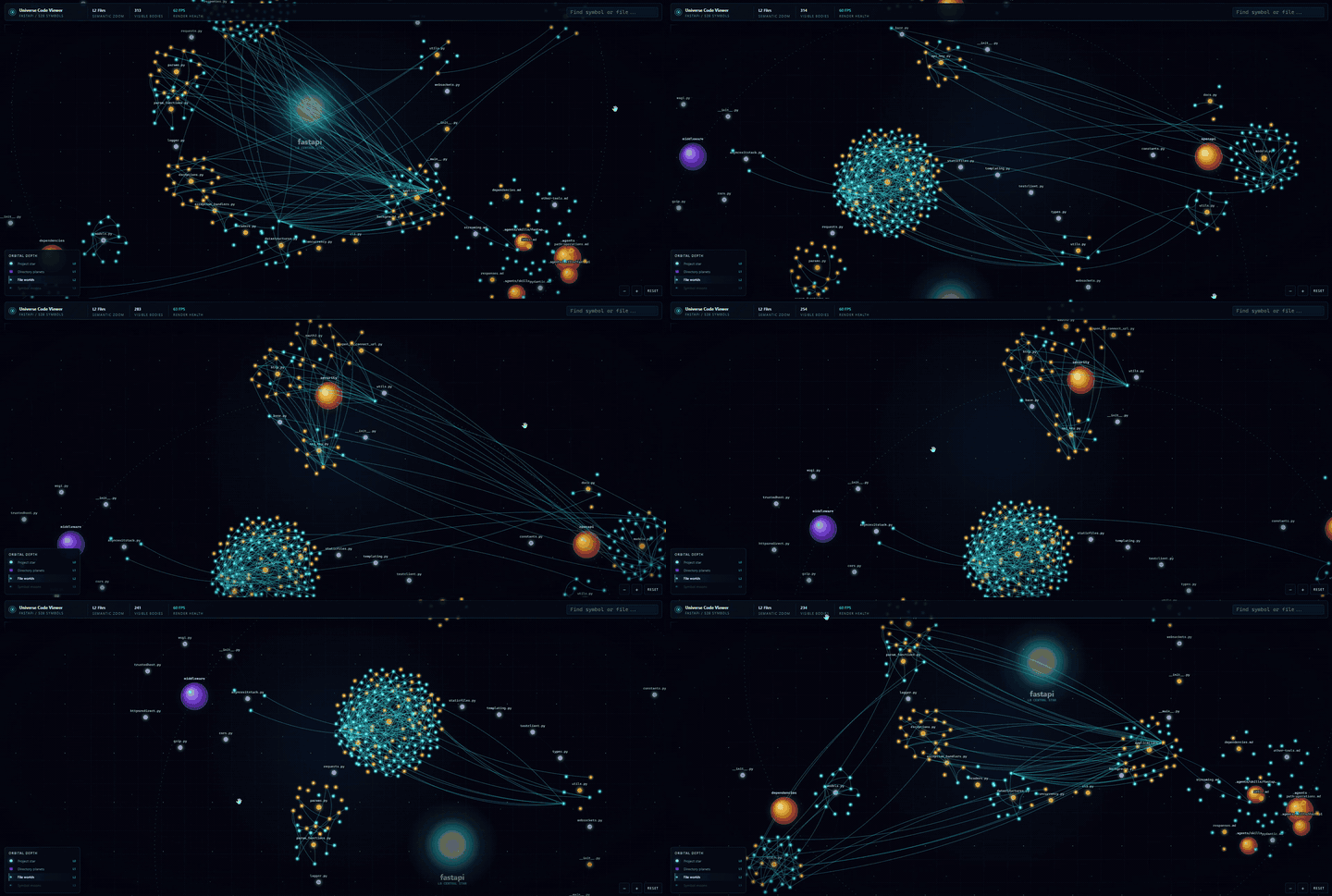
Zooming out reveals the causal web — every cyan arc is a real syntax_dependency
edge. Full flythrough (FastAPI)
Quickstart · Why it's different · How it works · MCP · Benchmarks
Quickstart
Install once, then index and view. droste view opens a full-screen, 60fps zoomable map of your
code — scroll to dive from the project star into folder orbits, down to the
individual functions, with the causal edges glowing between them.
Need it for an agent instead of your eyes?
Running droste with no arguments prints the command palette:
Why it's different
Most "code context" tools rank by keyword (ctags / ripgrep / repo-maps) or by embedding cosine (vector-RAG). Both can only return what resembles your query. A caller that shares no tokens — or a database function in a different language — is invisible to them, yet it's exactly what you need to understand or change the code.
Droste's edge is the causal graph:
- Causal wormholes. Real
syntax_dependencyedges (calls, imports, inheritance) in both directions — Droste hands the caller and callees, ordered, within a token budget. - Cross-language bridges. The part nobody else does well: Droste links across
languages — app code to SQL functions/tables (
.rpc('x'),.from('table')), to edge functions, and same-name handlers between any two languages. Your Dart/TS/Python frontend and your database stop being two separate worlds on the map. - A map you actually want to look at. The fractal galaxy isn't a gimmick — it's how you see coupling, risk hotspots, and the blast radius of a change.
- Zero-config and local. No cloud, no account, no API key. fastembed (ONNX, no torch) gives real semantics; a deterministic fallback keeps it runnable anywhere.
Polyglot: Python (AST) + tree-sitter for Dart, TypeScript/JavaScript, Go, Rust, Java, C#, C/C++, Kotlin, Swift, Ruby, PHP, SQL — symbols and edges.
Honest scope: the measured advantage is structural / causal retrieval. On pure semantic "concept" queries it's competitive with a vector baseline, not a leap. Cross-language bridges are strongest where the target is actually defined in the indexed repo (e.g. SQL schema in your migrations).
Benchmarks
Self-supervised eval (gold = the true caller/callee set from the AST), equal
retrieval breadth k, real embeddings, across Python + Dart repos
(eval/comparative_eval.py):
| structural retrieval | Droste | vector-RAG core | lexical core |
|---|---|---|---|
| neighbour-recall | 0.94 | 0.18 | 0.42 |
| nDCG@k | 0.65 | 0.10 | 0.29 |
…plus hundreds of true causal neighbours that both baselines structurally miss. This is a retrieval-method comparison (the cores of vector-RAG and lexical search), not a head-to-head against the finished products that wrap them.
How it works
- Causal graph. Each definition is parsed (Python
ast; tree-sitter for the rest) into the names it calls / imports / inherits, becoming first-classsyntax_dependencyedges. Cross-language edges add DB calls (.rpc,.from,.functions.invoke) and string-literal name matches across languages. - Hybrid seed. A query is matched by a normalized blend of lexical score and
semantic cosine (fastembed
bge-small-en-v1.5, 384-dim), then the graph expands the seed bidirectionally (callees and callers). - Token packer. Results fit a budget with LOD-demotion (full to contract to skeleton) and a hard guardrail that never cuts a line of code mid-token.
- Sharded persistence. One shard per file under
.droste/, blake2b dirty-tracking so a re-index rewrites only what changed; atomic writes + meta written last, so it is crash-safe and self-heals on the next run.
Use it as an MCP server
Droste is a drop-in MCP server — an AI agent can call it as primary code memory instead of doing blind file reads. Add this to your client configuration file (e.g., Cursor, Claude Desktop, or Codex):
First install or upgrade the PyPI package:
For Codex, add this to C:\Users\<you>\.codex\config.toml on Windows, or ~/.codex/config.toml on macOS/Linux:
By default, droste mcp uses Droste's global local database. That is fine for
quick use and small workflows. For serious multi-repo work, use one database per
repository so each project has isolated memory and agents can safely re-index
that project with reset=true.
The --db option is global, so keep it before mcp:
For JSON-based MCP clients:
The same isolated-DB pattern works in JSON clients:
Restart your client after changing the MCP config. In a repo, ask your agent to call droste_index_project first, then droste_get_context for causal context.
Key tools: droste_index_project, droste_get_context, droste_status.
Use it as an agent skill
Droste also ships agent skill templates for Codex and Claude. They teach an
agent how to use Droste safely: isolated DBs, indexing, droste context, MCP
config, and root-contamination guardrails.
Codex skill:
Claude-compatible skill:
Install the Codex skill by copying the folder into your Codex skills directory:
Then ask Codex:
For Claude, import or copy the Claude skill folder as a Claude Skill package and
keep its SKILL.md, references/, and scripts/ together.
Development
tests/ = invariants + concurrency (round-trip, dirty-oracle, packer guardrail,
cross-process shard race). eval/ = performance/quality benchmarks.
Status
v1.1.6 (alpha). Engine, polyglot + cross-language graph, CLI, fractal
visualizer and MCP server are working and tested. Packaging/distribution are
maturing — issues and PRs welcome (see CONTRIBUTING.md).
What's new in v1.1.6
- Fixed the PyPI wheel packaging for
droste viewby shipping the visualizer HTML/templates and public demo graph inside the installed package. - Verified the three-command pitch from a clean install:
pip install droste-memory,droste index .,droste view.
What's new in v1.1.5
- Fixed self-index contamination by excluding Droste's own
.droste/,.tmp/, and*.egg-infodirectories from project scans. - Improved small-budget context packing by pinning the focus node's direct callers/callees before secondary lexical matches.
- Guaranteed compact stubs for true causal neighbours so important wormholes do not disappear when full context cannot fit.
What's new in v1.1.4
- Fixed Python 3.10/3.11 compatibility by replacing Python 3.12-only
Path.walk()usage. - Hardened MCP Registry publishing so metadata is only published after the matching PyPI release is live.
- Improved CI diagnostics for faster multi-version release debugging.
What's new in v1.1.3
- Added public Codex and Claude skill templates for agent-side Droste adoption.
What's new in v1.1.2
- Added MCP Registry ownership metadata in the README/PyPI description.
- Added
server.jsonfor official MCP Registry publishing. - Added manual and scheduled growth workflows for MCP registry publishing and visibility checks.
What's new in v1.1.1
- Packaging/privacy hardening: generated visualizer JSON files (
graph.json,status.json,context.json) are excluded from source distributions, while the publicvisualizer/demo_graph.jsonremains included.
What's new in v1.1.0
- MCP context is root-isolated:
droste_index_projectrecords the active repo, anddroste_get_context/droste_statusfilter to that root unless an agent passes anotherrootexplicitly. - Multi-root databases no longer silently mix repositories when no safe root can be inferred; Droste returns a clean warning instead.
- Windows CLI output is guarded for UTF-8 consoles to avoid
UnicodeEncodeErrorcrashes on older terminal encodings. - Retrieval ranking is now query-aware: runtime code gets a slight boost for normal implementation queries, while tests/docs remain fully visible when the query asks for them.
License
MIT — see LICENSE.