MCP server for .NET: Roslyn code navigation and refactoring, build, and affected-test selection.
Quick Install
Automated & IDE SetupCopy the AI prompt to install this server into Claude Code, Cursor, or another agent — or use 1-click editor setup below.
One-click editor setup isn’t available for this listing yet — we don’t have a confirmed install command, and we’d rather show nothing than point your editor at the wrong package or host. Follow the project’s own setup instructions, linked above.
Manual Client & Custom JSON ConfigExpand JSON ▾
No confirmed setup config for this listing yet. We only publish a config block when the install details come from the project itself — its README, its docs, or a verified owner. We haven’t found those for dotnetdevmcp, and we’d rather show nothing than a guess you’d paste into your client. Follow the project’s own setup instructions for the current steps.
Documentation Overview
DotNetDevMCP
An MCP server that gives AI coding agents real .NET tooling: Roslyn code intelligence, dotnet build/test, affected-test selection, and an orchestrator that runs those tools concurrently as a dependency graph.





Agents working on .NET code usually get by with grep and shelling out to dotnet. That means they read files instead of symbols, edit text instead of syntax trees, and run one command at a time. DotNetDevMCP replaces that with 37 tools by default (53 with the optional groups below enabled) that use the compiler's view of your solution and can run builds, tests and analysis in parallel.
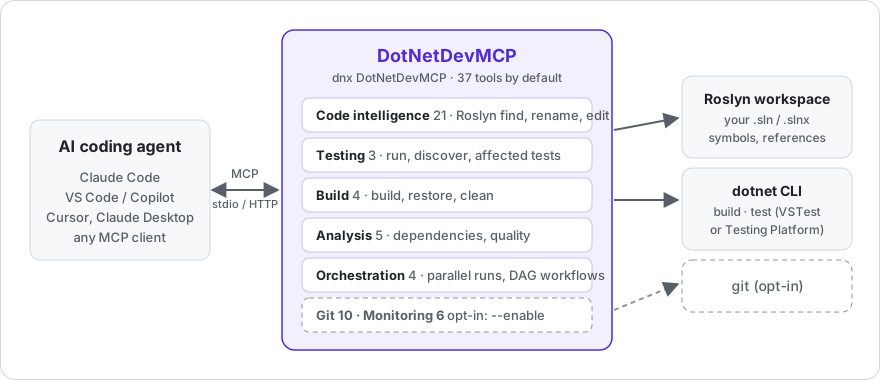
New here? The wiki has a first-session tutorial, setup for every MCP client, and troubleshooting.
Install
Requires the .NET 10 SDK.
Claude Code
VS Code / Visual Studio (.mcp.json or .vscode/mcp.json)
Claude Desktop / Cursor / any stdio client (mcpServers form)
dnx downloads the package from NuGet.org on first run. Prefer a permanent install? dotnet tool install -g DotNetDevMCP, then use dotnetdevmcp as the command.
Pass --load-solution <path> to have Roslyn load your solution at startup, or let the agent call SharpTool_LoadSolution when it needs to. --http --port 3001 serves Streamable HTTP instead of stdio (localhost only, no authentication: see Security); it rejects requests carrying a foreign Origin header or a non-localhost Host header. --allowed-origin <origin> (repeatable) adds an extra origin to that allow-list, e.g. --allowed-origin http://localhost:5173 for a local dev-server proxy that forwards its Origin - the server sends no CORS headers, so this doesn't let a browser page call it directly. --clean-env starts dotnet and git with a minimal environment so tokens and cloud credentials in environment variables aren't passed on. dotnetdevmcp --help lists everything.
Git and Monitoring tools (see the table below) are off by default - a shell an agent already has covers them, and every registered tool costs context tokens in every session. Pass --enable git,monitoring (comma-separated and/or repeated, e.g. --enable git --enable monitoring) to turn either or both on.
By default, the Roslyn edit tools (SharpTool_RenameSymbol, OverwriteMember, AddMember, MoveMember, FindAndReplace, CreateRoslynDocument, OverwriteRoslynDocument, ManageUsings, ManageAttributes) never touch git - they apply changes to disk and return the usual compile-check output, nothing else. Pass --git-commit-edits to opt into the old behavior: each edit creates a sharptools/<timestamp> branch (if you aren't already on one) and commits the change, which is also what SharpTool_Undo needs in order to revert. Without the flag, SharpTool_Undo returns an explanatory error instead of failing obscurely. (--disable-git still exists but is a no-op now that git integration is opt-in by default.)
What the agent gets
| Group | Tools | What they do |
|---|---|---|
| Code intelligence (Roslyn) | 21 | Load a solution; search and view definitions; find references and implementations; add, overwrite, move and rename members; manage usings and attributes; find-and-replace with syntax awareness; complexity analysis; undo. Forked from SharpTools. |
| Testing | 3 | dotnet_test_run (one dotnet test per project or solution, TRX parsed into per-test results with messages and stack traces), dotnet_test_discover, and dotnet_test_affected: Roslyn walks references from your changed files to the test methods that reach them, and runs only those. |
| Build | 4 | dotnet build, restore, clean, build with MSBuild properties. Structured error/warning output. |
| Analysis | 5 | Project dependency graph, circular-dependency detection, quality metrics, outdated-package scan. |
| Orchestration | 4 | orchestrate_parallel runs any of the server's own tools concurrently; execute_workflow runs them as a DAG. Resource limits and metrics. |
| Git (opt-in) | 10 | Status, branches, checkout, stage, commit, diff, log, push, pull. Enable with --enable git. |
| Monitoring (opt-in) | 6 | Process performance metrics, GC stats, resource utilization, health check, profiling sessions. Enable with --enable monitoring. |
Things you can say to an agent with this server attached:
- "Load
MyApp.sln, find every implementation ofIOrderRepository, and renameGetByIdtoFindByIdacross the solution." - "Run only the tests affected by what I just changed, and show me the failures with stack traces."
- "Build the API and the worker projects at the same time, then run both test projects."
- "Which projects have circular dependencies?"
Orchestration
The tools above are individually useful. The orchestrator is what makes them fast. Any tool on the server can be dispatched by name, in parallel or as a dependency graph, from a single call:
build-tests, build-worker and deps start immediately; test-api waits for build-tests. Steps are throttled by a resource manager (default: processor count, adjustable with configure_resource_limits). Failures are reported per step; a failed dependency stops its dependents.
Under the hood this is ConcurrentExecutor / WorkflowEngine / ResourceManager, plain C# classes in DotNetDevMCP.Orchestration that can be used without MCP.
Numbers
Measured with BenchmarkDotNet on an i7-10750H, .NET 10.0.9. The orchestration benchmarks use Task.Delay stand-ins for I/O-bound work, so they measure the engine's overhead and scheduling, not dotnet itself.
| Scenario (20 ops × 50 ms) | Mean | vs sequential |
|---|---|---|
| Sequential | 1,237 ms | 1.00 |
ConcurrentExecutor, throttled to 5 | 246 ms | 0.20 |
ConcurrentExecutor, unthrottled (12 cores) | 123 ms | 0.10 |
WorkflowEngine with dependencies | 185 ms | 0.15 |
Task.WhenAll (lower bound) | 62 ms | 0.05 |
| Workflow with a mix of dependent and independent steps | Mean | vs sequential |
|---|---|---|
| Sequential | 308 ms | 1.00 |
WorkflowEngine | 185 ms | 0.60 |
Affected tests
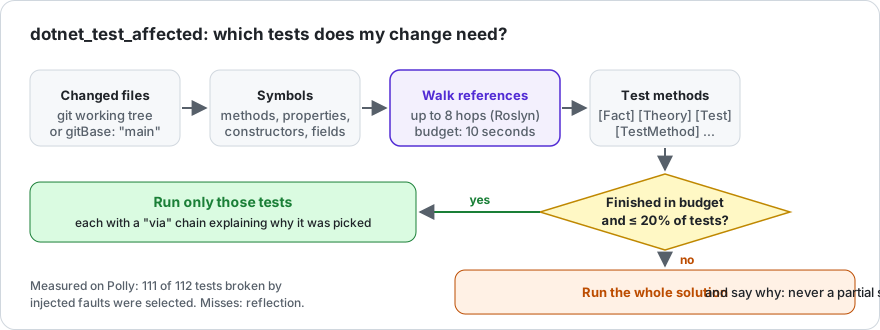
After an edit, the agent usually reruns the whole suite. dotnet_test_affected asks Roslyn instead: take the symbols declared in the changed files, follow references (up to maxDepth hops, default 8) until you land in a method with [Fact], [Theory], [Test], [TestCase] or [TestMethod], then run exactly those. Changed files default to the git working tree, or gitBase: "main" for a branch. dryRun: true lists the tests without running them; framework: "net10.0" runs one target framework of multi-targeted test projects.
Related MCP Servers
Reviews
No reviews yet — be the first to share how this listing worked for you.
Frequently Asked Questions about Dotnetdevmcp
AllMCPs Directory Badge
Showcase your server listing on GitHub or your project documentation. Embed this dynamic SVG badge to highlight official listing status and live engagement.
Badge Style:
Live Dynamic SVG Preview
Markdown (GitHub README)
[](https://allmcps.com/mcp/dotnetdevmcp)HTML Embed
<a href="https://allmcps.com/mcp/dotnetdevmcp"><img src="https://allmcps.com/api/badge/dotnetdevmcp?style=directory" alt="Dotnetdevmcp on AllMCPs" /></a>