Keymem README
The full upstream README, mirrored here for reference. Install config, tool schemas, adoption signals, and an original overview live on the Keymem listing page.
keymem


The associative memory layer for LLM agents — recall by association, not just similarity.
Most agent memory is a vector store. It surfaces what sounds like your query — and misses everything your query is connected to.
keymem stores memories in a key graph instead. A search for "Newton" can still reach "strawberries" — Newton → apple → fruit → strawberry. The path lives in the graph, not in embedding space. It runs locally as an MCP server, so any MCP-compatible agent gets human-like associative recall with no external database.
Works with: Claude Desktop · Claude Code · any MCP-compatible LLM agent
Why associative memory?
Vector-store memory retrieves by embedding similarity. That works until the thing you need isn't similar to the words you typed:
A person makes the leap anyway — Newton reminds them of the apple, apples are fruit, they like strawberries. keymem makes that same leap because the path exists in the key graph: Newton → apple memory → fruit key → strawberry memory. No embedding distance connects "Newton" and "strawberry"; a chain of shared keys does.
This is the core idea: memories are not islands ranked by distance. They are nodes in an N:M key/value graph that an agent can walk.
How it works
Memories live in a Value Space, reached through a separate Key Space — one memory reachable via many keys, one key leading to many memories.
recall("Newton") returns matching key clusters such as [Newton] and [apple] plus one passive Top-1 memory under the strongest key. That memory carries matched_key, validity, and connected_keys, so the agent can answer immediately or continue through read_key(fruit).
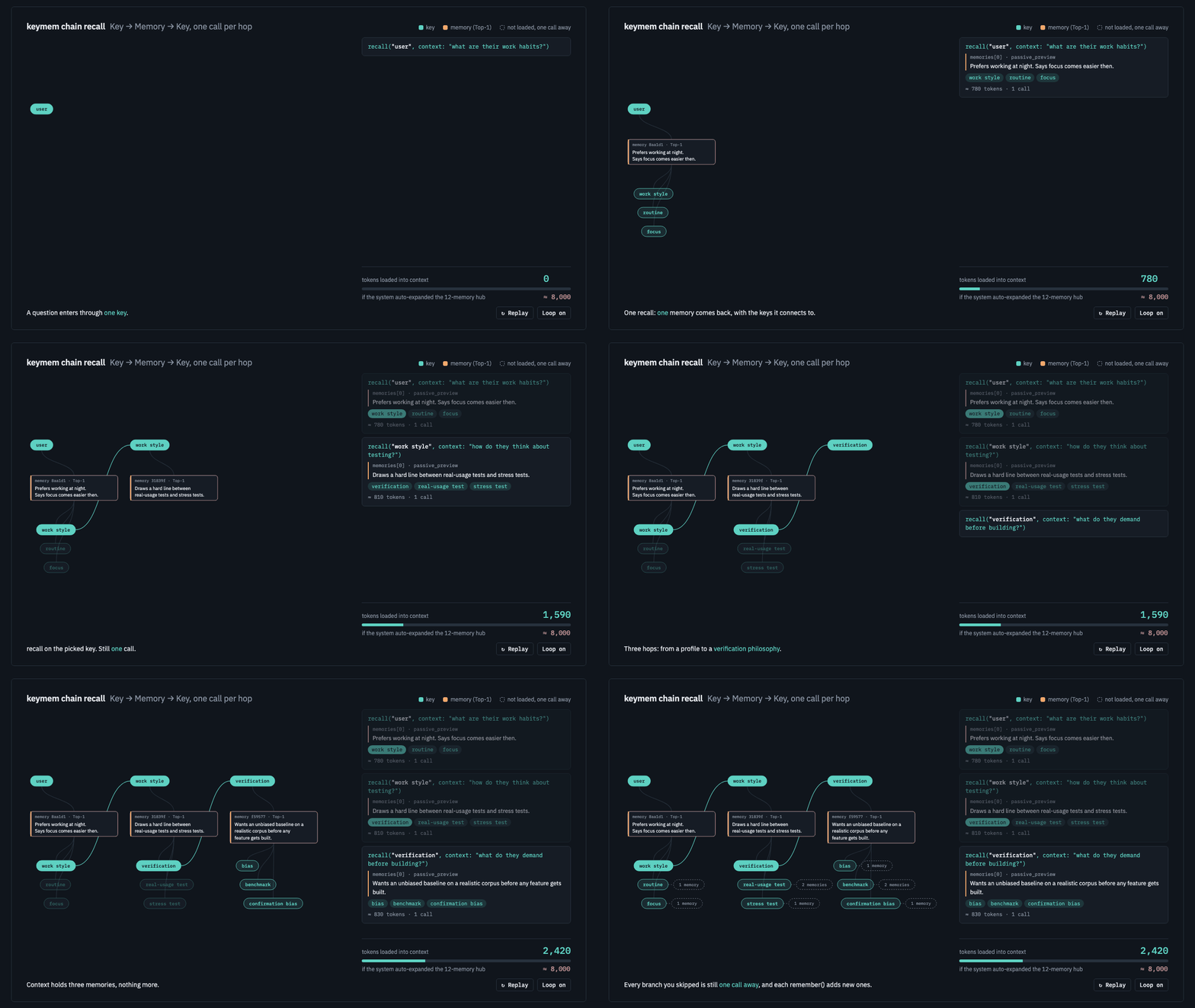
The default MCP flow remains Key → Memory → Key, but its first Key → Memory hop is completed in one call. Only one memory enters context automatically; later hops remain deliberate.
The animation at the top shows this on a real store: three recall() calls walk from a profile key to a verification philosophy, loading three memories (~2.4k tokens). The branches the agent skipped are still one call away, and auto-expanding the same 12-memory hub would have cost ~8k tokens. The graph knows the roads; the agent decides the steps. Source: docs/demo/chain-walk.html.
Quick Start
keymem is an MCP server (a CLI), not a library. Run it with
npx -y keymem(recommended — always the latest) or install the command globally withnpm i -g keymem. Do not add it to your app withnpm i keymemas a dependency: it bundlesopenai,zod, and the MCP SDK, so inside an existing project it just duplicates those trees (and can clash with your app'szod/openaiversions). Thenpm i keymemline npm shows on the package page is for libraries — it doesn't apply here.
Claude Desktop
Add to claude_desktop_config.json:
OpenAI embeddings:
Local embeddings (no API key required) — bge-m3 recommended:
bge-m3(multilingual, recommended) auto-downloads ~570MB on first run, then caches. OmitLOCAL_EMBEDDING_MODELfor the lighter default (fast-multilingual-e5-large). Cross-encoder reranking is part of the core recall path and downloads a second model on first use; set"KEYMEM_RERANK": "false"only to disable it.
Plugin (recommended — Claude Code & Codex)
The repo is also a plugin marketplace, so one install wires up everything: the MCP server
(daemon-backed shim), the UserPromptSubmit hook that passively surfaces related memories on every
prompt, and the keymem skill carrying the recall/remember protocol.
Claude Code:
Codex CLI:
Codex prompts once to trust the hook; approve it or the push path stays silent. The plugin defaults
to local bge-m3 embeddings (auto-downloads ~570MB on first run, no API key). For OpenAI
embeddings, use the manual setup below instead — plugin MCP servers only see the env they declare.
Claude Code (manual)
Codex CLI (manual)
Use the keymem-shim entry point (not bare keymem): it runs the shared daemon the push-path hook
talks to. For the hook, add to ~/.codex/config.toml:
Codex only forwards the env vars declared in its MCP entry, so pass every KEYMEM_* /
SUPER_MEMORY_* override with --env.
That's it — recall and remember work immediately. The agent calls recall before its first reply, navigates with read_key/read_memory, and saves with remember.
For reliable proactive saving in Claude Code, add the following to ~/.claude/CLAUDE.md (MCP prompts are not automatically applied as persistent Claude Code instructions):
In Codex, put the same block in ~/.codex/AGENTS.md. (The plugin install ships this as the keymem
skill instead, so you can skip it there.)
For other MCP clients, include the memory_system_prompt MCP prompt in the agent's persistent system instructions.
Manual / Development
Create .env:
Or use local embeddings (no API key required):
Requirements:
- Node.js 20+
- pnpm for local development
- OpenAI API key for OpenAI embeddings, or
fastembedfor local embeddings
Features
- N:M key/value graph — memories and the concepts that index them are separate spaces, linked many-to-many. One memory is reachable through many keys; one key leads to many memories.
- Agent-driven Key → Memory → Key navigation — the agent walks the graph deliberately instead of collapsing it into one opaque similarity search.
- Associative multi-hop recall — reach memories no embedding distance would connect, by following chains of shared keys.
- Confirmation-aware freshness — reads learn useful paths without certifying old content; explicit evidence refreshes facts across four decay profiles.
- One-step versioning — a correction retains its immediate predecessor and records what it superseded.
- Key types —
conceptkeys match by similarity;name/proper_nounkeys match exactly, so "동건" never matches "뉴턴" just for being short. - Cross-lingual key merging (IDF) —
파이썬andPythoncollapse into one canonical cluster instead of fragmenting the key space. - Hebbian link learning — the path an agent actually traverses gets reinforced ("fire together, wire together"), so useful associations become easier to reach.
- Hybrid retrieval (optional direct mode) — BM25 + dense + Reciprocal Rank Fusion, with depth/confirmation-freshness modulation and configurable multi-hop expansion.
- Cross-encoder reranking (core default) —
bge-reranker-v2-m3re-scores the passive Top-1 pool and compatibility direct-mode candidates. - Local-first — all data in a local JSON graph; no external database. OpenAI or fully-local embeddings (auto-downloaded).
Freshness and Depth
Every memory has a depth score 0.0 → 1.0, but retrieval and confirmation are separate:
| Stage | Depth | Behavior |
|---|---|---|
| Shallow | < 0.3 | Little explicit confirmation; minimal ranking boost. |
| Medium | 0.3–0.7 | Repeatedly confirmed; moderate ranking boost. |
| Deep | > 0.7 | Strongly confirmed; maximum ranking boost, but still correctable and age-sensitive. |
read_memory() increments access metadata and may reinforce the traversed key edge, but it does
not change depth, last_confirmed_at, confirmation_count, or freshness. Only
confirm_memory(memory_id, evidence) refreshes validity and increases depth +0.05; accepted
evidence is an explicit current user assertion, an authoritative current source, or direct
observation. A successful read alone is never confirmation.
Freshness decays from last_confirmed_at according to the memory's decay_profile:
| Profile | Default half-life | Intended use |
|---|---|---|
transient | 7 days | Fast-changing state such as temporary plans or availability |
standard | 90 days | General facts; the default |
stable | 365 days | Slowly changing facts |
permanent | No decay | Deliberately timeless or immutable facts |
Every memory view includes a validity payload with freshness, status (fresh, aging, or
stale), age_days, last_confirmed_at, confirmation_count, decay_profile,
verification_recommended, and verification_required. fresh means freshness is at least
0.5; aging is at least 0.125 but below 0.5; stale is below 0.125 and must not be
asserted as current without verification. Decay is soft: it lowers ranking through
0.2 + 0.8 × freshness and never deletes a memory. TTL remains the only automatic expiry mechanism.
For example, save a temporary plan with remember(..., decay_profile:"transient"); after the user
explicitly says it is still current, call confirm_memory(memory_id, evidence:"user"). Do not
confirm merely because read_memory returned it.
Key Types
Not all keys should behave the same. Names shouldn't match semantically — "동건" shouldn't match "뉴턴" just because they're both short Korean words.
| Type | Matching | Use Case |
|---|---|---|
concept (default) | Embedding similarity ≥ threshold (0.28 OpenAI / 0.60 local) | Topics, categories, attributes |
name | Exact match only | Person names |
proper_noun | Exact match only | Brands, places |
Name/proper_noun keys also get an IDF penalty (×0.5) when they become hub keys connected to many memories, preventing them from polluting unrelated searches.
Versioning (one-step predecessor)
keymem retains the immediate predecessor instead of overwriting it. The superseded record is
excluded from active retrieval regardless of its depth, and the new version becomes current. A
later correction prunes the grandparent, so provenance is one step rather than a full-history
archive.
Key Merging
Prevents key space fragmentation. The same concept across languages or phrasing stays unified.
Agent-driven Retrieval (default)
The default MCP API crosses from Key Space to one Value while preserving explicit graph navigation:
recall(query, context)returns ranked key clusters and the Top-1 memory under the strongest key. The rawcontextranks memories within that key.- The memory is a passive preview with
validity,matched_key, and everyconnected_keys[].key_id. It does not increment access/depth, reinforce links, learn aliases, or confirm freshness. - The agent can use relevant content immediately or follow a connected key with
read_key(key_id). Later memories are not automatically injected. read_memory(memory_id, via_key_id)remains the explicit full-read path. It updates access metadata and reinforces only the traversed edge; it does not confirm or deepen the memory.
Semantically merged keys are preserved as aliases on one canonical key cluster (for example Python + 파이썬). The recommended bge-m3 profile enables conservative short-key merging by default; override or disable it with KEYMEM_SHORT_KEY_MERGE. A key linked to at least three active memories is surfaced as a hub with is_hub, memory_count, and specificity metadata rather than being hidden by IDF. Override the hub threshold with KEYMEM_KEY_HUB_MIN_LINKS.
Direct Hybrid Retrieval (optional compatibility mode)
Set KEYMEM_DIRECT_RECALL=true to expose recall_memories(), a one-call memory retrieval path. Three signals run in parallel and are fused with Reciprocal Rank Fusion (RRF_K = 60):
- BM25 (sparse): lexical full-text search over memory content (MiniSearch, fuzzy + prefix). Catches exact terms, names, and rare tokens that embeddings blur.
- Dense Path A (key matching): query embedding → match keys → follow links → memories. Score =
keySim × IDF × linkWeight, summed across all matching keys. - Dense Path B (content matching): query embedding → directly compare against memory content embeddings. Finds memories even when they weren't tagged with the right keys.
Sparse and dense rank lists are merged by RRF, then modulated by depth and confirmation freshness before configurable multi-hop expansion (hops=1–5, default 2). This compatibility tool is hidden by default so agents use explicit key navigation instead of collapsing the graph into one search call.
Hebbian Link Learning
Reading a full memory is a write, not just a read. In the default flow, recall() and read_key() are read-only; read_memory(memory_id, via_key_id) reshapes the selected path:
- The traversed
via_key_id → memory_idlink is reinforced (+0.1, capped at3.0). - A full read increments access metadata but changes neither depth nor
last_confirmed_at, so it never refreshes freshness. Freshness continues to decay as elapsed time grows. Evidence-backedconfirm_memory()increases depth and refreshes freshness by advancinglast_confirmed_at.
Reinforcement is scoped to the key the agent actually traversed — not every key attached to the memory. This is the literal Hebbian rule ("fire together, wire together") and prevents unrelated associations from growing when the memory is reached through a different concept. Weights are clamped to [0.1, 3.0].
Link weights feed back into read_key() ranking, so repeatedly selected paths become easier to reach. Optional recall_memories() retains the previous matched-link reinforcement and explored-link decay behavior.
Architecture
Default MCP navigation:
- Embed the query and match canonical key concepts plus exact aliases.
- Return key clusters with
memory_count,is_hub, andspecificity; do not return memory content. - Rank a selected key's memory handles by link weight, depth, and confirmation freshness in
read_key(). - Return full content and adjacent key clusters from
read_memory(); reinforce the traversed edge only whenvia_key_idis supplied. - Repeat
read_key(next_key_id)to walk the graph deliberately.
Optional recall_memories() algorithm (hybrid, configurable 1–5 hops; default 2):
Three retrieval signals run in parallel, then get fused and expanded:
- BM25 (sparse): lexical search over memory content (MiniSearch, fuzzy
0.2+ prefix). Keep top 50. - Dense Path A (keys): embed query → match keys (concept: cosine ≥ threshold; name/proper_noun: substring match → score
1.0) → take top 10 keys → follow links. Score =keySim × IDF × linkWeight, summed across matching keys. - Dense Path B (content): compare query embedding directly against memory content embeddings (cosine ≥ threshold).
- RRF fusion: merge the BM25 and dense rank lists via
score += 1 / (RRF_K + rank + 1)(RRF_K = 60). - Depth & freshness modulation:
score × (0.9 + depth × 0.1) × (0.2 + 0.8 × freshness), using the selected 7/90/365-day half-life or no decay forpermanent. - Associative expansion (
hops, default 2): breadth-first from the directly-matched set — each round follows shared keys (× HOP_DECAY(0.3) × IDF × linkWeight) and explicitrelated_tolinks (bidirectional,× HOP_DECAY) to the next frontier.hops=Nwalks up to N steps, so a memory'shopis its shortest chain distance. Score decays byHOP_DECAYper hop. - Hebbian update: reinforce matched-key links of returned memories (
+0.1), decay explored-but-unreturned links (−0.005). - Return ranked results with
hopfield (1= direct,2+= associative distance).
Similarity thresholds (calibrated per embedding model)
Embedding backends have very different cosine distributions, so a single threshold set cannot serve all of them. The thresholds below are calibrated per model (getThresholdProfile() in src/embedding.ts):
| Threshold | OpenAI | Local BGE (en) | Local e5 (multilingual) |
|---|---|---|---|
| Key recall (query↔key cosine) | 0.28 | 0.60 | 0.85 |
| Content recall (query↔content cosine) | 0.28 | 0.50 | 0.80 |
| Key auto-link | 0.50 | 0.60 | 0.93 |
| Key merge | 0.85 | 0.85 | 0.97 |
| Memory dedup | 0.90 | 0.90 | 0.985 |
Why e5 differs so much: multilingual-e5 packs embeddings into a narrow high-cosine band (~0.86–0.99). Same-word query↔key pairs (asymmetric query:/passage: prefixes) still separate cleanly (~0.89 vs ≤0.82), but key↔key and content↔content do not — distinct facts like "A uses Postgres" and "B uses Mongo" sit at ~0.96, dangerously close to true paraphrases (~0.99). Hence e5's merge/dedup/auto-link thresholds are pushed high to avoid silently collapsing distinct memories.
Drift escape hatch: if you switch models or your data's character drifts, override any threshold without code changes:
Score gate, distribution gate, and contradiction band can also be tuned per deployment:
| Env var | Default (profile) | Description |
|---|---|---|
KEYMEM_MIN_SCORE | per-model (e.g. 0.55 for bge-m3) | Absolute cosine floor for optional recall_memories(). Set to 0 to disable. |
KEYMEM_GATE_Z | 0 by default | Opt-in distribution gate for recall_memories() (robust-z, median/MAD). Values around 2–5 are typical; 0 disables it. |
KEYMEM_CONTRADICTION | per-model (e.g. 0.80 for bge-m3) | Contradiction-band lower bound. Memory pairs whose cosine similarity falls in [contradiction, memoryDedup) are flagged as contradictions. read_memory(), related(), and optional recall_memories() expose conflicting IDs. |
KEYMEM_AUTOKEY | true | Auto-key self-healing: learn missing search terms from real usage. Set false to disable. |
KEYMEM_AUTOKEY_PROMOTE_N | 3 | Routing-confirmed selections of a (key, query) pair before the query is folded into the key space. |
KEYMEM_AUTOKEY_CONFIRM_FLOOR | 0.45 | Lowest query↔key cosine eligible for routing-confirmation learning. Repeated selections through the same key can teach a below-gate query alias; this confirms routing only, never content freshness. Lower (e.g. 0.40) to catch more borderline paraphrases; set ≥ the recall threshold to disable. |
KEYMEM_AUTOKEY_MAX_ALIASES | 8 | Max learned aliases promoted per key. |
KEYMEM_AUTOKEY_PRUNE_AGE | 2592000 | Seconds before a never-hit learned alias is pruned by cleanup_expired (30 days). |
KEYMEM_DECAY_TRANSIENT_DAYS | 7 | Half-life in days for transient memories. Must be finite and greater than zero. |
KEYMEM_DECAY_STANDARD_DAYS | 90 | Half-life in days for the default standard profile. Must be finite and greater than zero. |
KEYMEM_DECAY_STABLE_DAYS | 365 | Half-life in days for stable memories. Must be finite and greater than zero. |
Why e5 gates are opt-in: multilingual-e5's narrow cosine band (~0.86–0.99) makes a static floor unreliable, while held-out tests showed distribution and key-proximity gates can also overfit. Both are disabled by default to avoid hiding real memories. Use bge-m3 for reliable not-found behavior, or calibrate e5 gates on your own corpus.
Distribution gate parameters:
gateZ— set viaKEYMEM_GATE_Zor themin_zparameter of optionalrecall_memories().0disables the gate (default for bge-m3, bge, openai, minilm — wheremin_scorealready works).- Both gates compose (AND): a result must clear both
min_scoreandgateZto be returned. - A literal name/proper-noun key match (e.g. querying a stored
name-typed key exactly) is always a definite anchor and bypasses the distribution gate. GATE_MIN_POPULATION = 8: the gate is skipped when fewer than 8 memories exist (too few samples for a reliable distribution), so early-session recall is unaffected. The gate's background population is namespace-filtered and excludes superseded/expired memories, so recall scoped to a sparse namespace may fall below this threshold and skip the gate entirely.- Known e5 limitation: the optional gate keys off
maxContentSim(content cosine only). A relevant fuzzy-key hit with a flat content distribution may be rejected; literal key matches bypass the gate.
An uncalibrated LOCAL_EMBEDDING_MODEL falls back to the BGE profile and logs a warning so the miscalibration is never silent.
Multilingual note: cross-lingual content matching has a same-language bias (a Korean query scores Korean memories higher regardless of meaning). The reliable cross-lingual path is the key graph — tag memories with keys in multiple languages (e.g.
["딸기", "strawberry"]) so recall hits the key exactly instead of relying on biased content similarity.
MCP Tools
The full trusted-local tool set contains 16 tools by default. Plain untrusted
servers hide the two transcript tools (list_sessions, get_conversation):
| Tool | Description |
|---|---|
recall(query, top_k?, namespace?, context?, explain?) | Return ranked keys plus one passive Top-1 memory with validity, matched_key, and connected_keys. explain:true also returns namespace counts. |
browse_keys(namespace, hubs_only?, limit?, offset?) | Browse a namespace's active key vocabulary, hubs first, when recall has no entry hit. |
read_key(key_id, query?, namespace?, limit?, offset?) | List ranked memory IDs and metadata connected to one key. Pass the original query for relevance ordering; supports pagination for hubs. |
read_memory(memory_id, via_key_id?, namespace?) | Read full memory content, connected keys, and validity. Updates access and, when via_key_id is supplied, that traversed edge; never confirms or deepens content. |
confirm_memory(memory_id, evidence, namespace?, source?) | Refresh freshness and deepen a current memory after explicit user evidence, an authoritative source, or direct observation. A read alone is not evidence. |
remember(content, keys, key_types?, namespace?, ttl_seconds?, decay_profile?, related_to?) | Save memory with key concepts, optional TTL, and a transient, standard, stable, or permanent decay profile. |
correct(memory_id, content, keys?, key_types?, ttl_seconds?, decay_profile?, related_to?) | Versioned update. The immediate predecessor is preserved but inactive; omitted TTL/profile inherit from it. |
dismiss(memory_id, key_id, namespace?) | Negative feedback: the fact is fine, this key should not have surfaced it. Weakens that one edge (floored, never severed) and cancels its pending alias learning |
related(memory_id) | Find memories sharing keys (associative exploration) |
forget(memory_id) | Permanently delete |
list_sessions(agent?, limit?) | Discover recent host-agent conversation sessions (Claude Code, Codex) on this machine, newest first |
get_conversation(session_id, turn?, agent?) | Load original conversation turns from the host agent's on-disk transcript (Claude Code / Codex), normalized to {turn, role, content, ts} |
list_memories(namespace?) | List active memories with keys, depth, access count, and validity |
remember_batch(items) | Save multiple memories; each item accepts ttl_seconds and decay_profile |
cleanup_expired() | Delete memories whose TTL has expired |
memory_stats() | Get current key/memory/link counts |
Scores carry score_kind. Key recall exposes cosine-like key_relevance; read_key exposes content_relevance plus a within-key rank score; injected/direct memories expose relevance_score separately from their small RRF rank_score. Compare thresholds only within the same score kind.
Set KEYMEM_DIRECT_RECALL=true to expose a seventeenth compatibility tool, recall_memories(...), with BM25+dense+RRF multi-hop behavior.
A system prompt template is also available via the memory_system_prompt MCP prompt — include it to instruct the agent to recall silently, use diverse keys, and never mention the memory system to users.
Local embedding models
BGE-M3 (recommended, multilingual) — auto-downloaded: set LOCAL_EMBEDDING_MODEL=bge-m3 (aliases: bgem3, baai/bge-m3, fast-bge-m3). On first use the model is fetched automatically if missing — quantized ONNX (~570MB, from onnx-community/bge-m3-ONNX) plus the tokenizer/config (from BAAI/bge-m3) — and cached under ~/.keymem/models/bge-m3. No manual download needed:
First run downloads ~570MB once, then reuses the cache. If
LOCAL_EMBEDDING_MODEL_PATHalready holds the model it is used as-is with no download (a partial dir is self-healed — only missing files are fetched). Online-API backends (OpenAI) and fastembed built-ins are unaffected.
bge-m3 runs on its own ONNX session, not through fastembed. fastembed pads every input to 512 tokens, so a 4-token query cost as much as a full page — 199ms and a 9.6-core burst on every recall. Tokenizing to the actual length is 23x less CPU (15ms) at identical retrieval quality:
npm run bench(92%/97%/0.93), the ablation grid, andreal-evalover a 3018-vector live store all score the same, case for case. Pooling is unchanged (CLS + L2), but unpadded vectors sit ~0.98 cosine from padded ones, so the embedding fingerprint islocal:bge-m3+nopadand an existing graph re-embeds itself once on first load after upgrading (agraph.json.bak.local_bge-m3backup is written first). Other model families still use fastembed.
Cross-encoder reranking (core): the default recall() Top-1 path re-scores the candidate pool under its strongest key with bge-reranker-v2-m3. Compatibility recall_memories() results are reranked too. The model (~570MB, quantized) auto-downloads on first use and caches under ~/.keymem/models/reranker.
On by default. If the model cannot load, recall falls back to fused ranking. Query decomposition remains the caller's responsibility.
Reranker not-found gate (KEYMEM_RERANK_MIN_SCORE): in direct compatibility mode, reject the complete recall_memories() result when the top cross-encoder logit is below this floor.
⚠️ Caveats. (1) Unset by default — no gate. (2) The logit scale is model-dependent;
0(≈ sigmoid 0.5) suitsbge-reranker-v2-m3(measured: same-language found ≈ +3.9, not-found ≈ −5 to −6) — recalibrate for other rerankers. (3) Trusted for SAME-LANGUAGE only. Cross-lingual relevance logits run low even when relevant (KR query ↔ EN memory ≈ −5.4), so the gate auto-bypasses on a script mismatch (KR↔Latin) to avoid false-rejecting cross-lingual hits — which means cross-lingual content must be reachable via bilingual keys (["Jiwoo","지우"]), and cross-lingual not-found precision is a known limitation. Leave this off if you can't tag bilingual keys.
Prefix behavior: BGE-M3 does not use
passage:/query:prefixes — embeddings are passed through as-is. All other local models (e5, BGE-en, MiniLM) continue to use prefixes unchanged.
Recommended for multilingual / cross-lingual use:
bge-m3. It separates unrelated queries more reliably and performs substantially better than e5 on the project's Korean↔English fixtures. For the optional direct-mode not-found gate, bge-m3's absolutemin_scorereaches ≈96% on the gate fixture; e5 requires corpus-specific tuning.
If OPENAI_API_KEY is not set and EMBEDDING_BACKEND is unset, the server automatically uses the local fastembed backend.
For English-only use or lower local resource usage, set LOCAL_EMBEDDING_MODEL=fast-bge-base-en-v1.5 or fast-bge-small-en-v1.5.
Switching backends is safe. The graph records an embedding fingerprint (backend + model id) identifying the vector space its embeddings live in. On startup, if the current backend's fingerprint or dimension differs from what is stored, the graph auto-migrates — every key and memory is re-embedded with the new backend while content, links, depth, and access history are preserved (a
graph.json.bak.*backup is written first). The fingerprint matters because two models can share a dimension yet produce incompatible vectors (e.g.fast-multilingual-e5-largeandbge-m3are both 1024-d); a dimension check alone would miss that swap and silently corrupt every similarity. Disable withKEYMEM_AUTO_MIGRATE=false. Re-embedding via OpenAI incurs one-time API cost proportional to your memory count.Migrating a pre-fingerprint (legacy) graph across same-dimension models. A graph written before fingerprinting has no recorded vector space, so a same-dimension model swap off it cannot be detected automatically. Set
KEYMEM_FORCE_REEMBED=truefor one startup to re-embed unconditionally and stamp the fingerprint; remove it afterward (left on, it re-embeds on every start). This is exactly the one-shot needed when moving an existing e5 graph to bge-m3.
Data Storage
All data is local. No external database required.
Set KEYMEM_DATA_DIR to use a different storage directory.
get_conversation / list_sessions read the host coding agent's own transcripts directly — keymem does not record conversations itself. Locations are auto-detected per OS and honour the agents' env overrides:
- Claude Code —
~/.claude/projects/**/{session_id}.jsonl($CLAUDE_CONFIG_DIR) - Codex —
~/.codex/sessions/**/rollout-*-{session_id}.jsonl($CODEX_HOME)
session_id is restricted to a UUID and resolved within these roots (with symlink checks) to prevent path traversal.
Access is gated. Because transcripts are local, potentially sensitive history, get_conversation and list_sessions are only exposed when keymem is trusted as the owner's personal local agent — i.e. a recognized host injected its session env (CLAUDE_CODE_SESSION_ID / CODEX_THREAD_ID), or you explicitly opt in with KEYMEM_TRANSCRIPT_ACCESS=true. Otherwise (a plain server, a remote deployment, a non-owner/custom agent) the two tools are hidden from tools/list, calling them is refused, and memories are saved without a host link. Set KEYMEM_TRANSCRIPT_ACCESS=false to force-disable even under a host agent.
Linking a memory to its source conversation. When you save a memory, keymem stamps the active host session onto its source (host_session / host_agent / host_turn) so a recalled memory can drill back to the verbatim exchange via get_conversation. The active session is found two ways:
- Deterministic — the host injects its session id into every MCP server it spawns, and keymem reads it directly: Claude Code →
CLAUDE_CODE_SESSION_ID, Codex →CODEX_THREAD_ID(which equals the rollout file's session id). The link is exact, with no guessing. - Heuristic fallback — for hosts that don't expose a session id (e.g. Claude Desktop), keymem uses the most-recently-modified transcript (with a staleness guard). Reliable for a single active session; if ambiguous, use
list_sessionsto pick the right one.
Benchmarks
On HotpotQA bridge questions (real external multi-hop data, gold labels, no LLM judge — and
keys generated blind by independent subagents that never saw the question or answer), the
key-graph retrieves both gold supporting paragraphs 63% of the time vs 53% for flat
semantic retrieval and 35% for lexical (+10pp / +28pp) — the connected-but-dissimilar case
it's built for. (Honest: my own hand-derived keys inflated this to 78/60; on non-multi-hop
"comparison" questions the graph slightly hurts; it's retrieval-recall, not answer accuracy.)
The read path is also O(1) (read_memory p50 ~45ms → ~0.01ms @ 500 memories). Full methodology
and caveats: BENCHMARKS.md.
Limitations
- Linear scan — suitable for personal use (~10k memories). FAISS/ChromaDB integration planned for larger scale.
- Later-hop round trips —
recallcompletes the first Key → Memory hop, but following a connected key to another memory still requiresread_key → read_memory. - Hub breadth — broad keys can connect many memories.
read_key()paginates hubs; the agent must choose whether to continue paging or follow a more specific adjacent key. - Agent quality matters — key selection on
rememberaffects retrieval quality. System prompt tuning is important. - Cross-lingual content bias — with multilingual e5, raw content similarity favors same-language memories regardless of meaning. Tag memories with multilingual keys so the key graph (not biased content cosine) carries cross-lingual recall.
- Threshold calibration — thresholds are tuned per embedding model. A new/uncalibrated model falls back to the BGE profile (with a warning); recalibrate via the
KEYMEM_*env overrides.
Testing
scenarios.ts and robustness.ts exercise the real local embedding backend (direct/associative/cross-lingual recall, versioning, depth growth, dedup, TTL, Hebbian learning, namespace isolation). They double as a recalibration harness when tuning thresholds for a new model.
Roadmap
- FAISS/ChromaDB for scale
- Coding agent profile (different key strategies for code context)
- Memory export/import
- Multi-user support
Author
donggyun112 — github.com/donggyun112
Repository: donggyun112/keymem · Issues & PRs welcome.
License
MIT © donggyun112