dockercontainerrepositoriessearchdeveloper-tools
MCP server providing Docker Hub API access for searching and managing repositories and images.
Quick Install
Automated & IDE SetupCopy the AI prompt to install this server into Claude Code, Cursor, or another agent — or use 1-click editor setup below.
Not yet automatically verified
We haven't yet run this listing's install command through our automated sandbox check. This isn't a red flag — we're steadily working through the catalog.
Manual Client & Custom JSON ConfigExpand JSON ▾
Client Config & Setup
Choose your client or environment
Target File:
💡 Paste the JSON block into your client's configuration file under mcpServers, then restart the application.
Overview
Use cases
Search Docker Hub repositories and images with filters
Retrieve detailed information about Docker repositories
Check existence of repositories and specific tags
Create and update Docker repositories programmatically
Integrate Docker Hub data into AI-powered container workflows
Key features
Search repositories with advanced filters (architecture, OS, badges, categories)
List namespaces and repositories under namespaces
Get repository metadata and check repository/tag existence
Create and update repository information
Supports both unauthenticated public access and authenticated user access
Configurable HTTP and stdio transport modes with security options
Capabilities & Tool Schemas (35)
Inspect callable tools, capabilities, and parameters exposed to AI agents by Hub MCP.
searchSearch repositories and content using Search V4 API
querySearch query parameter (string, required)
architecturesFilter on architectures (string, optional)
badgesFilter by image content type badges (string, optional)
categoriesFilter on categories (string, optional)
extension_reviewedFilter on reviewed extensions (boolean, optional)
Documentation Overview
Docker Hub MCP Server
The Docker Hub MCP Server is a Model Context Protocol (MCP) server that interfaces with Docker Hub APIs to make them accessible to LLMs, enabling intelligent content discovery and repository management.
Developers building with containers, especially in AI and LLM-powered workflows, often face inadequate context across the vast landscape of Docker Hub images. As a result, LLMs struggle to recommend the right images, and developers lose time manually searching instead of building.
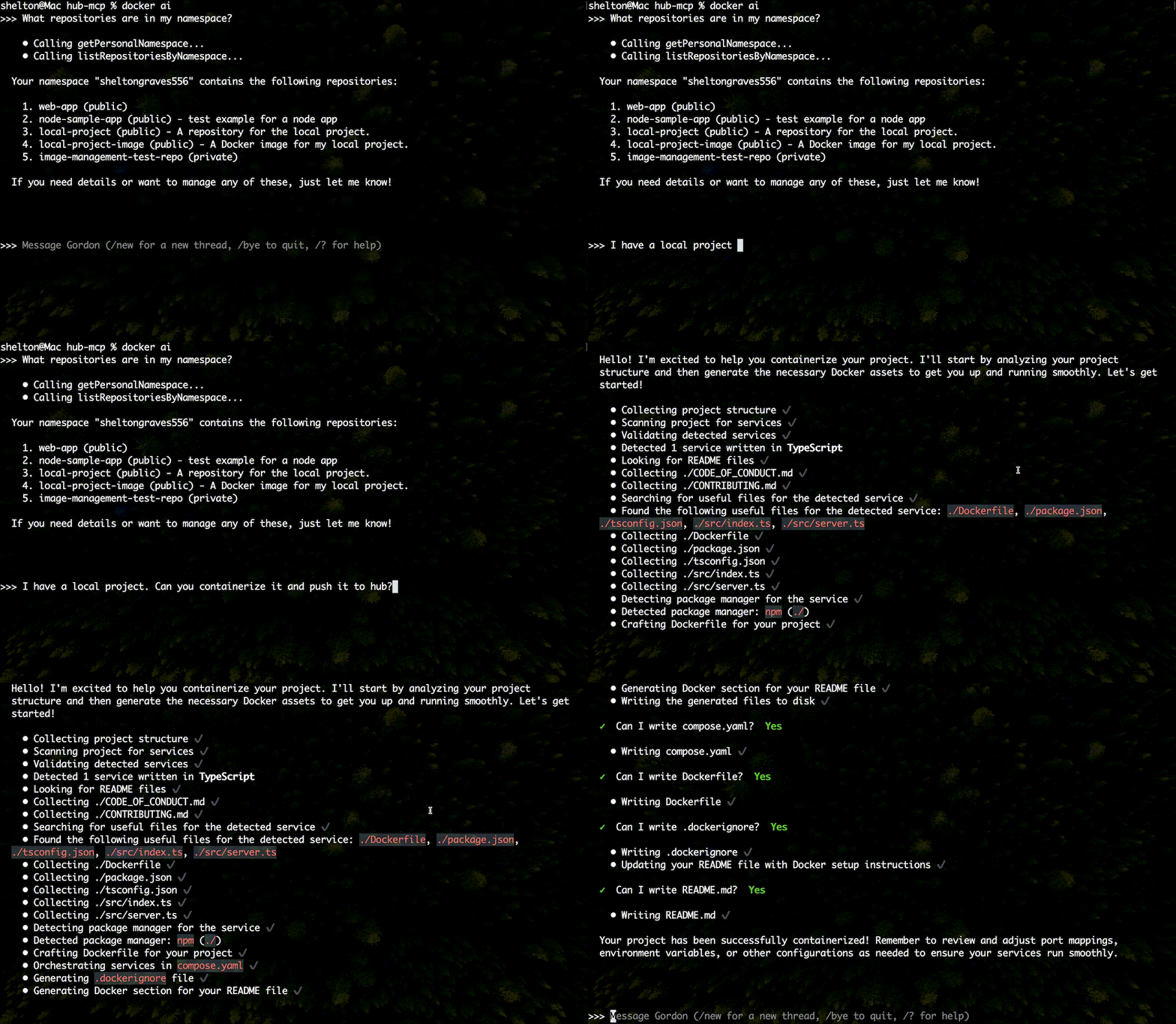
Use Cases
- AI-powered image recommendations - LLMs access real-time Docker Hub data for accurate container image suggestions.
- Enhanced content discovery - AI tools help developers find the right images faster.
- Simplified Hub workflows - Manage Docker repositories and images using natural language.
Prerequisites
- Docker installed
- Node.js (version 22+)
- [Optional] A Docker Personal Access Token (PAT) with appropriate permissions
Setup
-
Build
-
Run
- Default args:
transport: Choose betweenhttporstdio(default:stdio)port=3000host=127.0.0.1(HTTP transport only) This starts the server with default settings and can only access public Docker Hub content.
[!IMPORTANT] The
httptransport binds to127.0.0.1(loopback) by default and requires authentication. See Securing the HTTP transport before exposing it to a network.
Run in inspector [Optional]
The MCP Inspector provides a web interface to test your server:
Securing the HTTP transport
The stdio transport is only reachable by the local process that spawns it. The
http transport, however, dispatches every tool call using the server operator's
Docker Hub Personal Access Token (HUB_PAT_TOKEN). Anyone who can reach the HTTP
endpoint can therefore act as that Docker Hub identity — including creating and
modifying repositories. To prevent this, the HTTP transport is locked down by
default:
- Loopback binding. The listener binds to
127.0.0.1unless you pass--host=<addr>(for example--host=0.0.0.0to expose it from a container). - Authentication required (fail-closed). In
httpmode the server refuses to start unless you either provide a bearer token or explicitly opt out. Set the token via theMCP_AUTH_TOKENenvironment variable; clients must then send it asAuthorization: Bearer <token>on every request. - DNS-rebinding / CSRF protection. Requests are rejected when the
Hostheader is not in the allow-list (loopback plus--host, extendable with--allowed-hosts), or when they carry a browserOriginheader that is not listed in--allowed-origins. Non-browser MCP clients are unaffected.
Run the HTTP transport with authentication:
Expose it beyond loopback (e.g. inside a container), still authenticated:
| Flag / env var | Purpose |
|---|---|
MCP_AUTH_TOKEN | Bearer token required on every /mcp request. |
--host=<addr> | Address to bind (default 127.0.0.1). |
--allowed-hosts=a,b | Extra Host header values to accept (comma-separated). |
--allowed-origins=a,b | Browser Origin values to accept (comma-separated). |
--allow-unauthenticated | Serve /mcp with no authentication. Insecure; opt-in only. |
[!WARNING]
--allow-unauthenticateddisables authentication entirely and exposes your Docker Hub PAT to any client that can reach the port. Only use it on a trusted, isolated network.
Authenticate with docker
By default this MCP server can only query public content on Docker Hub. In order to manage your repositories you need to provide authentication.
Run with authentication
Run in inspector [Optional]
Usage in Docker Ask Gordon
You can configure Gordon to be a host that can interact with the Docker Hub MCP server.
Gordon Setup
Ask Gordon is your personal AI assistant embedded in Docker Desktop and the Docker CLI. It's designed to streamline your workflow and help you make the most of the Docker ecosystem.
You can configure Gordon to be a client that can interact with the Docker Hub MCP server.
- Create the
gordon-mcp.ymlfile file in your working directory. - Replace environment variables in the
gordon-mcp.ymlwith your Docker Hub username and a PAT token.
- Run
docker build -t hub . - Run
docker ai
Usage in other MCP Clients
Usage with Claude Desktop
NOTE: Make sure you have already built the application as mentioned in Step 1.
- Add the Docker Hub MCP Server configuration to your
claude_desktop_config.json:
NOTE: if you are using nvm to manage node versions, you should put the node binary path in the
commandproperty. This ensure MCP server runs with the right node version. You can find your binary path by runningwhich nodein your shell
For public repositories only:
/FULL/PATH/TO/YOUR/docker-hub-mcp-server- The complete path to where you cloned this repository
For authenticated access (recommended):
Replace the following values:
YOUR_DOCKER_HUB_USERNAME- Your Docker Hub usernameYOUR_DOCKER_HUB_PERSONAL_ACCESS_TOKEN- Your Docker Hub Personal Access Token/FULL/PATH/TO/YOUR/docker-hub-mcp-server- The complete path to where you cloned this
- Save the configuration file and completely restart Claude Desktop for the changes to take effect.
Usage with VS Code
- Add the Docker Hub MCP Server configuration to your User Settings (JSON) file in VS Code. You can do this by opening the
Command Paletteand typingPreferences: Open User Settings (JSON).
For public repositories only:
/FULL/PATH/TO/YOUR/docker-hub-mcp-server- The complete path to where you cloned this repository
For authenticated access (recommended):
Replace the following values:
YOUR_DOCKER_HUB_USERNAME- Your Docker Hub usernameYOUR_DOCKER_HUB_PERSONAL_ACCESS_TOKEN- Your Docker Hub Personal Access Token/FULL/PATH/TO/YOUR/docker-hub-mcp-server- The complete path to where you cloned this
- Open the
Command Paletteand typeMCP: List Servers. - Select
docker-huband selectStart Server.
Task Examples
Finding images
Repository Management
Related MCP Servers
Adoption & maintenance
Factual signals from GitHub, npm, and our automated checks — not a rating.
GitHub stars
163
Stargazers on the source repository.
npm downloads
1M
Package downloads in the last 30 days.
Last commit
15d ago
Most recent push to the default branch.
Tools exposed
35
Callable tools this server registers over MCP.
Directory activity
2 views
Config copies, upvotes, and views on AllMCPs.
Reviews
No reviews yet — be the first to share how this listing worked for you.
Frequently Asked Questions about Hub MCP
AllMCPs Directory Badge
Showcase your server listing on GitHub or your project documentation. Embed this dynamic SVG badge to highlight official listing status and live engagement.
Badge Style:
Live Dynamic SVG Preview
Markdown (GitHub README)
[](https://allmcps.com/mcp/docker-hub-mcp)HTML Embed
<a href="https://allmcps.com/mcp/docker-hub-mcp"><img src="https://allmcps.com/api/badge/docker-hub-mcp?style=directory" alt="Hub MCP on AllMCPs" /></a>Technical Specs & Signals
CategoryCloud Platforms
PricingFree
11/11 checks healthy over the last 33d
80Quality signal: Excellent · 80/100How this signal is calculated ▾
Server availability25/25
Verified ownership16/20
Documentation & tools27/30
Adoption & activity12/15
Community engagement0/10
A guidance signal from public completeness & health data — not a user rating. New listings start lower and rise as they add docs, get verified, and grow adoption. Signals we can't observe for a listing are skipped, not counted against it.
Supply-chain signal
2 high-severity advisories on record for this package. Most advisories affect transitive dependencies and may not be exploitable in this server's actual usage — this is a directional signal, not a security audit.
Critical 1High 1Medium 0Low 0
Scanned 27d ago via OSV.dev · @modelcontextprotocol/inspector (npm)
Share & Embed
Add our SVG badge (dark/light directory styles) or embeddable widget to your site.