DevTrack
Never write a standup again.
You commit. Tickets update, EOD reports write themselves — silently, in your voice, entirely on your machine.
devtrack — a single Go binary. Local-first. Offline by default.




The 30-second pitch
You write code. DevTrack handles the rest.
A background daemon watches your commits and infers everything around them — which ticket you're on (from the branch name), what you did today, what the standup should say. It drafts the ticket comment and the EOD report in your writing voice, learned from your own git history. Your only obligation: name branches with ticket IDs.
Nothing is sent behind your back. Every outbound action — a Jira comment, a ticket transition, an email — is staged in a review queue first. You approve it, or you let it earn auto-approve over time. The daemon never prompts you, never blocks a commit, and never interrupts.
And it's the memory your AI agents lack
Available since v3.1.0: Phase 9 onboarding and the local, read-only MCP server ship in the latest public release, v3.1.1. Five native MCPB bundles are available for Windows, macOS, and Linux.
Coding agents are session-based: they exist while invoked, then forget. DevTrack is always on. One command —
— and Claude Code knows your active ticket, today's commits, your pending queue, and how you write. Nothing else runs at 6pm, groups the day's commits by ticket, and has the EOD ready before you ask.
Trust
Local Ollama by default; SQLite on disk. The default daily path stays on your machine. If you
configure a PM system, email/chat delivery, an external server, or a cloud LLM, DevTrack sends only
the payload needed for that enabled operation. Anonymous usage telemetry is opt-in and off unless
you run devtrack telemetry on.
Ten-minute quickstart
The latest public release is v3.1.1. Download the matching platform asset from GitHub Releases, or build from source:
Verify that this is an MCP-capable build, then run setup from the Git repository you want DevTrack
to watch. Choose none when asked for a PM integration if you only want to try the local path.
Managed mode requires a PostgreSQL URL for the Python service; Ollama remains the default LLM and
can finish preparing in the background.
Minute 2: local context, no Python or model required
The Go binary and local SQLite database are ready as soon as setup finishes. Wire the current repository into Claude Code, then exercise the same MCP server locally:
Reload Claude Code after mcp setup. Its DevTrack tools can now read the active ticket, today's
commits, pending actions, voice profile, ticket context, and a template EOD summary. The MCP server
runs on demand over stdio; it does not need a background Python process.
Minutes 3–10: start the silent worker
status and doctor report background Python, PostgreSQL, and LLM readiness without blocking Git
monitoring or MCP. Once the AI server reports ready, create a normal ticket-named branch and commit:
Do not run queue approve while evaluating the no-send path. With the workspace PM integration set
to none and no --email argument, the walkthrough uses no PM credentials and has no external
destination. For a disposable, recorder-friendly version that verifies actual log output instead of
using a canned transcript, see the demo storyboard.
What is ready when?
| Capability | Available before AI readiness | Needs the managed/external Python service |
|---|---|---|
| Git monitoring, ticket extraction, local SQLite | Yes | No |
| MCP setup, self-test, and local context tools | Yes | No |
| Queue inspection and correction for local actions | Yes | No |
| Voice-aware ticket-comment generation | No | Yes |
devtrack eod generated narrative and staging | No | Yes |
The Python service and model preparation are background work. If they are not ready by minute ten,
keep coding and check devtrack doctor; the Go-native path remains usable and commits are not
blocked.
Update an existing installation
devtrack upgrade installs the latest public release, including the Phase 9 onboarding and MCP
commands introduced in v3.1.0.
The daemon mines enabled local repositories in Managed mode and builds the voice profile once the
local AI server is reachable. devtrack status and devtrack doctor show the persistent result and
suggest devtrack work report when the profile is ready.
Setup also checks Ollama's local model inventory. An existing generation model is used immediately without another pull. If no usable local model is ready and an OpenAI or Anthropic key is already in the environment, setup offers that key as a temporary fallback while Ollama downloads; Ollama stays primary and automatically takes over when the local model becomes available.
Updating? Run
devtrack upgradeto download and install the latest binary automatically (fetched from GitHub Releases; supports Linux/macOS and Windows). If the binary is in a root-owned location (e.g./usr/local/bin), runsudo devtrack upgradeinstead. On Windows, re-run as Administrator if a permission error occurs. Versioned migrations are applied automatically and the daemon is restarted after a successful upgrade.
devtrack setupwrites a complete environment file under the DevTrack XDG data directory and registers it in~/.devtrack/devtrack.conf. Visible runtime defaults are editable; valid shell, CI, and secret-manager overrides still take precedence.
Full walkthrough and guides: devtrack.cloud
Moving to a new machine?
Project memory and agent logs are committed to the repo (.claude/memory/, Data/agent_logs/). After cloning, wire up Claude Code's memory system with one command:
Claude Code will then read and write memory directly to the repo, keeping it in sync with git.
The core loop
The daemon is silent. It does not prompt, block, or interrupt — it observes and stages.
Review the queue whenever you like — it waits for you:
Optional: AI-enhanced commits
Separately, devtrack git commit is an interactive wrapper that refines your commit message with AI, offers a ticket picker, and can log time. It is opt-in and never part of the silent daemon path:
After that, git commit routes through DevTrack for monitored repos. Everything else (git push, git pull, git status) goes straight to real git, unmodified. Escape hatch: GIT_NO_DEVTRACK=1 git commit -m "skip".
AI commit enhancement is only active when the daemon is running. If you stop it,
git commitpasses through with zero delay and no errors.
What it connects to
| Integration | What DevTrack does |
|---|---|
| Azure DevOps | Post commit comments, transition work item states, create missing items; PR approval detection via ADO Pull Requests API (real IsPRApproved, vote ≥ 10) |
| GitHub | Comment on issues/PRs, sync recent activity, alert on review requests |
| GitLab | Comment on issues; list, view, create, and sync issues through the Go connector |
| Jira | Server-side webhook and PM support; Go-client connector parity is part of the staged rollout |
| Microsoft Teams | Learn your communication style for personalized AI output |
| Outlook / MS Graph | Send EOD reports by email |
| Telegram | Go-native daemon control, logs, queue review/corrections, and notifications |
| Slack | Outbound alert notifications through an incoming webhook |
| Ollama / OpenAI / Anthropic / Groq | AI commit messages, reports, conflict resolution, git-sage agent |
Key features
The pending-actions queue — nothing is sent without review
Every outbound action DevTrack wants to take is staged first, never fired blind. This is the trust primitive: one reviewable queue for everything that would otherwise write to your Jira, GitHub, or inbox.
Each action carries a confidence score. As you approve a given action type repeatedly, it can earn auto-approve — so DevTrack gets quieter the more you trust it, not louder.
End-of-day report — the standup, already written
Groups the day's commits by ticket and writes the narrative in your voice. It is staged in the queue like anything else — review it, then send.
Multi-repo monitoring
Per-workspace PM overrides (pm_assignee, pm_iteration_path, pm_area_path, pm_milestone) are applied when DevTrack creates work items or issues for that repo — Azure uses assigned_to/area_path/iteration_path, GitHub/GitLab use assignees and milestone. Omit any field to use the global default.
skip_issues: true marks a workspace as code-only — it is excluded from devtrack issues, ticket sync, and the commit-time ticket picker. Use this when the same repo is tracked in two PM platforms (e.g. GitHub for code review, Azure DevOps for sprint planning) to prevent duplicate ticket lists.
Empty repositories: If a monitored workspace has no commits yet, the daemon watches the folder silently and begins triggering normally once the first commit arrives — no log spam or errors during the empty-repo period.
Work session tracking
Every git commit while a session is active automatically attaches its hash — no manual logging.
git-sage — local LLM git agent
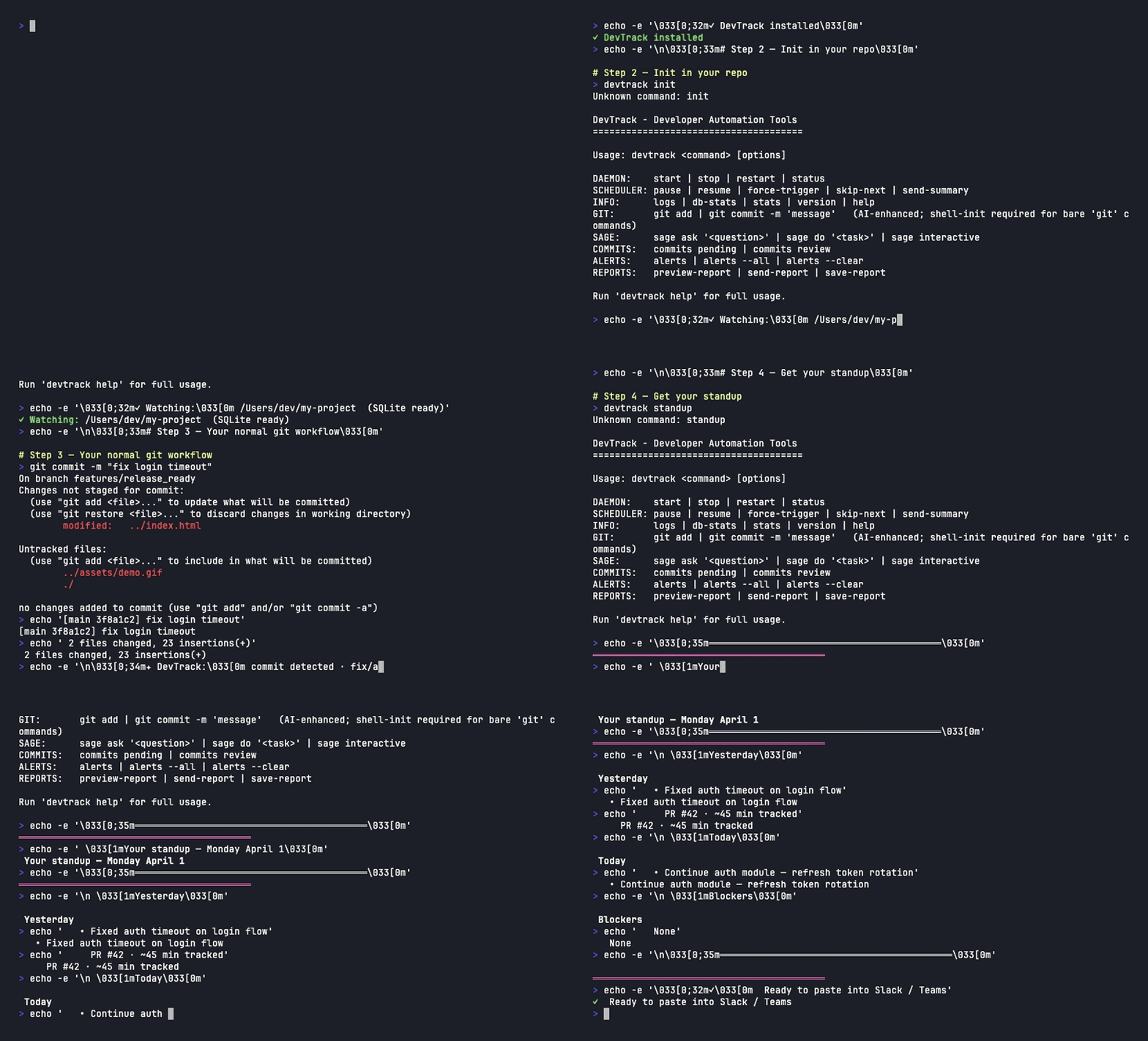
Runs an agentic loop: plans operations, executes them, reads output, handles failures with rollback, only asks when genuinely ambiguous. Session approval dialog (auto / review / suggest-only), step history, and interactive undo built in.
Personalized AI ("Talk Like You")
Learns your writing voice from your own git history — local, automatic, no external service. It combines a style profile with ChromaDB RAG (real examples of how you write) to personalize every commit message, ticket comment, and report the system generates.
On a fresh Managed installation, the daemon automatically seeds Tier 0 voice data from enabled local Git
workspaces and generates the first profile in the background. Completion is saved locally in
first-run-profile.json; no PM action is sent and daemon startup never waits for the profile.
Microsoft Teams is an optional extra signal (TEAMS_ENABLED), not a requirement — the local git-history path is the default and works entirely offline.
Ticket alerter
The Go-native background poller watches GitHub and Azure DevOps for assigned work, comments, review requests, and status changes. It can deliver terminal, OS, Telegram, and Slack-webhook notifications.
- GitHub: Issue/PR assigned, review requested, comment on involved issue
- Azure DevOps: Work item assigned, comment added, state changed
The poller is Go-native and runs inside the daemon — no Python subprocess, no MongoDB. Alert state (
last_checkedper source) and notifications persist to SQLite, so poll continuity survives daemon restarts.
Telegram bot — remote control from your phone
Control the daemon and supervise queued work without opening a terminal:
See Telegram Bot setup guide for full configuration.
Auto-start at login
One command installs the right service for your OS — no manual plist or unit file editing:
Relevant DevTrack runtime variables from the current environment are baked into the service definition
at install time so the daemon starts correctly even in a login session without a shell profile.
Re-run autostart-install after changing the environment file.
The daemon enforces a single running instance using an OS-level file lock (Data/devtrack.lock). On Windows this is a mandatory lock; on Unix a cooperative flock. Attempting to start a second instance prints a clear error and exits immediately rather than running in parallel and corrupting shared state.
Interactive setup wizard (devtrack setup)
Walks through every required setting interactively and writes the result for you:
What it does:
- Checks Git is installed before proceeding
- Prompts for operating mode (Managed / External) and LLM provider credentials
- Reuses an installed generation-capable Ollama model without downloading a prescribed model
- When Ollama still needs a model, can retain an already-present OpenAI/Anthropic key as an explicit temporary fallback; key values are never displayed and declining keeps setup local-only
- In Managed mode, starts the optional Python checkout,
uv sync, and any needed local Ollama model pull in a detached worker; setup does not wait for them - Generates the registered XDG environment file with visible runtime defaults and an auto-generated
ADMIN_SECRET_KEY - In Managed mode, writes and validates the required PostgreSQL connection configuration
- Creates the
~/.devtrack/configuration directory and writesworkspaces.yamlthere - Writes
WORKSPACES_FILEinto the generated environment file, pointing at the workspace file - Registers shell integration automatically in
.bashrcor.zshrcon Unix and the PowerShell profile on Windows - Writes
~/.devtrack/devtrack.confpointing at the generated environment file
After devtrack setup completes, run devtrack start — no manual source .env needed. Git
monitoring, local SQLite, scheduling, and MCP are ready while the optional AI server finishes in the
background. Use devtrack doctor or devtrack status for progress; retry a failed bootstrap with
devtrack doctor --repair.
Automatic .env loading
The daemon automatically finds and loads .env at startup. Resolution order:
DEVTRACK_ENV_FILEenvironment variable (explicit path)- Path recorded in
~/.devtrack/devtrack.conf(written bydevtrack setup) .envfile next to thedevtrackbinary
You no longer need to manually source .env before devtrack start for most setups. The env-first rule still applies for devtrack autostart-install — run it after devtrack setup so the service bakes the correct variables.
Uninstall (devtrack uninstall)
The uninstall command asks once for confirmation unless --yes is supplied. It:
- Stops the running daemon (if active)
- Removes the autostart entry (launchd on macOS, systemd on Linux, Task Scheduler on Windows)
- Deletes the configured DevTrack data home, including managed-server files, unless
--keep-datais supplied - Removes the
devtrackbinary fromPATH
The command prints the resolved targets before confirmation. There is no --dry-run flag.
Self-update (devtrack upgrade)
What happens on upgrade:
- Downloads the latest binary for your OS/arch from GitHub Releases (
sraj0501/Devtrack_) — Linux/macOS use.tar.gz; Windows uses a direct.exe - Applies all versioned migrations that have not yet run (schema changes, config file moves, etc.)
- Auto-restarts the daemon so the new binary takes effect immediately
- On Unix: falls back to
sudo cpautomatically if the target directory is root-owned and the command wasn't run as root - On Windows: if a permission error occurs, a message is printed asking you to re-run the command as Administrator
Post-commit hooks for all workspaces
Normally DevTrack installs hooks when the daemon starts. Use this command to push hooks to all workspaces at once — useful after adding new repos to workspaces.yaml.
Webhook + Trigger server (HTTP mode)
The Go daemon spawns backend.webhook_server as a subprocess in the default managed mode. In external/Docker mode the server runs separately and the Go daemon connects to it over HTTPS. Either way the same FastAPI server handles both:
- Inbound webhooks from Azure DevOps, GitHub, GitLab, and Jira at
/webhooks/<source> - Outbound triggers from the Go daemon at
/trigger/commitand/trigger/timer
All trigger endpoints require the X-DevTrack-API-Key header (set DEVTRACK_API_KEY in .env). Webhook signature verification uses source-specific secrets (AZURE_WEBHOOK_SECRET, GITHUB_WEBHOOK_SECRET, etc.). GitLab webhooks are registered automatically at startup when GITLAB_WEBHOOK_URL is configured.
The stable request and response shapes, authentication rules, and matching Go/Python contract tests are documented in the HTTP API contract.
Claude Code / MCP Integration (Phase 8)
DevTrack exposes a Model Context Protocol (MCP) server so Claude Code automatically knows your active ticket, commit voice, and pending queue — no manual context-setting needed.
devtrack mcp— starts the MCP server in stdio mode (the transport Claude Code uses)devtrack mcp serve --database PATH— starts it against an explicitly selecteddevtrack.db(used by packaged MCPB installs)devtrack mcp setup— writes.mcp.jsonin the current directory so Claude Code discovers the server automatically on next launchdevtrack mcp status— shows the registered tools and server infodevtrack mcp test— runs an in-process smoke test without starting a full server- Six SQLite-backed tools:
get_active_context,get_today_commits,get_pending_actions,get_voice_profile,get_ticket_context,get_eod_summary. Each declares a title and read-only, non-destructive, idempotent safety annotations. - The stdio handshake negotiates finalized MCP versions through
2025-11-25, retaining older-client compatibility. The newer2026-07-28per-request protocol is not supported yet. - Reproducible MCPB 0.3 bundles ship for Windows amd64, macOS amd64/arm64, and Linux amd64/arm64.
During bundle installation, select the
devtrack.dbcreated bydevtrack setup. Published bundle hashes are recorded in the release'schecksums.txtand official MCP Registry metadata. Dockerfile.mcpis the minimal Linux stdio image used for directory build/introspection checks. It creates disposable SQLite state and is separate fromdevtrack_server/Dockerfile, which runs the optional Python HTTP backend. The root.dockerignorekeeps local credentials and runtime data out of that build context.
Source: devtrack_client/internal/mcp/ (server core) and devtrack_client/mcp_cmd.go (CLI).
Development-agent playbooks
The repository retains five historical Claude role definitions under
.claude/agents/_archive/ and keeps the current role, memory, and
authorization contract in
.claude/memory/project_local_agents.md. These are
project-maintenance assets, not devtrack CLI commands, and the archived files are not advertised
as automatically installed Claude slash commands. A contributor's Codex or agent environment may
install adapters for the same roles separately.
| Role | Responsibility |
|---|---|
| project-vision | Break plans into board tasks and enforce vision and authorization boundaries |
| devtrack-engineer | Implement an approved TASK-NNN on a task branch and record engineering evidence |
| git-agent | Perform explicitly authorized Git plumbing without expanding the requested scope |
| memory-compactor | Reconcile durable project memory without discarding still-relevant decisions |
| post-generator | Turn engineer-log evidence into held dev.to, Hacker News, and LinkedIn drafts under Data/agent_logs/posts/ |
The documentation-maintenance workflow is checked in at
.claude/commands/docu-agent.md; how a contributor invokes it
depends on their local agent environment. The planning and
engineering roles use Data/agent_logs/project_board.md as their durable contract, while verified
implementation history is recorded in Data/agent_logs/engineer_log.md. Role names alone do not
authorize commits, pushes, PR operations, releases, publication, or deployment.
Anonymous telemetry — opt-in, off by default
DevTrack sends nothing unless you explicitly opt in:
If (and only if) you opt in, the daemon sends an anonymous install/daily-active ping containing a random install UUID, a hashed hardware fingerprint, the event type (install / active), OS, arch, and version. Never code, commit text, diffs, ticket contents, or personal data.
The setting is stored locally and read directly by the daemon, so it works in every operating mode — including lightweight, with no server running.
Admin console (CS-3)
A browser-based admin console built with FastAPI + HTMX. Start it with:
The admin console is server-owned. Run it from devtrack_server/ with
uv run python -m backend.admin, or set ADMIN_EMBED=true to mount it on the managed webhook
server at /admin. The Go client intentionally has no admin-start command.
Sign in with ADMIN_USERNAME / ADMIN_PASSWORD (set in .env). The dashboard shows live trigger-activity stats (triggers today, commits today, last trigger time, errors in the last 24 h) that refresh every 30 seconds via HTMX without a full page reload.
Pages and capabilities:
| Page | What you can do |
|---|---|
| Dashboard | Health overview, trigger throughput stats, quick links |
| Users | Create/delete users, change roles (admin / viewer), disable/enable accounts, reset passwords |
| API Keys | Generate and revoke per-user API keys |
| License | View current license tier, seat count, and terms acceptance status |
| Server | Real-time process table (CPU %, memory, health) with restart/stop/start controls |
| Audit Log | Full history of all admin actions |
Single-process mode (ADMIN_EMBED): By default the admin console runs as a separate process on ADMIN_PORT (default 8090). Set ADMIN_EMBED=true to mount the admin router directly on the main webhook server at /admin — no extra port, no extra process:
Required .env keys for the admin console:
Runtime visibility
The Python server TUI remains available to server operators with
cd devtrack_server && uv run python -m backend.server_tui; it is not a Go-client command. Its
trigger-throughput pane reads the Go daemon's internal stats endpoint when PostgreSQL mode is active
and degrades to zero-valued stats when that endpoint is unavailable.
The daemon health subsystem checks these monitored services:
| Check | What is verified |
|---|---|
| Daemon process | PID file present and process alive |
| Python backend | /health HTTP endpoint reachable |
| SQLite | Database file readable and schema valid |
| Ollama | /api/tags reachable; response normalised across Ollama versions |
| Ports | Bound ports recorded and checked across restarts |
The last-known port list is persisted so runtime diagnostics can report conflicts across restarts.
Deployment modes
| Mode | DEVTRACK_SERVER_MODE | How | Use case |
|---|---|---|---|
| Managed (default) | managed | Daemon spawns Python automatically | Local dev — full AI features |
| Lightweight | lightweight | Go daemon only — no Python | Git monitoring + scheduling without a Python environment |
| External | external | Python runs on a separate server; set DEVTRACK_SERVER_URL | Docker / self-hosted backend |
| Cloud | — | devtrack cloud login --url URL --key KEY | Remote managed backend |
devtrack setup prompts for Managed or External mode on first run and writes the choice to the
generated environment file. lightweight remains a supported manual configuration value: it maps
to the same internal non-managed mode as external, so the daemon does not spawn Python. Go-native
features continue; server-backed calls use the configured (or loopback fallback) URL and degrade if
no backend is reachable.
DevTrack runs natively — a Go binary plus a
uv-managed Python server. The Go client keeps its offline source of truth in local SQLite and does not connect to a database server. PostgreSQL is mandatory for Python-server persistence and server-side events; MongoDB remains optional as a Teams voice-learning source. Server startup validates PostgreSQL and advances the Alembic schema before accepting traffic; there is no server-side SQLite fallback.
Python AI server
Managed mode (default): devtrack setup configures the deterministic server location and starts
a background sparse checkout into ~/.local/share/devtrack/server/, followed by uv sync and, for
the local Ollama provider only, a model pull when no usable generation model is already installed.
An opted-in cloud-key fast lane remains a fallback behind Ollama, so local inference takes over as
soon as the model is ready. The wizard does not wait for these steps;
devtrack doctor shows durable progress and failures. No manual dependency setup is needed.
External mode (server on a separate host): clone the repo on that host,
cd devtrack_server && uv sync && uv run python -m backend.webhook_server.
Set DEVTRACK_SERVER_URL on the client machine.
See docs/INSTALLATION.md for the full setup walkthrough.
Technology
| Layer | Stack |
|---|---|
| Daemon / CLI | Go 1.24+, fsnotify, robfig/cron, modernc/sqlite |
| AI backend | Python 3.12+, uv, aiohttp, LLM-first structured task parsing |
| Local LLM | Ollama (default) · OpenAI · Anthropic · Groq · LM Studio |
| Storage | Client SQLite (offline state), server PostgreSQL (required), ChromaDB (RAG), optional MongoDB |
| Remote control | Go-native Telegram bot · outbound Slack webhook notifier |
| PM integrations | Azure DevOps · GitLab · GitHub · Jira REST APIs |
| Admin console | FastAPI + HTMX, JWT auth, bcrypt passwords, PostgreSQL-backed user/audit data |
| Observability | runtime-narrative — structured story/stage traces on every webhook request |
| Config discipline | All Python modules use backend.config.get() — no os.getenv() calls in business logic |
Documentation
Full user guides live on the project website: devtrack.cloud.
Key references in this repo:
| I want to… | Go to |
|---|---|
| Understand where the product is going | PRODUCT_BIBLE.md — the source of truth |
| Install it | Installation |
| Understand the architecture | Architecture |
| Maintain the Go↔Python HTTP boundary | HTTP API contract |
| Review what DevTrack wants to send | Pending-actions queue |
| See the client↔server split | Decoupling plan · Capability ownership |
| Set up the Telegram bot | Telegram |
| Set up interactively (new users) | devtrack setup |
| Run without Python (Lightweight mode) | Deployment modes |
| Deploy only the Python backend on a server | Python AI server |
| Manage users, licenses, and API keys in a browser | Admin Console |
| Update / remove DevTrack | devtrack upgrade · devtrack uninstall |
| Understand the development-agent roles and authorization boundaries | Agent role contract · archived Claude definitions |
| Connect Claude Code via MCP (Phase 8) | MCP Integration |
Releasing
The canonical release pipeline is .github/workflows/release.yml.
It runs when an authorized maintainer pushes a semantic-version tag:
GitHub Actions runs the Go tests, cross-compiles Linux amd64/arm64, macOS amd64/arm64, and Windows
amd64, validates the generated MCPB manifests, then publishes the platform binaries/tarballs and
five matching .mcpb bundles. It also publishes SHA-256 checksums, server.json, and the official
MCP Registry record through GitHub OIDC. v3.1.0 is the first release produced by this complete path.
Update release-facing website copy in the same release change.
The older scripts/release.ps1 helper is retained for local maintainer workflows, but it is not the
source of truth for published asset names or CI behavior.
Testing
Python business logic must use backend.config typed accessors rather than adding direct environment
reads. Missing required variables produce a ConfigError with the variable name rather than a
silent None.
Privacy
The default Go + SQLite + Ollama path is local and works without internet. Configured external services receive the minimum context required for the operation you enabled.
- Cloud LLMs are optional. OpenAI/Anthropic/Groq are used only if configured. The prompt may include commit messages, diff context, or work text required by the feature being invoked; do not enable a cloud provider if that conflicts with project policy.
- Nothing is posted without review. All outbound actions are staged in the pending-actions queue until you approve them.
- Telemetry is opt-in and off by default (
devtrack telemetry status). No pings are sent unless you rundevtrack telemetry on. - Voice learning is local in managed mode by default. Git-history seeding is local; Teams and
external-server learning sources require explicit configuration. Learning data can be wiped with
devtrack learning-reset.
License
DevTrack Community License — free for personal use and teams up to 10 users. Enterprise (11+ users) requires a paid license.
Full text: TERMS.md