Dbt MCP vs PostHog MCP Server
A side-by-side look at the Dbt MCP and PostHog MCP Server MCP servers: transport, auth, tools, quality signals, and the config to install either one in Claude, Cursor, Windsurf or VS Code.
Verdict: choose Dbt MCP for data platforms work; choose PostHog MCP Server for data platforms as a local process. You can also run both side by side in one mcpServers block.
Which MCP server should you choose?
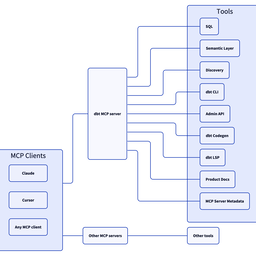 Choose Dbt MCP when
- You need dedicated capabilities in the Data Platforms domain.
- Its auth model fits you: API key required.
- You want tools like
execute_sql, text_to_sql, get_dimension_values.
 Choose PostHog MCP Server when
- You need dedicated capabilities in the Data Platforms domain.
- You prefer a local stdio subprocess transport.
- Its auth model fits you: API key required.
Feature & specification comparison
Rows where the two servers differ are marked.
| Spec | ||
|---|---|---|
| Category | Data Platforms | Data Platforms |
| Quality signal | 77/100 · Great | 49/100 · Fair |
| Install command | Not confirmed yet | Confirmed |
| Transport | — | Local subprocess (stdio) |
| Auth | API key required | API key required |
| Pricing | BYOK (pay the provider) | Not declared |
| Required env vars | None listed | None listed |
| Verified owner | Verified | Community listing |
| GitHub stars | 607 | 40,311 |
| Directory activity | 3 views 0 installs 0 upvotes | 2 views 0 installs 0 upvotes |
| Tools | 62 | Not listed |
| Full listing | View Dbt MCP | View PostHog MCP Server |
Tools & capabilities
Dbt MCP tools 62
execute_sqlExecutes SQL on dbt Platform infrastructure with Semantic Layer support.text_to_sqlGenerates SQL from natural language using project context.get_dimension_valuesGets distinct values for a dimension; option to scope to specific metrics.get_dimensionsGets dimensions for specified metrics.get_entitiesGets entities for specified metrics.get_metrics_compiled_sqlReturns compiled SQL for metrics without executing the query.list_metricsRetrieves all defined metrics.list_saved_queriesRetrieves all saved queries.query_metricsExecutes metric queries with filtering and grouping options.get_all_macrosRetrieves macros; option to filter by package or return package names only.get_all_modelsRetrieves name and description of all models.get_all_sourcesGets all sources with freshness status; option to filter by source name.- +50 more on the listing page
PostHog MCP Server tools
No tool names declared yet. Check the project README from the listing page.
Ready-to-paste client configs
Paste either block (or both) into your client config, e.g. claude_desktop_config.json or ~/.cursor/mcp.json. We only show a config when the install command is confirmed.
Dbt MCP
No confirmed install command for Dbt MCP yet — follow the setup steps linked from its listing page rather than a guessed package name.
PostHog MCP Server
{
  "mcpServers": {
    "posthog-mcp-server": {
      "command": "npx",
      "args": [
        "-y",
        "@posthog/wizard"
      ]
    }
  }
}
Frequently asked questions
Dbt MCP is categorized under Data Platforms and uses an install path we have not confirmed yet. PostHog MCP Server belongs to Data Platforms and uses a local stdio subprocess. Pick Dbt MCP for data platforms work and PostHog MCP Server for data platforms.
Copy the mcpServers block from the config section on this page into your client's config (for example claude_desktop_config.json or ~/.cursor/mcp.json), then fully restart the client. Dbt MCP has no confirmed install command yet — follow its own setup instructions.
Dbt MCP is bring-your-own-key: usage is billed by the API provider you supply a key for. Auth: api key required. PostHog MCP Server has no declared pricing — check the project's own site. Auth: api key required. If a server needs environment variables such as API keys, define them under the env key in your client's MCP config.
Yes. MCP clients support multiple servers: add dbt-labs-dbt-mcp and posthog-mcp-server as separate keys in the same mcpServers object, and your assistant will call tools from either one.
On AllMCPs, Dbt MCP has a quality signal of 77/100 (Great) with 3 views, 0 installs and 607 GitHub stars. PostHog MCP Server has 49/100 (Fair) with 2 views, 0 installs and 40,311 GitHub stars.