MCP server for DashClaw governance — guard, record, invoke, and discover capabilities.
Quick Install
Automated & IDE SetupCopy the AI prompt to install this server into Claude Code, Cursor, or another agent — or use 1-click editor setup below.
Not yet automatically verified
We haven't yet run this listing's install command through our automated sandbox check. This isn't a red flag — we're steadily working through the catalog.
Manual Client & Custom JSON ConfigExpand JSON ▾
Client Config & Setup
Choose your client or environment
Target File:
💡 Paste the JSON block into your client's configuration file under mcpServers, then restart the application.
Documentation Overview

DashClaw
With a supported enforcement integration, when your AI agent (OpenClaw, Hermes, Claude Code, Codex) tries something destructive or expensive, DashClaw catches it before it runs and asks you first, even when you are not at the keyboard. Every decision lands in a signed ledger.
Run agents unattended without giving them unconditional authority.








AI agents: setting DashClaw up for your user? Run
npx dashclaw up --yes --no-browser— the plain command prompts and will hang a non-interactive shell. The API key lands in~/.dashclaw/instance.json; verify withGET http://localhost:3000/api/healthandnpx dashclaw doctor. Full runbook: dashclaw.io/llms.txt. Do not attempt the hosted trial headlessly — its captcha needs your human.
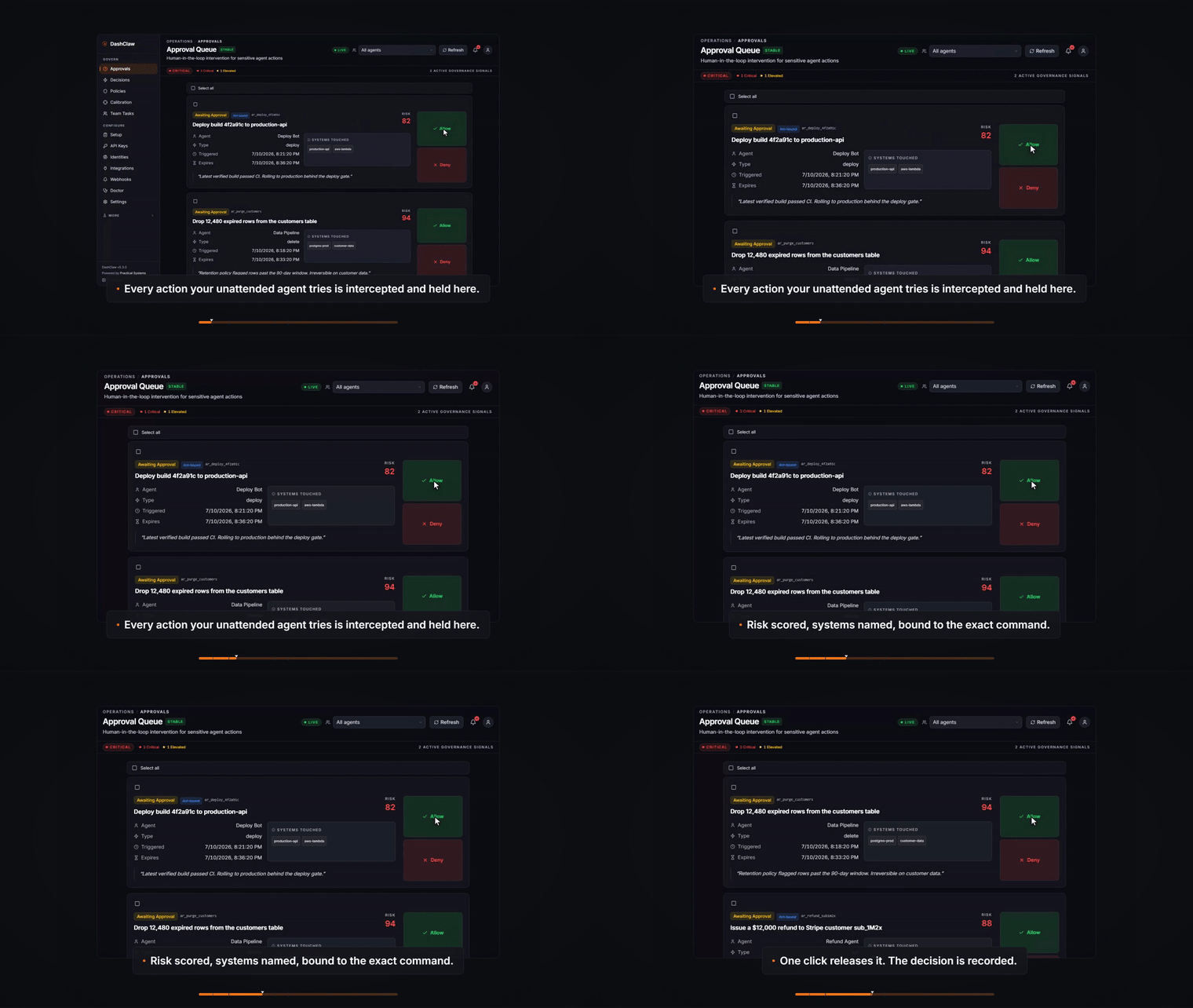
A hook-integrated agent tries a destructive tool call. DashClaw freezes it before it runs, routes it to the Approvals inbox, and writes a replayable decision record when you resolve it.
This illustration shows the approval workflow. Explore the current interactive demo for the supported product surfaces.
What you get
A 10-second capability scan before the dense sections:
- Fail-closed intercept at the execution seam. The Claude Code, Codex, and Hermes hooks, the OpenClaw gateway, and
dashclaw_invokecan cancel a blocked call before execution. Bare SDK, API, and ordinary MCP integrations are cooperative: the caller must honor the verdict. - One-click remote approval. Resolve from the
/approvalsinbox, the CLI, a phone PWA, Telegram, or Discord. No presence required. - Approvals in plain English. Every pending item leads with one sentence for what the command actually does, flags what cannot be undone, and warns when a file holds credentials. When no rule reads the command with confidence, it says so instead of guessing. The exact command is always shown underneath.
- "Allow, don't ask again." Preview the target, lease, and matching pending items before creating a scoped standing grant. The UI resolves eligible items through the normal approval path and reports partial failures. High-risk, ungrantable, expired, or self-approved sources are rejected. Standing grants remain visible and revocable in the inbox.
- Verifiable recorded evidence. Decision records, Ed25519 receipts where issued, and signed exports support later review. A receipt verifies its signed contents, not that an external effect happened. Authenticated identity and action-payload signing are shown separately.
- Calibrated interruptions. Your approve/deny verdicts tune how often it interrupts, with a proven cap on false interruptions instead of a guessed threshold.
- Autonomy is a number, not a prompt. How much your agent ships without a human looking is set by policy thresholds and checks, not by wording. Each action carries the agent's stated confidence — declared on the guard call, before the act, so it is a prediction and not a postscript — and the ledger scores it against the reported outcome, so an overconfident agent shows up as a number on /decisions, not as a surprise.
- Enforcement liveness. A probe tests whether a synthetic held action executes through the installed hook path. Setup distinguishes stale, broken, and unavailable evidence and shows measured runtime versions and hook fingerprints as client-reported diagnostics, not attestation.
- Prompt-injection scanning on by default. High-confidence system-override patterns force a
blockat guard time; weaker ones raise awarn. - Multi-runtime. Claude Code, Codex, Hermes, OpenClaw, MCP, Node and Python SDKs, plain REST.
- MIT-licensed self-hosting. Run locally or deploy your own instance. Hosting and provider usage are subject to their plans and limits.
What it actually stops
At a supported enforcement seam, DashClaw is a fail-closed approval layer between an agent deciding to call a tool and the tool actually running. The Claude Code, Codex, and Hermes hooks, the OpenClaw gateway, and dashclaw_invoke can stop the call. Bare SDK, API, and ordinary MCP integrations still evaluate and record governance, but enforcement is cooperative: their caller must honor the result.
These are the catches on the record, from the maintainer log and THESIS.md, each one the same loop firing:
rm -rfon a working directoryDROP TABLEagainst a live databasegit push --force origin main- reading
.envand preparing to exfiltrate it (risk 100, two policies firing at once)
The last one caught the maintainer's own shell command mid-verification: extracting an API key from .env.local, blocked live at risk 100. Here is roughly what the seam does with it:
The audience is narrow on purpose: a solo developer or small team running long, unattended coding-agent sessions (overnight runs, CI agents, background fleets) against a real repo and real infrastructure. You kick off a one-to-six-hour run, cannot watch every tool call, and are one bad run away from any of the four lines above.
Where DashClaw fits. Local runtime permission prompts serve the operator who is at the keyboard. DashClaw focuses on unattended work: remote and async approval, shared policy across supported runtimes, an auditable decision trail with signed evidence where issued, calibrated interruptions, and time-bounded liveness diagnostics for installed enforcement seams.
The loop in code
It is 2am, the run is in hour three, and the agent reasons its way to git push --force origin main. With the hook installed, DashClaw freezes the call and pages you wherever you are; you tap deny, and the decision ledger records the resolution. A signed receipt exists only where the eligible evidence path issues one.
The hook seam owns this lifecycle inside Claude Code, Codex, and Hermes. A bare SDK integration is cooperative, so application code must keep the real effect inside runGoverned() as shown here.
runGoverned() waits for required approval, claims one execution attempt under a fresh policy check, invokes the callback, and reports the outcome. The claim binds the action, agent, credential principal, and exact act; any applicable operator or plan authority is consumed atomically with the claim. If claim or completion acknowledgement is lost, the helper does not repeat the callback. Reconcile the action and external system before retrying; ledger idempotency cannot make an external effect exactly once. Python uses run_governed(). Full example: QUICK-START.md.
Related MCP Servers
Adoption & maintenance
Factual signals from GitHub, npm, and our automated checks — not a rating.
GitHub stars
300
Stargazers on the source repository.
npm downloads
9.3k
Package downloads in the last 30 days.
Last commit
6d ago
Most recent push to the default branch.
Reviews
No reviews yet — be the first to share how this listing worked for you.
Frequently Asked Questions about Dashclaw
AllMCPs Directory Badge
Showcase your server listing on GitHub or your project documentation. Embed this dynamic SVG badge to highlight official listing status and live engagement.
Badge Style:
Live Dynamic SVG Preview
Markdown (GitHub README)
[](https://allmcps.com/mcp/dashclaw)HTML Embed
<a href="https://allmcps.com/mcp/dashclaw"><img src="https://allmcps.com/api/badge/dashclaw?style=directory" alt="Dashclaw on AllMCPs" /></a>Technical Specs & Signals
CategoryDeveloper Tools
51Quality signal: Good · 51/100How this signal is calculated ▾
Server availabilityNot measured
Not scored for repo-hosted servers — we can't reach the running server, only its GitHub page. Hosted MCP endpoints are health-checked live.
Verified ownership10/20
Documentation & tools16/30
Adoption & activity12/15
Community engagement0/10
A guidance signal from public completeness & health data — not a user rating. New listings start lower and rise as they add docs, get verified, and grow adoption. Signals we can't observe for a listing are skipped, not counted against it.
Own this project?
This directory is pre-filled from public sources. Claim via GitHub README, site badge, or DNS TXT to unlock edit access and the Official badge and attach your website — proof is checked automatically, then reviewed by our team.
Free dofollow backlink: add your website and place the AllMCPs badge on it — no claim needed. We detect it automatically and keep it verified as long as the badge stays live.
Claim & get free dofollowShare & Embed
Add our SVG badge (dark/light directory styles) or embeddable widget to your site.